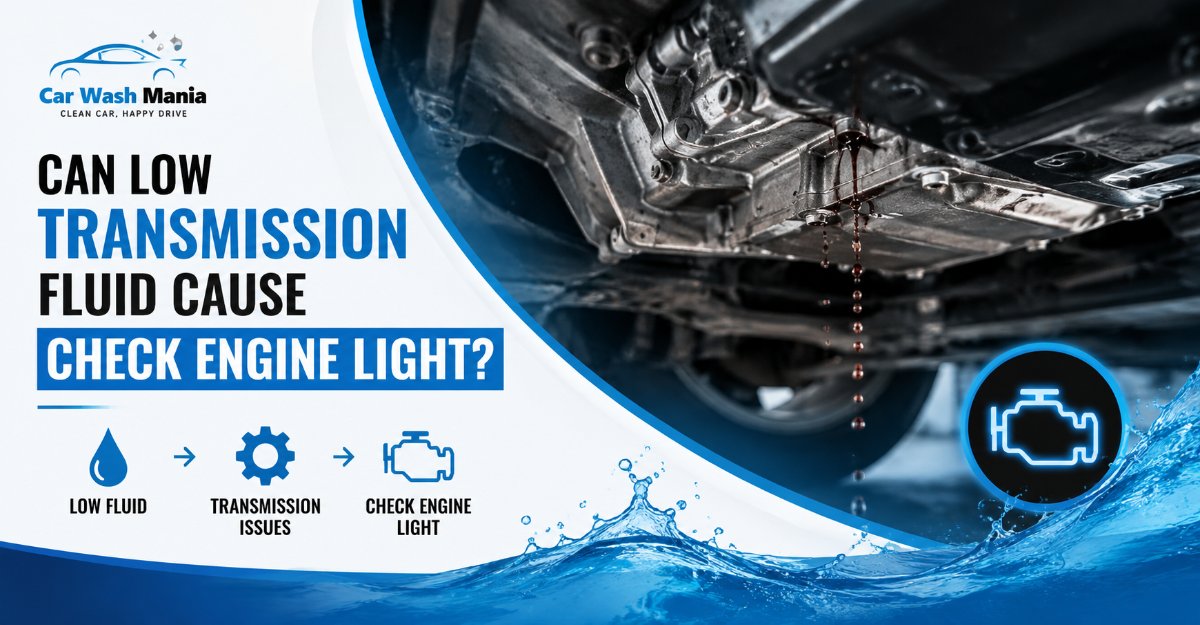
Yes, low transmission fluid can cause the check engine light, but usually indirectly. Low fluid drops hydraulic pressure, which makes internal clutches slip and produces abnormal gear-ratio, pressure, or temperature readings that the transmission control module (TCM) logs as trouble codes. Most transmissions have no dedicated low-fluid sensor, so the light typically appears only after slipping or overheating begins not the instant fluid gets low.
Key Facts at a Glance
- Low transmission fluid triggers the check engine light through slip, gear-ratio, pressure, or overtemperature codes rarely through a direct “low fluid” reading.
- The most common codes are P0700, P0730–P0736 (incorrect gear ratio), P0741 (torque converter clutch), P0841 (pressure sensor), and P0218 (overtemp).
- On many vehicles a low-fluid fault shows as a flashing overdrive light, gear symbol, or “wrench” transmission-fault light, not the engine icon.
- Topping off the fluid does not automatically clear a stored code the fault must be repaired and the code reset or cleared over several drive cycles.
- The same codes low fluid produces can also come from a bad solenoid, sensor, or worn clutches, so a scan alone cannot confirm low fluid is the cause.
- Ignoring a low-fluid warning can turn a $150 leak repair into a $3,500–$7,000 transmission replacement within weeks of continued driving.
Does Low Transmission Fluid Always Trigger a Code?
No, low transmission fluid does not always trigger a code, which is the single biggest misconception about this problem. Fluid can sit below the correct level for days or weeks while the transmission still builds just enough pressure to shift normally. The check engine light appears only when the shortfall becomes severe enough to cause measurable slip, a pressure drop, or overheating.
This is because the vast majority of automatic transmissions have no fluid-level sensor at all. The TCM cannot “see” the fluid; it can only infer a problem from its behavior shaft speeds, line pressure, and temperature. So the warning is a consequence of low fluid, not a direct reading of it. That lag is why many drivers notice rough shifting for a week before the light finally comes on.
The practical takeaway: a check engine light is a late symptom. If you already feel slipping or delayed engagement, treat the fluid as low even if no light is on yet.
Will the Check Engine Light or a Transmission Light Come On?
It depends on the vehicle — low transmission fluid may illuminate the standard check engine light (CEL), a dedicated transmission-fault light, or both. Understanding which light you have prevents misdiagnosis.
The generic amber engine-shaped icon is the true “check engine light,” and it’s driven by the powertrain control module (PCM). When a transmission fault is serious enough a P0700-series code, for example the TCM reports it to the PCM, which then lights the CEL.
Many manufacturers, however, use a separate transmission indicator: a flashing “D” or overdrive (O/D) light, a gear-with-exclamation symbol, a “wrench” powertrain-service icon, or a snowflake/PRNDL flash. These often appear before or instead of the engine icon. A flashing overdrive light on many Fords, Nissans, and Toyotas is the classic early low-fluid or slip warning. Don’t dismiss it because it isn’t the engine icon it frequently signals the same underlying pressure problem.
How Does Low Transmission Fluid Trigger a Warning?
Low transmission fluid triggers a warning through a pressure-and-slip detection chain that ends with the computer setting a trouble code. Transmission fluid does four jobs at once it’s the hydraulic medium that pushes clutches, the lubricant, the coolant, and the friction modifier so a shortage attacks the system on multiple fronts simultaneously.
Here is the actual sequence:
- A leak lowers the level. Common sources are the pan gasket, cooler lines, axle seals, or the output shaft seal.
- The pump aerates the fluid. With the level low, the pump draws in air, whipping the fluid into foam that cannot transmit hydraulic pressure a condition called cavitation.
- Line pressure drops. Foamy fluid can’t fully apply the clutch packs, so they begin to slip under load.
- Sensors catch the mismatch. The TCM compares the input shaft speed sensor (ISS) and output shaft speed sensor (OSS). In 4th gear at a 0.70:1 ratio, an input reading of 2,000 RPM should produce roughly 2,857 RPM of related output; when the clutch slips, the ratio drifts and the TCM flags it.
- A code sets and the light comes on. If the fault persists across a set number of drive cycles, the TCM stores a DTC and signals the PCM to illuminate the dashboard warning.
On severe drops, the TCM also monitors fluid temperature and will set an overtemp code (P0218) because a small volume of remaining fluid heats up far faster than a full charge.
What Transmission Codes Indicate Low Fluid?
The codes most often associated with low transmission fluid are listed below, but a critical caveat comes first: none of these codes means “low fluid” specifically. They describe symptoms slip, pressure loss, overheating that low fluid causes but that failing parts can cause too.
| OBD-II code | Meaning | Why low fluid produces it |
|---|---|---|
| P0700 | Transmission control system malfunction (informational) | Tells the PCM the TCM has logged a fault; a “look here next” flag |
| P0730–P0736 | Incorrect gear ratio | Slipping clutches make actual ratio diverge from the commanded gear |
| P0741 | Torque converter clutch stuck off / performance | Insufficient pressure prevents the converter clutch from locking |
| P0841 | Fluid pressure sensor A range/performance | Pressure reads outside the expected window due to aeration |
| P0218 | Transmission overtemperature | Low fluid volume overheats rapidly under load |
If your scan shows these codes, low fluid is a leading suspect but so is a failing shift solenoid, a clogged valve body, a bad pressure sensor, or genuinely worn clutches. The way to separate them is order of operations: check and correct the fluid level and condition first, because it’s the cheapest cause to rule out, then re-drive and re-scan. If the same slip codes return with correct fluid, the problem is internal or electronic.
What Are the Symptoms of Low Transmission Fluid?
The symptoms of low transmission fluid almost always show up as drivability problems before or alongside the warning light. Low fluid rarely throws a light in isolation, so these physical signs are your strongest confirmation:
- Delayed engagement: Shifting from Park into Drive or Reverse takes 2–3 seconds before the car “catches.”
- Slipping: Engine RPM climbs but the vehicle doesn’t accelerate proportionally, especially uphill or under throttle.
- Harsh or erratic shifting: The transmission bangs into gear or hunts between gears.
- Whining or buzzing: The pump makes a high-pitched whine from air cavitation.
- Burnt smell: Overheated fluid smells acrid; a check of the dipstick shows dark brown fluid instead of healthy pink/red.
There is one edge case worth naming: a light with no drivability symptoms at all. This usually points away from low fluid toward a sensor or wiring fault, since low fluid severe enough to set a code almost always affects how the car drives. If the light is on but shifting is flawless, suspect a solenoid or sensor before draining your wallet on fluid service.
Will Topping Off the Fluid Turn the Light Off?
Not by itself. Topping off correct fluid to the correct level restores hydraulic pressure, but the stored trouble code remains in memory until it’s cleared or the transmission completes several fault-free drive cycles. On many vehicles the light stays on for days of driving even after a proper fix.
Two further complications trip people up. First, some codes are “permanent” (mode $0A) DTCs that legally cannot be cleared with a scan tool they only self-erase after the computer confirms the fault is gone across multiple cycles. Second, and more important, if fluid was low, it leaked somewhere. Topping off masks the symptom while the leak continues, so the light and the damage will return. Repair the pan gasket, cooler line, or seal, refill to spec, then clear the code and verify it stays off.
Can You Drive With Low Transmission Fluid and the Light On?
You can physically drive short distances, but you shouldn’t drive far every mile on low fluid with the light on risks metal-on-metal wear that converts a cheap repair into a rebuild. Low fluid means the clutches are slipping and overheating, and heat is what actually destroys automatic transmissions.
As a practitioner rule of thumb: driving to a nearby shop or parts store (a few miles, gentle throttle, no towing) is a reasonable risk. Highway commuting, towing, or “waiting until next payday” is not. Slip damage is cumulative and often irreversible glazed clutches and burnt fluid don’t recover once the vehicle is refilled.
If the transmission has already dropped into limp mode (locked in a single gear, usually 2nd or 3rd, with sharply limited speed), that’s the computer’s self-protection response to dangerous pressure or temperature. Limp mode is a hard stop-driving signal. Add fluid if you can and get it inspected before driving further.
Does This Apply to CVTs, Dual-Clutch, and Manuals?
The relationship between low fluid and the warning light differs sharply by transmission type, and treating them all the same causes expensive mistakes.
Traditional automatics behave as described above: low fluid causes slip, and slip sets codes. CVTs are even more sensitive they rely on precise belt-or-chain clamping pressure, so low CVT fluid causes belt slip fast and frequently sets ratio or pressure codes plus a rapid overheat warning. CVT fluid is also chemically unique; using the wrong fluid is as damaging as running it low.
Dual-clutch transmissions (DCTs) use fluid for clutch actuation and cooling; low fluid can trigger clutch-adaptation and pressure faults, though wet and dry DCTs differ. Manual transmissions rarely trigger a check engine light from low gear oil because they have no pressurized hydraulic control system and few relevant sensors instead you’ll hear grinding or whining. The light on a manual is far more likely to be unrelated to the gearbox.
How Do You Check Transmission Fluid Level?
Checking transmission fluid level takes 5–20 minutes and requires either a dipstick or, on sealed units, a scan tool and jack stands. The method depends entirely on your transmission’s design, and using the wrong method is the most common source of false “low” readings.
Before you start:
- Time: 5 minutes (dipstick) to 30 minutes (sealed check).
- Difficulty: Easy (dipstick) to moderate/hard (sealed).
- Tools: Clean rag, correct fluid; for sealed units, an OBD-II scanner, jack + stands, and a fluid pump.
- Prerequisite: Vehicle on level ground; know your exact fluid specification from the owner’s manual.
Dipstick transmissions: Warm the engine to operating temperature, park on level ground, and leave the engine idling in Park (exception: many Hondas require the engine off). Pull the dipstick, wipe it, reinsert fully, then read against the “Hot” marks. Healthy fluid is translucent pink or red; brown or black fluid signals it’s overdue for service. You’ll know it’s right when the level sits between the hot marks and the fluid is clear.
Sealed transmissions: These have no top-side dipstick the level is verified at a fill/overflow plug underneath the car, and only at a specific fluid temperature. Raise the vehicle level, connect a scan tool, and monitor transmission temperature until it enters the manufacturer’s window (commonly around 35–50 °C / 95–122 °F, but verify your exact figure some ZF and Toyota units differ). With the engine running and the plug removed, a correct level produces a thin steady stream that thins to a drip. Overfilling or checking at the wrong temperature will read falsely.
Common mistake at this step: checking a dipstick transmission cold. Fluid expands when hot, so a cold reading looks dangerously low and tempts you into overfilling which causes foaming and the exact same slip symptoms as running low.
What Does It Cost to Fix?
Costs range from a $10 top-off to a $7,000 replacement, and the gap between them is almost entirely determined by how quickly you act. The table below reflects typical U.S. figures.
| Action | DIY cost | Shop cost | Time |
|---|---|---|---|
| Top off fluid | $10–$20 | $40–$70 | 15–30 min |
| Diagnostic scan | $0 (free at many parts stores) | $100–$150 | 15 min |
| Fluid & filter service | $40–$80 | $150–$300 | 1–2 hrs |
| Leaking gasket/line repair | $30–$60 | $200–$600 | 2–4 hrs |
| Transmission replacement | Not advisable | $3,500–$7,000+ | 1–3 days |
The number that matters most isn’t in the table: the cost of ignoring the light. A pan-gasket leak caught early is a sub-$100 fix. The same leak driven on for a month until the clutches glaze from heat and slip becomes a rebuild or replacement 30–50 times more expensive. Transmissions fail from accumulated heat damage, and heat is exactly what low fluid produces.
What This Article Can’t Tell You
This guide identifies whether low transmission fluid can cause your light and how the mechanism works, but it cannot diagnose your specific vehicle. Two limitations are worth stating plainly. First, identical codes have multiple causes a P0730 from low fluid and a P0730 from a failed solenoid read the same on a scanner, and telling them apart requires hands-on testing. Second, fluid specifications, check procedures, and temperature windows are model-specific to the point that a generic instruction can do harm; the factory service manual is the only authoritative source for your car. Use this as a framework, not a substitute for a scan and a level check on your actual transmission.
Frequently Asked Questions
Can low transmission fluid cause a check engine light with no symptoms? Rarely. Low fluid severe enough to set a code almost always causes noticeable slipping, delayed engagement, or harsh shifting first. A check engine light with completely normal shifting more often points to a sensor, solenoid, or wiring fault than to low fluid, so scan before assuming fluid is the cause.
How long can you drive with low transmission fluid? Only a few miles at gentle throttle, ideally straight to a shop. Continued driving causes clutch slip and overheating, which damages the transmission cumulatively and irreversibly. If the vehicle enters limp mode or slips badly, stop driving and add fluid or have it towed rather than risk a rebuild.
Does adding transmission fluid reset the check engine light? No. Adding fluid restores pressure, but the stored code remains until it’s cleared with a scan tool or self-clears over several fault-free drive cycles. More importantly, low fluid means a leak exists top-off is temporary unless the leak is repaired, or the light and damage will return.
What’s the difference between a transmission light and a check engine light? The check engine light is the amber engine-shaped icon driven by the PCM. A transmission light is often a separate indicator a flashing overdrive/O/D light, a gear symbol, or a wrench icon driven by transmission-specific faults. Both can signal low fluid, and on many vehicles the transmission light appears first.
Can low transmission fluid cause limp mode? Yes. When pressure or temperature crosses a safety threshold, the TCM locks the transmission into a single gear (usually 2nd or 3rd) to protect it this is limp mode. Low fluid is a common trigger. It’s a hard stop-driving signal; add fluid if possible and have the vehicle inspected before driving further.
Is it low fluid or a bad sensor if I have P0700? P0700 alone doesn’t tell you it only signals that the TCM has logged a fault, so you must read the accompanying codes. Because low fluid and failing solenoids or sensors can produce the same slip and pressure codes, check and correct the fluid level first (the cheapest cause to rule out), then re-scan.
The Bottom Line
Low transmission fluid can cause the check engine light, but almost always indirectly through the slip, gear-ratio, pressure, and overtemperature faults it produces, not through a direct fluid-level reading most transmissions can’t even take. Treat the light as a late warning, confirm it with drivability symptoms, check the fluid using the correct method for your transmission type, and repair the leak rather than just topping off. Acting within days keeps this a sub-$100 problem; ignoring it is how a leak becomes a rebuild.


