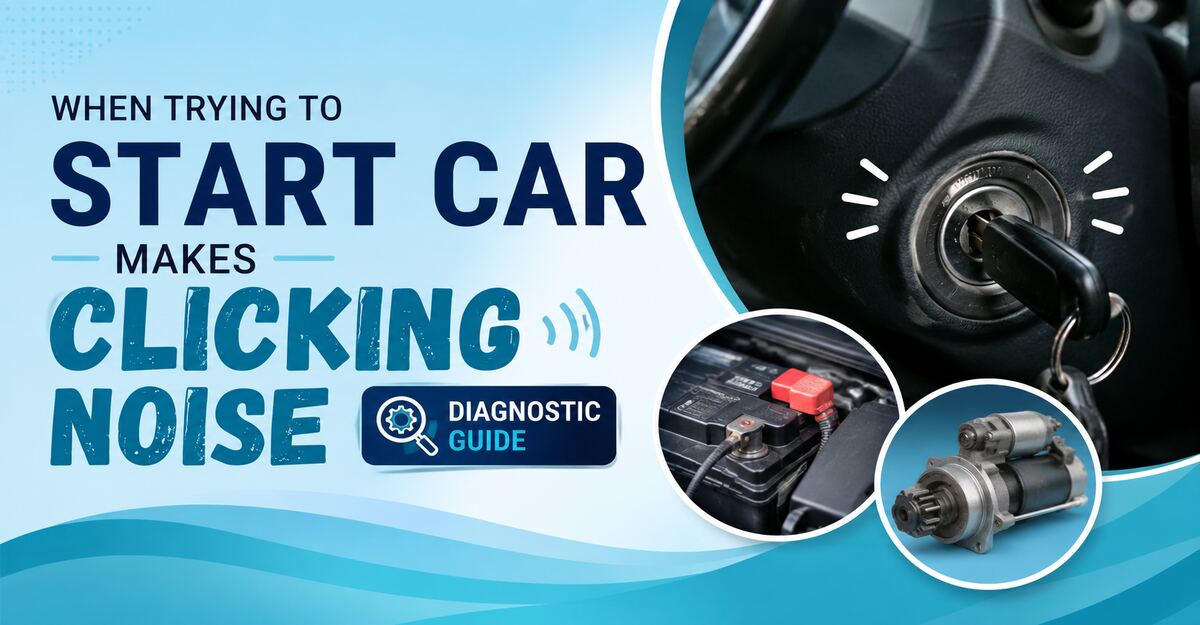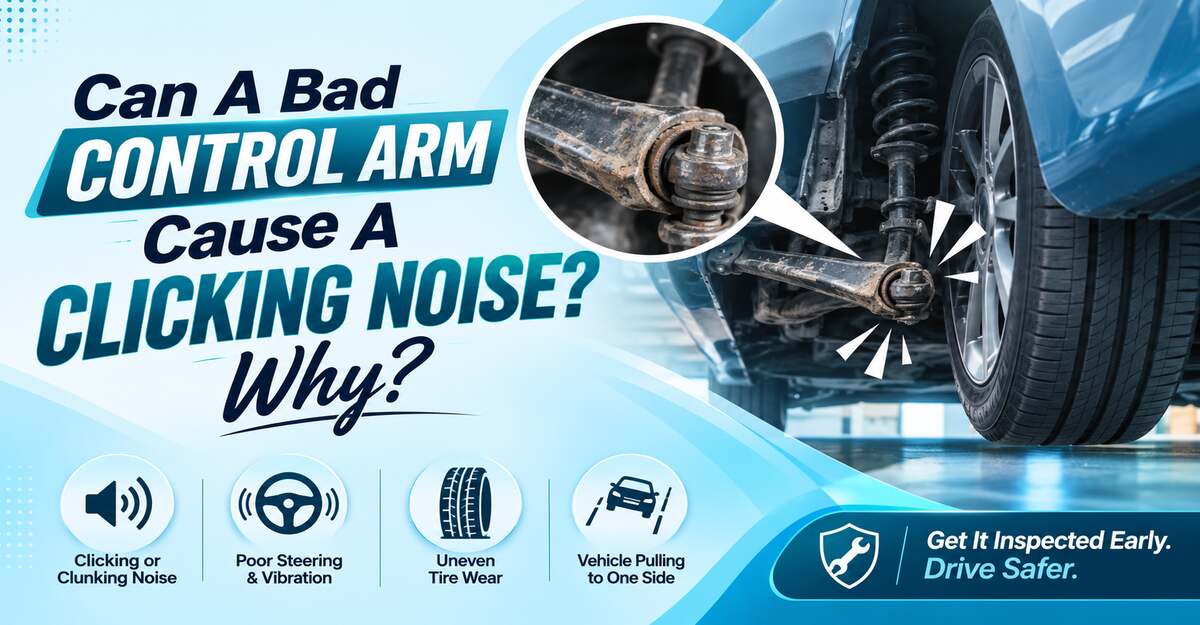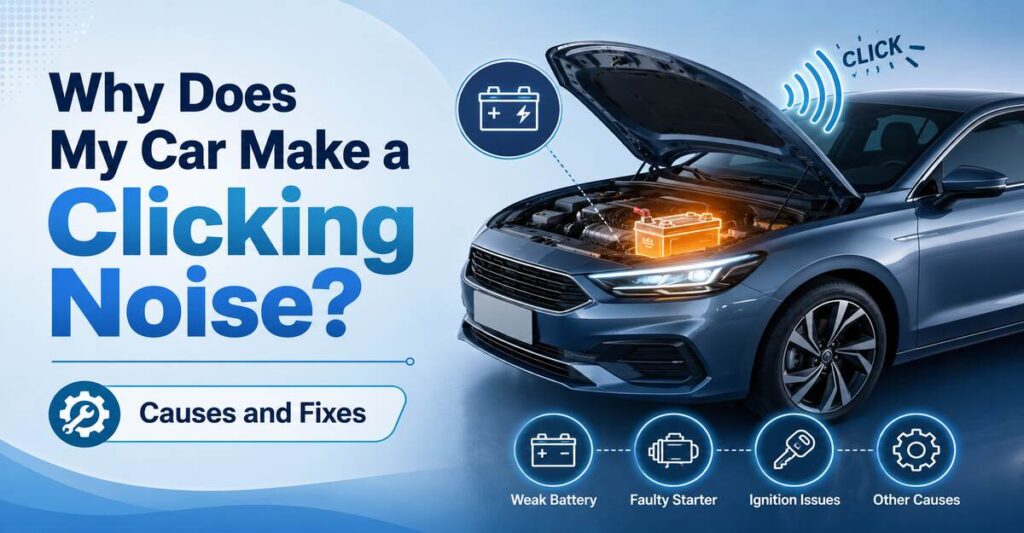
A car makes a clicking noise when an electrical switch, rotating joint, loose component, or moving engine part repeatedly contacts another surface. The likely cause depends on when the sound occurs: startup clicking commonly involves the battery or starter, while clicking during turns often points to a CV joint, wheel, brake, or suspension component.
At a Glance
- Rapid clicking during startup most commonly indicates low battery current or excessive resistance at a battery connection.
- One solid click without engine cranking often points to the starter, solenoid, cable, ground path, or a mechanically locked engine.
- Clicking that becomes louder during tight turns commonly indicates a worn outer CV joint.
- A click that follows vehicle speed may come from a tire, wheel, brake shield, axle, or driveshaft component.
- Dashboard lights can remain bright even when the battery cannot supply enough current to crank the engine.
- A new, repetitive click from a wheel or engine area should be inspected before continued driving.
What Does the Clicking Pattern Reveal?
The timing, speed, location, and operating condition of a clicking sound provide more diagnostic value than the sound alone. A technician first determines whether the click follows engine speed, wheel speed, steering angle, brake application, electrical operation, or the start command.
| Clicking pattern | Most likely area | Common causes | First observation |
| Rapid clicks while starting | Starting circuit | Weak battery, loose terminal, corroded ground | Watch the headlights while starting |
| One click with no crank | Starter circuit | Starter motor, solenoid, cable, relay | Try a proper jump-start |
| Click during tight turns | Front axle or wheel | Outer CV joint, loose wheel hardware | Compare left and right turns |
| Click during acceleration | Drivetrain | Inner CV joint, driveshaft joint, mount | Note whether it changes under load |
| Click once when braking | Brake assembly | Pad movement, loose hardware, worn clip | Check whether it repeats every stop |
| Click matching road speed | Wheel or tire | Embedded object, shield, hub, axle | Inspect the tire and wheel area |
| Fast ticking at idle | Engine compartment | Injector operation, valvetrain, relay | Compare cold and warm operation |
| Clicking after shutdown | Cooling or electrical systems | Thermal contraction, relay cycling | Note duration and component location |
A sound that follows engine revolutions usually originates in the engine or an accessory. A sound that follows vehicle speed more often comes from a tire, wheel, axle, brake, or driveshaft. A click that occurs only when pressing a button may be an electrical relay rather than a mechanical failure.
Why Does My Car Click Rapidly When I Try to Start It?
Rapid clicking during startup usually means the starter solenoid repeatedly engages and releases because battery voltage collapses under load. The battery may be discharged, internally damaged, poorly connected, or unable to pass current through corroded cables and grounds.
A starter motor can demand well over 100 amps, with larger or cold engines requiring substantially more. The battery may have enough energy to power the dashboard, radio, and interior lights but still fail when the starter requests high current.
Common causes include:
- A discharged battery after lights or accessories were left on.
- An aging battery with reduced cold-cranking capacity.
- Loose battery clamps that can be rotated by hand.
- Corrosion between a clamp and the actual battery post.
- A damaged negative ground cable or engine ground strap.
- Cold weather increasing engine resistance and reducing battery output.
- A charging-system fault that failed to replenish the battery.
Rapid solenoid chatter is a symptom of unstable current delivery, not automatic proof that the starter itself has failed. Battery condition and cable resistance should be checked before replacing the starter.
Why Does the Car Make One Click but Not Start?
One solid click without engine cranking usually means the starter solenoid received the start command but the starter motor did not rotate. The failure may be inside the starter, within the high-current cable path, at the engine ground, or in the engine itself.
A worn starter may contain damaged brushes, burnt contacts, a seized bearing, or an armature resting on an electrical dead spot. A poor cable can produce the same symptom because open-circuit battery voltage may look normal until current is demanded.
Less common possibilities include:
- A damaged starter relay or ignition control circuit.
- A loose starter power connection.
- A failed engine-to-body ground strap.
- Damaged flywheel or flexplate teeth.
- A seized accessory that prevents belt movement.
- An engine that cannot rotate because of internal mechanical damage or fluid intrusion.
Headlights that remain nearly unchanged during the click suggest that little starter current is flowing. Headlights that dim severely suggest heavy current draw, a weak battery, excessive cable resistance, or a starter that is mechanically locked.
A single click does not justify replacing the starter without voltage and cable tests. A professional voltage-drop test can distinguish a failed starter from a high-resistance power or ground connection.
Can the Lights Work When the Battery Is Too Weak to Start?
Yes. A weak battery can operate lights and electronics while remaining unable to crank the engine because lighting circuits require far less current than a starter motor.
A dashboard may illuminate normally with a battery that has acceptable voltage but inadequate capacity. Resting voltage measures electrical potential, while a load or conductance test evaluates the battery’s ability to deliver current.
Typical resting-voltage interpretation for a conventional 12-volt lead-acid battery is:
| Resting voltage | General interpretation |
| About 12.6 volts | Fully charged or close to fully charged |
| About 12.4 volts | Partially discharged but often serviceable |
| About 12.2 volts | Roughly half charged |
| Around 12.0 volts | Significantly discharged |
| Below 12.0 volts | Deeply discharged or potentially damaged |
These readings should be taken after the battery has rested because recent charging can create a misleading surface charge. Temperature, battery chemistry, meter accuracy, and vehicle design also affect interpretation.
A battery may show 12.6 volts and still fail a starting test if an internal plate connection is damaged. That is why voltage alone cannot confirm battery health.
How Can I Test a Clicking No-Start Safely?
Test a clicking no-start by checking the transmission position, observing the lights, inspecting the battery connections, measuring battery voltage, and attempting a correct jump-start. Stop testing if cables become hot, smoke appears, or the battery case is swollen, cracked, leaking, or frozen.
Step 1: Confirm Park or Neutral
Move an automatic transmission firmly into Park, then try Neutral. A worn range switch or shifter adjustment may prevent normal starter operation.
For a manual transmission, press the clutch pedal fully. A faulty clutch safety switch can prevent the start signal, although that condition often produces silence rather than a heavy starter click.
Step 2: Perform the Headlight Test
Turn on the headlights and watch them while another person attempts to start the car.
- Lights become very dim: Suspect a weak battery, bad cable, poor ground, or starter drawing excessive current.
- Lights go completely out: Suspect a severely discharged battery, loose main connection, or major voltage drop.
- Lights remain bright: Suspect that current is not reaching the starter motor or that the starter circuit is open.
The headlight test is directional, not conclusive. LED headlights controlled by vehicle electronics may not behave like traditional halogen lamps.
Step 3: Inspect the Battery Connections
Check whether either battery clamp moves on its post. Look for powdery white, green, or blue corrosion, damaged cable insulation, loose ground connections, and overheated terminals.
Do not place tools across both battery terminals. Disconnecting and cleaning a battery can also erase vehicle settings and may require special procedures on some modern vehicles.
Step 4: Measure Battery Voltage
Place a digital multimeter directly on the lead battery posts, not merely on the cable clamps. Measuring the posts first and then the clamps can expose resistance between the two surfaces.
A conventional cranking test often treats a drop near or below 9.6 volts under specified test conditions as evidence requiring further battery evaluation. Temperature and manufacturer procedures matter, so the value is a diagnostic reference rather than a universal replacement threshold.
Step 5: Attempt a Correct Jump-Start
Follow the vehicle manufacturer’s connection sequence and approved grounding points. Hybrid vehicles, electric vehicles, vehicles with batteries in enclosed compartments, and cars with battery-monitoring sensors may require model-specific procedures.
A successful jump-start confirms that additional current changed the outcome. It does not, by itself, identify whether the original battery was discharged, defective, poorly connected, or left uncharged by another fault.
Does a Successful Jump-Start Prove the Battery Is Bad?
No. A successful jump-start proves that the vehicle started when additional current or improved electrical contact was supplied, but it does not prove the battery itself is defective.
The original battery may simply be discharged because of:
- Lights or accessories left operating.
- Repeated short journeys.
- Long-term vehicle storage.
- Cold weather.
- A parasitic electrical drain.
- A loose or corroded connection.
- An alternator or charging-control fault.
After the engine starts, the battery should be charged and tested rather than judged only by the jump-start result. A battery that repeatedly requires assistance after being fully charged may have reduced capacity, an internal defect, or an external drain.
A jump-start can also temporarily overcome resistance at a poor terminal because the clamps alter pressure on the connection. That scenario can make a connection fault look like a battery fault.
The practical rule is simple: a jump-start identifies a current-delivery problem. Battery testing, charging-system testing, and a visual cable inspection identify the actual cause.
Can the Alternator Cause Clicking During Startup?
The alternator can indirectly lead to startup clicking by leaving the battery undercharged, but the alternator usually does not create the immediate starting click. The click normally comes from a relay, starter solenoid, or another electrical actuator.
The alternator recharges the battery while the engine is operating. A failed alternator, slipping belt, damaged charging cable, or control-system fault can allow the battery to discharge until the next start attempt produces rapid clicking.
Alternator-related clues include:
- A battery warning light while driving.
- Headlights changing brightness with engine speed.
- Electrical systems shutting down during a journey.
- A new battery becoming discharged again.
- The engine stopping after jumper cables are removed, although this test should not be deliberately performed on a modern vehicle.
A discharged battery does not prove alternator failure. The vehicle may have remained parked for weeks, completed repeated short journeys, or developed a parasitic draw.
Modern charging systems can vary alternator voltage according to temperature, battery condition, and fuel-efficiency strategy. A single voltage reading without manufacturer specifications may therefore be misleading.
Why Does My Car Click When I Turn?
Clicking during tight turns, especially while accelerating, most commonly indicates wear in an outer constant-velocity joint. The damaged joint clicks because worn internal tracks and bearings shift under the combined steering angle and drive load.
An outer CV joint normally becomes louder when turning in one direction, although sound transmission can make the failed side difficult to identify from the driver’s seat. A split CV boot often appears before joint failure because escaped grease and entering dirt accelerate wear.
Other causes include:
- A stone or screw embedded in a tire.
- Loose wheel nuts or damaged wheel hardware.
- A bent brake dust shield touching the rotor.
- Loose brake-pad or caliper hardware.
- A worn wheel bearing, although bearings more often hum or growl.
- A tire touching a splash shield or wheel-well liner.
- Suspension or steering joints moving under load.
A repeated click that becomes faster with vehicle speed points toward a rotating component. A single clunk near full steering lock may instead involve steering stops, suspension movement, a mount, or driveline lash.
Loose wheel hardware requires immediate attention. Do not assume every turning click is only a CV joint.
Why Does the Car Click While Accelerating?
Clicking during acceleration often comes from an inner CV joint, driveshaft joint, worn mount, exhaust contact point, or another drivetrain component shifting under torque. The defining clue is that the noise becomes more noticeable when the drivetrain is loaded.
An outer CV joint usually clicks most clearly during turns. An inner CV joint more commonly causes vibration, knocking, or clicking during straight-line acceleration, although symptoms overlap.
Possible causes include:
- Inner CV joint wear.
- Universal-joint or driveshaft wear on rear-wheel-drive vehicles.
- Engine or transmission mount movement.
- Loose exhaust heat shields.
- A cracked flexplate or damaged flywheel hardware.
- Spark knock or detonation, which is usually described as metallic pinging rather than a distinct mechanical click.
- Low oil pressure or valvetrain wear that becomes louder with engine speed.
A drivetrain click should be compared under three conditions: accelerating, coasting, and maintaining steady speed. A noise present only under power suggests torque-sensitive movement. A click that continues unchanged while coasting is more likely related to wheel speed than engine load.
Heavy clicking accompanied by vibration, steering pull, or fluid leakage warrants prompt inspection.
Why Does the Car Click While Braking?
A single click when the brakes are first applied can result from brake pads shifting slightly within the caliper bracket. Repeated, loud, or worsening clicks may indicate worn pad hardware, loose caliper components, rotor contact, axle movement, or suspension play.
Brake pads require limited clearance to move and release. Missing, bent, or worn anti-rattle clips can allow a pad to change position when the vehicle switches between forward and reverse or when braking force is first applied.
Possible causes include:
- Loose caliper mounting bolts.
- Worn pad-retaining clips.
- Incorrectly fitted brake pads.
- A bent backing plate contacting the rotor.
- A loose axle nut or wheel fastener.
- Worn control-arm, ball-joint, or tie-rod components.
- Normal ABS self-testing shortly after the vehicle begins moving.
A single ABS self-test click may occur at a similar low speed after each startup and may be accompanied by a brief pedal sensation. A random click at every stop is less likely to be an ABS self-check.
Any brake-related click accompanied by grinding, reduced braking, a soft pedal, pulling, heat, smoke, or a warning light requires immediate inspection.
Why Is There Clicking Under the Hood at Idle?
A light, even tick under the hood can be normal fuel-injector or high-pressure fuel-pump operation, but a new or loud click may come from low oil level, valvetrain wear, an accessory, a relay, or a damaged rotating component. Frequency, temperature, and location separate normal operation from failure.
Direct-injection systems can produce pronounced mechanical ticking because their injectors and high-pressure pumps operate at substantial pressure. Purge valves and electrical relays may also click during normal emissions-system operation.
Concerning causes include:
- Low engine-oil level.
- Incorrect oil viscosity.
- Hydraulic lifter or cam-follower wear.
- Timing-chain, tensioner, or guide problems.
- Exhaust manifold leakage that resembles ticking.
- A damaged belt tensioner, pulley, or accessory bearing.
- A loose spark plug allowing combustion leakage.
- Repeated relay cycling caused by unstable voltage.
Check the engine-oil level on level ground using the manufacturer’s procedure. Do not place hands, clothing, or tools near belts, fans, pulleys, or hot exhaust parts while the engine is operating.
A tick that becomes heavier, irregular, or accompanied by an oil-pressure warning requires immediate shutdown.
Why Does the Car Click After I Turn It Off?
Brief clicking or ticking after shutdown is often normal because exhaust, engine, and heat-shield components contract as they cool. The sound should gradually slow and disappear rather than continue in a fixed electrical rhythm.
Normal post-shutdown sounds may also come from:
- Electronic throttle or emissions-system self-checks.
- HVAC doors returning to a stored position.
- Cooling-system valves or pumps on some vehicles.
- Relays completing a timed shutdown sequence.
- Hybrid-system cooling or battery-management components.
Abnormal signs include clicking that continues for hours, repeatedly drains the battery, comes from a hot electrical connector, or is accompanied by a burning smell. A defective relay, HVAC actuator, control module, or aftermarket accessory can continue cycling after the vehicle is switched off.
Cooling contraction usually produces irregular metallic ticks from hot areas. Electrical cycling tends to create a more consistent rhythm from a relay box, dashboard, door, or actuator.
Record the duration and location before the sound stops. That information can prevent unnecessary disassembly during diagnosis.
Is It Safe to Drive a Car That Makes a Clicking Sound?
Driving safety depends on the click’s source. A quiet relay or cooling tick may be normal, while clicking from a wheel, CV joint, brake, steering component, or low-oil engine may indicate a failure that can worsen without warning.
Stop driving and arrange professional assistance when the clicking occurs with:
- Loose or wobbling wheel movement.
- Grinding, heavy vibration, or steering instability.
- Reduced braking or a changing brake pedal.
- An oil-pressure, charging, temperature, or brake warning light.
- Smoke, burning odor, leaking fluid, or visible overheating.
- A battery cable that becomes hot.
- A loud internal-engine knock or rapidly worsening tick.
- A starter that remains engaged after the engine starts.
A worn CV joint may continue operating for a period, but no mileage estimate can reliably predict when it will fail. A no-start click does not create a driving risk while the engine is off, but repeated attempts can overheat cables, relays, or the starter.
The safe rule is to treat a new click from a safety-critical or rotating assembly as an inspection issue, not merely a noise issue.
How Much Does Fixing a Car Click Usually Cost?
Repair costs range from nearly zero for tightening a connection to more than $1,000 for major drivetrain or engine work. Vehicle design, parts quality, labor rates, diagnostic time, and damage severity determine the actual total.
| Repair | Typical total cost | Typical workshop time |
| Clean or tighten battery connections | $0 to $100 | 15 to 45 minutes |
| Replace a conventional battery | $120 to $350 | 20 to 60 minutes |
| Replace an AGM or start-stop battery | $200 to $500+ | 30 to 90 minutes |
| Replace a starter motor | $300 to $900+ | 1 to 4 hours |
| Replace a starter relay | $50 to $250 | 30 minutes to 2 hours |
| Repair a battery cable or ground | $100 to $500+ | 1 to 3 hours |
| Replace one CV axle | $250 to $900+ | 1.5 to 4 hours |
| Repair brake hardware | $100 to $400+ | 1 to 2 hours |
| Replace a wheel bearing or hub | $300 to $800+ | 1.5 to 4 hours |
| Diagnose engine ticking | $100 to $250+ | About 1 hour initially |
These are broad United States market ranges, not quotations. European, luxury, performance, hybrid, and tightly packaged vehicles often require more labor.
Diagnosis is usually cheaper than replacing the wrong component. One hour of electrical testing can prevent unnecessary battery, starter, or alternator replacement.
What Mistakes Make Clicking-Noise Diagnosis Unreliable?
The most common mistake is diagnosing the sound by description alone. “Clicking” can describe starter chatter, injector ticking, CV-joint snapping, brake-pad movement, relay cycling, or thermal contraction, and each requires a different test.
Avoid these errors:
- Replacing the starter before testing the battery. A battery can illuminate every dashboard light and still lack cranking capacity.
- Assuming a jump-start proves alternator failure. The original battery may simply be discharged.
- Measuring only open-circuit voltage. A damaged battery may display normal voltage without supplying useful current.
- Ignoring voltage drop. Corroded cables can pass enough current for lights but not for the starter.
- Confusing engine speed with vehicle speed. Revving the engine while stationary helps separate engine-related noises from wheel-related noises.
- Using unsafe starter-tapping methods. Starter location near exhaust, moving parts, high-current terminals, or a raised vehicle can make the procedure hazardous.
- Continuing repeated start attempts. Extended clicking can heat cables, terminals, relays, and starter components.
- Ignoring recent repair work. A click that begins after brake, battery, axle, wheel, or engine service may involve loose or mispositioned hardware.
A useful technician’s rule is to reproduce the noise under controlled conditions, identify what speed or input controls it, and only then choose the test.
Frequently Asked Questions
Why does my car click but eventually start?
A car that clicks several times before starting may have a weak battery, poor terminal contact, worn starter contacts, or a starter motor with an intermittent dead spot. The intermittent start does not mean the fault has corrected itself. Battery, cable, and starter testing should be completed before the vehicle leaves you stranded.
Why does my car click once after changing the battery?
A single click after battery replacement may result from loose terminals, an unconnected ground, a discharged replacement battery, a failed starter, or incorrect battery installation. Verify that the clamps are fully seated and tight. Battery replacement does not repair a starter or cable fault that existed beforehand.
Can a bad key fob cause clicking but no start?
A weak key-fob battery usually causes a key-not-detected warning or prevents the start command rather than producing heavy starter clicking. Some vehicles may activate relays before immobilizer authorization fails. Try the manufacturer’s emergency key-detection position and a spare fob before assuming the starter system is defective.
Why does my car click when the air conditioner is on?
A click when the air conditioner switches on may be normal compressor-clutch or relay operation. Rapid, repeated, or grinding clicks may indicate relay cycling, low system pressure, clutch wear, an actuator problem, or unstable system voltage. The sound’s location and whether cooling performance changes determine its significance.
Can low engine oil cause a clicking noise?
Yes. Low oil can reduce lubrication and hydraulic pressure to lifters, cam followers, timing components, and other moving parts, producing ticking or clicking that follows engine speed. Check the level immediately. Shut the engine off if the oil-pressure warning remains illuminated or the noise becomes heavy and irregular.
Why does my car click when reversing?
A click when reversing may come from brake pads shifting direction, a worn CV joint, driveline lash, suspension movement, or loose wheel hardware. One light click during the first direction change may be pad movement. Repetitive clicking that follows wheel speed requires inspection of the wheel, brake, and axle assemblies.
The Bottom Line
The answer to “why does my car make a clicking noise” depends mainly on when the sound occurs and what controls its frequency. Rapid clicking during startup usually indicates weak current delivery, while one solid click points more strongly toward the starter circuit or a mechanical lock. Clicking during turns, braking, or driving shifts the diagnosis toward the axle, wheel, brake, suspension, or drivetrain. Stop driving when the noise appears with braking problems, steering changes, vibration, warning lights, overheating, smoke, or fluid leakage.