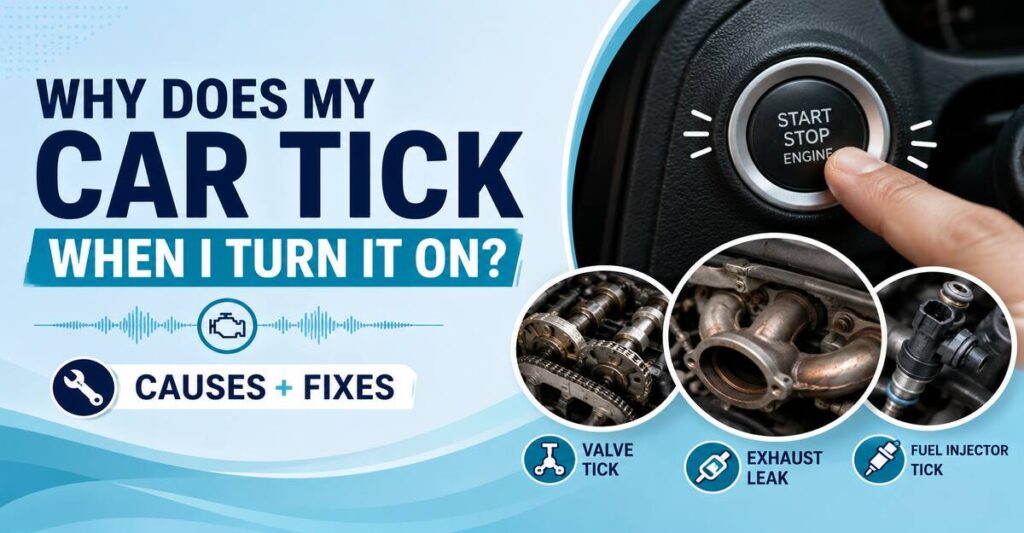
A car that ticks on startup is usually signaling low oil pressure, collapsed hydraulic lifters, or an exhaust manifold leak. The ticking happens when metal valvetrain parts strike each other before engine oil reaches them. A tick that clears within 3 to 10 seconds is common; one that persists needs inspection.
At a Glance
- Engine ticking that rises and falls with RPM points to the valvetrain, not the fuel or ignition system.
- A cold-start tick lasting under 10 seconds is usually harmless hydraulic lifter bleed-down.
- Ticking that grows louder as the engine warms, or when you accelerate, signals a mechanical fault.
- Healthy oil pressure is 20 to 30 PSI at idle; ticking commonly begins below 15 PSI.
- Fuel injector clicking is normal engine behavior and never requires repair.
- A deep, dull knock rather than a light tick may be rod knock a far more serious failure.
What does engine ticking actually sound like?
Engine ticking is a rapid, rhythmic, metallic click that speeds up and slows down in perfect sync with engine RPM. That RPM link is the defining trait: if the sound doubles when you rev and halves at idle, the source is inside the valvetrain or top of the engine.
Distinguish it from two neighbors. A knock is deeper, heavier, and blunter more of a thud than a click. A hiss or puff with a snapping edge usually comes from escaping exhaust gas, not metal contact. A true tick is sharp and high, like a sewing machine or a finger tapping glass.
Location helps confirm it. Valvetrain ticking radiates from the top of the engine near the valve covers. Exhaust ticking comes from lower and forward, near the manifold. Injector clicking is a light, buzzy chatter you often only hear with the hood up and your ear close.
How does oil pressure make the ticking start and stop?
Oil pressure controls the ticking because engine oil is the cushion that keeps valvetrain metal from striking metal. When you shut the car off overnight, oil drains down out of the upper engine into the pan. At the next start, components sit dry until the oil pump refills them.
The sequence runs like this:
- You turn the key and the starter cranks the engine.
- The oil pump begins drawing oil from the pan.
- For a few seconds, upper components lifters, rockers, cam followers move without a full oil cushion.
- Metal contacts metal on each cycle, producing the tick.
- Once oil pressure builds and refills the parts, the cushion returns and the noise stops.
This is why so many startup ticks vanish within 3 to 10 seconds. If oil is low, worn, or too thick for the temperature, that refill takes longer and the tick lasts longer with it.
What is a hydraulic lifter tick?
A hydraulic lifter tick is the most common cause of startup ticking, produced when an oil-filled lifter drains overnight and collapses, leaving a gap in the valvetrain until oil pressure refills it. Hydraulic lifters exist to maintain zero valve clearance automatically using pressurized oil; when they lose that oil, the gap they normally eliminate reappears.
Each morning the collapsed lifter allows a small slap between the lifter and the camshaft or pushrod until the oil pump repressurizes it. In a healthy engine this clears in seconds. A lifter that stays noisy after warm-up is likely worn, stuck with varnish, or fed by a clogged oil passage.
Cost depends heavily on engine layout: CHF 300 to CHF 1,200, with 3 to 6 hours of labour, because reaching the lifters often means removing the valve covers or intake. The frustrating truth practitioners see constantly: a lifter tick caused by dirty oil or a sticky check valve sometimes disappears after a simple oil and filter change but the same symptom from physical wear will not, and no additive fixes a mechanically worn lifter.
What does it mean if the tick clears in seconds vs. lasts minutes?
The duration of the tick is the fastest home diagnostic you have. A tick under 10 seconds points to normal lifter bleed-down; a tick lasting one to five minutes points to an exhaust leak; a tick that never leaves points to wear or low oil pressure.
Read the timeline like this:
- Under 10 seconds, then silent: standard hydraulic lifter refill. Usually benign.
- Lasts 1–5 minutes, fades as the engine heats: exhaust manifold leak. Hot metal expands and closes the crack or gasket gap, muffling the sound.
- Persists at full operating temperature: a mechanical fault worn lifters, low oil pressure, or valvetrain damage that will not resolve on its own.
- Only appears once warm and gets worse: often the most serious pattern, and reason to stop and inspect.
Time it with a stopwatch on a cold start. That single number narrows five possible causes down to one or two before you ever open the hood.
Is a ticking engine dangerous?
It depends entirely on cause and duration: a brief cold-start tick is harmless, while a persistent tick can range from mildly worrying to engine-destroying. The danger is not the sound itself it is what the sound reveals about lubrication, exhaust integrity, or worn parts.
Rank the risk by source. Fuel injector clicking carries zero risk; it signals a healthy fuel system. Hydraulic lifter tick is medium risk tolerable short-term, but chronic valvetrain hammering wears cam lobes over time. An exhaust manifold leak is higher risk because escaping gases can carry carbon monoxide toward the cabin and burn nearby components. Low oil pressure is the most dangerous of all: sustained metal-on-metal contact from oil starvation can seize an engine within minutes.
The rule professionals use: a tick you can set your watch by (same few seconds every cold start, then gone) is usually fine to monitor. A tick that lingers, worsens with heat, or coincides with an oil warning light is a stop-driving situation.
Is it safe to drive with a ticking engine?
Drive only if the tick disappears within seconds of starting and never returns while warm; do not drive if the oil pressure light is on, if the tick persists hot, or if it worsens with acceleration. Those three signs mean the engine may be losing lubrication or already damaging itself.
A clear if-then framework:
- If the tick clears in under 10 seconds and stays gone, then it is safe to drive and monitor.
- If the oil pressure or oil-can warning light is illuminated, then stop the engine immediately continued driving can destroy the block in minutes.
- If the tick persists at operating temperature or grows louder as you accelerate, then limit driving to reaching a mechanic and no further.
The costliest mistake drivers make is “driving it to see if it gets worse.” With oil starvation, by the time it gets audibly worse, the bearings are already damaged. When lubrication is in doubt, the safe assumption is the expensive one.
Why does the ticking go away once the engine warms up?
Ticking fades on warm-up for two separate reasons: engine oil reaches full pressure and thins to its working viscosity, and heated metal expands to close small gaps. Which reason applies tells you the cause.
For a lifter tick, warm-up matters because cold oil is thicker and refills the lifters slowly; once the oil is hot and thin, pressure builds instantly and the cushion holds, so the tick never gets a chance to start. For an exhaust leak, warm-up works differently the manifold physically grows as it heats, and that expansion presses the cracked surfaces or gasket faces together until the leak seals and the puffing stops.
This is a useful fork in diagnosis. A tick that quiets almost immediately as oil circulates behaves like a lubrication issue. A tick that takes two to five minutes to fade as the engine reaches temperature behaves like an exhaust issue. If a tick does not go away with heat, neither mechanism is helping it which usually means genuine wear rather than a cold-start quirk.
Why does my car tick only on cold mornings?
Cold-only ticking happens because oil drains out of the upper engine overnight and cold oil is too thick to refill components quickly, so the valvetrain runs briefly dry at the coldest start of the day. The colder the ambient temperature, the more sluggish the oil and the longer the tick.
Two conditions amplify it. First, an engine that sits many hours overnight or after a workday gives oil maximum time to drain from the lifters, so the first start is always the loudest. Second, thick or degraded oil, or oil a grade heavier than the manufacturer specifies, flows even slower when cold and stretches the dry interval.
A cold-morning tick that vanishes after a few seconds and does not return until the next long sit is typically normal lifter behavior, not a defect. It becomes a concern only if it lengthens week over week, appears at milder temperatures than before, or starts lingering after warm-up. A worn anti-drainback valve in the oil filter is a frequently overlooked culprit that lets oil drain faster than it should and a fresh, correct-grade oil and filter change sometimes cures a cold-only tick outright.
Why does the tick get louder when I press the gas?
Ticking that intensifies under acceleration means the noise is mechanically tied to engine load or RPM, which points toward valvetrain wear, an exhaust leak, or, in the worst case, rod knock never toward a harmless cause. A benign fuel injector click stays constant; it does not scale up with throttle.
Break the pattern down:
- Louder and faster in rhythm with RPM: a valvetrain tick worn lifter, loose rocker, or excess valve lash hammering harder as the engine spins faster.
- Louder as exhaust pressure rises: a manifold or gasket leak, since more throttle means more exhaust gas forcing through the crack.
- A deep knock that worsens under load, especially when the engine is warm: possible rod knock, which demands immediate attention.
The interpretation that surprises beginners: injector clicking is one of the few engine sounds that does not get proportionally louder or nastier under acceleration. So a noise that clearly escalates when you press the pedal has ruled out the one truly harmless cause and left only ones worth investigating.
Can an oil change stop engine ticking?
An oil change stops ticking only when the cause is dirty oil, wrong viscosity, or a sticky lifter not when parts are physically worn. When it works, the fix is dramatic: fresh oil restores pressure and flushes varnish that was jamming a lifter’s check valve, and the tick disappears within a drive or two.
An oil change is worth trying first when: the oil is overdue or visibly dark, the level is low, the wrong grade was used at the last service, or the tick appeared gradually alongside deferred maintenance. Use the exact viscosity in the owner’s manual and change the filter too, since a failed filter anti-drainback valve is itself a ticking cause.
An oil change will not fix a lifter with worn internals, a collapsed lifter body, a scored cam lobe, an exhaust leak, or a spun rod bearing. If the tick is unchanged after one full oil change and a few hundred kilometres, the problem is mechanical and further oil changes are wasted money. At CHF 15 to CHF 50 in materials, though, it is the cheapest diagnostic step available and often the answer.
What oil should I use to prevent lifter tick?
Use the exact viscosity your owner’s manual specifies commonly 0W-20 or 5W-30 in modern engines and never switch to a thicker grade to mask noise. The first number before the “W” governs cold-start flow, and that is precisely when lifter tick occurs, so thinner cold flow reaches the lifters faster.
The dangerous shortcut mechanics warn against: pouring heavy oil like 20W-50 into an engine designed for 0W-20. Thick oil does quiet some noises once warm, but on a cold start it flows too slowly to reach the upper valvetrain, starving the very components you were trying to protect and lengthening the dry interval. You trade a harmless tick for real wear.
Two supporting choices help. A quality full-synthetic resists the varnish buildup that sticks lifter check valves open, and it maintains flow better at low temperatures than conventional oil. And a correct, well-sealing oil filter with a functioning anti-drainback valve keeps oil in the upper engine overnight so lifters start closer to full. Additives sold to “stop engine tick” are the choice to avoid thick stop-noise products can clog the fine oil passages feeding the lifters and cause the total lubrication failure they promised to prevent.
How do I tell lifter tick from rod knock?
Listen to pitch, depth, and timing: a lifter tick is high, light, and clicks at camshaft speed, while rod knock is deep, heavy, and thuds at crankshaft speed roughly twice as fast — and worsens under load. Confusing the two is dangerous, because rod knock signals a failing bearing that can destroy the engine.
| Trait | Hydraulic Lifter Tick | Rod Knock |
|---|---|---|
| Sound | Light, sharp, metallic click | Deep, dull, heavy thud |
| Location | Top of engine, near valve covers | Lower block, from the crankcase |
| Under load | May rise slightly | Clearly worsens with acceleration and load |
| When cold vs. hot | Loudest cold, often clears warm | Frequently louder once warm |
| Severity | Medium — monitor and service | Critical — stop driving |
The practitioner’s test: with the engine idling, briefly load it or have a helper blip the throttle. A lifter tick stays roughly proportional to RPM; rod knock deepens and intensifies noticeably under load. If a low, heavy knock appears and grows worse warm and under throttle, treat it as rod knock and stop driving continuing risks a thrown rod and a destroyed block.
How do I diagnose which component is ticking?
Diagnose by working from cheapest and fastest to most involved, isolating the source with the oil dipstick, a stopwatch, and a mechanic’s stethoscope. Follow these steps in order:
- Check the dipstick first. Pull it on a cold engine. If the oil is low, dark, or off the stick, top it with the correct grade before anything else low oil alone explains many ticks.
- Time the noise. Stopwatch the tick from cold start. Under 10 seconds suggests lifter bleed-down; one to five minutes suggests an exhaust leak; permanent suggests wear or low pressure.
- Isolate with a stethoscope. Place the probe on the valve cover, then the exhaust manifold, then near the injectors. The loudest point is your source. No stethoscope? A long screwdriver held to your ear against each area works.
- Inspect the manifold for soot. Black carbon streaks around the manifold or gasket mark where exhaust gas is escaping.
- Check for spark arcing in the dark. With the engine running at night, look for faint blue arcs jumping from spark plug wires to the block a cracked boot leaking 15,000 to 40,000 volts mimics a tick.
Each step rules out a cause, so a full pass usually pins the component before you spend on parts.
What mistakes make a ticking engine worse?
The three mistakes that turn a manageable tick into a destroyed engine are ignoring the oil light, masking noise with thick oil, and pouring in “miracle” additives. Each one attacks lubrication, which is exactly what a ticking engine most needs protected.
Driving with the oil pressure light on is the fatal one. That light means components may be running without lubrication, and metal-on-metal contact can seize the block within minutes. No tick is worth diagnosing while that light is lit shut the engine off.
Switching to heavier oil to quiet the noise backfires. Thick oil like 20W-50 in an engine specified for 0W-20 flows too slowly on cold starts and starves the upper engine during the precise window when lifter tick occurs, causing more wear than the tick itself.
Pouring in stop-noise additives risks the whole system. Thick anti-tick products can clog the fine oil galleries feeding lifters and bearings, converting a localized tick into total lubrication failure. A fourth quieter mistake deferring inspection of a persistent warm-engine tick lets a cheap lifter service escalate into cam and valvetrain replacement.
How much does it cost to fix a ticking engine?
Repair cost ranges from CHF 15 for adding oil to over CHF 1,500 for a manifold replacement, depending entirely on the cause. Ranked from cheapest to most expensive:
| Cause | Typical cost | Labour time |
|---|---|---|
| Low oil (top off) | CHF 15–50 | 5 minutes |
| Spark plug wire/boot | CHF 60–200 | 30–60 minutes |
| Exhaust gasket | CHF 200 | 2–4 hours |
| Hydraulic lifters | CHF 300–1,200 | 3–6 hours |
| Oil pump replacement | CHF 400–900 | up to 5 hours |
| Full exhaust manifold | up to CHF 1,500 | 2–4 hours |
| Fuel injector clicking | CHF 0 (normal) | none |
The variable that swings lifter and manifold costs most is access. On a compact four-cylinder, reaching the lifters is relatively quick; on a V6 or V8 with the intake in the way, labour multiplies. Exhaust manifold repairs carry a hidden cost too the retaining bolts frequently snap during removal, adding extraction time. The cheapest path is always diagnosing correctly first: paying CHF 30 for oil that fixes the problem beats paying CHF 900 for lifters that were never the cause.
When should I take a ticking car to a mechanic?
See a mechanic within 48 hours if the tick persists at full operating temperature, changes sharply with acceleration, or is accompanied by any warning light and immediately if a deep knock appears. These are the thresholds that separate “monitor at home” from “professional diagnosis needed.”
Book an inspection when any of these are true:
- The tick remains after the engine is fully warmed up.
- The noise worsens noticeably as you accelerate or load the engine.
- The oil pressure or check-engine light is on alongside the tick.
- You smell exhaust in the cabin, which can indicate a manifold leak venting carbon monoxide.
- The sound has been getting louder over days or weeks.
Stop driving and seek help immediately, not in 48 hours, if a low heavy knock emerges or the oil light stays lit both risk catastrophic, expensive failure. Conversely, a tick that clears within seconds every cold start and never returns while warm can reasonably be monitored for a few days before deciding. When in doubt, the 48-hour rule protects against the one outcome you cannot undo: terminal valvetrain or bearing failure from delay.
The Bottom Line
A car that ticks when you turn it on is most often experiencing a brief hydraulic lifter bleed-down, low oil pressure, or an exhaust manifold leak and the timeline of the noise usually reveals which. A tick that clears within 10 seconds and stays gone is typically harmless; one that persists warm, worsens under acceleration, or coincides with an oil light demands prompt inspection. Above all, never drive with the oil pressure light on and never distinguish carelessly between a light tick and a deep rod knock the first is manageable, the second can end your engine.
Ticking is a sensitive diagnostic by nature, the same symptom spans a free non-issue and a seized block. If you can tell me how long your tick lasts, whether it changes with the throttle, and your car’s make, model, and year, I can narrow it to the exact component and refine the repair estimate for your market.