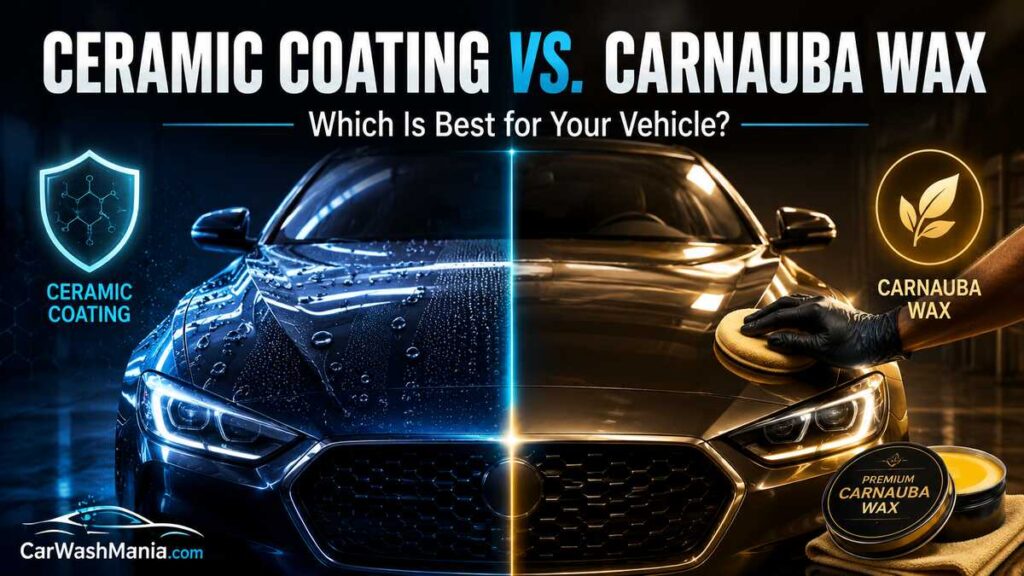
Choosing between ceramic coating and carnauba wax is not simply a question of which product creates more shine. The right choice depends on how often you drive, where you park, how much maintenance you enjoy, the condition of your paint, and how much you are prepared to spend.
Carnauba wax remains popular because it can give dark paint a rich, warm, and fluid appearance. It is affordable, forgiving, and satisfying to apply. Ceramic coating takes a different approach. It creates a more durable protective surface that resists contamination, improves water behavior, and makes routine washing easier.
For most daily drivers, ceramic coating is the more practical long term solution. For garage kept weekend vehicles, classic cars, and owners who enjoy frequent detailing, carnauba wax can still be the better choice.
This guide compares ceramic coating vs. carnauba wax across appearance, lifespan, protection, preparation, cost, maintenance, and real world vehicle use.
Quick Answer: Ceramic Coating or Carnauba Wax?
Choose ceramic coating when you want:
- Protection that can last for years rather than weeks
- Easier removal of dirt, road film, and environmental contamination
- Stronger resistance to chemicals and frequent washing
- A crisp, reflective, glass like finish
- Less frequent product reapplication
- Practical protection for a daily driver
Choose carnauba wax when you want:
- A deep, warm, traditional show car glow
- A simple product that is easy to apply and remove
- A lower initial cost
- The freedom to change or reapply protection frequently
- A forgiving option for older paint
- An enjoyable weekend detailing routine
A professionally installed ceramic coating commonly lasts several years, although actual performance depends on the coating, preparation, storage, climate, washing technique, and required maintenance. Traditional carnauba wax commonly provides several weeks to a few months of protection. Current detailing guides commonly place daily driver wax durability near four to eight weeks, while professional coatings may last two to five years.
Ceramic Coating vs. Carnauba Wax Comparison Table
| Comparison | Carnauba Wax | Ceramic Coating |
|---|---|---|
| Typical lifespan | About 4 weeks to 3 months | About 1 to 5 years, depending on product and care |
| Appearance | Warm, deep, wet looking glow | Bright, sharp, glass like reflection |
| Application difficulty | Beginner friendly | Moderate to advanced |
| Paint preparation | Wash and optional decontamination | Thorough decontamination, polishing, and panel preparation |
| Chemical resistance | Limited | Stronger, but varies by formula |
| Water behavior | Good beading when fresh | Strong beading and sheeting for longer periods |
| Scratch protection | Minimal | Limited resistance to very light surface marring |
| Stone chip protection | None | None |
| Maintenance | Frequent reapplication | Regular washing and occasional coating maintenance |
| Best use | Show cars and weekend vehicles | Daily drivers and frequently exposed vehicles |
What Is Carnauba Wax?
Carnauba wax is produced from the leaves of the Brazilian carnauba palm. Automotive wax products usually combine refined carnauba with solvents, oils, polymers, or other ingredients that make the wax easier to spread and remove.
When applied to clean paint, the product leaves a thin sacrificial layer over the clear coat. This layer increases gloss, improves water beading, and offers temporary protection against light contamination.
Carnauba wax does not permanently bond with automotive paint. It gradually deteriorates through washing, heat, rain, sunlight, friction, road film, and exposure to cleaning chemicals.
Carnauba Wax Benefits
The greatest advantage of carnauba wax is its appearance. Many enthusiasts believe it creates a warmer and more organic finish than ceramic coating, particularly on black, red, blue, and other deep colors.
Other benefits include:
- Low purchase cost
- Easy hand application
- Simple removal
- Minimal curing requirements
- Easy correction of streaks or missed residue
- Compatibility with frequent detailing
- Ability to improve the appearance of older paint
- No long term commitment
Wax can also temporarily reduce the visibility of extremely fine swirls because its oils and fillers may soften the way light reflects from the surface. It does not permanently remove those defects.
Disadvantages of Carnauba Wax
The main limitation is durability. A vehicle driven daily and parked outdoors may lose noticeable wax performance within four to eight weeks. A garage kept weekend vehicle can retain it longer.
Wax also offers limited resistance to strong cleaners, frequent washing, high surface temperatures, heavy rain, and prolonged exposure to road contamination.
It should be viewed as a renewable appearance product with light protective value, not as a durable physical shield.
What Is Ceramic Coating?
An automotive ceramic coating is a liquid paint protection product commonly based on silicon dioxide chemistry. Once applied and cured correctly, it forms a transparent layer over the vehicle’s clear coat.
Unlike traditional wax, a true ceramic coating is designed to bond more strongly with the prepared paint surface. This creates greater durability and resistance to environmental contamination.
The coating does not make paint invincible. It does not stop rock chips, deep scratches, dents, vandalism, or damage caused by poor washing. Its most useful benefits are chemical resistance, hydrophobic behavior, easier cleaning, gloss retention, and longer service life.
Gtechniq describes automotive ceramic coatings as products that bond with the clear coat and make it harder for dirt and grime to adhere. The coating still requires time to cure and needs regular maintenance after installation.
Benefits of Ceramic Coating
A properly installed ceramic coating can provide:
- Long term paint protection
- Strong water repellency
- Easier washing and drying
- Better resistance to road film and contamination
- Greater tolerance of automotive cleaning chemicals
- A slick and reflective finish
- Reduced need for frequent waxing
- Better protection against oxidation and environmental exposure
Product performance is not universal. For example, CarPro currently gives CQUARTZ UK 3.0 a real world durability claim of approximately 18 to 24 months and states chemical resistance across a pH range of 3 to 14. This illustrates why buyers should read the specifications for the exact coating rather than assuming that every ceramic product lasts five years or tolerates the same chemicals.
Disadvantages of Ceramic Coating
Ceramic coating has a higher initial cost and a much less forgiving application process.
Potential disadvantages include:
- Extensive paint preparation
- High professional installation cost
- Risk of cured high spots
- Need for controlled application conditions
- Greater difficulty removing the product
- Continued need for proper washing
- Possible water spotting
- Maintenance requirements for some warranties
A coating can preserve the condition of the surface underneath it, but that includes defects. Applying ceramic coating over swirl marks, oxidation, water spots, or polishing residue can make those problems more noticeable and harder to correct later.
Ceramic Coating vs. Wax Shine: Which Looks Better?
Appearance is subjective, and much of the final gloss comes from paint condition rather than the last protective product.
A properly polished vehicle with wax can look better than a poorly prepared vehicle with an expensive coating. Paint correction removes or reduces surface defects that scatter light. Wax or coating then changes the final surface behavior and visual character.
Carnauba Wax Appearance
Carnauba wax is commonly associated with:
- Warmth
- Rich color
- Visual depth
- A soft wet appearance
- A traditional show car finish
It is particularly attractive on deep, solid colors and vehicles displayed under warm indoor lighting.
Ceramic Coating Appearance
Ceramic coating is commonly associated with:
- Sharp reflections
- Bright gloss
- Strong clarity
- A glass like surface
- A modern polished appearance
It often works especially well on metallic, pearl, silver, white, and lighter finishes where clarity and reflection are more noticeable than warm color depth.
Enthusiast discussions show that many owners still prefer carnauba for maximum visual depth on a protected show vehicle, while others prefer the sharp gloss and easier care of a coating. This is an aesthetic preference rather than an objective rule.
Ceramic Coating vs. Wax Durability
Durability is where ceramic coating has the clearest advantage.
Fresh carnauba wax may bead water impressively, but the effect decreases relatively quickly through washing and exposure. A quality ceramic coating can retain useful protection much longer because it bonds more strongly to the surface.
These are general planning ranges. Climate, preparation, product quality, washing, mileage, storage, and maintenance can shorten or extend performance.
Do not treat advertised durability as guaranteed service life. A five year coating exposed to harsh automatic washes, poor maintenance, road salt, hard water, and outdoor storage may lose its strongest hydrophobic behavior much sooner.
The coating may also remain on the paint after obvious water beading declines. Hydrophobic performance and total coating survival are related, but they are not always identical.
Which Provides Better Paint Protection?
Ceramic coating offers stronger overall environmental resistance than carnauba wax. It is generally better suited to vehicles exposed to:
- Ultraviolet radiation
- Bird droppings
- Insect residue
- Tree sap
- Road salt
- Industrial fallout
- Acidic contamination
- Frequent rain
- Regular washing
- Dust and road film
However, contamination should still be removed promptly. Ceramic coating slows chemical interaction and makes cleaning easier, but it does not give owners permission to leave bird droppings or sap on the vehicle indefinitely.
Can Ceramic Coating Prevent Scratches?
Ceramic coating cannot prevent most scratches.
It may provide limited resistance to extremely light marring, but it will not stop:
- Scratches from automatic car wash brushes
- Damage from dirty wash mitts
- Key scratches
- Branch contact
- Shopping cart damage
- Stone chips
- Sand abrasion
- Improper polishing
Claims such as 9H hardness refer to a particular testing scale or marketing specification. They do not mean that the vehicle becomes scratch proof.
Drivers concerned about stone chips should investigate paint protection film for high impact areas. Ceramic coating can be applied over compatible film to improve cleaning and water behavior.
Best Choice for a Daily Driver
For most daily drivers, ceramic coating wins.
A commuter vehicle faces rain, sunlight, dust, insects, road film, parking lot contamination, and frequent washing. Long term protection and easier cleaning deliver more practical value than the subtle warmth of a traditional wax.
Ceramic coating is especially useful when the vehicle:
- Is driven almost every day
- Is parked outdoors
- Travels long distances
- Encounters heavy rain or winter salt
- Is exposed to dust, mud, or industrial fallout
- Has dark paint that shows dirt easily
- Is washed regularly
- Will be owned for several years
The coating does not eliminate maintenance. It reduces how strongly dirt bonds to the surface, which can make safe washing faster.
Best Choice for a Weekend or Show Car
Carnauba wax can be the better option for a garage kept vehicle that is driven only occasionally.
A weekend car receives less exposure, so wax may remain effective longer than it would on a daily commuter. Owners can refresh the finish before events and enjoy the hands on detailing process.
Wax is particularly suitable when:
- Maximum visual warmth is the priority
- The vehicle stays indoors
- Rain exposure is rare
- The owner enjoys frequent detailing
- The paint has minor imperfections
- Long term chemical resistance is unnecessary
- The owner does not want permanent product application
For a concours style presentation, paint preparation and lighting will still influence the result more than the wax brand alone.
Paint Preparation Requirements
Surface preparation is the most important part of either process.
No wax or coating can compensate for neglected, contaminated, or badly scratched paint.
Step 1: Wash the Vehicle Thoroughly
Wash in a shaded area using automotive shampoo, a clean wash mitt, and a safe contact washing method.
Remove loose dirt before touching the paint. Work from cleaner upper panels toward dirtier lower areas. Rinse the wash mitt frequently and dry the vehicle with clean microfiber towels or filtered air.
Step 2: Remove Embedded Contamination
Paint can appear clean while still feeling rough.
Use an automotive iron remover when metallic particles are present. Follow with a clay bar, clay towel, or clay mitt when needed. Always use sufficient lubrication because aggressive claying can introduce marring.
Step 3: Inspect and Polish the Paint
Polishing is optional before wax but highly recommended when gloss is the goal.
Before ceramic coating, polishing is usually advisable because the coating can preserve visible defects for a long time. The level of correction should match the paint condition, clear coat thickness, budget, and owner expectations.
A new vehicle may still have transportation marks, dealer installed swirls, water spots, or sanding defects.
Step 4: Prepare the Surface
Before wax, follow the wax manufacturer’s directions. Some products can be applied after washing, while others perform better on polished paint.
Before ceramic coating, remove polishing oils with a compatible panel preparation product. The surface must be clean and free from oils, old wax, sealants, and residue that could interfere with bonding.
Application and Removal Effort
How to Apply Carnauba Wax
- Work on cool, clean, dry paint.
- Apply a very thin and even layer.
- Allow the product to haze according to its instructions.
- Remove residue using a clean microfiber towel.
- Inspect the vehicle under multiple light angles.
Using more wax does not create more protection. Thick application wastes product and makes removal harder.
Wax mistakes are generally easy to fix. Remaining residue can usually be buffed away or softened with another light application.
How to Apply Ceramic Coating
- Work indoors or in a clean, shaded, controlled space.
- Divide each panel into small working sections.
- Apply the coating evenly with overlapping passes.
- Watch for the product’s flash behavior.
- Level residue at the correct time.
- Use a second clean towel for the final wipe.
- Inspect with focused lighting.
- Allow the coating to cure according to its instructions.
Application timing varies by product, temperature, and humidity. Some coatings must be leveled quickly, while others allow a longer working period.
A cured high spot may require machine polishing to remove. This is why first time users should practice on a small panel or choose a beginner friendly ceramic spray rather than immediately applying an advanced professional style coating.
Ceramic Coating Cost vs. Waxing Cost
Carnauba wax is cheaper at the point of purchase, but ceramic coating may be more convenient over several years.
Typical retail wax products can cost approximately $15 to $60, although premium products can cost more. Professional waxing often includes washing, decontamination, and paint enhancement, so service pricing can vary significantly.
Professional ceramic coating commonly costs far more because the service includes preparation, polishing, application labor, controlled curing, and inspection.
Current United States pricing guides place many professional coating services around $800 to $2,500 or more. Autotrader reported that a professional coating on an SUV requiring decontamination and paint correction could exceed $1,550, while DIY exterior preparation and coating materials may total approximately $200 to $400.
The price depends on:
- Vehicle size
- Paint condition
- Correction stages
- Coating brand
- Claimed durability
- Number of coated surfaces
- Installer experience
- Local labor rates
- Warranty requirements
- Annual inspection requirements
Do not compare quotes based only on the number of advertised years. Ask what preparation, correction, coating layers, maintenance, and covered surfaces are included.
Ceramic Spray, Hybrid Wax, and Other Alternatives
Drivers do not have to choose only between paste wax and a professional ceramic coating.
Ceramic Spray Coating
Ceramic sprays offer easier application and shorter durability than concentrated coatings. They can be an excellent choice for beginners, renters, and vehicle owners without an indoor application space.
Independent automotive testing has found that modern ceramic sprays can deliver legitimate water repellency and gloss with a much simpler spray and wipe process, although their durability remains below that of more substantial coatings.
Hybrid Ceramic Wax
Hybrid products combine wax, polymers, and silicon dioxide ingredients. They aim to provide a balance of warm gloss, water behavior, affordability, and easy application.
They are suitable for owners who want better durability than traditional wax without the preparation and risk of a true coating.
Synthetic Paint Sealant
Synthetic sealants generally last longer than traditional carnauba wax and are easier to apply than many ceramic coatings. They may provide several months of protection, making them a practical middle option.
Graphene Products
Graphene is frequently used as a marketing term in automotive protection products. Performance still depends on the total formulation, preparation, and application.
Do not assume that a graphene label automatically means greater durability or complete prevention of water spots.
Can You Put Carnauba Wax Over Ceramic Coating?
It is physically possible to apply some waxes over a cured ceramic coating, but it is not always useful.
Wax may temporarily alter gloss and water behavior, but it can cover the coating’s native surface characteristics. It may also attract or retain more contamination than a compatible ceramic maintenance product.
Some manufacturers allow certain toppers, while others recommend dedicated maintenance sprays. Follow the coating manufacturer’s system rather than mixing products based on general advice.
A compatible ceramic topper is usually a better choice when the goal is to restore slickness and water repellency.
Ceramic Coating Maintenance
Ceramic coating is low maintenance, not maintenance free.
To preserve it:
- Wash the vehicle regularly
- Use clean microfiber materials
- Choose a compatible automotive shampoo
- Avoid dirty automatic wash brushes
- Remove bird droppings and insects promptly
- Dry the paint to reduce water spotting
- Use approved maintenance products
- Schedule decontamination when performance declines
- Follow inspection requirements for warranty coverage
When water stops beading, the coating may be clogged with mineral residue, traffic film, or bonded contamination. A proper decontamination wash may restore performance.
Do not immediately assume the coating has failed.
Carnauba Wax Maintenance
Waxed vehicles need more frequent protection renewal.
Wash gently, avoid strong degreasers unless removal is intended, and inspect water behavior after each wash. Reapply when gloss, slickness, or water repellency noticeably declines.
Outdoor vehicles may require waxing every four to eight weeks. Garage kept vehicles may go longer depending on climate and use.
Common Ceramic Coating and Wax Myths
Myth 1: Ceramic Coating Makes a Car Scratch Proof
It does not. Safe washing remains essential.
Myth 2: Ceramic Coating Eliminates Water Spots
It can improve water behavior, but minerals can still remain when droplets dry on the surface.
Myth 3: Wax Removes Scratches
Wax may temporarily hide extremely fine marks. Abrasive polishing is required to remove or reduce clear coat defects.
Myth 4: Ceramic Coating Replaces Paint Protection Film
It does not. Paint protection film is designed for physical impact protection. Ceramic coating mainly improves surface resistance and maintenance.
Myth 5: A New Car Does Not Need Paint Preparation
New cars can have contamination, water spots, transportation damage, and dealership wash marks.
Myth 6: More Product Creates More Protection
Excess wax makes removal harder. Excess coating creates streaking and high spots. Thin, even application is usually best.
Decision Guide: Which Option Is Right for You?
Choose carnauba wax when:
- Your vehicle is garage kept
- You value warm visual depth
- You enjoy frequent detailing
- You want the lowest initial cost
- You prefer a reversible and forgiving product
Choose ceramic coating when:
- Your vehicle is a daily driver
- You park outside
- You face rain, sunlight, dust, or road salt
- You want easier washing
- You plan to keep the vehicle for several years
- You accept the higher preparation cost
Choose a ceramic spray or synthetic sealant when:
- You want a simple DIY process
- You cannot provide controlled curing conditions
- You want better durability than wax
- You are not ready for a permanent coating
- You prefer regular protection refreshes
Frequently Asked Questions
Is ceramic coating better than carnauba wax?
Ceramic coating is better for long term durability, chemical resistance, and easy maintenance. Carnauba wax can be better for warm visual depth, affordability, and simple application.
How long does carnauba wax last?
Traditional carnauba wax commonly lasts around four weeks to three months. Outdoor storage, heat, frequent rain, and strong cleaning products can shorten that period.
How long does ceramic coating last?
Consumer coatings may last around one to two years, while professionally installed systems may last several years. Actual life depends on the exact product, paint preparation, mileage, storage, climate, washing, and maintenance.
Does ceramic coating protect against bird droppings?
It provides a more resistant sacrificial surface and can make droppings easier to remove. It does not prevent all etching, so contamination should still be cleaned promptly.
Can ceramic coating be applied without polishing?
Yes, but polishing is often recommended. The coating will not remove existing swirls, scratches, oxidation, or water spots.
Is ceramic coating worth it for an older car?
It can be worthwhile when the paint is healthy enough to polish and the owner plans to keep the vehicle. The preparation cost should be compared with the vehicle’s condition and value.
Is wax better for black cars?
Carnauba wax can create attractive warmth and depth on black paint. Ceramic coating can provide greater clarity and easier maintenance. Paint correction has a larger influence on the final appearance than either product alone.
Can I use an automatic car wash after ceramic coating?
Touchless washing may be acceptable when compatible chemicals are used, but brush washes can still create scratches. Hand washing with clean tools is generally safer.
Conclusion: Is Ceramic Coating or Carnauba Wax Better?
Ceramic coating is the best overall choice for most daily driven vehicles because it lasts longer, tolerates environmental exposure better, and makes routine washing easier.
Carnauba wax remains an excellent choice for weekend cars, classic vehicles, show cars, and enthusiasts who prioritize a warm finish and enjoy frequent detailing.
The best product is ultimately the one that matches your ownership habits. A neglected ceramic coating can perform poorly, while a carefully maintained waxed vehicle can look exceptional. Preparation and washing technique matter more than exaggerated product claims.
Next Step
Protect your vehicle with a solution matched to its paint condition, driving environment, and maintenance needs. Contact a trusted automotive detailing specialist for a paint inspection and personalized recommendation between carnauba waxing, ceramic spray protection, paint correction, and professional ceramic coating.