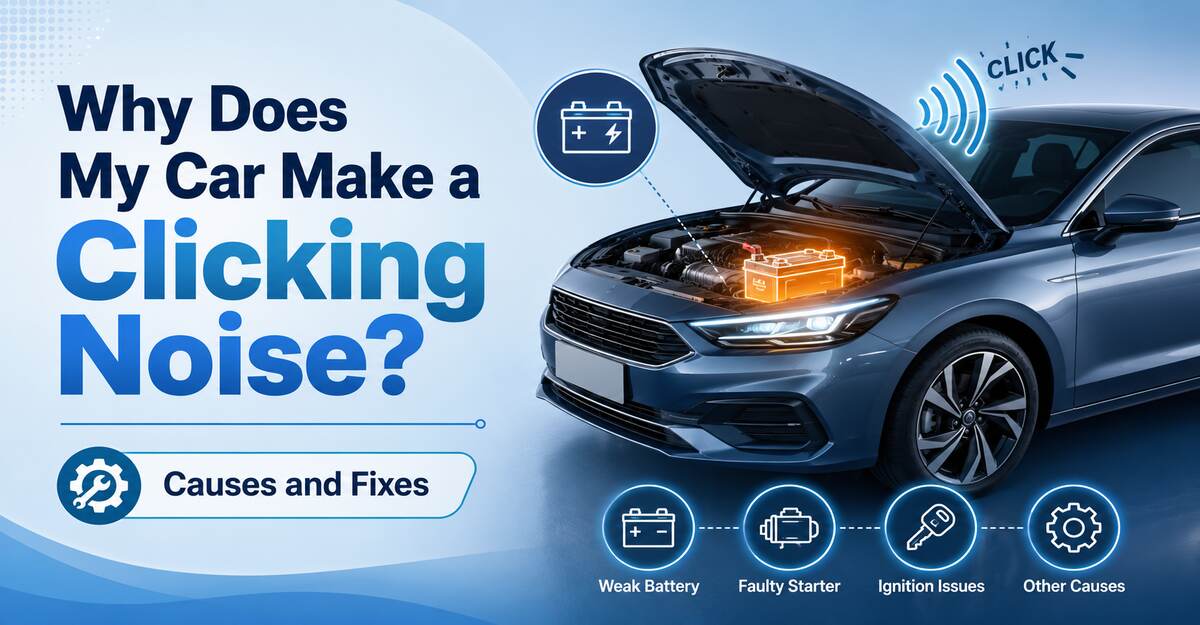
A clicking noise in a car usually means a mechanical or electrical component is worn, loose, under-lubricated, or unable to engage properly. The likely cause depends on when the clicking occurs. Clicking while turning often indicates a CV joint, while clicking during startup commonly points to a weak battery or starter circuit.
At a Glance
- Clicking while turning and accelerating commonly indicates a worn outer CV joint.
- Rapid clicking during startup usually means the battery cannot supply enough current to the starter.
- Engine ticking can result from low oil, valve-train wear, fuel injectors, or an exhaust leak.
- Dashboard clicking commonly comes from a failed HVAC blend-door actuator.
- Clicking over bumps may involve brake hardware, sway-bar links, struts, or loose suspension parts.
- A clicking sound accompanied by steering, braking, oil-pressure, or engine-performance problems requires prompt inspection.
Why Do Worn Car Parts Make Clicking Sounds?
Worn car parts click because excessive clearance allows two surfaces to contact each other repeatedly. The clicking frequency usually follows the speed of the rotating, moving, or electrically activated component.
Automotive joints, bearings, gears, valves, and fasteners are designed to operate with controlled clearances. Grease, engine oil, bushings, seals, and retaining clips prevent direct impact between their surfaces. When lubrication disappears or a component wears, the gap between those surfaces becomes larger.
A damaged CV boot provides a common example. The torn rubber boot allows grease to escape and contaminants to enter the CV joint. The joint’s internal grooves and bearings then wear, creating enough movement for the parts to snap against one another during a turn.
The same principle applies to valve-train components. Insufficient oil pressure can prevent a hydraulic lifter from maintaining the correct clearance, producing a tick each time the camshaft operates the valve.
Professionals compare the clicking frequency with four triggers:
- Engine RPM
- Vehicle speed
- Steering angle
- Road impacts
A sound that speeds up while the vehicle remains stationary is probably engine-related. A sound that increases only as the car moves is more likely connected to a wheel, axle, brake, tire, or drivetrain component.
What Causes Clicking When I Try to Start My Car?
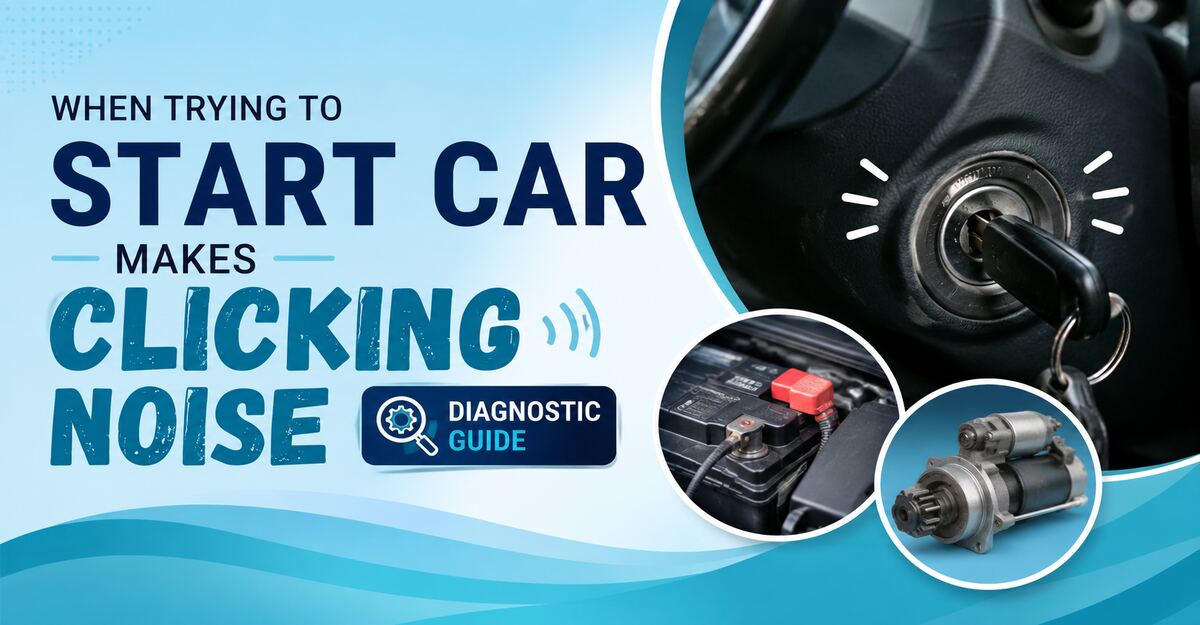
Rapid clicking during startup usually means the battery voltage collapses when the starter demands current. One solid click may indicate a starter solenoid, starter motor, cable, ground connection, or seized mechanical component.
A starter motor requires far more electrical current than headlights or dashboard accessories. A battery can therefore illuminate the dashboard but still be too weak to crank the engine.
Use this sequence:
- Observe the lights. Turn on the headlights and attempt to start the engine. Severe dimming during rapid clicking suggests low battery voltage or excessive resistance in the battery connections.
- Inspect the terminals. Loose or corroded battery terminals can interrupt starter current even when the battery itself is charged.
- Try an appropriate jump-start. If the engine starts normally with external power, the battery may be discharged, deteriorated, or unable to hold a charge.
- Test the charging system. A battery that repeatedly becomes discharged may be affected by an alternator, wiring, or parasitic-drain problem.
- Investigate a single heavy click. One click with no cranking can indicate that the starter solenoid engages but the starter motor does not turn.
Do not replace the starter before testing the battery, terminals, cables, and engine ground. Misdiagnosing a weak electrical supply as starter failure is a common and expensive mistake.
Why Does My Car Click When I Turn?
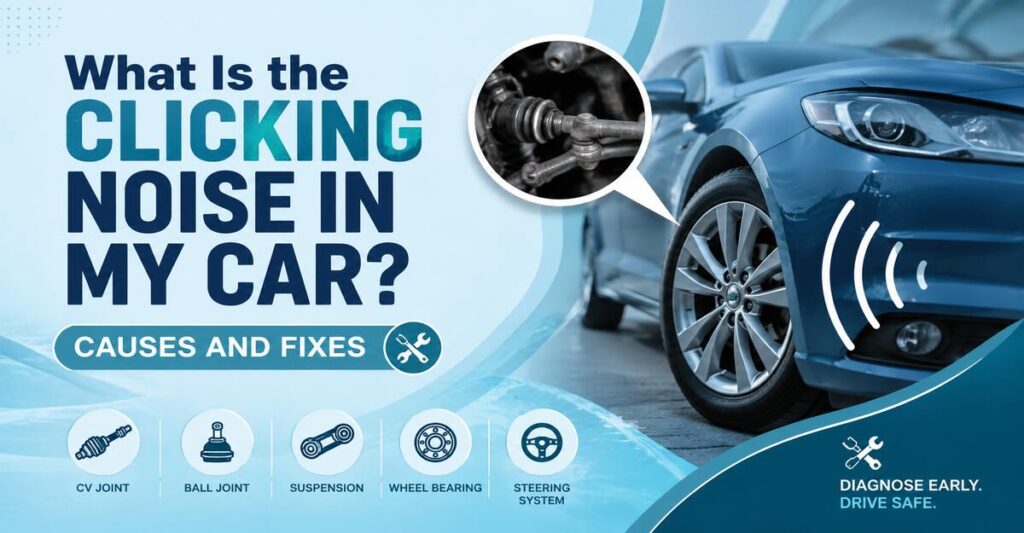
Clicking while turning, especially while accelerating, most commonly indicates a worn outer constant-velocity joint. The sound usually becomes louder during tight turns because the CV joint operates at a greater angle under load.
Front-wheel-drive and many all-wheel-drive vehicles use CV axles to transfer power while the wheels steer and move with the suspension. Each axle contains flexible joints protected by grease-filled rubber boots.
A torn boot may produce grease splatter around the inside of the wheel, suspension, or underbody before the joint begins clicking. Once contamination and wear have damaged the joint, replacing only the boot may no longer solve the problem.
A basic low-speed test can help:
- Use an open, unobstructed area.
- Lower the windows.
- Drive slowly in a tight circle.
- Repeat in the opposite direction.
- Listen for rhythmic clicking that becomes stronger under light acceleration.
A click during a left turn may place greater load on the right-side outer joint, but sound can travel through the vehicle. The loudest apparent side is not always the failed side.
Other possibilities include wheel-bearing movement, loose lug nuts, brake hardware, steering stops, tie-rod ends, or suspension joints. A technician should confirm the source before an axle is replaced.
Why Is My Engine Making a Ticking or Clicking Noise?
Engine ticking can be caused by low oil, insufficient oil pressure, worn valve-train components, fuel injectors, an exhaust leak, or an accessory driven by the belt. The sound’s location, temperature pattern, and relationship to RPM help separate these causes.
Check the engine oil first. Park on level ground, shut off the engine, allow the oil to settle, and follow the manufacturer’s dipstick procedure. Oil below the minimum mark can starve upper-engine components and cause lifters or cam-related parts to tick.
Do not assume that adding oil has repaired the underlying problem. Low oil may result from leakage, oil consumption, incorrect servicing, or extended maintenance intervals.
Common patterns include:
- Ticking that follows RPM: Valve train, injectors, exhaust leak, or rotating accessory.
- Ticking only when cold: Exhaust-manifold leak, oil-drain-back issue, or temporary lifter noise.
- Ticking after the engine warms: Reduced oil pressure, worn components, or temperature-related clearance.
- Ticking under acceleration: Exhaust leakage, detonation-like combustion noise, or load-sensitive mechanical wear.
- Deep knock rather than light tick: Potential bearing or internal-engine damage.
An illuminated oil-pressure warning requires immediate attention. Oil level and oil pressure are different measurements, so a full dipstick does not prove that the engine has adequate pressure.
Is Fuel-Injector Ticking Normal?
Yes, light and consistent fuel-injector ticking can be normal, especially in gasoline direct-injection engines. High-pressure injectors and fuel pumps often create a sharp mechanical tick that is most noticeable at idle with the hood open.
Normal injector noise is usually uniform, steady, and present without warning lights, misfires, smoke, power loss, or changes in oil pressure. Similar clicking should be audible from several injectors rather than one isolated location.
A sound is more suspicious when it:
- Appears suddenly
- Becomes noticeably louder
- Is limited to one cylinder area
- Changes after the engine warms
- Occurs with rough idling
- Accompanies a misfire code
- Occurs with low oil pressure
- Sounds deeper than the other injector pulses
Direct-injection systems also use a mechanically driven high-pressure fuel pump. The pump can produce noticeable ticking even when operating correctly.
The practical rule is to compare the current sound with the vehicle’s normal operating sound. A consistent tick that has always been present may be normal. A new or rapidly worsening tick should be diagnosed rather than dismissed as injector noise.
Avoid placing hands, tools, clothing, or listening devices near belts, fans, pulleys, or other moving engine components.
What Causes Clicking Behind the Dashboard?
Rhythmic clicking behind the dashboard commonly comes from an HVAC actuator with damaged internal gears. The clicking often begins when the temperature, airflow direction, recirculation mode, or defrost setting is changed.
Modern climate-control systems use small electric actuators to move doors inside the heater and air-conditioning case. These doors control whether air travels through the heater core, bypasses it, enters from outside, recirculates inside the cabin, or exits through specific vents.
Many actuators contain plastic gears. When the teeth wear or break, the actuator motor continues trying to reach the commanded position. The damaged gear repeatedly slips, producing a click or knock.
To isolate the problem:
- Start the vehicle or switch the ignition to the required accessory mode.
- Turn the climate fan to a low setting.
- Change the temperature from cold to hot.
- Switch between face, floor, and defrost outlets.
- Toggle the recirculation setting.
- Note which command starts or stops the clicking.
A failed actuator may leave the system stuck on hot, cold, defrost, or one vent position. The problem is usually not immediately dangerous, but loss of windshield defrosting can create a visibility hazard.
Access difficulty varies widely. Some actuators are reachable near the glove box, while others require extensive dashboard disassembly.
Why Does My Car Click When Driving Over Bumps?
Clicking over bumps usually means a suspension, steering, brake, exhaust, or underbody component has enough movement to strike another surface. Loose sway-bar links, brake pads, strut mounts, heat shields, and fasteners are common sources.
The noise pattern provides useful clues:
- Small rapid click over minor bumps: Sway-bar link, loose brake hardware, or trim panel.
- Single click during weight transfer: Control-arm bushing, ball joint, strut mount, or loose fastener.
- Metallic rattle on rough roads: Exhaust shield, brake shield, underbody panel, or loose mounting bracket.
- Click during braking and acceleration changes: Brake-pad movement, axle movement, engine mount, or drivetrain play.
- Noise near the top of the wheel well: Strut bearing or upper strut mount.
Remove loose objects from the glove box, door pockets, trunk, spare-wheel compartment, and cargo area before assuming the chassis has failed. A jack handle or spare-tire tool can imitate a suspension noise.
Do not crawl under a vehicle supported only by its emergency jack. Suspension fasteners also require specific torque values and loading procedures. Tightening random bolts without identifying the cause can mask damage or create alignment and safety problems.
A click accompanied by loose steering, uneven tire wear, pulling, or unstable braking deserves prompt professional inspection.
Does Clicking Speed Reveal What Is Causing the Noise?
Yes, the clicking speed is one of the most useful diagnostic clues. A sound that follows engine RPM points toward the engine or its accessories, while a sound that follows road speed points toward wheels, axles, brakes, tires, or the drivetrain.
Use these relationships:
| Clicking pattern | Most likely area |
|---|---|
| Speeds up when the engine is revved in Park | Engine, injectors, valve train, belt accessory, or exhaust |
| Speeds up only as the car moves faster | Tire, wheel, CV axle, brake, driveshaft, or wheel-related component |
| Appears only at a specific steering angle | CV joint, steering stop, strut bearing, or steering component |
| Occurs once when shifting direction | Brake pads, mounts, drivetrain lash, or axle movement |
| Occurs only over road impacts | Suspension, brake hardware, exhaust shield, or loose body panel |
| Starts when climate settings change | HVAC actuator |
| Occurs only during starting | Battery, cables, starter solenoid, or starter motor |
Frequency alone cannot identify the exact part. For example, a stone in a tire tread and a damaged brake shield can both click once per wheel rotation.
The strongest diagnosis combines frequency with location, load, steering angle, temperature, and operating condition. Record when the noise begins, when it disappears, and whether braking or acceleration changes it.
How Can I Tell Which Side of the Car Is Clicking?
The most reliable method is to reproduce the noise under controlled conditions while a passenger listens from different seating positions. Sound can travel through the chassis, so the side that appears loudest from the driver’s seat may not contain the failed component.
Start with these checks:
- Remove cabin and cargo noise sources. Empty loose items from storage areas and secure the spare tire and tools.
- Lower the windows. Compare the sound with the left window open, right window open, and both closed.
- Use a passenger. A passenger can listen from the front and rear seats while the driver concentrates on safe vehicle control.
- Compare left and right turns. Note whether steering angle or acceleration changes the sound.
- Inspect visible evidence. Look for a torn CV boot, grease splatter, loose wheel-well liner, damaged tire tread, hanging undertray, or shiny contact marks.
- Check after recent work. A click appearing after tire, brake, axle, or suspension service may relate to disturbed hardware.
Do not ask someone to walk beside a moving vehicle or place any part of the body beneath a running car. A repair shop can use chassis microphones, commonly called chassis ears, to compare several components during a road test.
How Can I Diagnose a Clicking Noise in My Car?
Diagnose a clicking noise by identifying the exact trigger before inspecting individual parts. The safest sequence is to determine whether the sound follows starting, engine RPM, vehicle speed, steering movement, braking, road impacts, or climate-control commands.
- Document the conditions. Record engine temperature, road speed, steering direction, braking input, gear selection, and whether the vehicle is moving.
- Check warning indicators. Oil-pressure, battery, brake, ABS, check-engine, and stability-control warnings can narrow the problem.
- Inspect the oil level. Low oil can cause valve-train ticking and serious engine damage.
- Check the battery symptoms. Rapid startup clicks with dimming lights suggest inadequate battery current.
- Test stationary engine speed. If the click accelerates when the engine is gently revved in Park, focus on engine-related components.
- Compare road speed. If frequency follows vehicle speed instead of RPM, inspect tires, wheels, brakes, axles, and drivetrain parts.
- Test climate controls. Dashboard clicking that reacts to vent or temperature changes points toward an actuator.
- Arrange an inspection. Seek professional diagnosis when the sound affects steering, braking, starting, engine lubrication, or vehicle stability.
A clear phone recording can help, but recordings often distort direction and frequency. Provide the technician with the exact conditions that reproduce the noise.
Can I Continue Driving With a Clicking Noise?
It depends on the source. A mild HVAC actuator click may allow limited driving, while clicking from a CV joint, brake system, loose wheel, steering component, or oil-starved engine can become unsafe.
Stop treating the noise as merely annoying when any of these symptoms appear:
- Steering vibration or looseness
- Clicking that becomes louder during turns
- Brake-pedal changes
- Vehicle pulling during braking
- Oil-pressure warning
- Engine overheating
- Misfiring or severe power loss
- Burning smell or smoke
- Wheel wobble
- Grinding mixed with clicking
- A visible loose or damaged component
A worn CV joint may continue operating for an unpredictable period, but increasing clicking means internal wear has already occurred. Continued driving can eventually cause loss of power delivery and leave the vehicle stranded.
Engine ticking caused by low oil deserves immediate investigation. Driving an oil-starved engine for even a short distance can turn a minor leak or low-level condition into expensive internal damage.
Dashboard clicking without visibility, electrical, or overheating problems is generally less urgent. However, a failed HVAC door that prevents windshield defrosting can make the vehicle unsafe in rain, cold weather, or high humidity.
When the source is unknown, reduce unnecessary driving until safety-related causes have been excluded.
How Long Can a Clicking CV Joint Last?
A clicking CV joint has no dependable remaining-life estimate. It may continue operating for weeks or fail much sooner, depending on joint wear, contamination, driving load, road conditions, and how aggressively the vehicle is turned and accelerated.
Clicking means the joint’s internal tracks and bearings have usually developed measurable wear. The damage cannot normally be reversed by adding grease once the joint is already noisy.
Urgency increases when:
- Clicking occurs during gentle turns
- The noise becomes louder quickly
- Vibration appears during acceleration
- The axle shudders under load
- Grease is visible around the wheel
- Clunking occurs when shifting between Drive and Reverse
- The vehicle is used for long-distance or high-speed travel
A torn boot without clicking may sometimes be addressed before the joint is damaged. A joint that already clicks is commonly repaired by replacing the complete CV axle or joint assembly.
Avoid relying on mileage estimates such as “another 500 miles” or “another month.” Wear progression is not linear, and no road test can guarantee how long the component will continue functioning.
The professional rule is simple: schedule repair promptly after a CV joint is confirmed as the source, especially when the vehicle is needed for highway driving or essential transportation.
How Much Does It Cost to Repair a Clicking Noise?
Repair costs can range from almost nothing for correcting a low fluid level or loose item to more than $2,000 for internal engine work. The final amount depends on the failed component, vehicle design, parts quality, labor rate, and required diagnostic time.
Typical broad U.S. estimates include:
| Cause | Approximate repair range |
|---|---|
| Battery-terminal cleaning or tightening | $0 to $100 |
| Battery replacement | $150 to $400 |
| Starter replacement | $350 to $900 |
| CV axle replacement | $300 to $900 per side |
| HVAC actuator replacement | $150 to $700 |
| Sway-bar link replacement | $150 to $450 |
| Brake-hardware correction | $100 to $400 |
| Strut or strut-mount repair | $400 to $1,200 per axle |
| Oil top-off | Cost of the correct oil |
| Valve-train or lifter repair | $800 to more than $2,500 |
| Exhaust-manifold or gasket repair | $250 to $1,500 |
These are planning ranges, not quotes. Luxury vehicles, performance models, corrosion, difficult dashboard access, and integrated axle or suspension designs can increase labor substantially.
Diagnosis may cost $100 to $250 or more, but accurate diagnosis is usually cheaper than replacing parts based only on sound. Ask whether the diagnostic charge is applied toward the repair and whether the estimate includes alignment, shop supplies, taxes, programming, and related hardware.
Should I Use a Mechanic, Dealership, or DIY Repair?
An independent mechanic is usually the best choice for common battery, starter, axle, brake, and suspension clicking noises. A dealership is most useful for warranty work, model-specific electronic diagnosis, software-related faults, and repairs requiring manufacturer procedures.
| Repair route | Best for | Main advantage | Main limitation |
|---|---|---|---|
| Independent mechanic | Most mechanical repairs | Competitive labor rates and practical diagnosis | Equipment and brand expertise vary |
| Dealership | Warranty and model-specific systems | Factory information, tools, and software | Usually higher cost |
| DIY | Simple inspections and low-risk maintenance | Saves labor costs | Incorrect work can create safety risks |
| Specialist shop | Electrical, transmission, exhaust, or performance issues | Deep expertise in one system | May require referral or additional appointments |
Reasonable owner-level checks include examining the oil level, inspecting battery terminals, removing loose cargo, observing dashboard warnings, and documenting when the noise occurs.
Axle nuts, suspension fasteners, brake components, and steering joints should not be tightened or replaced without proper tools, torque specifications, and procedures. Incorrect axle-nut torque can damage a wheel bearing. Incorrect suspension work can affect alignment or vehicle control.
New or leased vehicles should be checked for warranty coverage before outside repairs. Routine maintenance or independent repair does not automatically erase every warranty protection, but damage caused by improper work may not be covered.
When Should I Stop Driving and Tow the Car?
Stop driving and arrange towing when the clicking is accompanied by loss of steering control, braking problems, wheel movement, an oil-pressure warning, overheating, severe engine noise, smoke, or a rapidly worsening drivetrain vibration.
Immediate towing is appropriate when:
- A wheel appears loose or tilted
- Lug nuts are missing or visibly loose
- The steering wheel suddenly develops excessive play
- The brake pedal becomes soft or braking becomes uneven
- The oil-pressure warning remains illuminated
- The engine produces a deep knock with the clicking
- The vehicle shakes severely during acceleration
- A CV axle or driveshaft appears displaced
- A component is dragging beneath the vehicle
- The sound began immediately after striking a curb, pothole, or road debris
- Burning odors, smoke, or electrical heat accompany the clicking
Pull over in a safe location, activate the hazard lights, shut off the engine when appropriate, and avoid inspecting the vehicle from an exposed traffic lane.
Rapid startup clicking without engine cranking does not usually require towing if the car is safely parked, but repeated start attempts can further discharge the battery or overheat electrical connections.
When warning signs are absent but the source remains unknown, schedule an inspection soon and avoid unnecessary long-distance or high-speed driving.
The Bottom Line
A clicking noise in a car is a symptom rather than a diagnosis. Clicking during startup commonly indicates a battery or starter-circuit problem, clicking while turning commonly indicates CV-joint wear, and ticking from the engine requires an oil-level and mechanical assessment. The noise becomes urgent when it affects steering, braking, wheel security, oil pressure, engine performance, or drivetrain stability. Identifying the exact trigger is more reliable than replacing parts based on the sound alone.