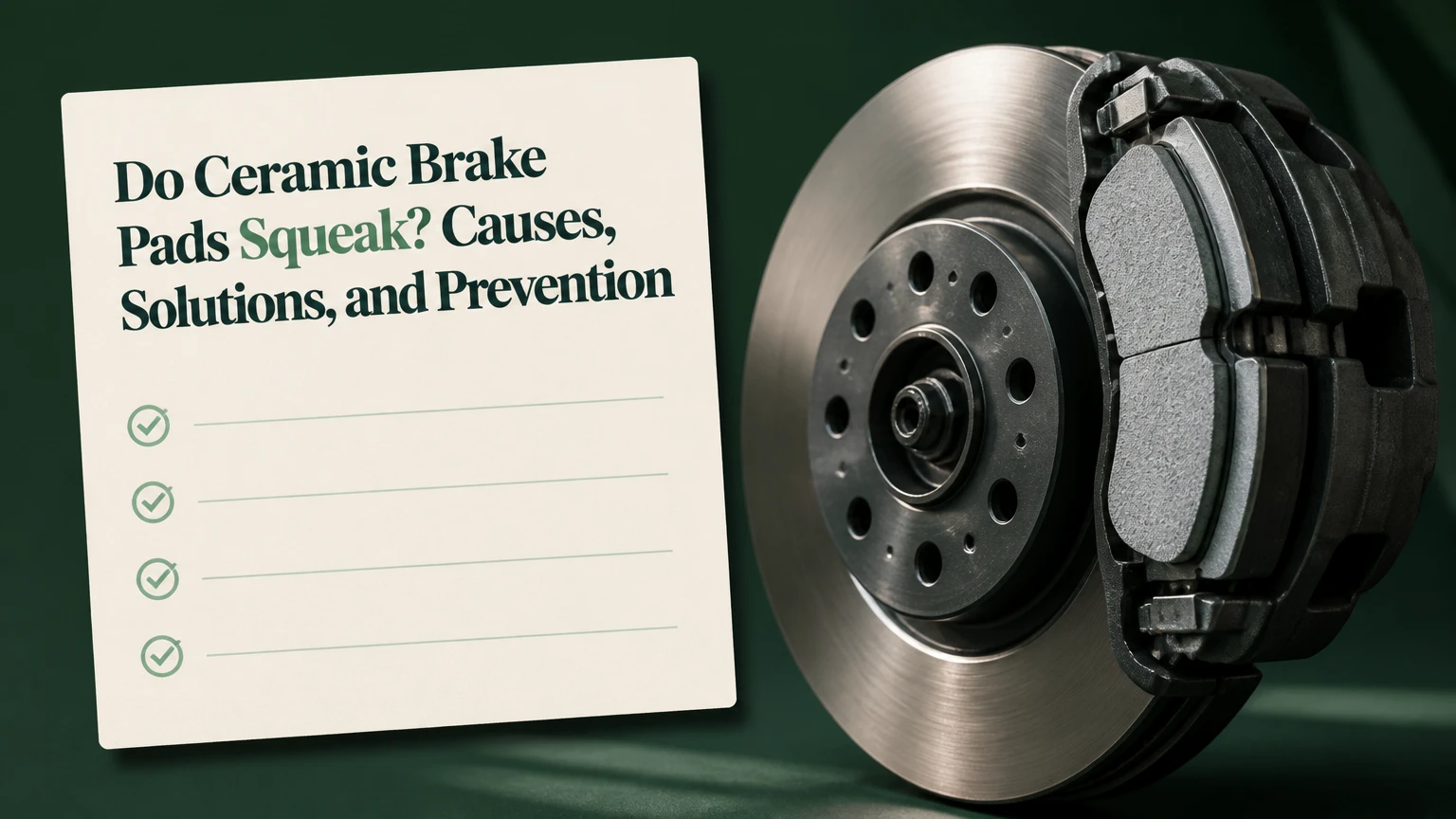
Ceramic brake pads can squeak, but they are significantly quieter than semi-metallic or organic friction materials. When ceramic pads produce noise, the cause is rarely a material defect; instead, it typically stems from cold operating temperatures, improper bedding-in, glazed friction surfaces, missing anti-squeal hardware, or rotor face contamination.
Key Facts: Ceramic Brake Pad Noise
- Frequency Range: Ceramic brake squeal is a high-frequency acoustic resonance, usually occurring between 1 kHz and 20 kHz, caused by microscopic stick-slip vibration between the pad and rotor.
- Cold Squeal Behavior: Ceramic compounds require an internal thermal threshold of roughly $50^\circ\text{C}$ ($122^\circ\text{F}$) to reach optimal friction compliance. Light braking during cold starts often creates temporary noise.
- Transfer Layer Requirement: Quiet operation depends entirely on an even microscopic boundary layer of friction material transferred onto the rotor face during a proper bed-in procedure.
- Hardware Impact: Over 60% of persistent ceramic pad noise is caused by worn caliper abutment clips, unlubricated pad ears, or absent anti-rattle shims rather than the pad material itself.
- Comparison: Ceramic pads generate up to 70% less audible brake dust and noise vibration harshness (NVH) compared to high-iron semi-metallic pads.
How Do Ceramic Brake Pads Control Noise Physics?
Ceramic brake pads control noise by utilizing dense non-ferrous ceramic fibers, synthetic binders, and soft filler metals (such as copper or brass alloys) that damp high-frequency acoustic vibrations. Unlike semi-metallic pads, which contain 30% to 65% steel wool or iron filaments, ceramic matrices absorb micro-vibrations before they transfer through the caliper piston into the vehicle cabin.
+-----------------------------------------------------------------------+
|                       BRAKE NOISE SPECTRUM                            |
|                                                                       |
|  [Low-Frequency Groan]      [Mid-Frequency Judder]    [High Squeal]   |
|      20 Hz - 100 Hz            200 Hz - 900 Hz        1 kHz - 20 kHz  |
|  (Caliper/Suspension)       (DTV / Rotor Thickness)    (Pad/Rotor)    |
|                                                                       |
|  =====================> CERAMIC PADS TARGET THIS <=================== |
+-----------------------------------------------------------------------+
Brake noise is not produced by the pad grinding down; it is caused by high-speed friction instability called stick-slip friction. As the rotor rotates through the caliper, the pad micro-welds and releases against the disc thousands of times per second. If this frequency matches the resonant frequency of the steering knuckle or caliper assembly, it radiates through the air as a high-pitched squeal. Ceramic compounds modify this friction curve ($d\mu/dv$) to prevent vibrational resonance.
Why Do Ceramic Brake Pads Squeak When Cold?
Ceramic brake pads squeak when cold because their synthetic phenolic resins and structural ceramic matrices require heat to soften slightly and conform to the micro-grooves of the brake rotor. Below $50^\circ\text{C}$ ($122^\circ\text{F}$), the pad face remains rigid, resulting in uneven surface contact that triggers high-frequency vibration during light pedal application.
       COLD OPERATING STATE                       HOT / BEDDED STATE
 (Rigid Pad + Microscopic Gaps)              (Conformal Contact + Transfer Layer)

   +--------------------------+                 +--------------------------+
   |   Ceramic Pad (Rigid)    |                 |  Ceramic Pad (Pliable)   |
   +--------------------------+                 +--------------------------+
     || (Gaps = Vibration)  ||                   ==========================  <-- Boundary Layer
   +--------------------------+                 +--------------------------+
   |        Brake Rotor       |                 |        Brake Rotor       |
   +--------------------------+                 +--------------------------+
This phenomenon is known as “cold glass squeal.” Once the brakes complete two or three moderate stops, friction raises the core temperature of the pad, establishing full surface contact and eliminating the noise. If the squeal vanishes after a few minutes of driving, the system is operating within normal technical tolerances.
What Is the Difference Between Brake Squeal and Brake Pulsation?
Brake squeal is an acoustic high-frequency air vibration (1,000 Hz to 20,000 Hz) caused by pad-to-rotor contact friction. Brake pulsation is a mechanical low-frequency hydraulic surge felt directly in the pedal or steering wheel, caused by Disc Thickness Variation (DTV) or excessive lateral runout.
It is critical to distinguish acoustic noise from structural mechanical variation:
- Disc Thickness Variation (DTV): Occurs when the rotor thickness varies by as little as $0.0005$ inches ($0.012\text{ mm}$) around its circumference. DTV forces the caliper piston inward and outward, sending hydraulic surges through the brake fluid into the pedal.
- Lateral Runout: Occurs when a rotor wobbles side-to-side as it spins, usually due to uneven lug nut torque (deviations exceeding $15\text{ to }20\text{ lb-ft}$) or rust buildup between the wheel hub and rotor hat exceeding $0.001$ inches ($0.025\text{ mm}$).
- High-Frequency Squeal: Does not push the brake fluid or vibrate the pedal physically; it creates purely airborne sound waves due to friction interface mechanics.
What Causes Persistent Squealing in Ceramic Brake Pads?
Persistent squealing in ceramic brake pads is caused by pad glazing, missing hardware, rotor incompatibility, unbedded friction material, or moisture oxidation. Identifying the underlying cause requires evaluating operating conditions and mechanical assembly factors.
| Primary Squeal Cause | Root Mechanical Mechanism | Diagnostic Marker | Corrective Action |
| Thermal Glazing | Overheating cooks phenolic binders into a slick, hard glass layer. | Mirror-like finish on pad face; reduced stopping bite. | Sand pad face with 120-grit sandpaper or replace. |
| Lack of Transfer Layer | Pad was never bedded-in; raw ceramic material chatters against bare steel. | Intermittent noise during gentle stops at low speeds. | Perform a structured 10-stop burnishing procedure. |
| Hardware Dryness | Metal-on-metal vibration between pad ears and caliper abutment clips. | Squeal changes pitch when turning or backing up. | Clean clips; apply high-temp silicone/copper grease. |
| Rotor Surface Roughness | Rotors machined too coarsely (directional finish instead of non-directional). | Rhythmic, speed-matched squeak during light braking. | Turn rotors with a fine non-directional swirl pattern. |
| Wear Indicator Contact | Mechanical steel tab scrapes rotor as pad thickness drops below $2\text{ mm}$. | Continuous, harsh metallic scraping under all conditions. | Immediately replace worn brake pads. |
How Do You Bed-In Ceramic Brake Pads to Prevent Noise?
You bed-in ceramic brake pads by performing a series of controlled heating and cooling cycles that transfer an even, microscopic layer of pad material onto the rotor face. This process fills the microscopic pores of the cast-iron rotor with ceramic friction material, allowing pad-to-film contact rather than pad-to-metal contact.
       STEP-BY-STEP BED-IN PROCEDURE (HEAT & TRANSFER MATRIX)

[50 MPH / 80 KM/H] === Moderate Hard Brake ===> [10 MPH / 16 KM/H]
       ^                                                |
       |                                                |
       +============== Repeat 5 to 7 Times =============+
                               |
                               v
                     [10 Minutes Cool Down]
               (Do NOT hold brake pedal down)
The 6-Step Bed-In Protocol
- Safety Check: Locate a safe, clear road with no trailing traffic.
- Initial Accelerations: Accelerate the vehicle to $35\text{ mph}$ ($56\text{ km/h}$).
- Moderate Decelerations: Apply moderate-to-firm pressure to slow the vehicle quickly down to $10\text{ mph}$ ($16\text{ km/h}$). Do not come to a complete stop.
- Repeat Cycle: Instantly accelerate back up to $35\text{ mph}$ and repeat the braking process 4 to 5 times.
- Higher Speed Cycle: Accelerate to $55\text{ mph}$ ($88\text{ km/h}$) and apply firm pressure down to $10\text{ mph}$. Repeat 3 times.
- Thermal Cool-Down: Drive the vehicle for 10 to 15 minutes at highway speeds using the brakes as little as possible. This allows the newly deposited transfer film to cure without thermal spot-imprinting.
Critical Rule: Never bring the vehicle to a dead stop and hold your foot firmly on the brake pedal while the pads are smoking hot. Doing so leaves a high-density pad footprint on one section of the rotor face, creating a spot with a higher friction coefficient that leads to noise and pseudo-warpage.
Ceramic vs. Semi-Metallic vs. Organic Pads: Noise and Performance
Evaluating friction material characteristics across operating metrics highlights clear structural trade-offs.
| Performance Attribute | Ceramic Friction Compounds | Semi-Metallic Compounds | Organic (NAO) Compounds |
| Noise & Squeal Tendency | Very Low (Occasional cold squeal) | Moderate to High | Lowest |
| Brake Dust Production | Very Low (Light gray, non-stick) | High (Dark, corrosive iron dust) | Moderate (Dark dust) |
| Operating Temp Range | $0^\circ\text{C}$ to $500^\circ\text{C}$ ($32^\circ\text{F}$ to $932^\circ\text{F}$) | $-18^\circ\text{C}$ to $800^\circ\text{C}$ ($0^\circ\text{F}$ to $1472^\circ\text{F}$) | $0^\circ\text{C}$ to $350^\circ\text{C}$ ($32^\circ\text{F}$ to $662^\circ\text{F}$) |
| Cold Initial Bite | Moderate | Exceptional | Strong |
| Rotor Abrasion Rate | Extremely Low | High (Wears rotors down faster) | Low |
| Ideal Vehicle Application | Commuter cars, luxury sedans, EV/Hybrids | Heavy towing, track days, performance cars | Light passenger compacts |
How to Fix Squeaking Ceramic Brake Pads
To resolve squeaking ceramic brake pads permanently, follow this step-by-step diagnostic and mechanical remediation process:
+-----------------------------------------------------------------------+
|                    SYSTEMATIC NOISE DIAGNOSIS                         |
|                                                                       |
|  [Inspect Hardware] ---> [De-Glaze Friction Surface] ---> [Chemical] |
|  Clips, Shims, Lubricant    Sand Pads & Clean Rotors     Dampening   |
+-----------------------------------------------------------------------+
Step 1: Inspect and Replace Hardware
Remove the caliper and discard old, fatigue-weakened abutment clips. Install new stainless steel hardware. Apply a thin layer of synthetic polybutylcuprysil or high-temperature silicone brake lubricant to the pad ear touchpoints where they slide against the clips. Keep grease strictly away from the friction face and rotor surface.
Step 2: Install Multi-Layer Anti-Squeal Shims
Ensure your ceramic pads feature vulcanized rubber-to-metal vulcanized shims or vulcanized elastomer backing plates. If the pads are unshimmed, apply an aftermarket liquid anti-squeal dampening compound to the back of the steel backing plate and allow it to dry tacky before reinstalling the caliper piston.
Step 3: Deglaze the Pads and Surface the Rotors
If pads show a reflective, glassy glaze from panic stops or prolonged drag, place a sheet of 120-grit sandpaper on a flat surface and rub the pad face in a figure-eight pattern until a uniform, dull matte finish returns. Clean the brake rotor faces using brake cleaner and an arbor disk or emery cloth to remove spotty transfer film.
Step 4: Verify Caliper Guide Pin Movement
Sealed slide pins that are dry or corroded prevent the floating caliper from centering itself properly. This causes the inner or outer ceramic pad to drag against the rotor at an angle, exciting high-frequency squeal. Remove pins, clean off old grease, polish off rust with wire wool, and lubricate with dedicated glycol-safe synthetic ceramic grease.
Frequently Asked Questions
Why do my new ceramic brakes squeak right after morning cold starts?
New ceramic pads squeak in the morning because humidity forms a thin micro-layer of surface rust (iron oxide) on cast-iron rotors overnight. When you first apply the brakes, the ceramic pads scrape off this oxidation, producing a high-pitched squeal for the first two or three stops until the rotor face is swept clean.
Do ceramic brake pads damage brake rotors?
No, ceramic brake pads do not damage brake rotors. They are less abrasive to cast-iron rotors than semi-metallic pads because they do not contain coarse steel or iron fibers. Rotors mated with ceramic pads typically experience smoother wear and significantly longer service lives.
Can I install ceramic brake pads on old, un-resurfaced rotors?
You should avoid installing ceramic pads on old, un-resurfaced rotors without at least scuffing the rotor faces. Old rotors retain a embedded transfer layer from the previous pad material (such as semi-metallic compounds). Ceramic material cannot bond over a semi-metallic film, leading to severe chatter, squeal, and reduced braking power.
Why do ceramic pads squeak when reversing or turning slowly?
Ceramic pads squeak when reversing or turning slowly because reversing alters the directional wear angle of the friction pad within the caliper bracket. Microscopic ridge edges on the pad shift against the rotor, causing high-frequency vibration if the pad edges lack chamfers or if pad ears lack proper slider lubrication.
How long does it take for ceramic brake pads to stop squeaking after installation?
Ceramic brake pads typically take between 100 and 300 miles of routine driving to settle completely and quiet down if they were not formally bedded in after installation. Performing an intentional 10-stop bedding procedure eliminates this break-in squeal period immediately on day one.


