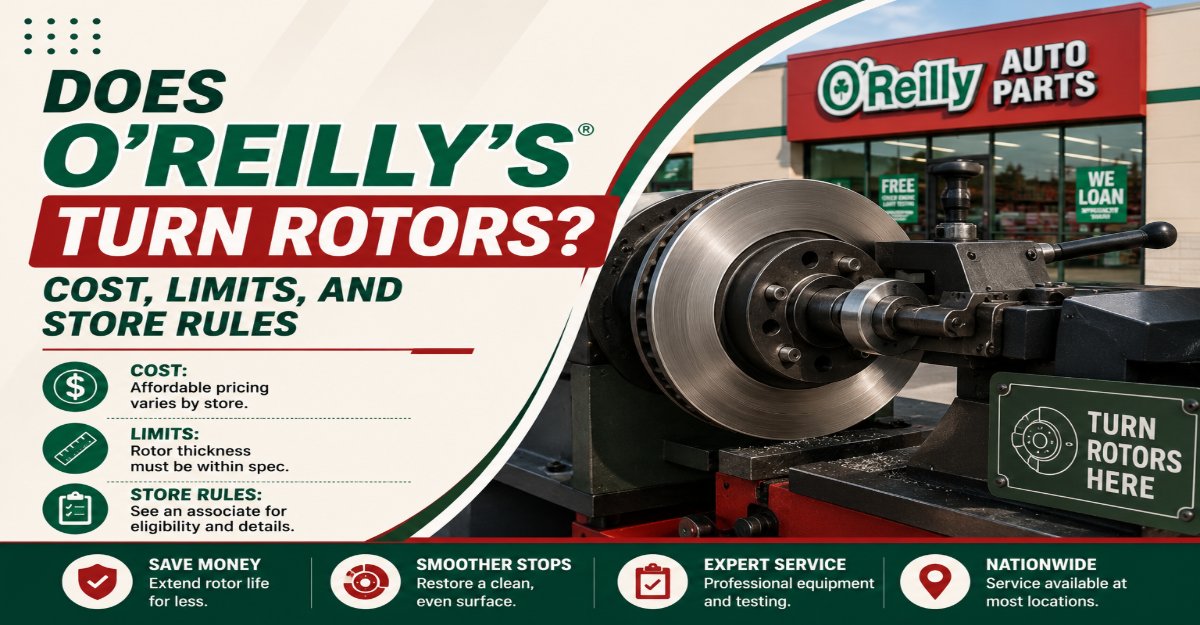
O’Reilly Auto Parts turns brake rotors at most store locations equipped with an on-site brake lathe. The service costs $15 to $25 per standard passenger rotor and takes 1 to 2 hours. Stores will only resurface rotors that exceed the stamped minimum discard thickness and pass visual inspection for damage.
At a Glance
- O’Reilly Auto Parts resurfaces standard automotive brake rotors for $15 to $25 each, while heavy-duty truck rotors cost up to $30.
- Rotors must be removed from the vehicle prior to drop-off, as O’Reilly stores operate retail counters rather than full-service repair bays.
- Staff measure rotors with a micrometer and will reject metal that sits at or near the discard limit printed on the rotor hub.
- Most locations refuse drilled, slotted, composite, or heavily rusted rotors to avoid damaging their lathe bits or cutting uneven surfaces.
- New economy rotors often cost $35 to $45, making full replacement a smarter financial choice than resurfacing old metal in many cases.
Does O’Reilly Auto Parts Turn Brake Rotors?
O’Reilly Auto Parts turns brake rotors at select store locations that maintain an operational brake lathe and trained staff. The retailer provides resurfacing for loose brake rotors brought directly to the counter by customers. Availability varies by store, so calling your local branch to verify lathe functionality before traveling is recommended.
Brake rotor turning, also known as resurfacing or machining, removes a thin layer of metal from the rotor surface. This process clears away pad deposits, light scoring, and minor heat checks to restore a smooth, flat contact face for new brake pads.
| Service Metric | Standard Passenger Vehicle | Heavy-Duty Truck / SUV |
| Average Cost per Rotor | $15 to $25 | $25 to $30 |
| Typical Turnaround Time | 1 to 2 Hours | 2 to 4 Hours |
| Service Availability | Select Stores (First-Come) | Select Stores (First-Come) |
| Vehicle Removal Required? | Yes (Customer Drop-off) | Yes (Customer Drop-off) |
How Much Does O’Reilly Charge to Turn Rotors?
O’Reilly Auto Parts charges $15 to $25 per rotor for standard passenger cars, crossovers, and light sedans. For larger pickup trucks, commercial vans, and heavy-duty vehicles, the price rises to $25 to $30 per rotor due to the increased metal mass and setup time on the bench lathe.
This pricing covers basic surface machining on a bare, off-vehicle rotor. The cost remains flat regardless of whether the technician takes a single light finish pass or multiple cuts to clean up deep grooves. If a rotor fails initial measurement during intake, O’Reilly does not charge an inspection fee.
How Long Does Rotor Resurfacing Take at O’Reilly?
Rotor turning at O’Reilly Auto Parts takes 1 to 2 hours under normal store conditions. If the machine shop queue is empty and an experienced operator is available, the physical machining process requires roughly 20 to 30 minutes per pair of rotors.
Turnaround times extend to overnight under three specific conditions:
- The store is experiencing high weekend customer volume.
- Multiple brake rotor jobs are waiting ahead of yours in the service queue.
- The designated brake lathe technician is off-shift, on lunch, or unavailable.
Do You Have to Take the Rotors Off the Car Yourself?
Yes, you must remove the brake rotors from your vehicle before bringing them into O’Reilly Auto Parts. O’Reilly operates as an automotive parts retailer rather than a full-service mechanic facility, meaning staff cannot perform repair labor on customer vehicles.
Customers cannot work on their vehicles or use loaner tools in O’Reilly parking lots due to corporate liability restrictions. You must disassemble the brake caliper, remove the rotor in your own garage or shop, and transport the loose metal components to the store retail counter.
How Do Staff Measure Rotors to Determine If They Can Be Turned?
O’Reilly technicians measure brake rotor thickness using a calibrated digital or mechanical micrometer before mounting metal onto the lathe. They compare the current thickness reading against two distinct thresholds: the stamped discard minimum and the internal machine-to safety margin.
Rotor Thickness Decision
The intake measurement process follows a strict protocol to determine rotor eligibility:
- Locate the Discard Stamp: The technician clears surface rust on the hub edge or inner lip to read the factory specification (for example, “MIN THK 24.0mm”).
- Take Multi-Point Measurements: The operator measures the brake surface at four separate points around the circumference to identify the thinnest section.
- Calculate Machine Margin: The technician subtracts 0.015 inches to 0.030 inches (0.38mm to 0.76mm) from the current thinnest reading to account for the metal depth the lathe bit will remove.
- Final Go/No-Go Decision: If the projected post-cut thickness falls at or below the factory discard minimum, the store rejects the rotor by law.
What Is the Minimum Thickness for Turning a Brake Rotor?
The minimum thickness for turning a brake rotor is the factory discard limit stamped on the component plus a safety margin of at least 0.015 inches (0.38mm). Store technicians will reject any rotor that reaches or falls below this combined metric.
For example, if your rotor hub is stamped with a minimum thickness of 24.0mm, its current thickness must measure at least 24.4mm to 24.5mm before touching the lathe. This buffer guarantees that after the cutting bit shaves off 0.015 to 0.030 inches of worn surface metal, the finished rotor remains safely above the legal 24.0mm discard floor.
Which Brake Rotor Types Does O’Reilly Refuse to Turn?
O’Reilly Auto Parts refuses to turn specialty, performance, or damaged brake rotors that risk breaking lathe bits or producing an untrue surface finish. Standard cast-iron smooth rotors are accepted, but complex modern designs are turned away.
Rotor Inspection at Store
- Solid Cast Iron
- Vented Passenger Car Rotors
- Smooth Truck Drums
- Drilled & Slotted
- Two-Piece Composite
- Deeply Pitted Rust
- Grooves > 1.5 mm
Stores consistently decline to machine the following four rotor categories:
- Drilled and Slotted Rotors: The chamfered holes and surface slots interrupt the lathe cutting bit. This interruption causes the bit to chatter, chip, or break, leaving an uneven, wavy finish across the friction face.
- Two-Piece Composite Rotors: Rotors featuring an aluminum inner hat pinned to a steel outer ring require specialized mounting cones. Most store lathes lack these adapters, preventing true alignment on the spindle.
- Heavily Rusted or Pitted Rotors: Severe rust scale on the center mounting hub prevents the rotor from sitting flush against the lathe arbor, resulting in off-center cuts.
- Rotors with Scoring Deeper Than 1.5mm: Deep gouges caused by worn-out brake pad rivets require removing too much surface metal to clear, driving the finished thickness far below safe limits.
Is Resurfacing Rotors Worth It vs. Buying New Ones?
Resurfacing rotors is often a false economy for standard commuter vehicles when compared to purchasing new replacement units. While turning a pair of rotors costs roughly $45 to $50, brand-new economy replacement rotors for common sedans and crossovers cost $35 to $45 each.
Cost Comparison: Resurfacing vs. Buying New
Opting for new rotors presents two distinct mechanical advantages over turning old ones:
- Thermal Mass Retention: Machining metal off a rotor reduces its overall thickness and mass. A thinner rotor absorbs less heat during hard braking, causing thermal energy to spike rapidly. This reduced cooling capacity increases the likelihood of pedal pulsation and premature warping within 5,000 to 10,000 miles.
- Material Fatigue: Old rotors have undergone thousands of heating and cooling cycles. Buying new units provides fresh, un-fatigued iron backed by a manufacturer warranty, eliminating the labor and time lost to drop-off appointments.
Resurfacing remains cost-effective primarily for heavy-duty trucks, rare performance vehicles, or high-end original equipment manufacturer (OEM) rotors where new replacements exceed $150 per unit.
How Can You Check Your Rotor’s Thickness at Home Before Going?
You can check your rotor’s thickness at home by using an outside vernier or digital micrometer to measure the metal friction surface. Measuring before traveling saves time and prevents unnecessary store trips with un-servicable parts.
To complete a home inspection, follow these four steps:
- Clean rust off the outer edge or center hat of the rotor using a wire brush to read the stamped minimum thickness number.
- Position the micrometer anvil inside the outer lip of the rotor, avoiding the raised wear ridge at the extreme edge.
- Tighten the micrometer until it contacts the flat braking surface on both sides, and record the reading in millimeters or inches.
- Compare your reading to the minimum thickness stamp. If your measurement sits within 0.030 inches (0.76mm) of the discard minimum, buy new rotors instead of attempting to machine them.
Does O’Reilly Resurface Brake Drums?
Yes, O’Reilly Auto Parts stores with operational bench lathes resurface rear brake drums alongside disc brake rotors. The service fees and queue rules for brake drums match standard rotor pricing ($15 to $25 per unit).
Technicians measure the inside diameter of the brake drum using a drum micrometer rather than checking external thickness. Every drum features a maximum safe diameter limit cast directly onto the outer shell (for example, “MAX DIA 9.050 IN”). If machining the internal shoe surface causes the diameter to exceed this specification, the store must condemn the drum.
Can You Make an Appointment to Turn Rotors at O’Reilly?
No, O’Reilly Auto Parts does not take advance appointments for rotor turning services. Bench lathe work operates strictly on a first-come, first-served basis at the retail counter.
To avoid unexpected delays when dropping off rotors, follow this protocol:
- Call your local O’Reilly store early in the morning.
- Confirm that the store’s brake lathe is in working order and not down for maintenance.
- Ask if a qualified lathe operator is working on-shift during your planned arrival window.
- Inquire about the current machine shop job queue to gauge turnaround time before bringing your parts to the counter.
What Happens If O’Reilly Damages Your Rotor During Machining?
If an O’Reilly technician damages your rotor by cutting it below minimum thickness or setting incorrect lathe speeds that chatter the surface, the store will compensate you by applying a store credit or discount toward a new replacement rotor.
O’Reilly rarely offers cash refunds or free premium rotors without evaluation, but store managers generally resolve operator error at the counter. Protect yourself from disputes by executing a two-step quality check before accepting the work:
- Perform the Fingernail Test: Drag a fingernail radially across the freshly machined face from the inner hub outward. The metal surface should feel glass-smooth. If you feel ridges, grooves, or spiral textures similar to a vinyl record, the cut was made too fast or with a worn bit.
- Verify Thickness at Pickup: Ask the counter employee to re-measure the finished rotor in front of you using their micrometer, confirming the final number sits above the discard stamp.
The Bottom Line
O’Reilly Auto Parts turns loose, standard cast-iron brake rotors for $15 to $25 each, provided the metal exceeds factory discard limits by at least 0.015 inches. Stores operate on a first-come, first-served basis and refuse specialty units like drilled, slotted, or composite rotors. For standard passenger cars, buying new replacement rotors for $35 to $45 is usually a better long-term investment than thinning down worn metal that will warp faster under heat stress.


