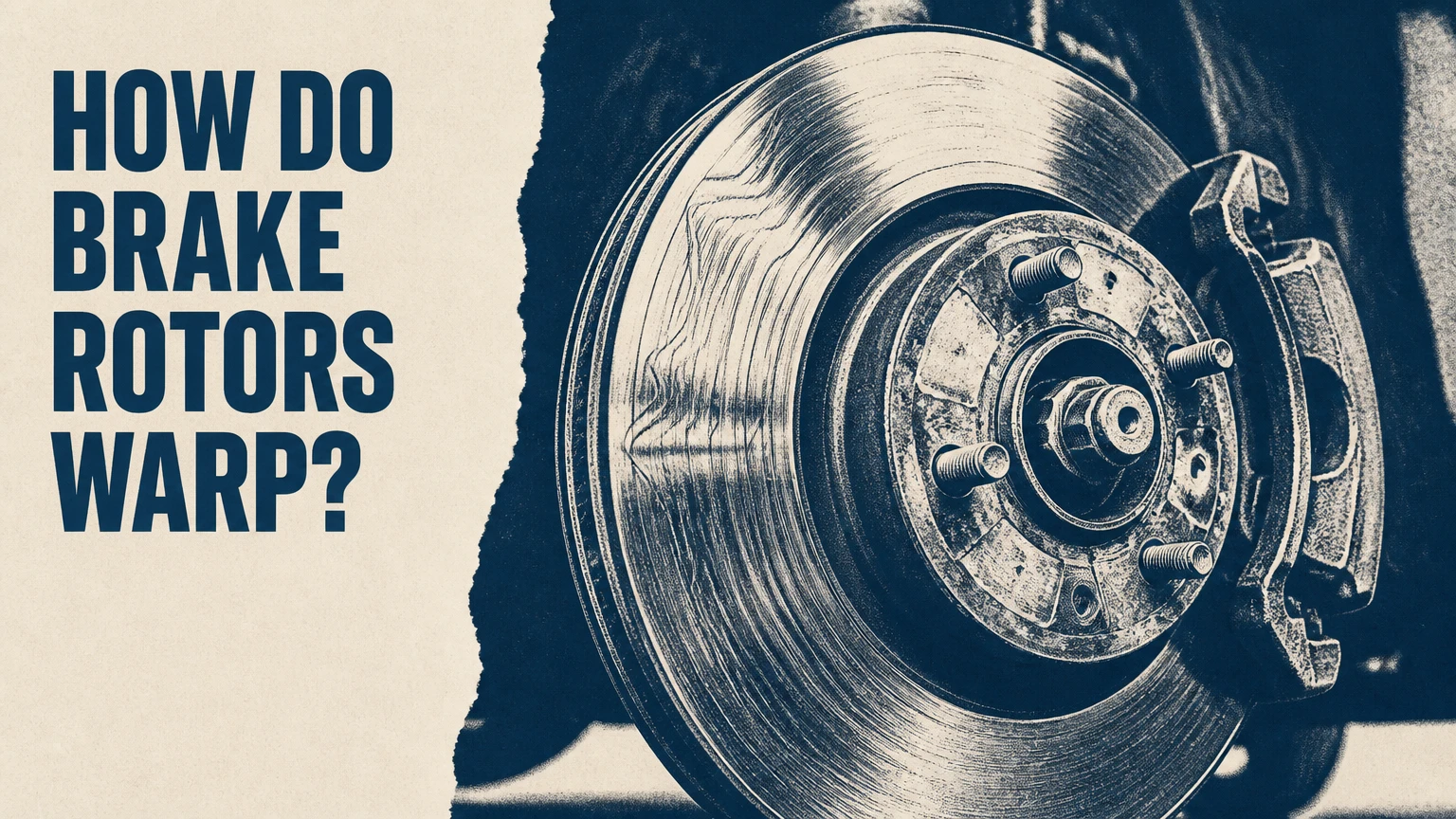
Brake rotors rarely bend or distort physically in passenger vehicles. Instead, brake rotor warping is caused by Disc Thickness Variation (DTV), an uneven layer of brake pad friction material deposited onto the spinning iron surface under high heat. This uneven film creates microscopic high spots that cause the brake pedal to pulse during deceleration.
At a Glance
- Over 90% of perceived rotor warping is caused by uneven brake pad material transfer rather than physical geometric bending.
- Disc Thickness Variation (DTV) as small as 0.012 mm (0.0005 inches) creates noticeable brake pedal pulsation.
- Holding the brake pedal down firmly after a sudden stop transfers a concentrated patch of liquefied resin onto a hot rotor face.
- Localized friction on pad transfer spots elevates iron temperatures above 650°C (1200°F), forming ultra-hard cementite phase structures.
- True mechanical geometric twisting occurs primarily through severe thermal shock, extreme caliper bracket flex, or un-stress-relieved budget castings.
- Uneven lug nut tightening creates immediate lateral runout, which induces uneven wear and DTV within 3,000 to 5,000 miles.
What Is the Difference Between True Warping and Disc Thickness Variation?
True mechanical warping refers to a physical distortion of the cast iron disc, where the flat plane of the rotor face becomes cone-shaped or wave-like. Disc Thickness Variation (DTV) refers to a rotor that remains flat on its overall axis but varies in thickness at different points along its friction track.
+-----------------------------------------------------------------------+
|                         TRUE MECHANICAL WARPING                       |
|   The rotor flange physically twists or bends out of its flat plane.  |
|                                                                       |
|         ~~~~~~~~~~~~~~~~~~~~~ (Wavy / Twisted Rotor Face)             |
+-----------------------------------------------------------------------+
|                     DISC THICKNESS VARIATION (DTV)                    |
|   Rotor remains flat, but friction material or cementite spots build  |
|   up, creating localized high points across the circumference.        |
|                                                                       |
|         === [High Spot] ======= [Normal] ======= [High Spot] ===     |
+-----------------------------------------------------------------------+
While true mechanical warping requires extreme structural heat failure, DTV develops during everyday driving. When a rotor has DTV, the distance between the inner and outer friction surfaces changes constantly as the disc spins through the caliper. This changing thickness pushes the caliper pistons inward and outward, forcing hydraulic fluid back up the brake lines to produce a rhythmic pulsation in the brake pedal.
How Does Heat Transfer Brake Pad Material Onto a Rotor Surface?
Brake systems shift from abrasive friction to adherent friction as operating temperatures rise. Abrasive friction involves the hard pad particles physically scraping the iron surface, while adherent friction involves a thin, continuous film of pad material bonding to an identical microscopic layer of pad material on the rotor face.
During aggressive braking, friction converts kinetic energy into intense thermal energy. When the friction interface warms up evenly, the pad deposits a uniform, microscopic layer of friction material across the entire circumference of the rotor. This uniform transfer layer is necessary for smooth, predictable stopping power. However, if heat distribution becomes uneven, or if the pad remains clamped against one spot on a stationary, glowing rotor, the bonding process becomes concentrated in a single area, creating an elevated imprint of friction material.
What Temperatures Cause Brake Pad Resins to Liquefy and Deposit on Iron?
Brake pad resins and binding polymers begin to breakdown, liquefy, and transfer heavily onto cast iron rotors when temperatures reach 315°C to 535°C (600°F to 1000°F). Normal commuting temperatures stay between 93°C and 204°C (200°F to 400°F), where material transfer remains stable and controlled.
Operating Temperature Ranges & Thermal Milestones

[93°C - 204°C]   ====================== Safe Commuting Range (Stable Transfer)
[315°C - 535°C]  ********************** Resin Liquefaction & Imprint Hazard Zone
[650°C - 700°C]  ###################### Cementite Phase Transformation (Permanent)
When heavy braking from high speeds or prolonged mountain descent pushes the system into the 315°C to 535°C window, the synthetic binders within the friction material liquefy. If the vehicle comes to a complete halt while the system is at these elevated temperatures, the pad acts as a hot stamp. Keeping the brake pedal firmly depressed forces the liquefied resin and friction material out of the pad matrix and onto the stationary rotor surface, leaving a thick, uneven imprint approximately 0.01 mm higher than the surrounding metal.
How Do Friction Hot Spots Transform Cast Iron into Cementite?
Friction hot spots transform cast iron into cementite when an uneven pad deposit repeatedly rubs against the brake pads, generating intense localized heating above 650°C (1200°F). Cast iron contains carbon flakes suspended within its matrix, and sustained high temperatures alter this metallic structure.
As the rotor continues to spin during routine driving, the elevated pad deposit hits the brake pads on every revolution. This continuous friction creates localized thermal spikes at the high spot while the rest of the rotor remains cool. Once these localized spots exceed 650°C (1200°F), the iron reacts with the carbon in the alloy to form iron carbide, known metallurgically as cementite. Cementite is an exceptionally hard, brittle crystalline structure that resists wear. While the soft grey iron around it wears down normally from daily use, the hard cementite spot does not wear, transforming a temporary pad deposit into permanent Disc Thickness Variation.
What Are the Exact Tolerance Limits for Lateral Runout and DTV?
Modern automotive braking systems require extremely tight engineering tolerances, where deviations measured in thousandths of a millimeter produce noticeable driver feedback.
| Metric or Operational Parameter | Critical Threshold Limit | Practical Engineering Significance |
| Max Allowable Lateral Runout | 0.050 mm (0.0020 in) | Maximum side-to-side wobble before pad contact induces uneven wear over time. |
| Max Disc Thickness Variation (DTV) | 0.012 mm (0.0005 in) | The threshold where pedal pulsation becomes distinctly noticeable to the driver. |
| Cementite Transformation Temp | 650°C to 700°C (1200°F) | Temperature where cast iron molecularly hardens into immutable iron carbide. |
| Normal Commuting Temp | 93°C to 204°C (200°F – 400°F) | Operating window for clean, uniform friction film maintenance. |
| Max Lug Nut Torque Variance | ±15 ft-lbs from spec | Uneven clamping force that distorts the rotor hat and induces severe runout. |
What Causes True Physical Geometric Warping in Cast Iron Rotors?
True physical geometric warping is caused by extreme thermal shock, un-stress-relieved manufacturing castings, or excessive structural flexing under high mechanical load. Unlike pad material deposition, true warping changes the actual physical shape of the rotor hat and vane structure.
Causes of Physical Rotor Distortion:

1. Thermal Shock: Rapid cooling (e.g., cold water submersion at >400°C) contracts surface iron unevenly.
2. Residual Casting Stress: Budget rotors machined too quickly twist when subjected to their first heat cycle.
3. Mechanical Caliper Flex: Extreme racing loads flex mounting brackets, squeezing the disc at an angle.
Thermal shock occurs when a rotor heated above 400°C (752°F) is suddenly submerged or splashed with cold water, such as driving through a deep puddle after hard braking. The sudden temperature drop forces rapid, uneven contraction across the outer friction plate while the inner hat remains hot, physically twisting the metal plane. Additionally, budget aftermarket rotors that skip proper thermal stress-relieving cycles during manufacturing retain internal stresses from rapid machining. When exposed to high heat on the vehicle, these internal stresses release, causing the rotor face to permanently bow or twist.
How Does Uneven Lug Nut Torque Cause Brake Rotor Wobble?
Uneven lug nut torque causes brake rotor wobble by clamping the thin center hat section of the rotor unevenly against the wheel hub face. When lug nuts are tightened unevenly, the rotor hat bends slightly to match the unequal pressure points.
If one lug nut is torqued to 110 ft-lbs while an adjacent nut is torqued to only 70 ft-lbs, the variance exceeds the safe limit of ±15 ft-lbs. This uneven clamping force pulls the rotor face out of square relative to the hub centerline, introducing immediate lateral runout exceeding 0.050 mm (0.0020 inches). Although the driver might not feel an immediate vibration, this side-to-side wobble causes the rotor face to brush lightly against the brake pads once per revolution as the car moves. Over 3,000 to 5,000 miles, this continuous light rubbing wears down specific spots on the rotor, inducing severe Disc Thickness Variation.
Why Does Resurfacing or Turning Rotors Often Fail to Stop Brake Pulsation?
Resurfacing or turning rotors fails to stop brake pulsation when the underlying cause is localized cementite formation or uncorrected hub runout. Standard lathe cutting bits are designed to cut soft grey cast iron, not ultra-hard iron carbide inclusions.
When a machinist turns a rotor containing cementite inclusions, the carbide cutting tip glides cleanly through the surrounding soft iron but flexes outward when it hits the ultra-hard cementite spot. Although the refinished rotor surface may look smooth and flat to the naked eye, the dense cementite structure remains embedded in the disc face. Within 1,000 to 2,000 miles of driving, the softer iron surrounding the cementite spot wears down again under normal brake pad friction, re-exposing the high spot and causing the pedal pulsation to return completely.
Rotor Refinishing Lathe Behavior:

Cutting Tool ---> [ Soft Cast Iron ] ---> Cuts cleanly at designated depth.
Cutting Tool ---> [ Cementite Spot ] ---> Tool bit flexes/skips over hard spot.
Result       ---> Visual flatness initially, but DTV returns as soft iron wears.
Can You Fix Warped Rotors Without Machining or Replacement?
You can fix unevenly coated rotors without machining or replacement if the condition is caught in its earliest stage before cementite transformation occurs. Early-stage pulsation is simply a localized layer of pad material that can be scrubbed off using a controlled re-bedding process or manual abrasion.
To clear light pad deposits using a re-bedding procedure:
- Accelerate the vehicle to 60 mph on a clear, safe road.
- Apply hard, firm brake pressure to decelerate rapidly down to 10 mph without locking the tires or engaging ABS.
- Immediately accelerate back to 60 mph without coming to a complete stop.
- Repeat this deceleration cycle 5 to 6 times in rapid succession to generate uniform heat across the rotor face.
- Drive the vehicle for 10 to 15 minutes at highway speeds using the brakes as little as possible to allow the system to cool uniformly.
If re-bedding fails, removing the rotor and scrubbing the friction surface with 80-grit garnet sandpaper or an abrasive hone block can physically break up the surface film. However, if the underlying iron has already converted to cementite, machining or replacing the rotor is required.
Why Does the Steering Wheel Shake Only When Braking at High Speeds?
A steering wheel that shakes exclusively during braking at high speeds indicates that the front brake rotors have developed Disc Thickness Variation or excessive lateral runout. Front wheel suspension and steering linkages directly connect the front wheel hubs to the steering rack, transmitting mechanical feedback straight to the driver’s hands.
Rear brake rotor issues do not route through the steering column. When rear brake rotors develop DTV or surface irregularities, the resulting vibration transfers through the vehicle chassis, causing a shudder that is felt in the driver’s seat, the floorboards, or the center console. High speeds amplify steering wheel shake because the higher rotational velocity increases the frequency and hydraulic force of the caliper piston displacement, sending stronger feedback pulses through the steering geometry.
Why Do New Replacement Rotors Start Pulsing After a Few Thousand Miles?
New replacement rotors start pulsing within a few thousand miles when they are installed over a dirty, corroded hub face or clamped down with uneven torque. Mounting a perfectly flat new rotor onto a hub with rust or rust-scale buildup forces the rotor to sit at a slight angle relative to the caliper bracket.
                CORRODED HUB FACE INDUCED RUNOUT

   [ Caliper ]                   [ Caliper ]
      ||                            ||
      ||     /-- New Rotor --/      ||  <-- Sits at angle due to rust
      ||    /               /       ||
      +----+               +--------+
           | Rust/Scale    |
           +---------------+
           [ Wheel Hub Face ]
Even a tiny particle of rust or debris measuring 0.02 mm (0.0008 inches) trapped between the hub face and the rotor hat creates significant lateral runout at the outer edge of the disc. As the vehicle travels down the road, this crooked rotor wobbles side-to-side between the brake pads. Even when the brakes are not applied, the high spots brush against the pads thousands of times per mile. This constant contact wears away metal in specific locations, inducing brand-new Disc Thickness Variation within 3,000 to 5,000 miles of installation.
Do Drilled and Slotted Rotors Prevent Warping Better Than Blank Rotors?
Drilled and slotted rotors do not prevent pad material transfer or DTV better than high-quality blank rotors in street applications. In fact, cross-drilled rotors often increase the risk of thermal issues on heavy consumer vehicles.
+------------------+-----------------------------------+-----------------------------------+
| Rotor Type       | Primary Design Advantage          | Primary Thermal Disadvantage      |
|------------------|-----------------------------------|-----------------------------------|
| Plain Blank      | Maximum thermal mass & heat absorption | Slower initial gas evacuation    |
| Cross-Drilled    | Rapid gas/water dispersion        | Lower mass, crack stress points   |
| Slotted          | Continuous pad surface refreshing | Slightly higher pad wear rate     |
+------------------+-----------------------------------+-----------------------------------+
Cross-drilled rotors have less overall thermal mass than solid blank rotors because metal has been removed to create the holes. For heavy street cars, trucks, or towing vehicles, lower thermal mass means the rotor heats up faster during sustained braking, driving temperatures directly into the 315°C to 535°C hazard window where resins breakdown and deposit unevenly. Furthermore, the structural stress concentrations around drilled holes frequently develop thermal stress cracks under heavy use. Slotted rotors perform better than drilled rotors by continuously shaving away glazed pad material, but they do not eliminate DTV if improper braking habits or torque procedures are used.
How Do You Diagnose Whether Rotor Pulsation Is From the Front or Rear Brakes?
Diagnosing whether brake pulsation originates from the front or rear rotors requires isolating the mechanical feedback mechanisms during a test drive under safe conditions.
To isolate the source of brake pulsation:
- Observe the Steering Wheel vs. Seat: Apply the brakes firmly at 50 mph. If the steering wheel oscillates visually or vibrates strongly in your hands, the primary fault lies in the front rotors. If the steering wheel remains steady while your seat cushion, floorboard, or pedal pulses, the issue lies in the rear rotors.
- Perform the Parking Brake Test (Manual/Mechanical Brakes Only): Drive at 20 to 30 mph on an empty road. Hold the parking brake release button down completely and gently pull or press the mechanical parking brake lever to apply rear braking force alone. If the vehicle shudder occurs during this test, the rear rotors are confirmed to have thickness variation. (Note: Do not attempt this test with electronic parking brakes).
- Measure with a Dial Indicator: Remove the wheels, secure the rotor to the hub using lug nuts and washers, and mount a dial indicator with a magnetic base to the suspension knuckle. Rotate the rotor by hand; lateral runout exceeding 0.050 mm confirms an issue on that specific corner.
Does Driving Through Puddles or Washing a Car Warp Hot Brake Rotors?
Driving through deep water puddles or spraying cold water on a car immediately after hard driving can physically warp hot brake rotors through severe thermal shock. Cast iron expands when heated and contracts when cooled; rapid, uneven cooling forces structural distortion.
When a brake rotor reaches temperatures above 400°C (752°F) during aggressive driving, the iron matrix is expanded. Plunging that glowing rotor into cold water causes the outer contact surfaces to contract almost instantly, while the inner cooling vanes and center hat remain expanded. This sudden differential contraction creates immense internal stresses that exceed the yield strength of the cast iron, permanently pulling the rotor face out of flat alignment. To prevent thermal shock, avoid washing a vehicle immediately after mountain driving or aggressive track use, allowing the brake system 15 to 20 minutes to cool down through natural airflow.
What Symptoms Differentiate a Warped Rotor From a Bad Wheel Bearing?
Differentiating between a warped rotor (DTV) and a failing wheel bearing requires analyzing when the noise or vibration occurs and how it reacts to vehicle dynamics.
Differential Diagnosis Comparison:

WARPED ROTOR (DTV)
├── Symptom: Rhythmic pedal pulsation & steering wheel shake.
├── Trigger: Occurs strictly when pressing the brake pedal.
└── Pitch: Frequency changes directly with vehicle speed, independent of steering angle.

BAD WHEEL BEARING
├── Symptom: Low-frequency humming, growling, or roaring noise.
├── Trigger: Present continuously during coasting, accelerating, and braking.
└── Pitch: Volume and pitch shift dramatically when turning left or right (loading/unloading).
A warped rotor or DTV produces a rhythmic pulsation felt in the pedal or steering wheel that occurs exclusively when the brake pedal is depressed. The frequency of the pulsation slows down in direct proportion to vehicle speed as the car comes to a stop. In contrast, a bad wheel bearing creates a continuous growling, humming, or roaring noise that is present whether the brakes are applied or not. Wheel bearing noise changes in pitch and volume when turning the steering wheel side-to-side, as load shifts onto or off the failing bearing races.
How Can Drivers Prevent Brake Pad Transfer and DTV in Daily Driving?
Drivers can prevent brake pad material transfer and Disc Thickness Variation by adopting proper driving, parking, and maintenance practices that manage heat and mechanical alignment.
- Release Pedal Pressure at Complete Stops: After braking hard from high speeds (such as an emergency highway stop or exiting a freeway), do not keep your foot firmly pressed on the brake pedal while sitting stationary. Shift the transmission into Neutral or Park and release the foot brake to prevent the hot pads from stamping resin into one spot on the rotor.
- Allow Proper Cool-Down Time: If you drive aggressively down a steep grade, drive smoothly at cruising speeds for a few miles afterward without heavy braking to allow natural airflow to cool the rotors evenly.
- Always Torque Wheels with a Torque Wrench: Never allow technicians to install wheels using an uncalibrated air impact wrench. Insist that lug nuts be hand-torqued in a crisscross or star pattern to the exact manufacturer specification using a calibrated torque wrench.
- Clean the Hub Face During Brake Service: Whenever replacing rotors, thoroughly clean the wheel hub mounting surface with a wire brush or hub cleaning disc until all rust, corrosion, and debris are removed before installing the new rotor.
- Follow Proper Pad Bedding Procedures: Always perform a proper series of moderate slowdowns when installing new brake pads and rotors to establish a clean, uniform material transfer layer across the entire disc face.
The Bottom Line
True physical warping of brake rotors is rare and occurs primarily through extreme thermal shock or structural manufacturing defects. Over 90% of pulsing brake conditions are caused by Disc Thickness Variation (DTV), which develops when high temperatures melt brake pad resins and deposit an uneven layer of friction material onto the iron face. Over time, these deposit spots cause localized overheating, forming hard cementite structures that cannot be machined away cleanly. Preventing brake pulsation requires correct lug nut torque procedures, thorough hub face cleaning during service, and proper cooling habits after hard stops.


