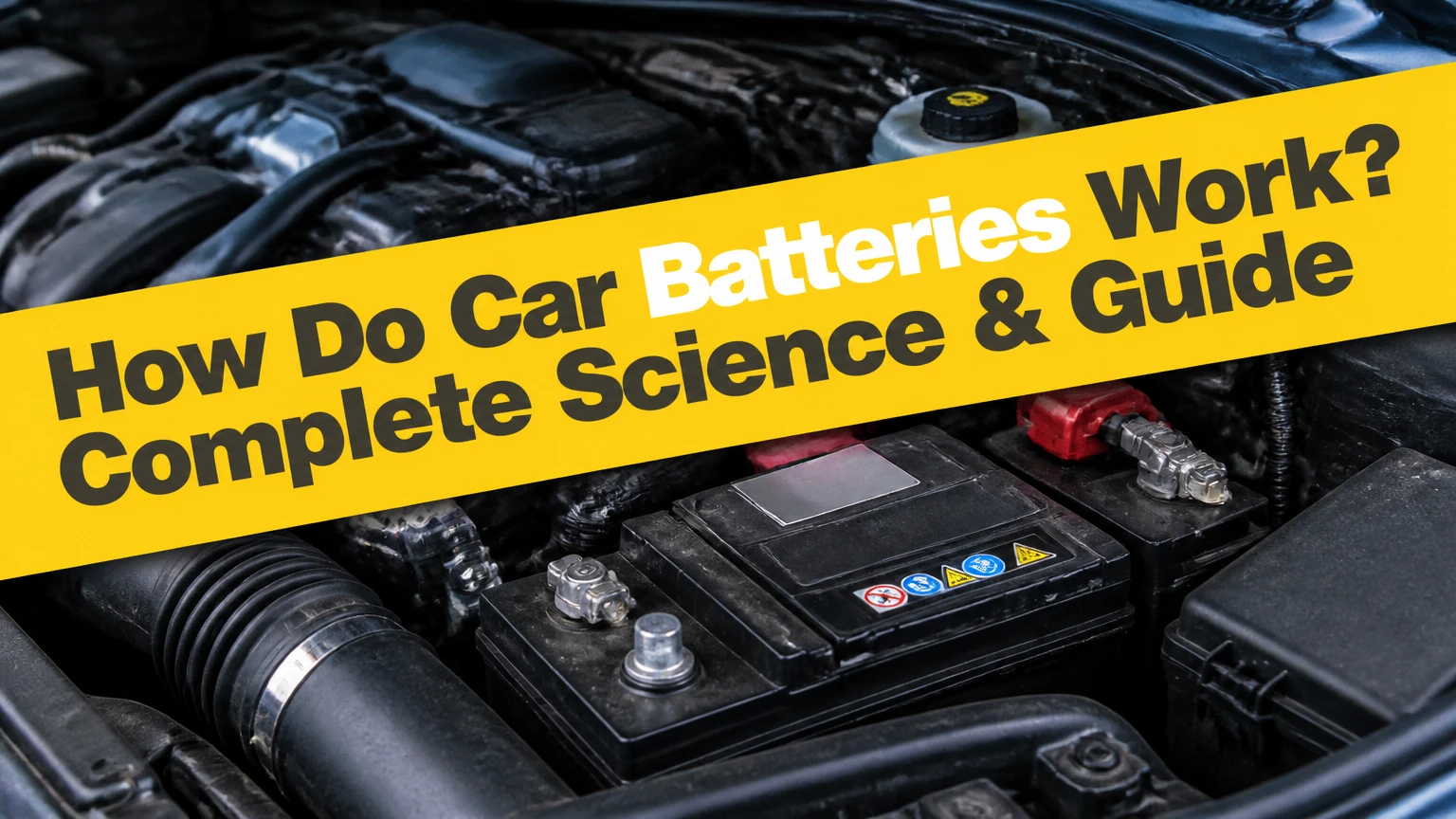
A car battery works by converting chemical energy into electrical energy through a reversible electrochemical reaction inside six series-connected cells. When you start a vehicle, lead dioxide and sponge lead react with sulfuric acid to release electrons, generating a massive electrical current. Once the engine runs, the alternator reverses this chemical process to recharge the unit.
At a Glance
- A fully charged 12-volt lead-acid car battery measures $12.6\text{V}$ to $12.8\text{V}$ when resting.
- Each battery contains six individual galvanic cells producing approximately $2.1\text{V}$ per cell.
- Extreme heat degrades internal lead plates faster than cold, though cold exposes existing damage.
- Parasitic draw slowly drains unused vehicle batteries at a rate of $30\text{mA}$ to $50\text{mA}$ continuously.
- Vehicles with Stop-Start technology require Absorbent Glass Mat (AGM) batteries rather than flooded types.
What Chemical Reaction Powers a Lead-Acid Car Battery?
A lead-acid car battery is powered by a reversible reaction between lead dioxide positive plates, sponge lead negative plates, and a liquid electrolyte consisting of 35% sulfuric acid and 65% water.
$$\text{PbO}_2 + \text{Pb} + 2\text{H}_2\text{SO}_4 \rightleftharpoons 2\text{PbSO}_4 + 2\text{H}_2\text{O}$$
During discharge, sulfuric acid reacts with the active materials on both plates. The positive cathode (lead dioxide) and negative anode (sponge lead) both transform into lead sulfate. This chemical transformation releases free electrons, producing a current of hundreds of amperes to power the starter motor. As discharge continues, the electrolyte loses acid density and becomes predominantly water.
During the charging cycle, the alternator pushes electric current back through the battery in the opposite direction. This input forces the lead sulfate on the plates to break down, reforming lead dioxide on the positive electrode, pure sponge lead on the negative electrode, and concentrated sulfuric acid back into the water solution.
What Are the Critical Voltage Readings for a Car Battery?
Critical car battery voltage readings range from $11.9\text{V}$ for a completely discharged unit to $14.4\text{V}$ for an active alternator charging cycle. Measuring resting voltage with a digital multimeter provides an accurate picture of state-of-charge.
+---------------------------------------------------------------+
|                      BATTERY VOLTAGE SPECTRUM                 |
+---------------------------------------------------------------+
|  11.9V or lower : Completely Discharged (0% State of Charge)  |
|  12.2V          : Weak / Half-Charged (50% State of Charge)   |
|  12.6V - 12.8V  : Fully Charged Resting Voltage (100% Charge) |
|  13.8V - 14.4V  : Active Alternator Charging Output           |
+---------------------------------------------------------------+
A healthy, fully charged 12-volt battery shows an open-circuit voltage between $12.6\text{V}$ and $12.8\text{V}$ after sitting idle for at least twelve hours. A reading of $12.2\text{V}$ indicates a 50% state of charge, meaning the battery is weak and prone to starting failure in cold conditions. Any reading at or below $11.9\text{V}$ indicates a 0% state of charge. When the engine is running, a properly functioning alternator should boost system voltage to between $13.8\text{V}$ and $14.4\text{V}$ to feed power back into the cells.
How Long Does a Car Battery Last Before Requiring Replacement?
A standard flooded lead-acid car battery lasts an average of 3 to 5 years under normal operating conditions. Life expectancy varies significantly depending on ambient temperature, driving habits, and vehicle electrical demands.
+---------------------------------------------------------------+
|                  AVERAGE LIFESPAN BY CLIMATE                  |
+---------------------------------------------------------------+
|  Hot Climates (Southern US / Middle East) : 2 to 3 Years      |
|  Moderate / Mixed Climates                : 3 to 4 Years      |
|  Cold / Northern Climates                 : 4 to 5+ Years     |
+---------------------------------------------------------------+
Batteries in hot climates typically fail within 2 to 3 years due to accelerated electrolyte evaporation and internal plate corrosion. In cooler northern climates, the same battery often reaches 4 to 5 years of service life. High-performance Absorbent Glass Mat (AGM) batteries generally last 4 to 7 years because their sealed design retains moisture and handles repeated cycling better than conventional flooded units.
Why Does Extreme Heat Kill Car Batteries Faster Than Cold Weather?
Extreme heat kills car batteries faster than cold weather because high temperatures accelerate internal chemical corrosion and evaporate the water content within the electrolyte solution.
Engine bay temperatures frequently exceed $60^\circ\text{C}$ ($140^\circ\text{F}$) during summer driving. Every $10^\circ\text{C}$ ($18^\circ\text{F}$) increase in operating temperature doubles the internal chemical reaction rate, causing grid structure oxidation and shed active material.
Cold weather does not destroy battery components directly. Instead, cold weather thickens engine oil and slows down chemical activity, which reduces available cranking power. This drop in power reveals internal structural damage that was caused by summer heat months earlier.
Why Does a Deep Discharge Permanently Ruin a Standard Flooded Battery?
A deep discharge permanently ruins a standard flooded battery because it forces large lead sulfate crystals to form across the grid plates, a destructive condition known as hard sulfation.
When headlights or interior accessories drain a standard flooded battery to $0\text{V}$, the electrolyte turns almost entirely into water. Under these conditions, soft lead sulfate deposits crystallize into large, hardened structures. Standard vehicle alternators cannot generate the voltage profiles necessary to break down hard lead sulfate crystals. These crystals block the active plate area permanently, reducing total electrical capacity and preventing the cell from holding a full charge ever again.
What Is Acid Stratification and How Do Short Trips Cause It?
Acid stratification occurs when the heavy sulfuric acid in the electrolyte separates from water and settles at the bottom of the battery cell, leaving a diluted water layer at the top. Short trips cause this because the alternator never runs long enough to mix the solution through gassing.
+---------------------------------------------------------------+
|                      ACID STRATIFICATION                      |
+---------------------------------------------------------------+
|  TOP LAYER    : Diluted Water Layer -> Upper Plate Corrosion  |
|  BOTTOM LAYER : Heavy Concentrated Acid -> Hard Sulfation     |
+---------------------------------------------------------------+
When a car is driven for only 5 minutes at a time, the electrical energy taken by the starter motor is not fully replenished. Repeated partial charges cause dense acid to accumulate at the floor of the casing. The diluted upper layer accelerates corrosion on the top portion of the lead plates, while the concentrated bottom layer causes severe hard sulfation on the lower portion. Fixing acid stratification requires a specialized battery charger equipped with an equalizing or reconditioning mode.
How Do Modern Smart Alternators Affect Battery Charging Voltage?
Modern smart alternators adjust charging voltage dynamically between $12.6\text{V}$ and $14.8\text{V}$ based on real-time engine loads, ambient temperature, and battery charge status, rather than outputting a continuous $14.4\text{V}$.
Engine control units reduce alternator output during vehicle acceleration to lower engine drag and save fuel. Output drops as low as $12.6\text{V}$ during highway cruising, then spikes to $14.8\text{V}$ during coasting or braking to capture kinetic energy. Testing a modern smart alternator with a static idle voltage test can lead to a false diagnosis of charging failure when the system is actually operating as designed.
Why Can’t You Replace an AGM Battery With a Standard Flooded Battery?
You cannot replace an Absorbent Glass Mat (AGM) battery with a standard flooded battery because standard batteries cannot survive the high charge-acceptance rates and frequent cycling demanded by modern vehicles with Stop-Start systems.
+---------------------------------------------------------------+
|                   AGM VS. FLOODED TECHNOLOGY                  |
+---------------------------------------------------------------+
|  FEATURE             | AGM BATTERY         | FLOODED BATTERY  |
+----------------------+---------------------+------------------+
|  Electrolyte State   | Absorbed in Glass   | Free Liquid      |
|  Deep Cycle Life     | 3x Higher           | Standard         |
|  Vibration Support   | High Resistance     | Low Resistance   |
|  Stop-Start Suitable | Yes                 | No               |
+----------------------+---------------------+------------------+
Vehicles engineered for AGM units use charging profiles tailored for glass mat separators. If a standard flooded battery is installed in an AGM vehicle, the vehicle charging computer will overcharge the flooded cell, causing heat buildup, water boiling, and rapid plate destruction. A standard battery installed in a Stop-Start vehicle often fails in under 6 months.
How Do You Test If a Car Battery Is Bad or Just Discharged?
Testing whether a car battery is bad or merely discharged requires taking a resting voltage measurement with a multimeter, followed by a digital conductance or carbon-pile load test.
- Check Resting Voltage: Measure open-circuit voltage across the terminals with a digital multimeter after the car has rested for four hours. If the reading is below $12.4\text{V}$, recharge the battery completely using a smart battery charger before proceeding.
- Apply a Known Load: Connect a dedicated battery load tester or disable ignition and crank the engine for 15 seconds while observing terminal voltage.
- Analyze the Voltage Drop: If terminal voltage drops below $9.6\text{V}$ at $21^\circ\text{C}$ ($70^\circ\text{F}$) during the load test, the battery has damaged internal plates or a shorted cell and must be replaced. If voltage stays above $9.6\text{V}$ and holds a charge after recharging, the unit is healthy and was simply discharged.
What Are the Early Warning Signs That a Car Battery Is Failing?
Early warning signs of a failing car battery include slow engine cranking, dimming headlights during idle, clicking noises during ignition, and unexpected electrical glitches in onboard electronics.
- Slow Engine Crank: The starter motor turns over sluggishly (“rrmm-rrmm-rrmm” sound) because internal resistance restricts cold cranking amperage.
- Dim Headlights at Idle: Headlights brighten when accelerating and dim when idling, indicating the battery can no longer support system voltage without alternator assistance.
- Clicking Sound on Ignition: Rapid solenoid clicking when turning the key indicates sufficient voltage to trigger the relay, but insufficient current to turn the starter motor.
- Corrosion Around Terminals: Blue-white powdery buildup around the positive terminal signals hydrogen gas leaks, often caused by thermal stress or internal overcharging.
Can a Dead Battery Ruin a Perfectly Good Alternator?
Yes, a dead or shorted car battery can ruin a functioning alternator by forcing it to operate at maximum output continuously, overheating its internal components.
An alternator is designed to supply operational vehicle electronics and top off battery charge, not act as a primary battery charger. When a battery develops a shorted cell or severe sulfation, it cannot hold voltage. The voltage regulator forces the alternator to produce 100% duty cycle continuously. This sustained load overheats the alternator diodes and burns out stator windings, leading to total alternator failure.
How Long Does an Alternator Take to Fully Recharge a Dead Battery?
An alternator takes approximately 2 to 4 hours of uninterrupted highway driving to recharge a dead battery that has been jump-started, though it will rarely achieve a true 100% charge state.
Idle driving or short 15-minute trips replenish only a fraction of the power used during startup. Modern smart alternators cut back charging output once basic voltage is restored, leaving the battery partially discharged. The proper way to recover a deeply discharged battery is using a dedicated 3-stage smart battery charger for 12 to 24 hours.
Why Does a Car Battery Die If the Vehicle Sits Unused for Weeks?
A car battery dies when a vehicle sits unused because onboard computer systems pull a constant, small electrical current known as parasitic drain.
+---------------------------------------------------------------+
|                      PARASITIC DRAIN SOURCES                  |
+---------------------------------------------------------------+
|  Keyless Entry Receivers | Security Systems | Engine Computers |
|  Clock Modules           | Telematics       | Door Modules     |
+---------------------------------------------------------------+
|  Total Normal Draw: 30mA to 50mA continuously                 |
+---------------------------------------------------------------+
Modern automobiles draw between $30\text{mA}$ and $50\text{mA}$ while turned off to sustain security alarms, engine control memory, and keyless entry receivers. A standard 60-amp-hour battery loses roughly 0.72 to 1.2 amp-hours daily through parasitic draw alone. Over 3 to 4 weeks of inactivity, this steady loss lowers battery voltage below the threshold needed to crank the starter motor.
Can You Jump-Start a Frozen Car Battery?
No, you must never jump-start or attempt to charge a frozen car battery because doing so can cause the plastic casing to rupture or trigger an internal explosion.
When a lead-acid battery discharges, its electrolyte converts to mostly water, raising its freezing point from $-50^\circ\text{C}$ ($-58^\circ\text{F}$) up to $0^\circ\text{C}$ ($32^\circ\text{F}$). As ice forms inside the casing, it expands, damaging internal lead plates and tearing plate separators. Attempting to force current into a frozen unit produces rapid hydrogen gas inside a sealed block of ice, creating an immediate explosion hazard. A frozen battery must be brought indoors and thawed completely before inspection or testing.
Does Turning On Headlights Before Starting Warm Up a Cold Battery?
No, turning on headlights before starting a vehicle does not warm up a cold battery in any meaningful way, and instead drains valuable energy needed to crank the engine.
While running current through a battery generates a small amount of heat, the minimal temperature gain is offset by the loss of overall capacity. Cold weather already reduces a battery’s chemical reaction rate by up to 50%. Wasting initial amp-hours on exterior lighting leaves less available energy for the starter motor during cold starts.
The Bottom Line
Car batteries rely on a balanced electrochemical reaction between lead plates and sulfuric acid to start engine cycles and stabilize electrical systems. Keeping voltage levels above $12.4\text{V}$ prevents severe plate sulfation and extends overall service life. Avoid frequent short trips, address parasitic drains promptly, and never use standard flooded units in vehicles designed for AGM batteries.


