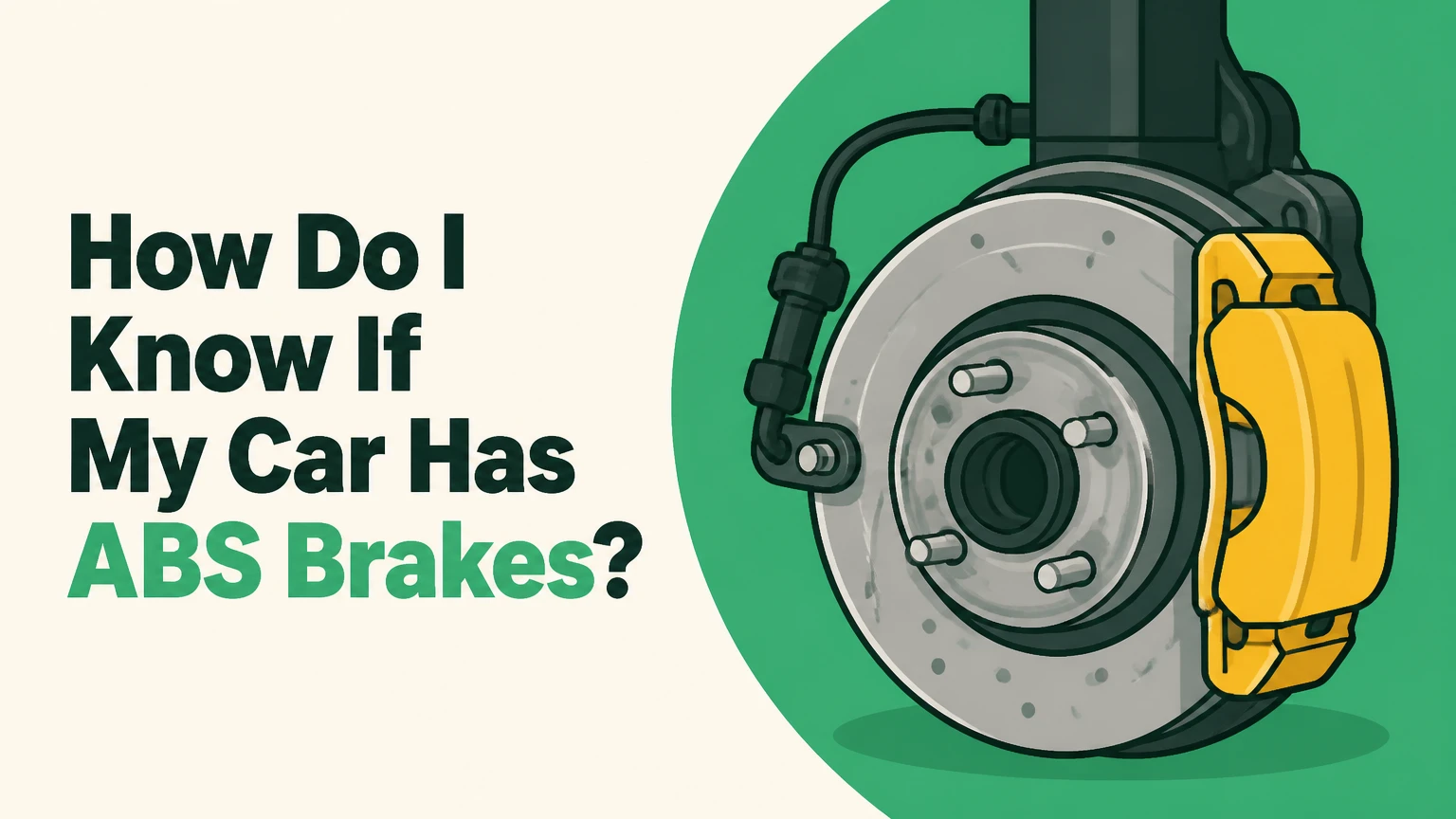
You can determine whether your car has ABS brakes by watching for an amber ABS light during the dashboard startup test, checking the vehicle specifications or VIN-linked build information, and locating ABS hardware such as a hydraulic modulator and wheel-speed sensors. The dashboard bulb test is usually the fastest first check, but documentation provides the strongest confirmation.
Key Facts at a Glance
- An amber ABS light that appears briefly when the ignition is switched on usually confirms that the vehicle has an anti-lock braking system.
- An ABS hydraulic modulator normally has several rigid metal brake lines and a large electrical connector.
- Wheel-speed sensor wiring near the wheel hubs is strong evidence of ABS, although the sensors may be hidden inside the bearings.
- A permanently illuminated ABS light normally means the anti-lock function is disabled, not that the regular hydraulic brakes have completely failed.
- ABS helps preserve steering control during hard braking, but it does not guarantee a shorter stop on every surface.
- The most reliable confirmation comes from the manufacturer’s build sheet, equipment list, or ABS-capable diagnostic scan.
How Do I Know If My Car Has ABS Brakes?
The quickest way to know if your car has ABS brakes is to switch the ignition to the ON position and look for an amber warning symbol marked “ABS.” On most equipped vehicles, the light appears for approximately 2-3 seconds while the control module checks the system, then turns off after the engine starts or the self-test finishes.
Use these five checks in order:
- Perform the dashboard warning-light test.
- Review the owner’s manual or original equipment list.
- Check the VIN through a manufacturer or dealer database.
- Inspect the ABS hydraulic unit under the hood.
- Look for wheel-speed sensors or scan the ABS control module.
No single visual check is perfect. A previous owner could have removed the warning bulb, installed a different instrument cluster, replaced wheel hubs, or modified brake components. Documentation and electronic communication with the ABS module are therefore more conclusive than appearance alone.
Where Is the ABS Light on the Dashboard?
The ABS warning light is normally located in the instrument cluster near the speedometer, tachometer, red brake warning symbol, or traction-control indicator. The symbol usually consists of the letters “ABS” inside a circle, sometimes surrounded by curved brackets.
How to perform the dashboard bulb test
- Park the vehicle and apply the parking brake.
- Insert the key and turn it to ON without starting the engine. For a push-button car, press the start button without pressing the brake pedal.
- Observe all warning lights for several seconds.
- Confirm whether an amber ABS symbol appears.
- Start the engine and check whether the symbol turns off.
A light that appears and then goes out normally indicates that the vehicle has ABS and that the controller has not detected an active fault during its initial test.
A light that remains on confirms the vehicle is equipped with ABS, but the system has detected a problem. A light that never appears does not conclusively prove that the vehicle lacks ABS because the bulb, display segment, fuse, instrument cluster, or warning circuit may be faulty.
| Dashboard result | Likely meaning | Recommended action |
| ABS light appears for 2-3 seconds, then turns off | ABS is installed and passes the initial check | No immediate action |
| ABS light remains on | ABS is installed but has stored or active faults | Scan the ABS module |
| ABS light flashes intermittently | Electrical, sensor, voltage, or communication issue | Diagnose before relying on ABS |
| No ABS symbol appears | Vehicle may lack ABS, or the warning circuit may be faulty | Verify through VIN and hardware |
| ABS and red brake lights stay on | ABS fault plus possible hydraulic or brake-system issue | Stop and inspect promptly |
Can the Owner’s Manual Confirm ABS?
The owner’s manual can confirm that ABS was available for the vehicle, but it may not prove that every trim level received the system. Manuals often cover multiple engines, body styles, option packages, and regional configurations.
Check the sections titled:
- Braking system
- Anti-lock braking system
- Warning and indicator lights
- Emergency braking
- Vehicle specifications
Read the wording carefully. “If equipped” means ABS was optional on at least some versions. A manual that explains ABS without that qualification provides stronger evidence, but the build sheet or electronic parts catalog is still more vehicle-specific.
The original window sticker, factory equipment label, sales invoice, or dealer build record may list “4-wheel ABS,” “rear-wheel anti-lock brakes,” “anti-lock braking system,” or an option-package code. These records are particularly useful for older trucks that may have rear-wheel ABS rather than independent control at all four wheels.
Can a VIN Confirm Whether a Car Has ABS?
A VIN can help confirm ABS when it is entered into a manufacturer database, dealer parts catalog, factory build-sheet service, or reliable vehicle-equipment system. However, the 17 characters do not always encode every optional feature in a way that a basic public decoder can display.
The strongest VIN-based confirmation comes from:
- A manufacturer build sheet.
- A franchised dealership’s parts or service system.
- The original window sticker.
- A factory service-information database.
- A parts catalog showing an ABS module assigned to that VIN.
The U.S. National Highway Traffic Safety Administration VIN decoder can identify major vehicle attributes, but its displayed equipment information may not list every installed brake option. A result that does not mention ABS should therefore be treated as inconclusive rather than proof that ABS is absent.
When buying a used car, compare the VIN record with the physical vehicle. Rebuilt vehicles can contain substituted axles, hubs, wiring harnesses, control modules, or instrument clusters that no longer match the original configuration.
What Does an ABS Unit Look Like Under the Hood?
An ABS hydraulic modulator is usually an aluminum block connected to several rigid metal brake lines, an electric pump motor, and a multi-pin wiring connector. It is commonly mounted near the brake master cylinder, along a fender, near the firewall, or toward the front of the engine compartment.
Start by finding the brake-fluid reservoir and master cylinder. Trace the metal lines leaving the master cylinder. In a non-ABS system, those lines may travel more directly toward the wheels or a simple proportioning valve. In an ABS-equipped vehicle, they commonly enter a hydraulic control unit before separate lines continue toward the brakes.
| Component | Typical appearance | What it indicates |
| Brake master cylinder | Metal cylinder below a plastic fluid reservoir | Present on ABS and non-ABS vehicles |
| ABS hydraulic modulator | Aluminum valve block with multiple brake lines | Strong evidence of ABS |
| ABS pump motor | Cylindrical electric motor attached to the modulator | Supplies hydraulic pressure during ABS operation |
| ABS control module | Black electronic housing with a large connector | Processes wheel-speed data |
| Proportioning valve | Smaller block with fewer lines and no pump motor | Does not by itself confirm ABS |
Do not loosen a brake line to identify the system. Brake fluid can damage paint, introduce air into the hydraulic circuit, and reduce braking performance. Visual inspection is sufficient.
Some modern vehicles place the electronic brake controller and hydraulic unit low in the engine bay or behind protective covers. Hybrid and electric vehicles may also integrate ABS with regenerative braking and electronic stability systems, making the assembly difficult to identify without service information.
Can I Identify ABS Behind the Wheels?
ABS-equipped vehicles normally have wheel-speed sensors that monitor wheel rotation. A visible insulated wire leading toward the wheel hub, steering knuckle, rear axle, or differential can indicate the presence of ABS.
At a front wheel, turn the steering fully to one side and look behind the wheel without crawling under an unsupported vehicle. The rubber hydraulic brake hose will connect to the caliper. A separate electrical cable may run toward the hub or knuckle, where it connects to the wheel-speed sensor.
Older designs may use a visible toothed ring, called a tone ring or reluctor ring, on the axle, CV joint, hub, or rotor. Newer vehicles often use magnetic encoder rings built into sealed wheel bearings, so no external teeth are visible.
A sensor wire alone is not absolute proof of four-wheel ABS because the vehicle may use wheel-speed data for traction control, stability control, speedometer operation, or transmission functions. Those systems are usually built on an ABS platform, but the manufacturer’s documentation or a scan remains the better final check.
Can an OBD Scanner Tell Me If My Car Has ABS?
An ABS-capable scan tool can provide one of the clearest confirmations because it communicates directly with the anti-lock brake control module. A basic code reader designed only for engine emissions may not detect the ABS computer, even when the car has ABS.
Connect the scanner to the diagnostic port and select the correct year, make, model, and system. Look for menu labels such as ABS, ESC, EBCM, brake control module, chassis, or stability control.
| Scanner type | Typical access | Can confirm ABS? |
| Basic generic OBD-II reader | Engine and emissions codes | Usually no |
| Enhanced consumer scanner | Engine, transmission, ABS, and airbags | Usually yes |
| Professional bidirectional scanner | Full module access and active tests | Yes |
| Manufacturer diagnostic software | Factory-level functions and coding | Yes |
| Smartphone adapter with basic app | Depends on adapter and software license | Sometimes |
Successful communication with the ABS module confirms that the vehicle contains an electronic anti-lock system. A “no communication” message is not proof that ABS is absent. A blown fuse, low battery voltage, damaged network wiring, incorrect vehicle selection, or incompatible scanner can block access.
What Does ABS Do When You Brake?
The anti-lock braking system prevents individual wheels from remaining locked during hard braking. Wheel-speed sensors report rotation to an electronic controller, which commands hydraulic valves and a pump to hold, reduce, and restore brake pressure at selected wheels.
The sequence occurs rapidly:
- A wheel begins slowing much faster than the vehicle.
- The ABS controller identifies an approaching lock condition.
- A valve temporarily holds or reduces pressure at that wheel.
- The tire resumes rotation.
- Hydraulic pressure is reapplied.
- The cycle repeats while the lock risk remains.
Keeping the tires rotating allows the driver to retain more directional control while braking. A locked front tire slides across the road and provides little useful steering response. ABS attempts to keep tire slip near a controllable range rather than allowing continuous skidding.
ABS does not create extra tire grip. Worn tires, excessive speed, standing water, ice, gravel, brake defects, and poor road conditions still determine how much deceleration and steering force the vehicle can produce.
Why Does the Brake Pedal Pulse During ABS Operation?
Brake-pedal pulsing, rapid vibration, mechanical buzzing, and clicking can be normal when ABS activates during a hard stop. These sensations result from hydraulic valves adjusting brake pressure and the ABS pump operating.
Drivers sometimes mistake normal ABS feedback for brake failure and release the pedal. That response increases stopping distance and removes the benefit of the system. On an ABS-equipped car, keep firm, steady pressure on the brake pedal and steer toward a safe path.
Normal ABS activation generally occurs only when one or more tires approach wheel lock. Frequent activation at very low speeds on dry pavement may indicate a cracked tone ring, corroded wheel bearing, weak sensor signal, incorrect tire size, excessive sensor gap, or damaged encoder ring.
A pedal that pulses during ordinary light braking can also indicate warped rotors or uneven rotor thickness. ABS-related pulsing is usually rapid and linked to low-traction or hard-braking conditions, while rotor-related pulsation often follows vehicle speed and repeats during routine stops.
How Should I Brake in a Car With ABS?
Press the brake pedal firmly and continuously during an emergency stop in an ABS-equipped car. Do not pump the pedal, because the electronic system already adjusts hydraulic pressure faster and more precisely than a driver can.
Follow this technique:
- Look toward the safe path, not the obstacle.
- Apply firm brake pressure quickly.
- Maintain pressure when the pedal vibrates.
- Steer smoothly around danger when space allows.
- Avoid abrupt steering that exceeds available tire grip.
- Continue braking until the vehicle stops or the hazard clears.
Drivers of older non-ABS vehicles may use threshold braking, which means applying the greatest possible pressure without locking the wheels. If the wheels lock, the driver must reduce pressure enough to restore rotation and steering. This is different from repeatedly pumping the brakes without sensing tire behavior.
| Driving action | ABS-equipped car | Non-ABS car |
| Emergency pedal input | Press and hold firmly | Use threshold braking |
| Pedal pumping | Not recommended | May help an untrained driver regain wheel rotation |
| Steering while braking | Usually preserved within tire limits | Reduced if front wheels lock |
| Pedal vibration | Normal during ABS activation | May indicate a brake or rotor issue |
| Wheel lock control | Automatic hydraulic modulation | Driver-controlled pedal modulation |
Does ABS Always Shorten Stopping Distance?
ABS often improves controllability and may reduce stopping distance on wet or paved surfaces, but it does not guarantee the shortest stop in every condition. Its primary safety advantage is preventing prolonged wheel lock so the driver can maintain steering control.
On loose gravel, deep snow, or some unpaved surfaces, a locked tire can build a wedge of loose material ahead of it. That wedge may stop the vehicle sooner than a rolling tire, although the locked wheel provides poor steering control. ABS may therefore require more distance while still allowing the driver to maneuver.
Stopping performance also depends on:
- Tire tread depth and compound
- Vehicle speed
- Road temperature
- Brake condition
- Vehicle load
- Surface contamination
- Driver reaction time
- Electronic stability-control intervention
ABS cannot overcome hydroplaning when the tires completely lose contact with the road. It also cannot compensate for bald tires or excessive entry speed. The system manages available traction. It does not manufacture traction.
What Type of ABS Does My Car Have?
Most modern passenger vehicles use four-channel, four-sensor ABS, which controls each wheel independently. Older trucks, vans, and utility vehicles may use three-channel or rear-wheel-only systems.
| ABS configuration | Sensors | Hydraulic channels | Typical application |
| Four-channel, four-sensor | 4 | 4 | Modern cars, crossovers, SUVs |
| Three-channel, three-sensor | 3 | 3 | Older pickups and light trucks |
| Three-channel, four-sensor | 4 | 3 | Some older passenger vehicles |
| One-channel, one-sensor | 1 | 1 | Legacy rear-wheel ABS trucks |
| Integrated brake-control system | 4 or more | Electronically managed | Hybrids, EVs, newer luxury vehicles |
Four-channel systems can reduce pressure at one wheel without reducing it at the other three. Three-channel truck systems often control each front wheel separately while both rear wheels share one hydraulic channel. Rear-wheel anti-lock systems reduce rear-axle lock and fishtailing but do not provide anti-lock control at the front wheels.
A dashboard ABS light confirms the presence of some form of anti-lock braking, but it does not identify the channel configuration. Service information, a hydraulic diagram, or an ABS-capable scan tool is required for exact identification.
Is ABS the Same as Traction Control?
ABS and traction control are related but perform opposite wheel-speed corrections. ABS reduces brake pressure when a wheel is locking during braking, while traction control limits wheelspin during acceleration by applying a brake, reducing engine torque, or using both actions.
Electronic stability control adds another layer. It compares steering input, yaw movement, acceleration, and wheel speed to determine whether the vehicle is following the driver’s intended path. The system may brake individual wheels to reduce understeer or oversteer.
These technologies commonly share:
- Wheel-speed sensors
- Hydraulic modulator
- Electronic control network
- Warning lights
- Diagnostic trouble codes
A vehicle with traction control or electronic stability control almost certainly uses ABS hardware as its foundation. However, an early ABS-equipped vehicle may not include traction or stability control.
Is ABS Standard on Every Car?
ABS is common on modern passenger vehicles, but it is not safe to assume that every car has it. Availability depends on model year, country, trim level, vehicle class, and the regulations that applied when the vehicle was manufactured.
In the United States, electronic stability control became mandatory for most new light vehicles by model year 2012. Because stability control depends on anti-lock brake hardware, affected vehicles generally include ABS. Older cars, imported vehicles, stripped commercial models, classic cars, and some specialty vehicles may not.
Model year alone remains an imperfect test. A 1990s luxury sedan may have four-wheel ABS, while a basic vehicle from a similar period may use conventional brakes. Some older pickups have rear-wheel anti-lock braking but no anti-lock function at the front wheels.
Use the dashboard, equipment documentation, hardware inspection, and scanner together when the exact configuration matters.
What Causes an ABS Warning Light?
An ABS warning light remains on when the controller detects a fault that could make anti-lock operation unreliable. The base hydraulic brakes often continue working, but ABS, traction control, and stability control may be disabled.
Common causes include:
| Fault | Typical symptom | Typical repair |
| Failed wheel-speed sensor | ABS and traction lights, erratic speed data | Replace sensor |
| Damaged tone or encoder ring | Low-speed false ABS activation | Replace ring, axle, hub, or bearing |
| Broken sensor wiring | Intermittent warning after suspension work | Repair harness or connector |
| Low system voltage | Multiple warning lights after starting | Test battery and charging system |
| Blown ABS fuse | No module communication or pump operation | Find cause and replace fuse |
| Failed control module | Internal codes or communication loss | Repair, program, or replace module |
| Hydraulic pump fault | Pump-motor code, no active pressure control | Replace or rebuild modulator |
| Mismatched tires | Unexpected wheel-speed differences | Fit correct matching tire sizes |
Brake dust alone is not the most common cause on sealed modern magnetic sensors. Corrosion, damaged wiring, bearing play, cracked tone rings, metal debris on magnetic encoders, and internal sensor failure are usually more meaningful diagnostic targets.
Does an ABS Light Mean the Car Has No Brakes?
An amber ABS light by itself usually means the anti-lock feature is unavailable while conventional hydraulic braking remains. The vehicle may still stop, but its wheels can lock during hard braking, and related traction or stability functions may also be disabled.
A red brake warning light is more urgent. It can indicate an applied parking brake, low brake-fluid level, hydraulic pressure imbalance, electronic parking-brake fault, or another base-brake problem.
Stop driving and inspect the vehicle promptly when:
- The red brake light stays on after releasing the parking brake.
- The brake pedal feels soft or sinks toward the floor.
- Brake fluid is visibly leaking.
- ABS and red brake warnings appear together.
- The vehicle pulls severely during braking.
- Grinding, smoke, or overheating occurs at a wheel.
An amber ABS light with a normal pedal may allow cautious travel to a repair facility, but the vehicle should not be treated as fully protected during emergency braking.
How Much Does ABS Diagnosis or Repair Cost?
ABS diagnosis commonly costs $90-$180, while repairs can range from about $100 for minor wiring work to more than $2,000 for a hydraulic modulator. Vehicle design, parts availability, programming requirements, corrosion, and labor rates create substantial variation.
| Service item | Typical total cost | Typical labor time |
| ABS diagnostic scan and testing | $90-$180 | 0.5-1.0 hour |
| Wheel-speed sensor replacement | $150-$400 | 0.5-1.5 hours |
| Hub bearing with integrated sensor | $250-$750 | 1-3 hours |
| Sensor wiring repair | $100-$350 | 0.5-2 hours |
| ABS control-module replacement | $500-$1,500 | 1-3 hours plus programming |
| Hydraulic modulator replacement | $900-$2,500 | 2-5 hours |
| Brake-fluid bleed with ABS activation | $120-$300 | 1-2 hours |
A trouble code identifies the circuit or system that detected a problem, not automatically the failed part. A wheel-speed sensor code can result from a broken wire, damaged encoder ring, loose wheel bearing, incorrect sensor gap, low voltage, or control-module issue. Data analysis should come before parts replacement.
How Can I Verify ABS Before Buying a Used Car?
Verify ABS on a used vehicle by combining the dashboard test, VIN equipment record, scan-tool check, hardware inspection, and controlled brake evaluation by a qualified technician. Do not accept a seller’s verbal claim as the only evidence.
Use this inspection sequence:
- Confirm the ABS light illuminates during startup.
- Check that it turns off after the self-test.
- Scan the ABS module for current, pending, and history codes.
- Compare live wheel-speed readings during a slow drive.
- Inspect sensor wiring, hubs, tone rings, and warning-light circuits.
- Match the VIN to a build sheet or dealer equipment record.
- Review repair invoices for module, hub, or collision work.
A missing ABS light can be more concerning than an illuminated one because the bulb or instrument cluster may have been altered to hide a fault. A professional pre-purchase inspection should verify that every warning symbol completes its normal startup test.
Should I Test ABS by Braking Hard?
A hard-braking road test should not be the first method used to determine whether a car has ABS. Dashboard verification, documentation, physical inspection, and scan-tool communication are safer and more conclusive.
Testing on public roads can cause a collision, tire damage, loss of control, or conflict with nearby traffic. Surface conditions may also prevent ABS from activating even when the system works correctly.
When a functional test is necessary, it should be performed by a trained technician in a controlled area with adequate space, no pedestrians, no surrounding traffic, correctly inflated tires, and no loose objects in the vehicle. The technician should first confirm that the base brakes, tires, steering, and warning systems are safe.
The Bottom Line
To answer “how do I know if my car has ABS brakes,” begin with the dashboard bulb test, then verify the result through the vehicle’s build information or an ABS-capable diagnostic scanner. The under-hood hydraulic modulator and wheel-speed sensor wiring provide additional physical evidence.
Do not rely solely on vehicle age, pedal feel, or the presence of a brake warning symbol. A brief ABS light during startup confirms the system is installed, while a permanently illuminated light usually means the anti-lock function needs diagnosis.
Frequently Asked Questions
Can a car have ABS without traction control?
Yes. Many older vehicles have anti-lock braking without traction control or electronic stability control. ABS only needs to reduce brake pressure during wheel lock. Traction control requires additional software or engine-management integration to limit wheelspin during acceleration.
Can ABS be added to a car that did not have it?
Adding factory-style ABS to a non-ABS vehicle is usually impractical. The conversion may require wheel hubs, sensors, tone rings, brake lines, a hydraulic modulator, wiring, control modules, programming, and a compatible instrument cluster. Buying a vehicle originally engineered with ABS is normally safer and less expensive.
Will removing the ABS fuse disable normal brakes?
Removing the ABS fuse usually disables electronic anti-lock operation while leaving the base hydraulic brakes functional, but system behavior varies by vehicle. It can also disable traction control, stability control, electronic brake-force distribution, or speed-related functions. The fuse should not be removed as a substitute for diagnosis.
Can different tire sizes trigger an ABS light?
Yes. Tires with meaningfully different rolling circumferences rotate at different speeds, which can confuse the ABS controller. The system may interpret the difference as wheel slip or sensor failure. All tires should match the manufacturer’s approved size, and tires on the same axle should have similar wear.
Does ABS work if the brake fluid is low?
ABS cannot operate correctly without a sound hydraulic brake system and adequate brake fluid. Low fluid may result from pad wear or a leak, and some vehicles disable ABS when the red brake warning is active. Check the fluid level and locate the cause rather than simply topping up the reservoir.
Is a grinding sound normal when ABS activates?
A rapid buzzing, clicking, or coarse mechanical sound can be normal during ABS operation because the hydraulic pump and valves are cycling. Continuous grinding during normal braking is not normal and may indicate worn pads, rotor damage, a seized component, or another mechanical brake fault.


