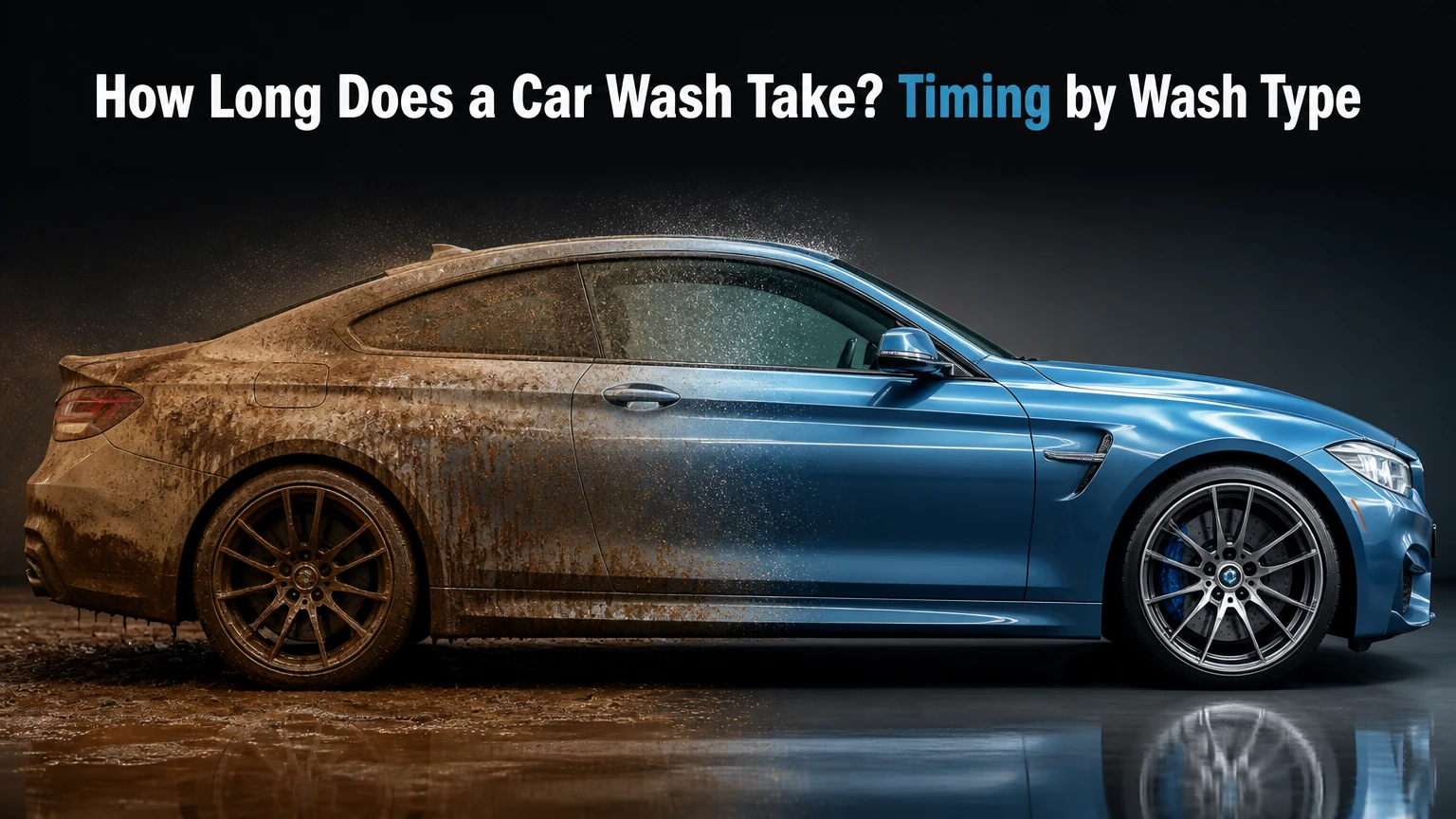
A car wash usually takes 2-7 minutes for an automatic machine, 10-20 minutes at a self-serve bay, or 20-45 minutes for a professional hand wash. A mobile wash commonly takes 45-90 minutes, while a full interior and exterior detail takes 2-5 hours. Queue length, vehicle size, and contamination determine total visit time.
Key Facts at a Glance
An automatic car wash cycle takes about 2-7 minutes, but waiting in line can add 5-40 minutes.
A self-serve car wash usually takes 10-20 minutes when washing one normally dirty vehicle.
A professional hand wash takes approximately 20-45 minutes for an exterior wash and basic drying.
A mobile wash commonly requires 45-90 minutes because the technician sets up equipment at your location.
A full detail takes 2-5 hours, and pet hair, stains, sap, or paint correction can extend the appointment.
The fastest wash is not automatically the safest for paint: touchless systems use stronger chemicals, while brushes create physical contact.
How Long Does a Car Wash Take?
A routine car wash takes 2-45 minutes depending on whether the vehicle goes through an automatic machine, a self-serve bay, or a hand-wash service. The advertised machine cycle is not the same as the time you spend at the facility, because queueing, payment, loading, drying, and driving away add elapsed time.
A useful planning formula is:
Total visit time = queue time + wash cycle or labor time + drying and exit time.
For example, a five-minute tunnel cycle with a 15-minute queue and a two-minute exit takes roughly 22 minutes. A touchless in-bay wash may run for only four minutes, yet a busy Saturday visit can take 25 minutes from arrival to departure.
The ranges below are typical practitioner estimates rather than universal service standards. A compact sedan with light dust falls near the lower end; a three-row SUV covered in mud falls near the upper end.
| Wash type | Wash or labor time | Typical total visit time | Typical price, USD |
|---|---|---|---|
| In-bay touchless automatic | 2-5 minutes | 5-20 minutes | $8-$18 |
| Friction conveyor tunnel | 3-7 minutes | 10-30 minutes | $10-$25 |
| Self-serve wash bay | 10-20 minutes | 15-30 minutes | $5-$12 |
| Professional exterior hand wash | 20-45 minutes | 25-60 minutes | $25-$50 |
| Mobile wash with light detailing | 45-90 minutes | 60-120 minutes | $40-$90 |
| Full interior and exterior detail | 2-5 hours | 3-6 hours | $150-$350 or more |
Prices vary substantially by country, city, vehicle size, labor rates, and included services. The dollar figures are typical North American reference ranges, not fixed market prices.
What Happens During an Automatic Car Wash?
An automatic car wash combines pre-rinse, detergent application, mechanical or high-pressure cleaning, rinsing, optional protectant, and drying. The machine itself generally operates for 2-7 minutes, although a staffed facility may spend another 1-3 minutes positioning the vehicle or cleaning unusually dirty wheels.
A typical tunnel sequence looks like this:
- Vehicle positioning, 30-60 seconds: The driver follows the conveyor instructions, folds mirrors if required, and confirms that windows and doors are closed.
- Pre-rinse, 30-60 seconds: High-pressure water removes loose grit, mud, and salt before soap reaches the paint.
- Foam and cleaning, 1-3 minutes: Detergent loosens oily road film while cloth strips, brushes, or spray arches contact the vehicle.
- Rinse and optional protectant, 30-90 seconds: The system removes detergent and may apply a wax, sealant, or spot-free rinse.
- Drying and exit, 1-3 minutes: Blowers remove much of the remaining water as the vehicle leaves the conveyor.
The Cleaning Pie model describes cleaning as a balance of time, agitation, chemical action, and temperature. Longer chemical dwell time can loosen contamination, while agitation removes bonded material. Temperature helps some cleaners work faster, but hot water does not make every wash safer or more effective, especially on hot paint or delicate trim.
How Long Does a Touchless Car Wash Take?
A touchless car wash usually takes 2-5 minutes for the programmed cycle and 5-20 minutes for the complete visit. Touchless systems use pressurized water and detergents instead of brushes or cloth strips, so they reduce contact-related swirl risk but may leave behind bonded traffic film, insects, or grease.
Touchless washing is a practical choice for winter salt, light dust, and frequent maintenance. Strong alkaline pre-soaks are often necessary because no brush provides physical agitation. Repeated use can reduce the life of wax or some sealants, although the exact effect depends on chemical concentration, dwell time, and product quality.
Touchless cleaning is not a substitute for decontamination. Tree sap, tar, dried insects, brake dust, and industrial fallout may require dedicated chemicals and controlled hand agitation afterward.
How Long Does a Tunnel Wash Take?
A friction or conveyor tunnel takes approximately 3-7 minutes once the vehicle enters the equipment, with a typical total visit of 10-30 minutes. The conveyor moves the car through pre-soak, brushes or cloth curtains, rinse arches, optional wax, and air dryers.
A tunnel wash is efficient for routine road film, but the result depends on equipment maintenance and the condition of the cleaning media. Dirty or poorly maintained brushes can transfer abrasive particles between vehicles. A modern facility with frequent media inspection and strong pre-rinse control presents less risk than an old tunnel with visibly contaminated brushes.
Remove roof racks, antennas, loose exterior accessories, and automatic wipers when the facility instructions require it. Never stop, brake, or steer on a conveyor unless an employee directs you.
How Long Does a Self-Serve Car Wash Take?
A self-serve car wash takes about 10-20 minutes for a normally dirty car and 20-30 minutes when the driver adds wheel cleaning, underbody rinsing, careful drying, or heavy-mud removal. The timer usually begins when the selected program starts, so planning and payment are separate from the paid wash period.
A practical self-serve sequence is:
- Preparation, 1-2 minutes: Remove floor mats, select the bay, and place personal drying towels where they remain clean.
- High-pressure rinse, 2-4 minutes: Start with the roof and upper panels, then work downward to flush grit away.
- Soap application, 2-4 minutes: Cover one section at a time rather than allowing foam to dry.
- Wheel and lower-panel cleaning, 2-5 minutes: Use the facility brush only if it is visibly clean, and rinse it before touching paint.
- Final rinse, 2-4 minutes: Use spot-free water when available, then dry with clean automotive microfiber.
Do not use a self-serve foam brush on delicate paint without inspecting its bristles. Embedded gravel can create scratches. Bringing two or three clean, plush microfiber towels often produces a safer finish than using a shared brush for drying.
How Long Does a Professional Hand Wash Take?
A professional exterior hand wash usually takes 20-45 minutes for a moderately dirty car and 45-75 minutes for a large, neglected, or heavily contaminated vehicle. Hand washing takes longer because technicians clean wheels, badges, door jambs, mirrors, grilles, and crevices individually rather than relying on one machine pass.
A careful exterior service commonly includes:
- Wheel and tire cleaning, 5-10 minutes: A dedicated wheel cleaner and separate brushes address brake dust and tire residue.
- Pre-rinse and pre-treatment, 3-7 minutes: Loose grit, bugs, and mud are removed before contact washing.
- Contact wash, 8-15 minutes: A clean microfiber mitt and fresh shampoo solution move from the least dirty panels toward the dirtiest areas.
- Rinse and jamb wipe, 3-7 minutes: Door edges, trunk channels, fuel-door recesses, and grilles receive attention.
- Drying, 5-12 minutes: Towels and air tools remove water from mirrors, badges, trim, and panel gaps.
A two-bucket system can reduce contamination in the wash solution, but bucket count alone does not guarantee safe washing. Clean mitts, frequent rinsing, adequate lubrication, and a thorough pre-rinse matter more than copying the label of a method.
Does a Full Detail Take Longer Than a Car Wash?
A full detail takes 2-5 hours because it includes interior cleaning, exterior washing, decontamination, trim work, and sometimes paint correction. A light interior-exterior detail may finish in 90 minutes to 3 hours, while pet hair, odor treatment, stain extraction, engine-bay cleaning, or machine polishing can extend the appointment beyond five hours.
| Detail service | Typical labor time | Main work included | Common extra time |
|---|---|---|---|
| Exterior wash and spray protection | 45-90 minutes | Wash, wheels, dry, spray sealant | 15-30 minutes for bugs or sap |
| Interior maintenance detail | 60-120 minutes | Vacuum, surfaces, glass, mats | 30-60 minutes for pet hair |
| Full interior-exterior detail | 2-5 hours | Deep clean, wash, wheels, protection | 1-2 hours for stains or odor |
| Paint decontamination and polish | 4-8 hours | Clay or chemical decon, machine polishing | 2-4 hours for severe defects |
| Resale preparation | 4-10 hours | Interior restoration, exterior correction | Vehicle condition and inspection goals |
Detailing is not always necessary for routine maintenance. A detail is appropriate before selling a vehicle, after transporting pets or children, or when embedded contamination remains after normal washing. It is inefficient to schedule a five-hour restoration when the vehicle only needs a 15-minute salt rinse.
Which Wash Method Is Fastest and Safest for Paint?
Touchless automatic washing is usually fastest, while a careful hand wash offers the greatest control over paint contact. No method is universally safest: touchless systems may use aggressive detergents, friction tunnels create brush contact, and inexperienced hand washing can drag grit across clear coat.
| Method | Speed | Contact with paint | Typical paint concern | Best use |
|---|---|---|---|---|
| Touchless automatic | 2-5 minutes | None from brushes | Strong detergent and incomplete cleaning | Salt and light maintenance |
| Friction tunnel | 3-7 minutes | Cloth or brushes | Swirl marks from media or trapped grit | Convenience and frequent drivers |
| Self-serve bay | 10-20 minutes | User-controlled | Shared brush contamination | Budget washing |
| Professional hand wash | 20-45 minutes | Clean mitt and towels | Technique or towel contamination | Paint-sensitive maintenance |
| Home two-bucket wash | 30-60 minutes | User-controlled | Poor rinsing, drying, or shade | Maximum control |
| Professional detail | 2-5 hours | Controlled tools and chemicals | Incorrect polishing or chemical use | Restoration and resale |
A clean, well-maintained friction tunnel can be less damaging than a careless home wash performed with one dirty sponge. That is a practitioner rule worth remembering. Process quality controls risk more reliably than the word “automatic” or “hand” on the menu.
What Makes a Car Wash Take Longer?
Vehicle condition, size, queue length, weather, and extra services create most timing differences. A small hatchback with light dust may need 10 minutes at a facility, while a mud-covered SUV requiring wheel cleaning and interior vacuuming can occupy a technician for more than an hour.
Expect these typical additions:
- Peak queue: 10-40 minutes after rain, snow, pollen events, or weekend traffic.
- Heavy mud: 5-15 additional minutes for pre-rinse and underbody work.
- Dried insects: 10-20 minutes for chemical softening and careful removal.
- Tree sap or tar: 15-30 minutes for spot treatment and re-washing.
- Brake dust: 5-15 minutes for dedicated wheel cleaner and brush work.
- Pet hair: 30-60 additional minutes during interior detailing.
- Large vehicle: 5-15 additional minutes for a van, pickup, or three-row SUV.
- Water restrictions or poor weather: 10-30 minutes for slower drying or rescheduling.
How Long Does Washing an SUV Take?
An SUV usually takes 5-15 minutes longer than a compact car for a hand wash or detail because it has more glass, roof area, wheels, trim, and cargo space. An automatic machine cycle normally does not change significantly, although oversized vehicles may require a special bay or operator inspection.
For planning, budget 15-30 minutes for an SUV at a self-serve bay, 30-60 minutes for a professional hand wash, and 3-6 hours for a deep interior-exterior detail. Three-row SUVs can require additional vacuuming and cargo-area cleaning, especially when child seats or pet hair are present.
Can Weather Change the Washing Time?
Weather changes both wash duration and finish quality. Washing in direct sun can make shampoo and rinse water dry before removal, so technicians may work in smaller sections, rinse more often, or pause the service; shade, moderate temperature, and low wind usually produce a faster finish.
Rain does not automatically make washing pointless. A wash before light rain can still remove salt, bird droppings, and abrasive road film, but rain may add new spotting or road grime before the vehicle dries. Avoid washing during lightning, freezing conditions, or strong wind that blows grit onto wet paint.
The best practical conditions are a shaded surface, cool-to-moderate panel temperature, and enough time to dry the vehicle before driving through dirty standing water. Weather is a quality variable, not merely a comfort issue.
What Should You Avoid During a Car Wash?
Avoid direct sunlight, household dish soap, dirty shared brushes, and drying with rough or contaminated towels. These mistakes increase the chance of mineral spots, stripped protection, or fine scratches, and correcting the resulting defects can take far longer than the original wash.
Common mistakes and fixes
- Washing hot paint: Move the vehicle into shade and let panels cool before applying shampoo.
- Using dish detergent: Replace it with pH-balanced automotive shampoo; dish detergent is formulated for kitchen grease, not regular paint maintenance.
- Using one bucket: Use separate wash and rinse water, or replace the solution frequently.
- Starting with the dirtiest panel: Begin with the roof and upper glass, then move downward toward rocker panels.
- Letting foam dry: Rinse immediately and work in smaller sections.
- Skipping the underbody in winter: Select an undercarriage rinse after driving on salted roads, then dry exposed seams when possible.
A single automatic wash will not remove every contaminant. Repeating the same high-pressure cycle against bonded sap or tar wastes time and can encourage stronger chemical use than the surface requires.
How Often Should a Car Be Washed?
Most vehicles benefit from washing every 1-2 weeks when driven regularly, with more frequent rinsing after road salt, coastal exposure, mud, or bird droppings. The correct interval depends on contamination severity rather than a calendar rule.
A commuter in a dry city may need a full wash every two weeks. A vehicle driven on salted roads should receive an underbody rinse as soon as practical after exposure. Bird droppings, insect residue, and tree sap deserve prompt removal because their acids or resins can damage unprotected surfaces when baked onto warm paint.
Use an automatic or touchless wash for quick maintenance when time is limited. Use a hand wash when the vehicle has a durable coating, delicate trim, visible contamination that machines miss, or paint defects that you are trying to avoid worsening.
Is a Home Wash Faster or Cheaper?
A home wash typically takes 30-60 minutes from setup through towel drying and costs about $3-$10 in consumables when equipment is already available. The first wash takes longer because hoses, buckets, mitts, shampoo, wheel tools, drying towels, and shade must be prepared.
| Home-wash item | Typical quantity | Typical replacement cost, USD | Purpose |
|---|---|---|---|
| Automotive shampoo | 30-60 milliliters | $8-$20 per bottle | Lubricated paint cleaning |
| Wash mitts | 2 units | $8-$20 each | Separate upper and lower panels |
| Buckets | 2 units | $8-$20 each | Wash and rinse separation |
| Microfiber drying towels | 2-4 towels | $5-$15 each | Low-lint drying |
| Wheel brushes | 1-2 brushes | $10-$30 | Brake dust and wheel barrels |
| Hose or pressure washer | 1 system | $30-$400 | Pre-rinse and final rinse |
Home washing provides control, but local water-use rules, drainage regulations, and weather matter. Storm drains can carry detergent and contaminants into waterways. A commercial wash may route wastewater to a treatment system, so the cheapest private option is not automatically the lowest-impact option.
Which Option Fits Your Situation?
The best method depends on the condition of the car and the time available. Choose touchless for a quick salt rinse, professional hand washing for controlled exterior care, self-serve for low-cost access, and detailing when the goal extends beyond ordinary cleaning.
The busy commuter
Choose an in-bay touchless wash when the vehicle has light road film and the complete visit must remain under 20 minutes. Add a hand wash or detail periodically if the automatic cycle leaves bonded grime around badges, wheels, or the rear hatch.
The paint-conscious enthusiast
Choose a skilled hand wash or careful home wash when preserving a polished or ceramic-coated finish matters more than speed. Avoid poorly maintained friction tunnels, but remember that poor hand-washing technique can still create marring.
The budget-conscious driver
Choose a self-serve bay for a 15-30 minute visit and bring clean drying towels. Use the high-pressure rinse thoroughly, because rushed contact with muddy paint creates more risk than the time saved.
The family vehicle owner
Choose a full interior-exterior detail when crumbs, stains, odor, or pet hair are the main problem. A basic exterior wash cannot address embedded interior contamination, and repeated quick washes will not replace extraction or thorough vacuuming.
The resale seller
Schedule a 4-10 hour resale preparation when presentation affects the sale. Ask whether the quote includes paint correction, stain extraction, odor treatment, and engine-bay cleaning, because “detail” can describe very different scopes.
What Is the Fastest Way to Get a Clean Car?
The fastest practical option is a touchless in-bay wash during a low-traffic period, with a total budget of 5-20 minutes. The fastest option that usually produces a more complete finish is a professional hand wash, which commonly requires 25-60 minutes including queue and drying.
Call ahead for a hand-wash appointment, visit an automatic facility outside weekend peaks, and remove personal items before arrival if interior service is planned. For heavy contamination, spending an extra 10 minutes on pre-rinse is often more efficient than rushing the contact-wash stage and correcting scratches later.
A fast wash is suitable for maintenance, not restoration. Mud, salt, sap, pet hair, stains, and paint defects require different processes.
FAQ
Does a car wash remove scratches?
A car wash removes dirt but does not remove paint scratches. Light surface marks may look less visible after wax or sealant, while genuine clear-coat scratches require polishing or paint correction; deep scratches that catch a fingernail may need refinishing rather than washing.
Should I wash my car before or after rain?
Wash before rain when the vehicle has salt, bird droppings, or insect residue that needs prompt removal. Light rain can leave mineral spots or fresh road film, so dry the vehicle afterward when conditions allow; heavy rain does not replace a controlled rinse and dry.
How long should I wait after waxing a car before washing it?
Follow the wax or sealant manufacturer’s cure instruction, commonly 8-24 hours for a fresh protective product. Avoid strong detergents and abrasive brushes during the stated cure period, because early washing can reduce bonding and shorten the product’s service life.
Is a touchless car wash safe for ceramic coating?
A touchless car wash is generally safer for ceramic coating than a dirty friction brush because it avoids direct contact, but strong alkaline detergents can reduce hydrophobic behavior over time. Use a coating-safe wash when available and rinse thoroughly after winter salt exposure.
How long does a car wash take when the car is very dirty?
A very dirty vehicle can add 15-30 minutes to a hand wash and 5-15 minutes to a self-serve visit. Dried sap, tar, heavy brake dust, and mud require separate chemicals or repeated rinsing, while pet hair can add 30-60 minutes to interior detailing.
Can I drive immediately after washing my car?
You can usually drive immediately after an automatic or professional wash, but short driving may leave water trapped in mirrors, badges, grilles, and door seams. Use a clean towel or compressed air for those areas, and avoid dusty roads until the exterior is fully dry.
The Bottom Line
How long a car wash takes depends mainly on the wash method, vehicle condition, queue, and service scope. Budget 5-20 minutes for touchless automatic washing, 10-30 minutes for self-serve, 25-60 minutes for a professional hand wash, 60-120 minutes for a mobile wash, and 3-6 hours for a full detail. For routine maintenance, choose the shortest method that removes the actual contamination; for paint care, favor controlled contact and clean equipment over speed alone.


