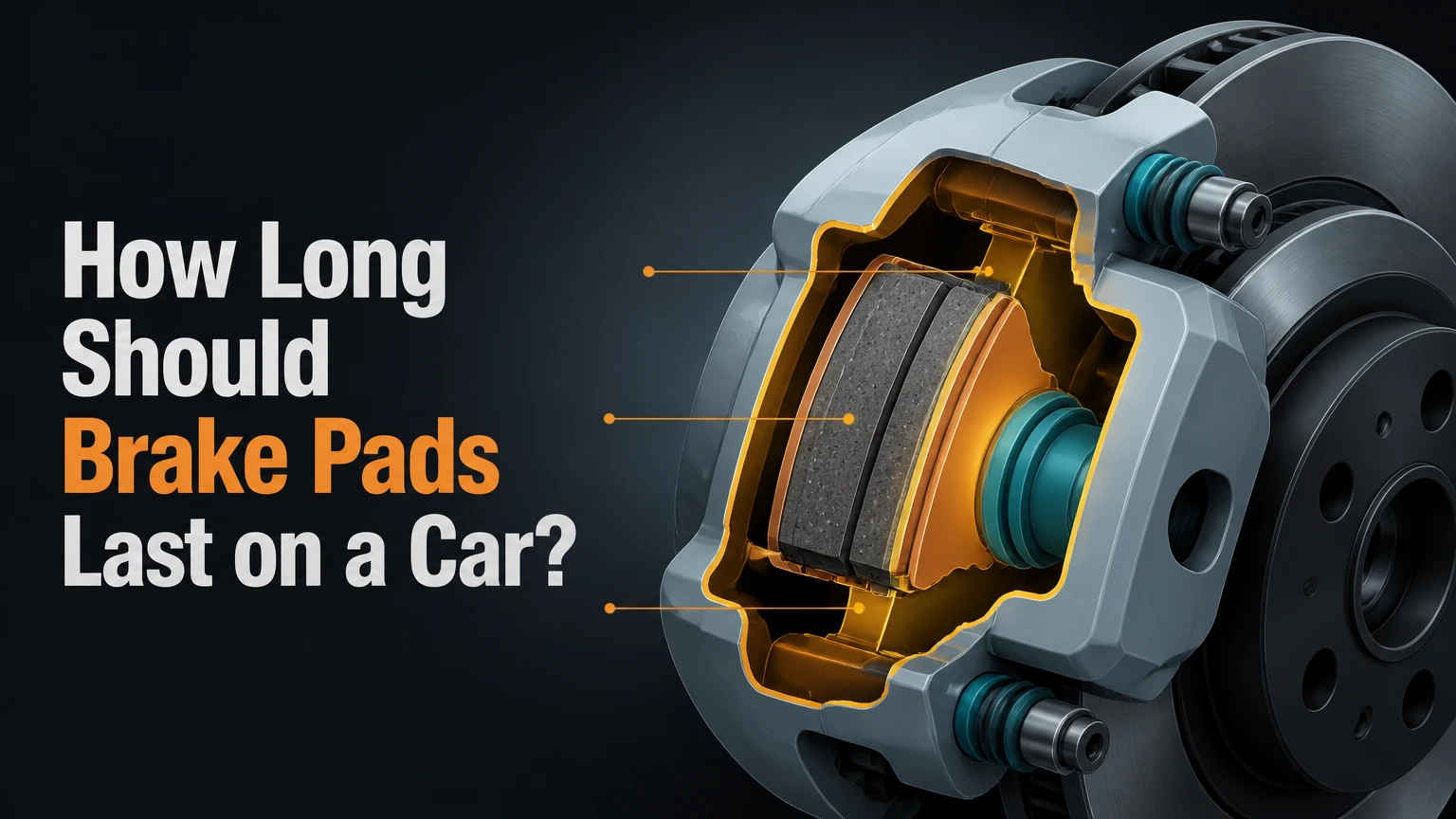
Standard automotive brake pads typically last between 30,000 and 70,000 miles, with 50,000 miles serving as the baseline average for most passenger vehicles. Exact brake pad longevity depends on pad material, driving environment, vehicle weight, axle position, and mechanical system health.
At a Glance
- Average Mileage Lifespan: 30,000 to 70,000 miles under normal driving conditions.
- Average Time Lifespan: 3 to 5 years, as environmental exposure degrades friction compounds over time.
- Front vs. Rear Split: Front brake pads wear out 30% to 50% faster than rear pads due to weight transfer during stopping.
- Material Variance: Organic pads wear fastest (25,000-40,000 miles), while ceramic pads last longest (50,000-75,000 miles).
- EV Advantage: Regenerative braking extends electric vehicle brake pad life past 80,000 to 100,000 miles.
What Is the Average Lifespan Difference Between Front and Rear Brake Pads?
Front brake pads last between 30,000 and 60,000 miles, whereas rear brake pads last between 50,000 and 100,000 miles. Front pads wear down significantly faster because the front axle handles 60% to 80% of the vehicle total braking force due to forward momentum and weight transfer during deceleration.
Rear brake pads endure less friction pressure in standard stopping conditions, which preserves their thickness over longer intervals. However, modern automotive technology can narrow this lifespan gap. Vehicles equipped with electronic parking brakes, hill-start assist, and torque-vectoring stability control apply micro-braking forces to the rear wheels during everyday turns and stops. On vehicles with aggressive electronic stability control tuning, rear brake pads may wear out at a rate nearly equal to the front pads.
How Long Do Brake Pads Last in Years?
Brake pads last between 3 to 5 years on a low-mileage vehicle, even if the car has not reached the standard mileage thresholds. Friction materials, bonding adhesives, and backing plate hardware naturally degrade over time when exposed to moisture, road salt, and ambient temperature swings.
Vehicle storage conditions dictate time-based degradation rates. A car driven only 3,000 miles per year and parked outside will experience corrosion on the steel backing plates and rotor surfaces. Rust buildup creates surface scaling, which chips away at the friction material and causes premature pad separation. Professional mechanics recommend inspecting brake pads every 12 months or 12,000 miles, regardless of total distance driven, to confirm the friction lining remains intact and bonded to the steel backing plate.
How Do Driving Environments Impact Brake Pad Wear?
Driving environment is the primary external factor influencing brake pad wear rates, altering pad lifespan by tens of thousands of miles depending on stop frequency and thermal load.
| Driving Environment | Expected Pad Lifespan (Miles) | Primary Wear Mechanism |
| Highway Commuting | 70,000 – 100,000 | Low stopping frequency, constant airflow cooling |
| Mixed City / Highway | 40,000 – 60,000 | Moderate thermal cycling, standard stop-and-go |
| Urban Grid / City Taxi | 15,000 – 25,000 | High stop frequency, persistent friction buildup |
| Mountain / Steep Incline | 15,000 – 30,000 | Continuous riding, extreme thermal degradation |
| Heavy Towing / Hauling | 20,000 – 35,000 | High kinetic energy transfer, elevated heat |
| Track / Performance Driving | 5,000 – 15,000 | Severe heat cycles, extreme friction demand |
Urban environments force frequent brake applications, keeping pad temperatures elevated and accelerating wear. Conversely, highway driving relies on engine drag and aerodynamic resistance to manage speed, preserving pad friction material over extended distances.
How Long Do Brake Pads Last on Electric and Hybrid Vehicles?
Brake pads on electric vehicles (EVs) and hybrid cars last between 80,000 and 100,000 miles or more. EVs use regenerative braking systems that reverse the electric motor to slow the vehicle, converting kinetic energy into usable battery power without engaging the physical brake pads.
In standard driving conditions, mechanical brake pads on an EV only engage during aggressive hard stops, full stops below 5 miles per hour, or emergency maneuvers. Because the electric motor absorbs the vast majority of deceleration force, physical friction wear is minimal. However, EV brake pads face an elevated risk of rust and caliper pin seizure due to disuse. EV manufacturers recommend periodic brake service to clean, lubricate, and exercise the mechanical brake hardware to prevent corrosion from ruining unused pads.
How Does Brake Pad Material Selection Dictate Longevity?
Brake pad composition dictates wear speed, noise output, dust production, and heat tolerance. Manufacturers formulate three primary categories of friction material: Non-Asbestos Organic (NAO), Semi-Metallic, and Ceramic.
[Organic / NAO]      ===> 25,000–40,000 miles (Softest, Quietest, Fast Wear)
[Semi-Metallic]      =======> 30,000–65,000 miles (Hard, Durable, Rotor Wear)
[Ceramic]            ===========> 50,000–75,000 miles (Durable, Clean, Low Noise)
Non-Asbestos Organic (NAO) Pads
Organic brake pads last 25,000 to 40,000 miles. Composed of fibers, glass, rubber, and Kevlar bound in resin, organic pads are soft, quiet, and gentle on rotors. Their soft composition causes them to wear down much faster than metallic or ceramic alternatives, making them common on light passenger vehicles but unsuitable for heavy loads or high speeds.
Semi-Metallic Pads
Semi-metallic brake pads last 30,000 to 65,000 miles. Formulated with 30% to 65% metal content by weight (including steel fibers, iron, and copper), these pads excel at dissipating thermal energy during heavy braking. They offer strong stopping power across wide temperature ranges but generate more brake dust, produce higher operational noise, and accelerate rotor surface wear.
Ceramic Pads
Ceramic brake pads last 50,000 to 75,000 miles. Built from dense ceramic compounds mixed with fine copper fibers, ceramic pads provide high durability, clean operation with light-colored dust, and low noise output. They maintain stable stopping power under repeated hard use, though they carry a higher retail price tag and perform slightly less effectively in extreme freezing temperatures until warmed up.
Can Mechanical Component Failures Destroy Brake Pads Prematurely?
Mechanical failures within the braking assembly can ruin brand-new brake pads in under 5,000 miles, independent of standard driving habits.
[Seized Slider Pins]   ===> Pad stuck against rotor ===> 3,000–5,000 mile death
[Collapsed Brake Hose] ===> Trapped hydraulic fluid  ===> Continuous pad drag
[Warped/Grooved Rotor] ===> Uneven surface contact  ===> 50% lifespan reduction
- Stuck Caliper Slider Pins: Corrosion or dried grease causes caliper slider pins to freeze. This prevents the floating caliper from retracting, locking the inner or outer pad against the spinning rotor continuously while driving.
- Collapsing Brake Hoses: Internal rubber layers of aging flexible brake lines can crack and delaminate, forming a internal one-way check valve. Hydraulic pressure pushes fluid into the caliper when you press the pedal, but trapped pressure cannot return when released, causing persistent brake drag.
- Severely Grooved or Warped Rotors: Installing new brake pads over uneven or grooved rotors reduces initial contact surface area. The high spots on the worn rotor gouge channels into the new pad friction material, increasing local thermal stress and cutting total pad life by over 50%.
How Do You Know When Brake Pads Need to Be Replaced?
Brake pads need replacement when the friction material lining measures 3 millimeters or less in thickness. New brake pads typically measure between 10 millimeters and 12 millimeters when uninstalled.
[10mm – 12mm]  =====> New Condition (100% Life)
[6mm – 9mm]    =====> Good Condition (Safe Operational Zone)
[4mm – 5mm]    =====> Fair Condition (Plan for Replacement Soon)
[3mm]          =====> CRITICAL LIMIT (Immediate Replacement Required)
[2mm or less]  =====> DANGER (Metal-on-Metal Rotor Damage)
Drivers can monitor several key physical and acoustic warning indicators to identify pad wear:
- Acoustic Wear Indicator Squeal: A high-pitched metallic squeak heard while driving that disappears when applying the brakes indicates the pad built-in metal tab is touching the rotor.
- Deep Metallic Grinding: A harsh grinding noise means friction material is completely depleted, allowing the steel backing plate to grind directly into the iron brake rotor.
- Visual Inspection Through Rim: Looking through the wheel spokes reveals the remaining pad thickness pressed against the rotor face. If the pad friction lining is thinner than the backing plate itself, replace it immediately.
- Spongy or Deep Brake Pedal: A brake pedal that travels closer to the floorboard before engaging signals thin pad linings or air trapped inside the hydraulic lines.
- Dashboard Brake Light: Many modern luxury and European vehicles feature electronic wear sensors wired into the pad. When the pad wears down, the circuit breaks, illuminating a brake warning light on the gauge cluster.
What Causes a High-Pitched Squealing Sound When Braking?
A high-pitched squealing sound during braking is primarily caused by an acoustic wear indicator tab contacting the brake rotor face. Brake manufacturers rivet a curved metal strip to the pad backing plate set at a height of 2 to 3 millimeters above the backing plate. When the friction material wears down to this limit, the metal tab scratches against the rotor surface, producing a loud warning noise to alert the driver before metal-on-metal rotor damage occurs.
High-pitched squealing can also stem from superficial causes unrelated to pad depth. Morning moisture rust on rotors, vibration between the back of the pad and the caliper piston due to missing shims, or glaze formation on pads from sudden hard stops can create high-frequency squeaks. If the squeal persists consistently across multiple days and temperature shifts, inspect pad thickness directly.
Why Is Only One Brake Pad Worn Down Completely?
Single-pad wear on an axle indicates a mechanical restriction inside the caliper hardware assembly or hydraulic system. Uneven wear across the inner and outer pads on the same wheel stems from seized caliper slider pins or a stuck caliper piston.
When slider pins seize due to rust or degraded grease, the outer caliper housing cannot slide back and forth to equalize pressure. The hydraulic piston continues pushing the inner pad against the rotor during braking, but when you release the pedal, the outer pad remains pressed against the rotor face. This creates continuous drag, wearing that single pad down to the steel backing plate while the opposite pad retains most of its original thickness. Replacing friction pads without repairing or greasing the seized caliper hardware will cause the rapid failure pattern to repeat.
Should You Always Replace Rotors When Replacing Brake Pads?
No, you do not always need to replace brake rotors when replacing brake pads, provided the rotors meet safety specifications. Rotors can be safely reused if their measured thickness exceeds the manufacturer stamped minimum thickness specification, they display no structural cracking, and they are free from severe surface grooves or lateral runout (warping).
Rotor Condition Check:
├── Thickness > Minimum Specification?
│   ├── YES ──> Surface Smooth/No Grooves?
│   │           ├── YES ──> Reuse or Light Resurface (Safe)
│   │           └── NO  ──> Resurface (Turn) or Replace
│   └── NO  ──> REPLACE ROTOR IMMEDIATELY (Safety Hazard)
Many automotive repair shops advocate replacing rotors and pads simultaneously as a complete service package. Fresh, smooth rotor surfaces optimize the bedding-in process for new friction pads, preventing brake noise, pedal pulsation, and uneven wear patterns. If an existing rotor shows minor surface ridges but retains adequate thickness, a machine shop can resurface (turn) the rotor on a lathe to restore a flat plane, saving money over full rotor replacement.
Can You Replace Just Front or Rear Brake Pads, or Do You Need All Four?
You can safely replace brake pads on just one axle without replacing all four pads simultaneously. Front and rear brake pads wear at distinct rates due to vehicle weight distribution and braking bias, making simultaneous four-wheel wear uncommon under standard driving conditions.
However, you must always replace brake pads in complete axle pairs (both front wheels together or both rear wheels together). Never replace a brake pad on only one individual wheel. Replacing pads on only the front-left wheel while leaving worn pads on the front-right wheel creates an uneven friction coefficient across the axle. Under heavy braking, this imbalance pulls the vehicle violently toward the side with higher friction, compromising vehicle control and anti-lock braking system (ABS) stability.
How Much Does It Cost to Replace Brake Pads?
Replacing brake pads costs between $150 and $300 per axle for standard passenger vehicles, combining parts and professional labor. Completing both axles (all four wheels) raises total service costs to between $300 and $600.
Brake Replacement Cost Factors:
├── Parts Only (Per Axle): $40 - $100
├── Professional Labor (Per Axle): $100 - $200
├── Total Pad Service (Per Axle): $150 - $300
└── Total Pad + Rotor Service (Per Axle): $300 - $550
Cost variations depend on vehicle class, component quality, and geographical labor rates:
- Economy Cars and Sedans: $150 to $225 per axle for standard semi-metallic or ceramic replacement sets.
- Trucks, Large SUVs, and Heavy Vehicles: $200 to $350 per axle due to larger friction pad volume and heavy-duty hardware.
- Luxury and European Sports Cars: $300 to $600 per axle for specialty low-dust ceramic pads or high-friction European OEM pads.
- Full Pad and Rotor Package: Adding new rotors increases total repair costs to between $300 and $550 per axle, as new rotors cost $50 to $150 each depending on size and ventilation design.
Is It Dangerous to Drive With Worn Brake Pads?
Yes, driving with worn brake pads below the 2-millimeter threshold is extremely dangerous. As friction lining wears away, the brake system loses its capacity to absorb and dissipate heat, causing severe brake fade and significantly increasing vehicle stopping distances during emergencies.
When friction lining wears off entirely, the pad steel backing plate presses directly against the iron rotor face. Metal-on-metal braking drastically cuts stopping power, scoring deep gouges into the rotor and generating extreme heat transfer into the brake fluid. This excessive heat can boil hydraulic brake fluid, introducing compressible gas bubbles into the system that cause complete brake pedal failure. Continued driving on bare metal backing plates can also push caliper pistons out of their bores, leaking brake fluid and causing total system loss.
How Do You Properly Bed In New Brake Pads to Maximize Lifespan?
Bedding in (or burnishing) new brake pads involves performing a series of controlled heating and cooling cycles to deposit an even layer of friction material onto the surface of the new rotor face. Proper bedding prevents brake judder, reduces noise, and maximizes total pad lifespan.
1.Accelerate to 40 MPH:Find a quiet, open road without trailing traffic.
Accelerate your vehicle smoothly up to 40 mph. Ensure the road behind you is clear of other vehicles before initiating deceleration.
2.Perform Moderate Deceleration:Slow down firmly without locking the tires.
Apply firm, steady pressure to the brake pedal to slow the vehicle rapidly down to 10 mph. Do not bring the vehicle to a complete stop during this maneuver.
3.Repeat Deceleration Cycles:Complete 4 to 5 consecutive cycles.
Accelerate back up to 40 mph and repeat the firm braking process 4 to 5 times in succession to build initial thermal energy in the pads.
4.Perform High-Speed Deceleration Cycles:Increase speed to 50 MPH.
Accelerate to 50 mph and brake hard down to 10 mph 2 to 3 times. Avoid triggering the anti-lock braking system (ABS) or locking the tires.
5.Cool the Braking System:Drive uninhibited for 5 to 10 minutes.
Drive for 5 to 10 minutes at cruising speed without coming to a complete standstill. Airflow cools the hot pads evenly. Avoid holding the brake pedal down while fully stopped with hot pads, as this leaves uneven material deposits on the rotor face.
Does Aggressive Driving Shorten Brake Pad Life More Than Heavy Vehicle Weight?
Aggressive driving habits shorten brake pad life significantly faster than vehicle weight increases. Kinetic energy scales linearly with mass, but exponentially with speed ($E_k = \frac{1}{2}mv^2$). Consequently, doubling vehicle weight doubles braking energy, but doubling vehicle speed quadruples the kinetic energy the brake pads must convert into heat.
Tailgating, sudden high-speed stops, and aggressive mountain driving generate extreme friction temperatures exceeding 600 degrees Fahrenheit. These intense thermal spikes induce brake pad glazing, a condition where resins in the friction material melt, crystallize, and form a slick surface plane across the pad face. Glazed pads lose their friction coefficient, requiring higher pedal force to stop, which accelerates mechanical wear and structural pad breakdown far faster than carrying steady payload weight.
The Bottom Line
Passenger car brake pads last between 30,000 and 70,000 miles, with 50,000 miles serving as the industry baseline standard. Front brake pads wear faster than rear pads due to momentum weight transfer, while vehicle choice, driving style, and friction pad chemistry shift individual longevity. To maximize safety and prevent expensive secondary repairs, visually check your pad depth at every oil change and replace any brake pads that measure 3 millimeters or less in thickness.


