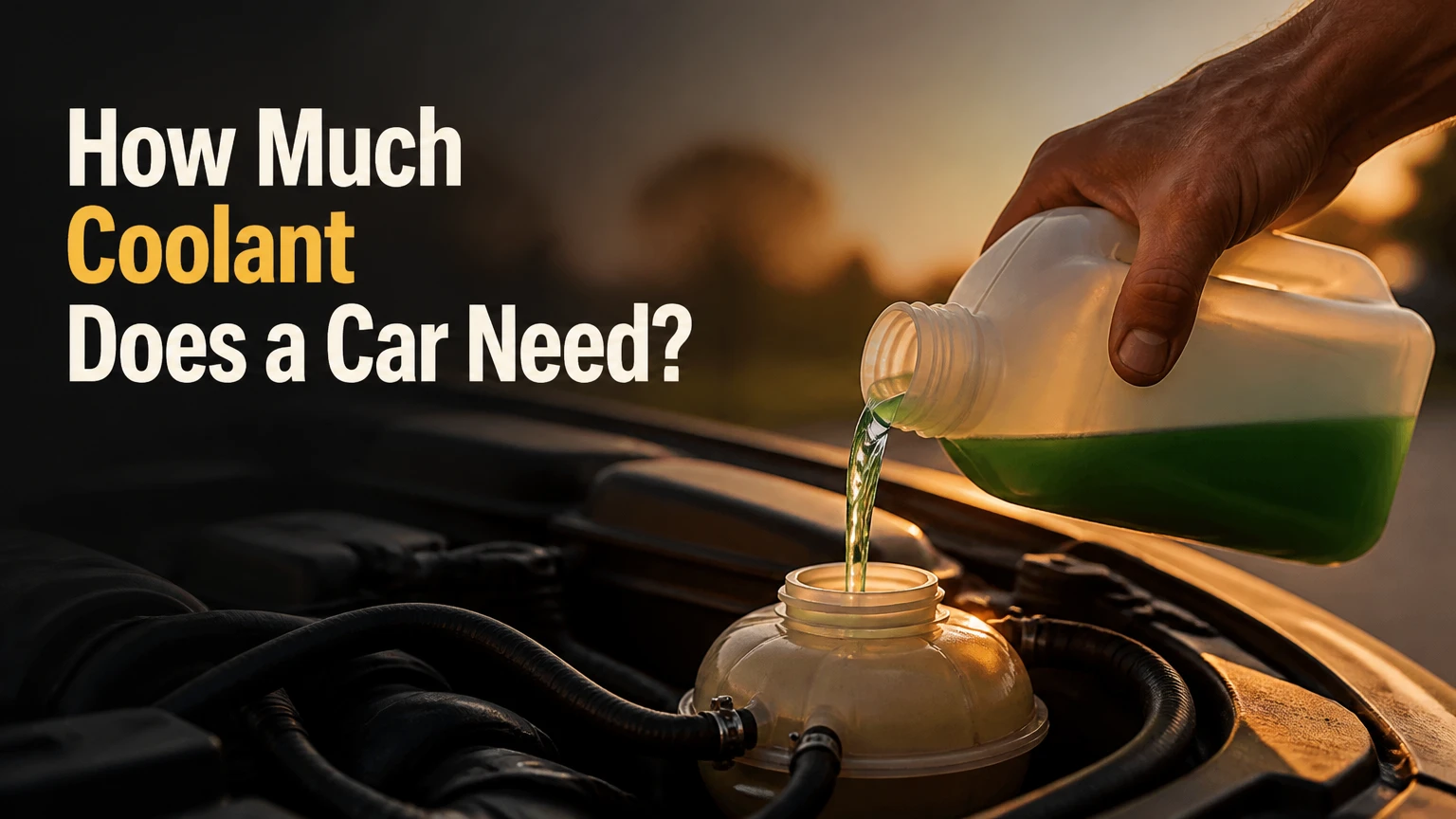
An average passenger car requires between 4 and 10 quarts (1 to 2.5 gallons, or 3.8 to 9.5 liters) of coolant for a complete system fill. The exact amount depends on engine displacement, radiator size, and whether you are performing a simple radiator drain or a full system flush.
At a Glance
- Standard 4-cylinder passenger cars require 4 to 6 quarts (1.0 to 1.5 gallons) of coolant.
- 6-cylinder sedans and crossovers require 6 to 8 quarts (1.5 to 2.0 gallons) of coolant.
- 8-cylinder trucks and large SUVs require 10 to 16 quarts (2.5 to 4.0 gallons) of coolant.
- A routine radiator drain-and-fill only requires 40% to 60% of total system capacity because fluid remains trapped in the engine block.
- Prediluted 50/50 coolant is poured directly into the system, whereas concentrated coolant must be mixed equally with distilled water.
What Is the Average Coolant Capacity by Vehicle Type?
Automotive coolant capacity scales directly with engine size and total cooling system surface area. Larger engines generate more thermal energy and require larger engine jackets, bigger radiators, and higher total fluid volume to regulate operating temperatures.
| Vehicle Type | Engine Displacement | Total Capacity (Quarts) | Total Capacity (Liters) |
|---|---|---|---|
| Compact / Midsize Sedan | 1.5L – 2.5L (4-Cylinder) | 4 to 6 Quarts | 3.8 to 5.7 Liters |
| Full-Size Sedan / Crossover | 3.0L – 3.8L (V6 / Flat-6) | 6 to 8 Quarts | 5.7 to 7.6 Liters |
| Full-Size Truck / SUV | 5.0L – 6.2L (V8) | 10 to 16 Quarts | 9.5 to 15.1 Liters |
| Heavy-Duty Diesel Truck | 6.6L – 6.7L (V8 Turbo Diesel) | 20 to 32 Quarts | 18.9 to 30.3 Liters |
To find your vehicle’s exact specification, consult the “Capacities and Specifications” section near the back of your owner’s manual.
Why Do Certain Vehicles Need Significantly More Coolant?
Specialized vehicle layouts, hybrid powertrains, and high-performance engineering require expanded cooling capacity that exceeds standard class averages. Long fluid routes, multiple heat exchangers, and secondary heating circuits significantly increase total fluid requirements.
- Mid-Engine and Rear-Engine Sports Cars: Vehicles such as the Porsche 911 or Chevrolet Corvette C8 place the engine behind the driver while mounting radiators at the front bumper. Plumbing lines running the entire length of the chassis can add 3 to 6 additional quarts of capacity.
- Hybrid and Electric Vehicles (EVs): Modern electrified platforms often use 2 or 3 isolated cooling loops. A Toyota Prius or Tesla Model 3 uses separate fluid circuits for the internal combustion engine, high-voltage battery pack, and power electronics inverter, demanding more total fluid across multiple reservoirs.
- Vehicles with Rear Passenger HVAC: Large minivans and full-size SUVs equipped with rear heating units route engine coolant through secondary lines to an auxiliary heater core near the tailgate. This extended piping increases total capacity by 1 to 3 quarts.
- Factory Towing and Heavy-Duty Packages: Packages designed for heavy payloads feature thicker, multi-pass radiators, external transmission oil coolers, and expanded expansion tanks, raising overall system volume by 15% to 30%.
How Much Coolant Do You Need for a Drain-and-Fill vs. a Full Flush?
A standard radiator drain-and-fill requires roughly half the vehicle’s total system capacity, whereas a complete dry system flush requires 100% of the manufacturer specification. Understanding this operational difference prevents buying double the required fluid or underfilling during service.
Total System Capacity (e.g., 8 Quarts Dry Fill)
├── Radiator & Expansion Tank Drain: ~4 Quarts (50% Removed)
└── Trapped Fluid (Engine Block & Heater Core): ~4 Quarts (50% Retained)
Drain-and-Fill Maintenance
Opening the radiator drain petcock empties only the radiator and expansion tank. Between 40% and 60% of the total fluid volume remains trapped behind closed thermostat valves, inside the engine block jacket, and within the heater core. If your car lists an 8-quart total capacity, a routine drain-and-fill only requires purchasing 4 quarts of pre-mixed coolant.
Dry System Overhaul or Chemical Flush
You only need the full capacity volume listed in your vehicle manual if the engine block drain plugs were removed, the system was flushed repeatedly with distilled water, or a complete engine overhaul was performed.
How Does Coolant Type Affect How Much You Need to Buy?
The volume of fluid you purchase depends heavily on whether you select “Prediluted 50/50” coolant or “Concentrated” antifreeze. Purchasing the wrong formulation can leave you short on fluid or disrupt your freeze protection ratio.
Prediluted 50/50 Coolant
Prediluted coolant comes pre-mixed with 50% antifreeze and 50% deionized water. It is formulated for direct pouring into the radiator or overflow tank without adding water. If your service requires 6 quarts of fluid, you must buy 6 quarts (or 2 full gallon jugs) of 50/50 solution.
Concentrated Coolant
Concentrated antifreeze contains 100% pure chemical glycol and rust inhibitors. It must be diluted with equal parts distilled water prior to or during installation. Purchasing 1 gallon (4 quarts) of concentrate yields 2 gallons (8 quarts) of usable 50/50 coolant mix.
Important Rule: Never pour 100% concentrate directly into an engine without water. Pure glycol freezes at a higher temperature than a 50/50 mixture (-8 degrees Fahrenheit compared to -34 degrees Fahrenheit) and loses up to 30% of its thermal heat transfer capability.
How Do You Mix Concentrate Correctly After a Distilled Water Flush?
When you flush a cooling system with pure distilled water, several quarts of pure water remain trapped inside the engine block. Adding pre-mixed 50/50 coolant into a system containing trapped water results in an overly weak mixture.
To achieve an accurate 50/50 ratio after a water flush, perform the following calculation:
- Look up your vehicle’s total dry capacity (for example, 10 quarts).
- Calculate 50% of that total capacity to find the required amount of pure concentrate (5 quarts).
- Pour that exact amount (5 quarts) of pure concentrated antifreeze directly into the empty radiator.
- Top off the remaining capacity with pure distilled water.
The circulating water pump will naturally blend the concentrate with the trapped water inside the engine block to form a precise 50/50 mixture.
How Do You Check if Your Vehicle’s Coolant Level Is Low?
Check the coolant level visually by inspecting the translucent plastic overflow tank mounted inside the engine bay while the vehicle is parked on flat ground with the engine cold.
The fluid level must rest between the “MIN” (low) and “MAX” (full) cold fill indicator marks stamped on the side of the plastic tank.
+---------------------------+
|   [ MAX / COLD FILL ]     | <-- Coolant level should sit here
|                           |
| ~ ~ ~ ~ ~ ~ ~ ~ ~ ~ ~ ~ ~ | <-- Current Fluid Surface
|                           |
|   [ MIN / LOW LEVEL ]     |
+---------------------------+
Never remove a pressure cap or radiator cap while the engine is warm or hot. Cooling systems operate under 12 to 16 PSI of pressure when hot, and opening the cap can spray boiling coolant and steam, causing serious thermal burns.
Can You Top Off a Low System with Plain Water?
You can top off a low coolant reservoir with distilled water in an emergency, but you should never use tap water or hose water. Tap water contains minerals like calcium, magnesium, and chloride that precipitate out under heat, forming scaling deposits that clog radiator passageways and ruin water pump seals.
Adding pure distilled water dilutes your cooling system’s corrosion inhibitors and alters its freeze protection point. If you add more than 1 quart of distilled water to remedy a low system, test the fluid concentration using a coolant hydrometer or optical refractometer.
What Happens if You Put Too Much Coolant in the Reservoir?
Overfilling the plastic coolant overflow tank past the “MAX” line does not damage internal engine components, but it causes the fluid to vent externally once the engine reaches operating temperature.
As engine coolant heats up, it expands volumetrically. The pressure cap opens at its rated threshold (typically 13 to 15 PSI) to discharge excess expanded fluid into the overflow reservoir. If the reservoir is already filled past its maximum line, the excess fluid vents out through the overflow relief tube onto the ground. This creates an environmental hazard and a toxic risk for domestic pets, as glycol possesses a sweet smell and taste.
Can You Mix Different Colors or Chemical Types of Coolant?
You must not mix different colors or chemical formulations of coolant. Modern automotive coolants rely on distinct chemical technologies that can react negatively when combined, causing chemical precipitation and engine failure.
- Inorganic Additive Technology (IAT): Typically green in color; uses silicates for rapid corrosion protection; standard in vintage vehicles; replaced every 2 years or 30,000 miles.
- Organic Acid Technology (OAT): Typically orange, red, or dark pink; uses organic acids without silicates or phosphates; common in modern GM, European, and Asian vehicles; lasts 5 years or 150,000 miles.
- Hybrid Organic Acid Technology (HOAT): Typically yellow, turquoise, or purple; combines organic acids with silicates; used heavily by Ford, Chrysler, and European manufacturers.
Mixing IAT and OAT coolants causes the silicates and organic acids to react and form a thick, gelatinous sludge. This sludge clogs the narrow passages of the heater core and radiator, leading to sudden overheating and head gasket failure. Always refill your system with the fluid specification designated in your owner’s manual.
How Do You Prevent Air Pockets When Refilling Coolant?
Air pockets form inside upper radiator hoses, heater cores, and cylinder heads whenever a cooling system is drained and refilled. Trapped air prevents coolant from contacting hot metal surfaces, leading to localized hotspot overheating, air binding at the water pump, and false dashboard temperature sensor readings.
To bleed or “burp” air out of a refilled cooling system, follow these standard steps:
- Attach a spill-free funnel tightly to the radiator neck or expansion tank opening.
- Fill the system with coolant until the fluid sits 2 inches deep inside the funnel base.
- Turn the cabin heater control to “Maximum Heat” and set the fan speed to low to open the heater core valve.
- Start the engine and allow it to idle until it reaches operating temperature (when the main radiator cooling fan cycles on).
- Watch the funnel for escaping air bubbles while gently squeezing the upper radiator hose using heavy thermal gloves.
- Once air bubbles stop rising to the surface, turn off the engine, let it cool completely, and reinstall the sealed pressure cap.
How Much Coolant Loss Is Normal over Time?
Under normal operating conditions, a healthy, fully sealed cooling system should lose no more than 2 to 4 ounces of coolant per year due to slow evaporation through the pressure cap relief valve and plastic expansion tank walls.
If your vehicle loses more than 1 pint (16 ounces) of coolant over a 6-month period, a leak is present.
- External Leaks: Indicated by bright green, orange, or pink puddles under the front bumper, crusty white residue on radiator seams, or sweet-smelling steam coming from the engine bay.
- Internal Leaks: Caused by a failing head gasket or damaged intake manifold. Symptoms include thick white exhaust smoke under acceleration, a sweet smell from the tailpipe, or milky brown emulsion under the engine oil filler cap.
How Long Can a Car Safely Run on Low Coolant?
A car should not be driven at all once the coolant level drops far enough to empty the radiator or illuminate the dashboard low-fluid or high-temperature warning light. Driving with insufficient coolant causes rapid thermal buildup in aluminum cylinder heads.
Operating an engine without adequate coolant for even 3 to 5 minutes can warp cylinder heads, blow head gaskets, score piston skirts, or crack the engine block. If your temperature gauge enters the red zone or the engine hot light illuminates, pull off the road safely, shut off the engine immediately, and allow it to cool completely before inspecting fluid levels.
The Bottom Line
An average car requires 4 to 10 quarts of total coolant capacity, but performing a standard radiator maintenance drain only requires purchasing 4 to 6 quarts of pre-mixed 50/50 fluid due to trapped fluid inside the block. Always select the exact chemical type (IAT, OAT, or HOAT) specified by your vehicle manufacturer, use distilled water when mixing concentrate, and bleed all trapped air pockets after refilling to protect your engine from costly thermal damage.


