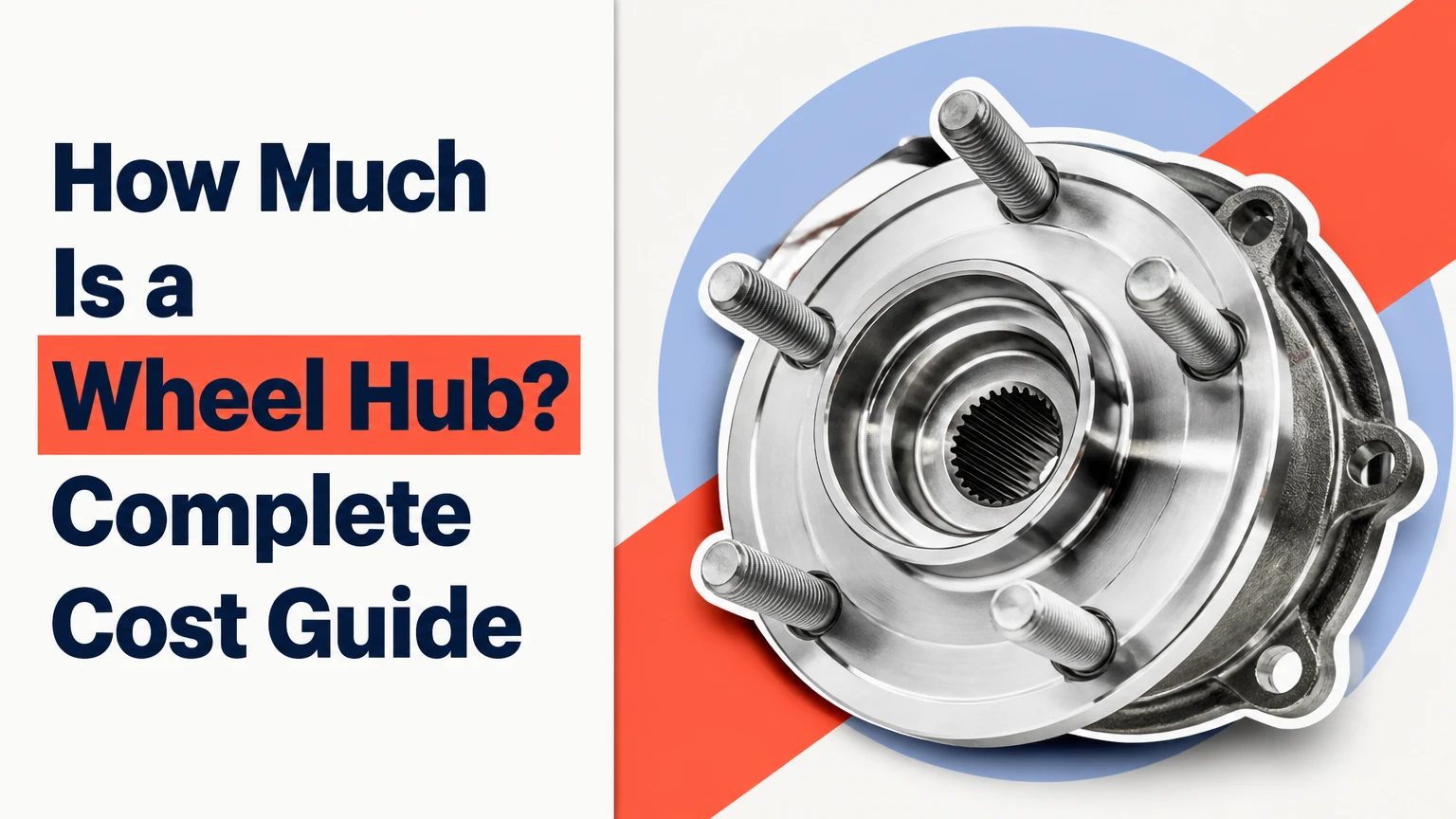
A wheel hub usually costs $50-$250 for the part, while professional wheel hub replacement commonly totals $200-$600 per wheel. Costs can exceed $800 on luxury vehicles, heavy-duty trucks, rusted assemblies, or designs that require pressing the bearing into the steering knuckle.
Key Facts at a Glance
- A basic aftermarket wheel hub assembly commonly costs $50-$120.
- A premium aftermarket or OEM hub often costs $130-$350.
- Professional labor generally adds $100-$350 per wheel.
- Most bolt-on wheel hub replacements take 1-2 hours.
- Press-in wheel bearings may require 2-4 labor hours and hydraulic equipment.
- Vehicle model, drivetrain, ABS integration, corrosion, and brand quality determine the final price.
How Much Is a Wheel Hub by Itself?
A wheel hub assembly generally costs $50-$250, but the exact price depends on whether the unit includes the bearing, ABS sensor, tone ring, seals, wheel studs, and mounting hardware. Some basic rear hubs for compact cars cost less than $70, while OEM front hubs for trucks, luxury vehicles, or performance models can exceed $300.
The term “wheel hub” may refer to different parts. On many modern vehicles, the wheel hub, wheel bearing, seals, and ABS speed-sensing components form one sealed bolt-on assembly. On other vehicles, the hub and bearing are separate, so the repair may require additional components and machine-press labor.
Typical Wheel Hub Part Prices
| Wheel hub type | Typical part price | Common application | Important detail |
| Economy bolt-on hub | $50-$100 | Older sedans and budget repairs | Lower-cost seals and sensors may have shorter service life |
| Premium aftermarket hub | $100-$200 | Daily-driver cars, SUVs, and light trucks | Often offers stronger sealing and better warranty coverage |
| OEM hub assembly | $180-$350 | Newer, luxury, performance, or warranty-sensitive vehicles | Designed to match factory tolerances and electronics |
| Press-in bearing and hub parts | $70-$220 | Compact cars and some older platforms | Requires a press or specialized bearing tools |
| Heavy-duty truck hub | $180-$450 | Towing, commercial, and large pickup applications | Built for higher axle load and larger braking systems |
| Luxury or performance hub | $250-$600 | European luxury and high-output vehicles | May include advanced sensors or model-specific electronics |
Online prices may appear much lower than repair-shop prices because online listings often exclude shipping, hardware, axle nuts, seals, taxes, diagnostic work, and labor. Fitment mistakes are also common when a vehicle has multiple hub options based on drivetrain, production date, wheel size, or brake package.
How Much Does Wheel Hub Replacement Cost?
Professional wheel hub replacement normally costs $200-$600 per wheel. A straightforward bolt-on hub on a common sedan may cost about $250-$400, while a seized hub, press-in bearing, luxury vehicle, or heavy-duty truck can raise the total to $500-$900.
A complete estimate should identify the part brand, labor hours, shop rate, replacement hardware, diagnostic charges, and warranty. A low estimate may use an economy hub, while a higher estimate may include an OEM assembly, new axle nut, mounting bolts, ABS diagnosis, and corrosion removal.
Total Replacement Cost by Repair Source
| Repair source | Parts | Labor and fees | Typical total per wheel |
| DIY with economy hub | $50-$100 | $0-$80 for tools or rentals | $50-$180 |
| DIY with premium hub | $100-$220 | $0-$100 for tools or hardware | $100-$320 |
| Independent repair shop | $90-$250 | $120-$300 | $210-$550 |
| Mobile mechanic | $90-$250 | $130-$320 | $220-$570 |
| Dealership service department | $180-$400 | $200-$450 | $380-$850 |
| Press-in bearing repair | $70-$220 | $200-$500 | $270-$720 |
| Rusted truck or SUV hub | $180-$450 | $250-$500 | $430-$950 |
The repair source is not the only cost variable. A skilled independent shop using a premium hub may provide better long-term value than a low-priced shop installing an unknown white-box component.
What Makes One Wheel Hub More Expensive?
Wheel hub prices rise when the assembly carries more weight, transfers engine power, integrates electronic sensors, or requires vehicle-specific machining. Front driven hubs are often more expensive than simple non-driven rear hubs because they must connect to the CV axle and tolerate steering, braking, and acceleration loads.
Vehicle Type
Compact-car hubs are usually less expensive because they are smaller, lighter, and produced in high volumes. Pickup trucks and large SUVs use larger bearings and stronger flanges that must support higher curb weights, towing loads, and larger wheels.
Luxury and European vehicles may require model-specific sensor designs or OEM-only components. Limited aftermarket availability can increase both the part price and ordering time.
Drivetrain
A driven hub has a splined center that connects to an axle shaft. Front-wheel-drive, all-wheel-drive, four-wheel-drive, and some rear-wheel-drive vehicles use driven hubs on the powered axle.
Driven hubs usually require axle-nut removal and precise axle-nut torque during installation. A seized axle spline adds labor because the technician may need penetrating oil, heat, a puller, or an air hammer.
ABS and Wheel-Speed Electronics
Many modern hubs include a magnetic encoder or wheel-speed sensor used by the anti-lock braking system, traction control, stability control, and sometimes driver-assistance systems. A hub with integrated electronics generally costs more than a purely mechanical unit.
Cheap sensors may create an ABS warning light even when the bearing itself feels normal. For this reason, part quality matters beyond noise and durability.
Corrosion
Rust can turn a one-hour hub replacement into a three-hour repair. The hub flange may seize inside the steering knuckle, mounting bolts may corrode, and the axle splines may bind to the hub.
Vehicles operated in coastal areas, salted winter roads, flooded areas, or high-humidity environments often require additional cleaning and extraction time. Shops may quote extra labor only after disassembly reveals the actual corrosion level.
Is a Wheel Hub the Same as a Wheel Bearing?
A wheel hub and wheel bearing are related, but they are not always the same component. The hub provides the flange and wheel studs that support the wheel, while the bearing allows the hub and wheel to rotate with low friction.
Modern vehicles often combine the hub, bearing, seals, and ABS components into one sealed wheel hub assembly. When the bearing fails, the technician replaces the entire assembly.
Older or differently engineered vehicles may use a separate press-in bearing. In that design, the steering knuckle must be removed or positioned in specialized equipment so the bearing can be pressed out and replaced.
| Design | Replaceable components | Labor difficulty | Typical total cost |
| Bolt-on hub assembly | Complete sealed hub unit | Moderate | $200-$600 |
| Press-in bearing | Bearing, retaining ring, sometimes hub | High | $270-$720 |
| Serviceable tapered bearings | Bearings, races, grease seal | Moderate | $150-$450 |
| Heavy-duty unitized hub | Large sealed hub and bearing assembly | Moderate to high | $430-$950 |
A press-in bearing may have a cheaper part price but a higher total repair cost. Labor, not the component, becomes the dominant expense.
How Much Is Labor for a Wheel Hub?
Wheel hub labor commonly costs $100-$350 per wheel, based on approximately 1-2 hours at typical independent-shop labor rates. Complicated press-in designs, seized components, or heavy-duty applications may require 2-4 hours and cost $250-$600 in labor.
Technicians must remove the wheel, brake caliper, brake rotor, ABS connection, axle nut where applicable, and hub mounting bolts. They must then clean the mounting surface, install the new hub, route the sensor wiring, torque all fasteners, and verify operation.
Typical Labor Time by Repair Type
| Repair condition | Typical labor time | Main complication |
| Clean bolt-on rear hub | 0.8-1.3 hours | Minimal disassembly |
| Front driven bolt-on hub | 1.0-2.0 hours | Axle nut and splined shaft |
| Moderate rust or corrosion | 1.5-3.0 hours | Hub seized in steering knuckle |
| Press-in wheel bearing | 2.0-4.0 hours | Knuckle removal and hydraulic pressing |
| Heavy-duty truck hub | 1.5-3.5 hours | Larger fasteners and heavier components |
| Damaged axle or knuckle | 3.0-6.0 hours | Additional parts and alignment work |
A written estimate should state whether labor is based on a flat-rate guide or actual time. It should also explain whether diagnostic labor is included.
How Long Does Wheel Hub Replacement Take?
A professional mechanic usually needs 1-2 hours per wheel for a normal bolt-on hub assembly. A DIY repair may take 2-4 hours, while heavy corrosion, damaged hardware, or a press-in bearing can extend the job to half a day.
The fastest repairs occur when the hub is accessible, rust-free, and supplied with correct replacement hardware. The slowest repairs involve seized axle splines, rounded bolts, broken sensor clips, damaged threads, or a bearing that must be pressed from the steering knuckle.
Parts availability can also delay the repair. Some vehicles use different hubs for front-wheel drive and all-wheel drive, even within the same model year.
What Are the Symptoms of a Bad Wheel Hub?
A failing wheel hub commonly causes a humming, growling, or roaring noise that changes with vehicle speed. Other symptoms include wheel play, steering vibration, uneven tire wear, ABS warnings, and a loose or unstable feeling during turns.
Common Warning Signs
- Speed-related humming: The noise becomes louder as road speed increases, regardless of engine RPM.
- Noise changes while turning: Vehicle weight shifts during cornering and changes the load on the damaged bearing.
- Wheel movement: Excessive play may be felt when the lifted tire is rocked at the 12 and 6 o’clock positions.
- ABS or traction-control light: A damaged encoder or wheel-speed sensor may send an irregular signal.
- Steering vibration: Severe bearing wear can allow the hub flange to move under load.
- Grinding or rough rotation: Advanced damage may create metal contact inside the bearing.
- Uneven brake behavior: Hub movement can affect rotor alignment and pedal feel.
Noise diagnosis is not always obvious. Tire cupping, differential wear, brake contact, and CV axle problems can imitate a bad hub.
A technician should compare noise during left and right turns, inspect tire tread, check wheel play, spin the wheel, scan ABS data, and verify that the sound is not coming from another corner.
Is It Safe to Drive With a Bad Wheel Hub?
Driving with a mildly noisy hub for a short distance may be possible, but continued driving is not considered safe because wheel-bearing damage usually worsens. Severe looseness, grinding, overheating, steering instability, or wheel wobble requires immediate attention.
Stop driving and arrange towing when any of these conditions appear:
- The wheel visibly tilts or wobbles.
- Grinding is loud and constant.
- The vehicle pulls or wanders unpredictably.
- The hub area becomes unusually hot.
- The brake pedal pulses because the rotor is moving.
- The axle nut or wheel appears loose.
- Steering control changes suddenly.
A noisy bearing may survive for weeks, or it may deteriorate rapidly after impact, heat, water intrusion, or loss of lubrication. Noise alone cannot predict remaining service life.
Can You Replace a Wheel Hub Yourself?
A competent DIY mechanic can replace many bolt-on wheel hub assemblies, but the repair requires safe lifting equipment, correct sockets, a breaker bar, a torque wrench, and often a hub puller. Press-in bearings are better handled by a shop unless the person has access to a suitable press and vehicle-specific procedures.
Typical DIY tools include:
- Floor jack and rated jack stands
- Wheel chocks
- Socket and wrench set
- Large axle-nut socket
- Breaker bar
- Calibrated torque wrench
- Penetrating oil
- Wire brush or abrasive cleaning tools
- Hub puller or slide hammer
- Bungee cord for supporting the brake caliper
The most important step is final torque. An impact wrench may remove stubborn hardware, but it should not be used as the final tightening method for the axle nut.
Overtightening can preload and damage the bearing. Undertightening can allow movement between the axle, hub, and bearing. Use the exact manufacturer specification for the vehicle.
What Common Replacement Mistakes Increase the Cost?
Incorrect installation can destroy a new wheel hub in a few thousand miles. The most expensive mistakes involve wrong torque, contaminated mounting surfaces, damaged ABS wiring, incorrect fitment, and reused locking hardware.
Common Installation Errors
| Mistake | Likely result | Correct practice |
| Tightening axle nut with an impact gun | Bearing preload damage | Finish with a calibrated torque wrench |
| Reusing a damaged locking axle nut | Nut loosening or incorrect clamp load | Install the specified new nut |
| Leaving rust behind the hub | Hub sits crooked and rotor runout increases | Clean the knuckle to bare, flat metal |
| Pulling on ABS wiring | Broken internal wire or warning light | Disconnect and route the harness carefully |
| Buying the wrong drivetrain version | Incorrect splines, sensor, or flange | Verify VIN, axle, brake package, and production date |
| Hammering through the bearing | Internal race damage | Use a puller, press, or approved contact points |
| Ignoring damaged threads | Inaccurate torque or loose mounting | Repair or replace damaged hardware |
A low-cost hub installed incorrectly is expensive. A premium hub installed incorrectly is equally vulnerable.
Should Wheel Hubs Be Replaced in Pairs?
Wheel hubs do not automatically need pair replacement. Replacing only the failed side is normally acceptable when the opposite hub is quiet, tight, and produces a stable wheel-speed signal.
Pair replacement may make sense when both sides have similar mileage, both are noisy, both show play, or the vehicle has a known pattern of same-age bearing failure. Replacing both can also reduce repeat labor inconvenience, but it doubles the immediate parts and labor cost.
Unlike brake pads or tires, wheel hubs do not require symmetrical friction or matching tread depth. The decision should be based on inspection, mileage, usage, and risk tolerance rather than a universal pair-replacement rule.
Which Wheel Hub Brand Tier Should You Buy?
Premium aftermarket hubs usually provide the best balance for a daily-driven vehicle. OEM parts make sense for newer vehicles, sensitive ABS systems, high-load applications, and owners prioritizing factory fitment.
Brand-Tier Comparison
| Brand tier | Typical price | Best use | Main risk |
| Economy or white-box | $50-$100 | Temporary budget repair or low-value vehicle | Shorter seal, sensor, or bearing life |
| Premium aftermarket | $100-$220 | Most daily-driven cars and SUVs | Higher upfront cost than economy parts |
| OEM-equivalent specialty | $140-$280 | Vehicles with known fitment or sensor sensitivity | Availability varies by model |
| Genuine OEM | $180-$400 | Newer, luxury, performance, or warranty-sensitive vehicles | Highest purchase price |
| Heavy-duty upgraded hub | $200-$450 | Towing, commercial, oversized tire, or severe-duty use | May be unnecessary for standard driving |
Check the warranty terms carefully. A lifetime part warranty may replace the component but not cover the second labor charge if the hub fails.
For professionally installed parts, ask whether the shop warranty covers both parts and labor. A 12-month or 12,000-mile labor warranty may be more valuable than a longer parts-only warranty.
Does Wheel Hub Replacement Require an Alignment?
A basic bolt-on wheel hub replacement usually does not require wheel alignment because the technician does not change the normal adjustment points. However, alignment becomes advisable when the steering knuckle, control arm, strut bolts, tie rod, or other suspension components are loosened or removed.
An alignment should also be considered when the vehicle already has uneven tire wear, steering pull, a crooked steering wheel, accident damage, or excessive bearing looseness.
Press-in bearing procedures sometimes require removing the steering knuckle. Depending on the suspension design, that process may disturb camber or toe settings.
How Can You Evaluate a Wheel Hub Repair Quote?
A good wheel hub estimate identifies the exact failed corner, part brand, labor time, hardware, taxes, warranty, and any additional services. A vague quote that says only “bearing replacement” makes comparison difficult because the repair may involve a hub assembly, separate bearing, ABS sensor, or steering knuckle.
Ask these questions before approving the work:
- Which wheel hub has failed?
- How was the failure confirmed?
- Is the replacement part economy, premium aftermarket, or OEM?
- Does the assembly include the ABS sensor?
- Are the axle nut and mounting hardware included?
- Is additional corrosion labor possible?
- Does the quote include diagnostic charges and taxes?
- What parts-and-labor warranty applies?
- Will alignment be necessary?
- Are any related axle, brake, or knuckle repairs recommended?
Request the old part when practical. A reputable shop should also be able to explain whether it found bearing play, roughness, noise, overheating, sensor failure, or physical damage.
Wheel Hub Cost by Vehicle Scenario
The following ranges show how vehicle design changes the likely total. These figures are typical planning estimates, not exact quotes.
| Vehicle scenario | Typical total per wheel | Why the price changes |
| Compact front-wheel-drive sedan | $220-$450 | Common parts and moderate access |
| Midsize SUV | $280-$550 | Larger hub and higher part cost |
| All-wheel-drive crossover | $300-$650 | Driven hubs and model-specific sensors |
| Full-size pickup truck | $350-$750 | Heavy-duty bearing and larger hardware |
| European luxury vehicle | $450-$900 | OEM pricing and electronic integration |
| Performance vehicle | $400-$850 | Tight tolerances and specialized parts |
| Older rusted vehicle | $350-$800 | Extraction and hardware replacement |
| Electric vehicle | $350-$800 | High vehicle weight and model-specific fitment |
The vehicle identification number is the most reliable starting point for pricing. The same model may use different hubs based on engine, drivetrain, wheel size, brake package, or production month.
Frequently Asked Questions
How long should a wheel hub last?
A wheel hub commonly lasts 85,000-100,000 miles, but there is no fixed replacement interval. Pothole impacts, oversized wheels, water intrusion, towing, poor installation, collision damage, and incorrect axle-nut torque can shorten its life. Some original hubs last well beyond 150,000 miles under favorable driving conditions.
Can a bad wheel hub damage other parts?
Yes. Excessive hub movement can damage the tire, brake rotor, brake pads, ABS sensor, axle splines, and steering knuckle. Advanced bearing failure may also create heat and instability. Early replacement is usually less expensive than waiting until the hub damages surrounding components.
Can a wheel hub cause an ABS light?
A wheel hub can trigger an ABS light when its integrated wheel-speed sensor, magnetic encoder, tone ring, connector, or wiring fails. The bearing may also develop enough movement to disturb the sensor signal. A scan tool should identify the affected wheel-speed circuit before parts are replaced.
Is a cheap wheel hub worth buying?
A cheap wheel hub may be acceptable for a low-value vehicle, temporary repair, or limited-use application, but it carries greater risk of premature bearing noise, seal failure, incorrect fitment, or ABS sensor faults. Paying for labor twice often costs more than buying a premium component once.
Can a pothole damage a wheel hub?
A severe pothole impact can damage a wheel hub or accelerate existing bearing wear. The force travels through the tire, wheel, hub flange, bearing, and suspension. After a major impact, inspect for wheel bends, tire bubbles, alignment changes, hub noise, looseness, and ABS warnings.
Is the front wheel hub more expensive than the rear?
Front hubs are often more expensive because they may handle steering, braking, vehicle weight, and engine torque through a splined CV axle. Rear non-driven hubs can be simpler. However, rear hubs with electronic parking-brake systems, specialized suspension designs, or integrated sensors may cost just as much.
The Bottom Line
How much is a wheel hub? Expect $50-$250 for most replacement hub assemblies and approximately $200-$600 per wheel for professional installation. Simple economy repairs may cost less, while OEM parts, press-in bearings, heavy-duty vehicles, corrosion, and electronic integration can push the total toward $800-$950.
Compare estimates by part brand, labor hours, hardware, diagnostic work, warranty, and vehicle-specific fitment. The best-value repair is usually a correctly fitted premium hub installed with clean mounting surfaces and exact factory torque specifications.


