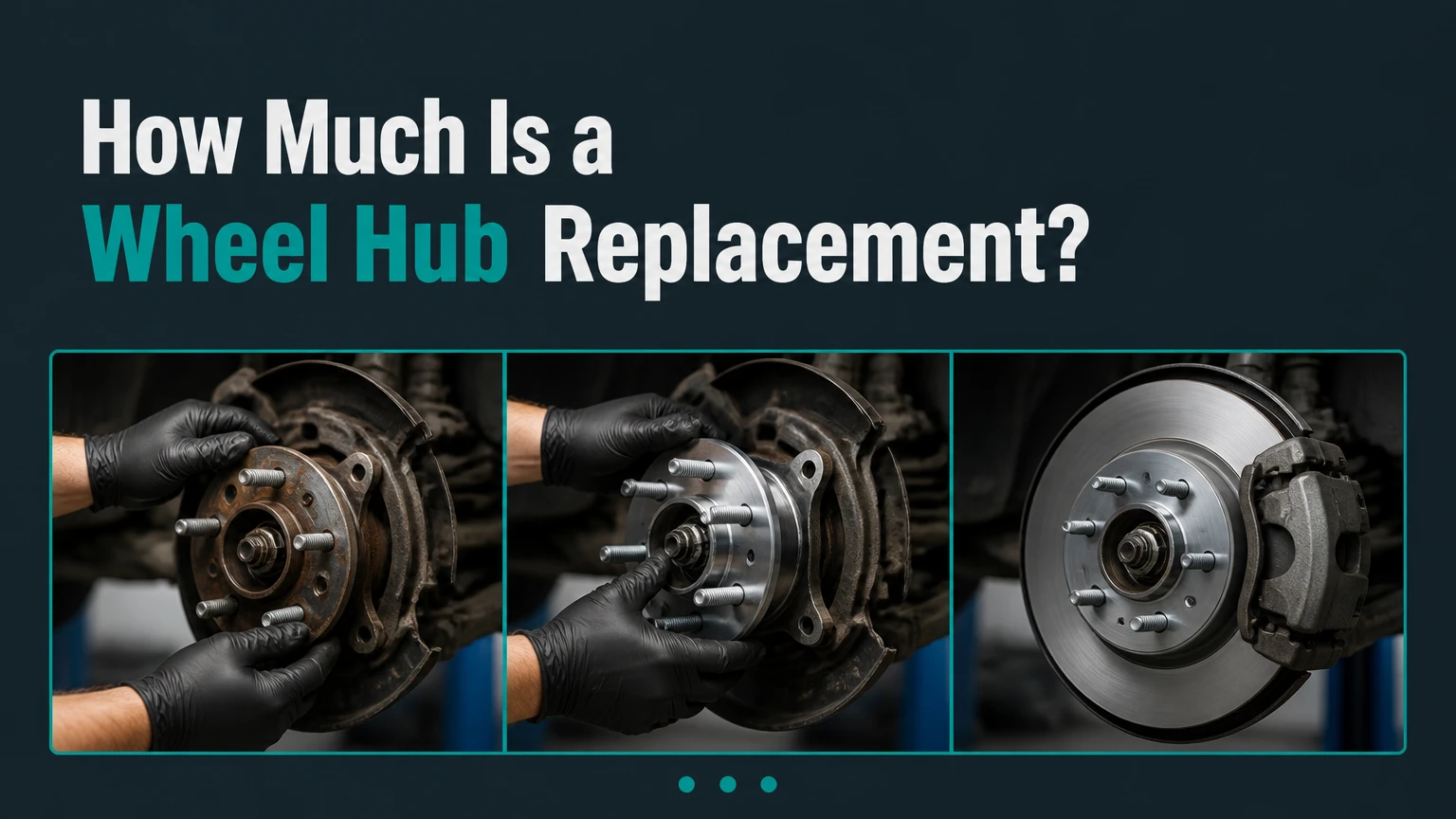
A wheel hub assembly replacement costs between $200 and $750 per wheel, including both parts and professional labor. The wheel hub part itself typically costs $50 to $450, while professional mechanic labor adds $150 to $300 for a standard one-to-two-hour installation procedure on standard passenger vehicles.
At a Glance
- Average Total Cost: $200 to $750 per assembly (parts plus professional shop labor).
- Parts Alone: $50 to $150 for economy cars; $200 to $450+ for heavy trucks and luxury cars.
- Labor Time: 1 to 1.5 hours per wheel under normal shop conditions.
- Key Cost Variables: Press-in vs. bolt-on bearings, heavy corrosion, and integrated ABS sensors.
- Replacement Rule: Replace individually upon failure; pair replacement is optional.
What Is the Difference Between a Wheel Hub and a Wheel Bearing?
A wheel bearing allows the wheel to rotate smoothly around the axle with minimal friction, while the wheel hub is the heavy metal housing that mounts the wheel rim, brake rotor, and ABS wheel speed sensor to the vehicle suspension.
On almost all modern light-duty automobiles, the wheel bearing and wheel hub are manufactured as a single sealed unit known as a complete hub assembly. Older vehicles and select modern import models utilize a separate press-in wheel bearing that fits directly inside the steering knuckle, requiring distinct disassembly procedures during replacement.
What Are the Early Symptoms of a Failing Wheel Hub?
The most common early symptom of a failing wheel hub is a low pitched roaring, humming, or growling noise that intensifies as vehicle speed increases or when leaning into turns.
Additional warning signs include steering wheel vibration, uneven tire tread wear, excessive play in the wheel when elevated on a hoist, and an illuminated anti-lock braking system (ABS) warning light on the dashboard. Ignoring these symptoms leads to increased heat generation, metallic grinding, and eventual detachment of the wheel from the vehicle spindle.
How Much Does a Wheel Hub Part Cost by Vehicle Type?
Wheel hub parts costs scale directly with vehicle weight, load ratings, electronic sensor complexity, and structural size specifications.
| Vehicle Class | Average Part Cost | Total Installed Cost (Per Wheel) | Common Models |
|---|---|---|---|
| Compact & Economy | $50 – $150 | $200 – $350 | Honda Civic, Toyota Corolla, Hyundai Elantra |
| Midsize & Crossovers | $100 – $250 | $250 – $500 | Ford Explorer, Subaru Outback, Toyota RAV4 |
| Full-Size Trucks & SUVs | $200 – $450+ | $400 – $750+ | Ford F-150, Chevrolet Silverado, RAM 1500 |
| Luxury & High-Performance | $300 – $600+ | $500 – $1,000+ | Mercedes-Benz E-Class, BMW 5 Series, Audi Q7 |
How Does an Integrated Hub Unit Differ from a Press-In Bearing?
An integrated bolt-on hub assembly unbolts directly from the steering knuckle as a single factory-sealed unit, whereas a press-in bearing requires pressing the bearing out of the knuckle using a hydraulic press.
Integrated units are more expensive as replacement components ($100 to $300) but require significantly less labor time ($150 to $200). Press-in bearings cost less as raw components ($30 to $80), but the labor costs $200 to $350 because the mechanic must fully detach the steering knuckle, remove the old bearing with specialized press tools, and press the new unit in precise alignment.
How Much Does Heavy-Duty or Dually Truck Wheel Hub Replacement Cost?
Heavy-duty Class 2 and Class 3 trucks—such as the Ford F-350, Chevrolet Silverado 3500, or RAM 3500 dual-rear-wheel (dually) models—cost between $600 and $1,200 per wheel for a complete hub replacement.
These industrial-grade hub assemblies are physically larger, feature heavy-duty tapered roller bearings, and must handle extreme towing payloads. The raw replacement hub for a dually truck regularly ranges from $400 to $800, and shop labor takes up to 2.5 hours per side due to high torque values, heavy axle shafts, and complex dual-wheel brake mounting hardware.
Why Are Luxury Vehicle Wheel Hub Replacements More Expensive?
Luxury automobile wheel hub replacements cost $500 to $1,200+ per wheel due to higher original equipment manufacturer (OEM) part prices and complex suspension geometry.
Vehicles equipped with multi-link aluminum suspensions, active air springs, adaptive damping, or integrated dynamic torque vectoring systems require substantial labor time just to clear access to the wheel hub mounting bolts. Furthermore, European luxury brands require brand-specific diagnostic calibration after installing hubs containing digital wheel-speed sensors, increasing total billable dealership labor hours.
How Does Rust and Road Salt Increase Wheel Hub Repair Costs?
Road salt and ambient humidity cause severe galvanic corrosion between the steel body of the wheel hub assembly and the surrounding aluminum steering knuckle, increasing labor costs by $100 to $300.
When corrosion fuses these two distinct metals together, standard 1-hour shop labor estimates fail. Mechanics must utilize air hammers, acetylene torches, specialized hydraulic hub removal pullers, and chemical penetrants to break the fused bond without cracking the steering knuckle. This intensive labor can extend a routine repair from 1 hour to 3 or 4 hours per wheel.
What Additional Repairs Can a Damaged Wheel Hub Cause?
A severely damaged wheel hub creates excessive heat and mechanical play that rapidly degrades adjacent braking, steering, and driveline components.
- Brake Rotors & Calipers: Wobbly wheel hubs cause uneven rotor contact, leading to severe brake rotor warping and premature brake pad destruction.
- ABS Harnesses & Sensors: Friction heat generated by failing bearings melts internal speed sensor wiring harnesses, requiring electronic replacement.
- CV Axles & Shaft Splines: Severe hub play places lateral stress on constant velocity (CV) joints, destroying axle seals and damaging axle splines.
A delayed hub repair can turn a $300 single-part replacement into a $1,000+ repair overhaul.
Why Does an Aftermarket Wheel Hub Cause ABS Warning Lights?
Low-quality aftermarket wheel hubs cause dashboard ABS and traction control warning lights because their built-in magnetic encoder rings or speed sensors fail to signal the vehicle electronic control unit (ECU) at the correct pulse frequency.
Modern electronic braking systems depend on micro-second accuracy from the hub-integrated sensor ring. Inexpensive hubs frequently feature incorrect tooth counts or low-grade magnetic material. When the ECU detects speed signal discrepancies across wheels, it disables anti-lock braking and stability control functions, requiring diagnostic inspection or replacement with an OEM-spec hub.
How Long Does It Take a Mechanic to Replace a Wheel Hub?
A professional technician takes 1 to 1.5 hours to replace a standard bolt-on wheel hub assembly under typical shop conditions.
Press-in bearing replacements require 2 to 3 hours due to the additional steps of disassembling the steering knuckle and operating a bench press. If the vehicle exhibits severe rust seam fusion or seized axle nuts, total repair times regularly extend to 3 or 4 hours.
How Much Can You Save by Replacing a Wheel Hub Yourself?
Replacing a wheel hub assembly yourself saves $150 to $300 in shop labor fees per wheel, leaving you responsible only for the cost of the replacement part ($50 to $300).
DIY replacement is feasible on modern vehicles utilizing direct bolt-on hub assemblies, provided you own a torque wrench capable of reaching 150–250 lb-ft for the main axle nut, a heavy-duty breaker bar, and a slide hammer puller. However, DIY replacement is not recommended for press-in bearings unless you own a hydraulic bench press and bearing race drivers.
Can You Drive With a Bad Wheel Hub?
No, driving with a bad wheel hub assembly is extremely unsafe and should be avoided entirely.
As the internal bearing disintegrates, friction causes exponential heat buildup capable of melting the spindle or snapping the wheel studs. In severe cases, the entire wheel, tire, and rotor assembly can completely detach from the moving vehicle, resulting in immediate loss of vehicle control and catastrophic collision risks.
Should You Replace Wheel Hub Assemblies in Pairs?
No, you do not need to replace wheel hub assemblies in pairs unless both sides are showing active signs of mechanical wear or noise.
Unlike tires, brake pads, or shock absorbers, wheel hubs operate independently and do not suffer performance imbalances if one side is newer than the other. However, if both hubs are original factory components with high mileage (exceeding 100,000 miles), replacing both simultaneously can save money on total vehicle shop downtime.
How Long Do Wheel Hub Assemblies Last Before Failing?
A high-quality original equipment wheel hub assembly typically lasts between 80,000 and 120,000 miles under normal driving conditions.
Lifespan is significantly reduced by frequent driving over deep potholes, impacts with curbs, heavy towing, off-road driving, or standing water immersion that breaks down the factory grease seals. Low-cost economy replacement hubs generally last only 30,000 to 50,000 miles under standard usage.
Does Car Insurance or Warranty Cover Wheel Hub Replacement?
Standard auto insurance does not cover routine wheel hub failure due to normal mechanical wear and tear, but collision insurance covers replacement if the damage resulted directly from an accident, curb impact, or pothole collision.
Factory bumper-to-bumper warranties and powertrain warranties usually cover wheel hub assemblies for 3 years/36,000 miles up to 5 years/60,000 miles, provided the vehicle has not been modified or overloaded beyond rated towing capacity.
The Bottom Line
Replacing a wheel hub costs $200 to $750 per wheel, with the part taking up $50 to $450 of the total bill and labor requiring $150 to $300. While bolt-on hub assemblies on standard sedans land near the lower end of this range, heavy rust corrosion, luxury suspension systems, or press-in bearing designs can drive repair bills past $1,000. Address grinding noises immediately to prevent damage to your brakes and axles, and replace hubs individually as they fail.


