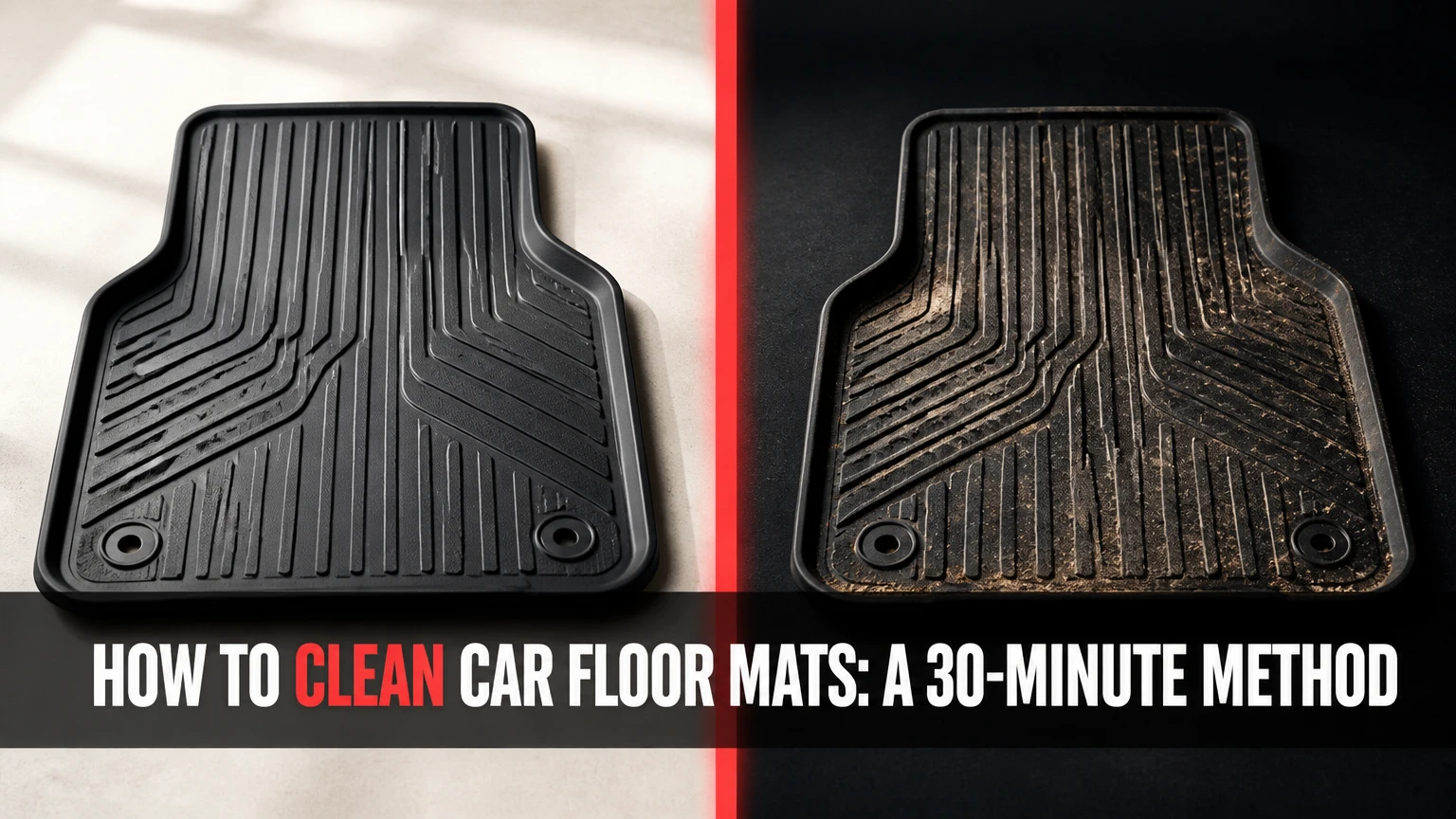
To clean car floor mats, remove them from the vehicle, shake and vacuum away loose debris, wash them according to their material, rinse or extract all residue, and dry them completely before reinstalling. Rubber mats usually take 15-30 minutes to dry, while saturated carpet mats commonly need 4-12 hours.
Key Facts at a Glance
Rubber, vinyl, and TPE mats tolerate water, but silicone tire dressing can make them dangerously slippery.
Carpet mats need low-moisture cleaning or controlled rinsing because wet backing can trap odor and mildew.
Vacuuming before washing prevents mud and grit from becoming abrasive paste inside the mat fibers.
A carpet floor mat is ready to reinstall only when the face, edges, and backing are completely dry.
White winter salt dissolves in warm water and mild vinegar solution, but vinegar should not be used indiscriminately on leatherette.
Typical DIY cleaning costs $3-$15, excluding equipment already owned.
Before You Start: Check the Mat Material
Car floor mats are usually carpet, molded rubber, vinyl, thermoplastic elastomer (TPE), or leatherette. Material determines the safe water exposure, brush stiffness, cleaner chemistry, and drying method, so identify the construction before applying any product.
Look at the underside first. A flexible molded mat with raised channels is usually rubber, vinyl, or TPE. A woven face with stitched or molded backing is carpet. Smooth, padded imitation leather requires gentler wiping and should not be saturated.
The underside also reveals whether the mat has anti-slip dots, a fabric layer, or a deteriorating foam backing. A damaged backing can shed into the vehicle even when the visible surface appears clean.
What supplies and time do you need?
A basic clean needs a vacuum, two buckets or a hose, a nylon brush, microfiber towels, and a material-appropriate cleaner. Typical total working time is 20-40 minutes for four rubber mats and 35-60 minutes for four carpet mats, excluding carpet drying.
| Item | Typical quantity | Typical cost | Use |
|---|---|---|---|
| Shop vacuum or household vacuum | 1 unit | $0-$120 | Removes grit and loose soil |
| pH-neutral car or upholstery cleaner | 250-500 ml | $5-$15 | Cleans without heavy residue |
| Nylon detailing brush | 1-2 brushes | $4-$12 | Agitates grooves and fibers |
| Microfiber towels | 4-8 towels | $5-$15 | Wipes edges and leatherette |
| Garden hose or low-pressure sprayer | 1 unit | $0-$40 | Rinses washable mats |
| Carpet extractor | 1 rental, optional | $25-$50 per day | Removes water from carpet |
Avoid starting with a pressure washer, laundry detergent pod, wire brush, or glossy dressing. Those tools can damage fibers, force water into backing, or leave a slick film under the driver’s feet.
Step 1: Remove, Shake, and Vacuum the Mats
Remove every mat from the vehicle before cleaning. Cleaning mats inside the cabin allows dirty water to reach carpet, seat rails, electrical connectors, and the floor pan, where trapped moisture dries slowly.
Open all doors or the hatch before removal. Release the driver’s mat from its factory retention clips instead of pulling against them. Put mats on a hard outdoor surface, not on a lawn where grit and cleaner can spread into soil.
Shake each mat face-down, then tap the underside against a solid surface. Do not beat a brittle rubber mat aggressively because cold plastic compounds can crack around mounting holes.
Vacuum the top, edges, and underside. Use a crevice tool along stitched borders and a brush attachment on carpet fibers. The American Automobile Association recommends removing loose debris before applying cleaning products because abrasive particles can scratch interior surfaces during agitation.
You will know Step 1 worked when no loose sand falls from the mat after two firm taps and the vacuum no longer collects visible grit.
Common mistake: spraying a dirty carpet mat immediately. Water turns dry soil into a paste that penetrates deeper and increases extraction time.
Step 2: Select a Safe Cleaner and Test a Hidden Area
Use a pH-neutral automotive cleaner for rubber and TPE, a low-residue upholstery cleaner for carpet, and a damp microfiber cloth with mild soap for leatherette. Test every cleaner on a corner or underside for five minutes before treating the visible surface.
A small test prevents color transfer, whitening, adhesive failure, and surface swelling. Read the mat manufacturer’s care instructions first, especially for branded molded liners, leatherette mats, and mats with printed logos.
| Mat material | Safe starting cleaner | Water exposure | Brush or cloth | Avoid |
|---|---|---|---|---|
| Carpet fabric | Upholstery cleaner, diluted as labeled | Controlled rinse or extraction | Soft nylon brush | Bleach, wire brush |
| Molded rubber | Mild car soap in warm water | Full rinse acceptable | Medium nylon brush | Silicone shine, petroleum solvents |
| TPE liner | pH-neutral cleaner | Full rinse, low pressure | Soft or medium nylon brush | High heat, abrasive powder |
| Vinyl | Mild dish soap solution | Short rinse, towel dry | Soft nylon brush | Strong degreaser, acetone |
| Leatherette | Damp cloth and diluted mild soap | Wipe only, no soaking | Microfiber cloth | Vinegar, alcohol, stiff brush |
Dish soap is acceptable as a temporary cleaner for heavily soiled rubber, but repeated use can remove protective additives and leave a residue. Dedicated automotive cleaners are preferable when mats are cleaned frequently.
The EPA states, “The key to mold control is moisture control.” That principle applies to vehicle interiors: cleaner chemistry matters, but preventing water from remaining in the backing matters more.
Step 3: Wash Rubber, Vinyl, and TPE Mats
Rinse rubber, vinyl, and TPE mats with a garden hose or low-pressure sprayer, apply diluted cleaner, scrub the grooves, and rinse until no foam remains. These materials can handle substantially more water than carpet, but they still require complete drying before use.
Place the mat on a slight slope so dirty water runs away from the surface. Use warm water, not boiling water, because excessive heat can soften TPE, distort molded edges, or accelerate vinyl aging.
Apply approximately 30-60 ml of diluted cleaner to a large mat, following the product label rather than guessing its concentration. Work from the cleanest edge toward the dirtiest area, using overlapping strokes that reach each channel.
Use a medium nylon brush on deep grooves and a softer brush on textured anti-slip zones. A pressure washer is usually unnecessary. If used, keep the nozzle at least 30-45 cm away and choose a wide fan pattern, because concentrated pressure can lift labels, roughen rubber, or drive grime into seams.
Rinse both surfaces. Pay special attention to the underside, where soap residue can reduce friction against the vehicle carpet.
You will know Step 3 worked when rinse water runs clear, no slick film remains, and a dry microfiber towel passes over the surface without picking up gray residue.
Common mistake: applying tire shine or silicone dressing to restore black color. A glossy mat can become a foot-slip hazard during braking. Leave the surface clean and matte.
Step 4: Deep-Clean Carpet and Fabric Mats
Clean carpet mats with a small amount of upholstery product, gentle agitation, and water extraction rather than uncontrolled soaking. Carpet fibers can tolerate scrubbing, but foam, felt, latex, and rubber backing often cannot tolerate prolonged saturation.
Start by identifying the stain. Mud should dry before vacuuming; salt needs dissolution; grease needs a compatible degreaser; coffee and food stains usually respond to upholstery cleaner and extraction.
Mist cleaner over a section approximately 30 by 30 cm. Do not flood the entire mat at once. Allow the product to dwell for the label’s stated period, commonly 3-10 minutes, while keeping the surface damp rather than wet.
Agitate with a soft or medium nylon brush in one direction, then across the fibers. Circular scrubbing can create visible nap changes on plush mats. Extract with a carpet machine, wet-dry vacuum, or several clean, barely damp towels.
If rinsing is necessary, use low water pressure and direct the stream across the face for a short period. Do not fold a saturated mat, because bending can crease the backing and trap dirty water against the carpet.
You will know Step 4 worked when the extracted water becomes pale, the fibers feel clean rather than sticky, and the backing remains flat without bubbling.
Common mistake: sprinkling dry laundry powder onto a wet automotive mat. Undissolved granules can remain in the pile, attract moisture, and create a new odor. A labeled liquid upholstery product is easier to remove.
Step 5: Remove Moisture and Dry Every Layer
Dry car floor mats vertically in moving air until the face, edges, and backing are completely dry. Rubber mats typically dry in 15-30 minutes outdoors, while carpet mats commonly require 4-12 hours after extraction and longer in humid weather.
Hang mats from a sturdy line or place them over a clean railing with both sides exposed. A fan pointed across the mat is more reliable than sunlight alone because airflow removes evaporated moisture from the backing.
Do not place wet mats on a hot engine hood, radiator, or electric heater. Localized heat can warp TPE, harden rubber, damage adhesive, or create a fire risk. Sunlight can help, but shade plus airflow is safer for dark mats and leatherette.
Press a dry towel firmly against the thickest area for 10 seconds. If the towel shows moisture or the backing feels cool and damp, continue drying. For a more objective check, compare the mat’s weight with a fully dry mat of the same type.
| Mat type | Typical surface drying | Typical complete drying | Best drying method |
|---|---|---|---|
| Molded rubber | 10-20 minutes | 15-30 minutes | Stand upright with airflow |
| TPE liner | 10-25 minutes | 20-45 minutes | Wipe channels, then air-dry |
| Vinyl | 15-30 minutes | 30-60 minutes | Towel dry away from heat |
| Low-pile carpet | 2-4 hours | 4-8 hours | Extract, then fan dry |
| Thick plush carpet | 4-8 hours | 8-12 hours | Extract repeatedly, fan both sides |
| Leatherette | 5-15 minutes | 15-30 minutes | Wipe dry with microfiber |
You will know Step 5 worked when the underside has no cool damp patches, the edges do not feel swollen, and a closed vehicle does not develop a musty smell after reinstallation.
Step 6: Clean the Footwell Before Reinstalling Mats
Vacuum the vehicle floor and inspect the footwell before returning the mats. Grit under a mat can wear through carpet, while moisture under a rubber liner can remain against metal or insulation.
Blot any wet area with a towel and leave the doors open until the floor is dry. Inspect the driver’s retention clips and confirm that each mat’s anchor hole aligns with the vehicle’s original attachment point.
Reinstall the driver’s mat only after it is flat and securely clipped. A loose or incorrectly positioned mat can interfere with accelerator or brake pedal movement. The National Highway Traffic Safety Administration has repeatedly warned drivers to use properly fitted mats and secure them with retention systems.
Place mats in their original positions. Do not stack a universal carpet mat over a molded liner unless the vehicle manufacturer specifically permits that arrangement.
How Should You Handle Specific Stains?
Specific stains need different first treatments because salt dissolves in water, grease repels water, and biological residue can remain active inside damp fibers. Treat the stain before general washing, then extract the cleaner rather than allowing residue to dry in place.
| Problem | First treatment | Dwell time | Removal method | Material limitation |
|---|---|---|---|---|
| Dried mud | Dry brushing and vacuuming | Until fully dry | Vacuum, then wash | Do not wet first |
| Road salt | Warm water, or 1:1 vinegar-water on carpet | 5-10 minutes | Blot and extract | Patch-test dyed fibers |
| Coffee | Upholstery cleaner and blotting | 3-5 minutes | Extract with clean water | Avoid rubbing outward |
| Grease | Automotive fabric degreaser | Label range, often 5-10 minutes | Extract twice | Keep solvent off vinyl |
| Milk or food | Enzyme upholstery cleaner | 10-15 minutes | Extract and air-dry | Do not mix with bleach |
| Pet urine | Enzyme cleaner for automotive upholstery | 15-30 minutes | Repeated extraction | Replace contaminated foam if persistent |
How do you remove white salt from carpet mats?
Dissolve road salt with warm water, apply a small amount of 1:1 white vinegar and water only after a colorfastness test, then blot or extract the dissolved residue. Salt returns when moisture evaporates and leaves minerals behind, so one rinse may not remove a heavily crusted winter stain.
Do not pour vinegar directly into a saturated mat. Mist the affected area, wait 5-10 minutes, agitate gently, and extract with clean water. Vinegar’s odor usually dissipates during ventilation, but it can damage or discolor some coatings.
How do you remove grease from a floor mat?
Remove grease with a labeled automotive fabric degreaser, used sparingly and followed by two clean-water extraction passes. Paper towels can lift surface oil before cleaner is applied, but rubbing spreads the stain through the pile.
Test solvent-based products on the underside. Never use gasoline, acetone, brake cleaner, or paint thinner on vehicle mats because these chemicals can dissolve backing, discolor fibers, and leave flammable residue.
How do you remove mildew odor?
For a mild odor, clean the mat, extract it thoroughly, and dry it completely in moving air. Baking soda can absorb some odor from a dry carpet mat overnight, but it does not kill mold or correct wet backing.
If visible mold, recurring odor, or damp insulation remains, inspect the vehicle for leaks around door seals, windshield trim, air-conditioning drains, and sunroof channels. The mat may be only the visible part of a larger moisture problem. Porous backing with established mold may need replacement rather than repeated deodorizing.
Which Car Mat Material Is Easiest to Maintain?
Rubber and molded TPE mats are easiest to maintain because they tolerate rinsing and do not absorb liquid like carpet. Carpet mats offer a quieter, more integrated appearance, but they require vacuuming, controlled extraction, and longer drying.
| Material | Cleaning effort | Typical drying | Stain resistance | Best user |
|---|---|---|---|---|
| Carpet | Moderate to high | 4-12 hours | Low to moderate | Dry daily commuters |
| Rubber | Low | 15-30 minutes | High | Families and muddy climates |
| TPE liner | Low | 20-45 minutes | High | Snow, rain, and off-road use |
| Vinyl | Low to moderate | 30-60 minutes | Moderate | Older vehicles and utility use |
| Leatherette | Moderate | 15-30 minutes | Moderate | Premium interiors needing gentle care |
Rubber is not automatically the best choice. A deep liner can contain mud and snow, but an incorrectly fitted or slippery mat creates a safety problem. Carpet is also not inherently unhygienic when vacuumed regularly and dried correctly.
Professional cleaning is useful when mats have extensive pet contamination, embedded grease, or odor that survives two complete cleaning and drying cycles. Typical professional pricing is $20-$60 for a set, while replacement costs vary widely by vehicle and material.
Common Mistakes and How to Fix Them
Reinstalling a damp carpet mat
Remove the mat immediately, dry it with extraction and airflow, and inspect the footwell. Repeated damp installation can create mildew odor and transfer moisture into carpet padding.
Using a wire brush
Stop brushing and vacuum loose fibers. Switch to a soft nylon brush; if the pile is permanently shredded, cleaning cannot restore its original texture.
Leaving detergent residue
Rinse or extract with clean water until the towel or recovery water shows no foam. Residue attracts dust and can make a mat feel greasy after drying.
Pressure-washing too close
Move the nozzle back to at least 30-45 cm and use a wide spray pattern. Replace a mat if pressure has separated its layers or exposed sharp backing.
Using bleach on colored carpet
Blot the area with clean water, then use a fabric-safe stain product. Bleach can permanently remove dye and weaken fibers, even when the stain itself appears lighter.
Cleaning mats inside the vehicle
Remove all mats and dry any affected floor immediately. Use towels and airflow around seat rails and trim, where hidden moisture can remain longer than surface carpet.
How Often Should You Clean Car Floor Mats?
Vacuum carpet mats weekly and deep-clean them every 2-3 months, or sooner after spills, heavy rain, or winter salt. Rinse rubber and TPE mats every 4-6 weeks under normal use, with weekly cleaning for muddy work, pets, or frequent snow.
A practical schedule depends more on contamination than mileage. A vehicle used for short winter trips can collect more damaging salt than a lightly used car in a dry climate.
| Use pattern | Vacuuming | Washing | Immediate trigger |
|---|---|---|---|
| Dry commuting | Weekly | Every 8-12 weeks | Coffee or food spill |
| Rainy climate | Weekly | Every 4-8 weeks | Mud or standing water |
| Snow and road salt | 2 times weekly | Every 2-4 weeks | White salt crust |
| Pets or children | 2-3 times weekly | Every 2-6 weeks | Urine, milk, or vomit |
| Off-road or trades work | After each outing | Weekly or as needed | Clay, oil, or metal grit |
Replace a mat when the backing is torn, the driver’s heel has worn through the surface, retention holes have split, or the mat no longer lies flat. Cleaning cannot correct a fit or structural failure.
Variations for Difficult Situations
What changes in winter?
Remove salt and slush mats more often, empty trapped water from molded channels, and dry both the mat and footwell. Winter salt can remain active after visible moisture disappears, so a warm-water rinse is more useful than a dry wipe.
What changes for pet contamination?
Wear gloves, remove solid material first, and use an enzyme cleaner labeled for upholstery. Enzyme products need adequate dwell time, but they must still be extracted and dried fully; fragrance only masks residual contamination.
What changes for leatherette mats?
Wipe leatherette with a damp microfiber cloth and diluted mild soap, then dry it immediately. Avoid vinegar, abrasive powder, steam, and prolonged soaking because coated surfaces can crack, peel, or lose their texture.
Can you machine-wash car mats?
Only machine-wash a mat when its manufacturer explicitly permits it. Rubber-backed or foam-backed automotive mats can deform, shed backing, damage a washing machine, or retain water inside stitched layers, so hand cleaning and extraction are safer defaults.
Typical Time and Cost by Cleaning Method
The lowest-cost method uses household water, a vacuum, and a small amount of mild soap, but a carpet extractor usually gives better results on thick fabric because it removes dissolved soil and moisture together.
| Method | Working time | Drying time | Typical DIY cost | Best use |
|---|---|---|---|---|
| Hose and brush | 15-30 minutes | 15-60 minutes | $0-$10 | Rubber and TPE |
| Spray and hand extraction | 30-60 minutes | 4-12 hours | $5-$20 | Lightly soiled carpet |
| Wet-dry vacuum | 25-50 minutes | 2-8 hours | $0-$120 | Frequent carpet cleaning |
| Extractor rental | 45-90 minutes | 2-6 hours | $25-$50 | Deep carpet soil |
| Professional detailer | 1-3 hours | Same day or overnight | $20-$60 | Persistent stains and odors |
These are typical consumer ranges in the United States, not fixed prices. Local labor, vehicle size, mat construction, and contamination level can change the total.
FAQ
Can I use laundry detergent to clean car floor mats?
Laundry detergent can clean some washable fabric mats, but automotive upholstery cleaner is easier to rinse and leaves less residue. If laundry detergent is the only option, dissolve a small amount completely in warm water, use it sparingly, and perform a clean-water extraction pass before drying.
Should I use baking soda on rubber mats?
Baking soda is unnecessary for routine rubber-mat cleaning and can settle into texture or grooves. Wash rubber with mild soap, rinse thoroughly, and dry it. Baking soda is more useful as a temporary odor absorber on dry carpet, where it can be vacuumed away completely.
Can I use a steam cleaner on car mats?
A steam cleaner may be suitable for some carpet mats, but heat can distort TPE, soften vinyl, loosen adhesive, or damage leatherette coatings. Use steam only when the manufacturer permits it, keep passes brief, and extract or ventilate the mat afterward.
Why do clean car mats still smell?
A lingering smell usually indicates moisture or contamination in the backing, vehicle carpet, or insulation rather than dirt on the visible surface. Dry the mat fully, inspect the footwell and HVAC drain area, and replace porous backing if odor returns after repeated extraction.
How can I keep car mats clean longer?
Vacuum regularly, use properly fitted retention clips, remove wet or muddy mats promptly, and place no loose layer over the driver’s mat. Rubber or TPE liners reduce soil penetration, while a small absorbent towel can help manage temporary winter slush without replacing the fitted mat.
When should I replace rather than clean a car mat?
Replace a mat when it is torn near the pedals, curled, slippery after residue removal, missing retention hardware, or worn through at the driver’s heel. A damaged mat can interfere with pedal operation, and no cleaning method can restore safe fit or structural support.
The Bottom Line
How to clean car floor mats depends on material, contamination, and drying conditions. Remove and vacuum every mat first, use water-resistant methods for rubber and TPE, use controlled extraction for carpet, and never reinstall a damp or unsecured driver’s mat. Clean mats are useful only when they remain dry, stable, and properly fitted.


