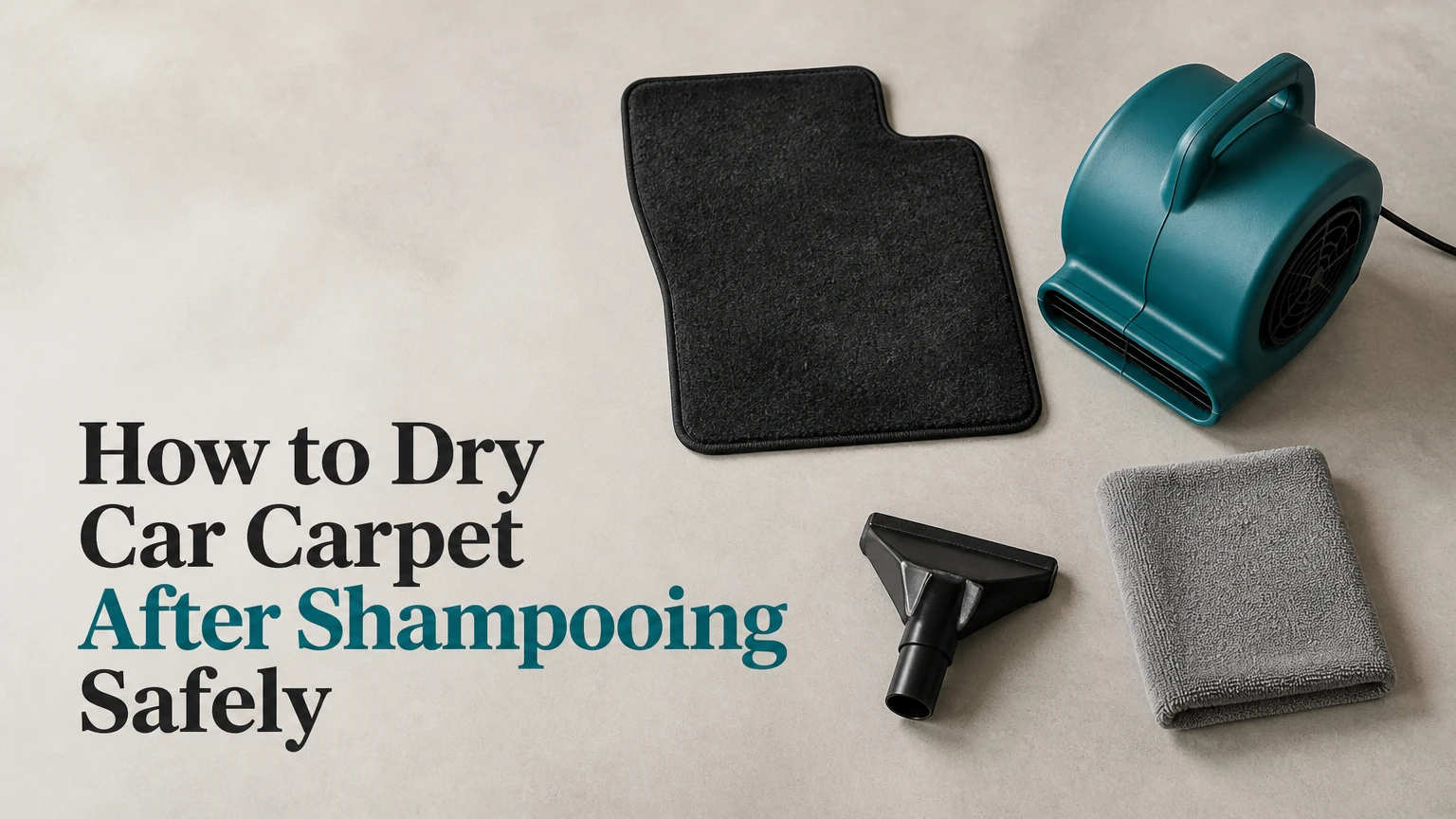
To dry car carpet after shampooing, extract as much water as possible, blot the fibers, expose the floor to moving dry air, and verify the foam padding is dry before replacing the mats. A typical lightly shampooed interior dries in 4-8 hours with strong airflow, while saturated padding can require 24 hours or carpet removal.
Key Facts at a Glance
A wet-dry vacuum or extractor removes bulk water faster than towels, but several slow overlapping passes are needed.
Carpet foam can remain wet after the visible fibers feel dry, especially around seat rails, door sills, and footwell corners.
Strong airflow reduces drying time more reliably than high heat because moving air carries humid vapor away.
A closed car in humid weather can stay damp for 24 hours or longer, even when the surface feels dry.
A moisture meter should compare readings with a known-dry area, not be forced to read 0%, because automotive materials naturally contain some moisture.
Never run a gasoline or diesel engine inside an enclosed garage, carport, or other poorly ventilated space.
What Makes Car Carpet Difficult to Dry?
Automotive carpet usually consists of a synthetic face fabric bonded to foam or another underlay over a metal floor. Shampoo solution can travel through the face fabric, collect in the foam, and migrate toward low points beneath seats and center-console edges.
The visible surface is therefore a poor indicator of total moisture. Pressing a dry towel into the carpet with firm pressure reveals more than a fingertip test, while a pinless moisture meter provides a useful relative comparison between damp and dry sections.
Drying has three parts. Extraction and blotting remove liquid water, evaporation changes remaining liquid into vapor, and convection carries that vapor away from the cabin. A fan pointed at a closed, humid vehicle may move air without reducing humidity, so ventilation or dehumidification must complete the process.
Mildew risk rises when organic residue, warmth, and trapped moisture remain together. The commonly repeated 24-48-hour warning is a practical restoration threshold, not a guaranteed biological deadline. Temperature, humidity, contamination, and padding thickness all change the outcome.
Before You Start: Tools, Time, and Safety
The minimum practical setup is a wet-dry vacuum, 4-8 absorbent microfiber towels, a soft brush, and one or two fans. A carpet extractor is useful when the carpet is heavily saturated, but an extractor should finish with multiple suction-only passes rather than leave additional rinse water behind.
| Item | Typical quantity or specification | Purpose |
|---|---|---|
| Wet-dry vacuum | 5-12 gallon, 100-150 air watts typical | Removes bulk water from carpet and foam |
| Microfiber towels | 4-8 towels, approximately 400-800 GSM | Blots residual surface moisture |
| Air mover or fan | 500-1,500 CFM typical | Moves air across floor coverings |
| Household dehumidifier | 20-50 pint/day rating | Lowers cabin humidity indoors |
| Moisture meter | Pinless or pin meter with comparative readings | Checks damp zones against dry zones |
| Nitrile gloves | 1 pair during extraction | Protects hands from dirty solution |
| Extension cord with GFCI | Outdoor-rated where applicable | Reduces electrical shock risk |
Park on a dry, level surface before opening the vehicle. Remove personal items and all floor mats, then disconnect accessories that could be damaged by moisture. Do not place a fan where rain can reach it, and do not use mains-powered equipment near standing water without appropriate ground-fault protection.
If the car is indoors, operate fans and a dehumidifier with doors positioned safely for the equipment. Do not idle the vehicle in a garage. Carbon monoxide can reach dangerous concentrations without a noticeable smell.
How to Dry Car Carpet After Shampooing
The reliable sequence is extraction, blotting, airflow, humidity control, and verification. Complete the first two actions immediately after shampooing because every additional minute allows solution to spread deeper into the padding.
Step 1: Remove Seats, Mats, and Loose Water
Remove every floor mat before drying the carpet. Rubber mats can hold water against the carpet, while carpet mats may conceal a damp area that requires separate drying.
If the carpet is soaked around seat tracks, unbolt the seats only when you understand the vehicle’s airbag, occupancy-sensor, and electrical connectors. Many modern seats contain side-airbag wiring and weight sensors. Disconnecting or reconnecting them incorrectly can trigger a warning light or create a safety fault.
Wipe visible puddles from door sills and floor depressions with a towel. Keep liquid away from seat connectors, fuse panels, amplifier modules, and wiring junctions, which may sit beneath carpet in some vehicles.
You will know this step worked when: no floor mat remains on the vehicle carpet and no free water is visible in the footwell.
Common mistake: lifting a wet mat and placing it on the vehicle roof or trunk without protection. Dry mats separately on a nonporous surface.
Step 2: Extract the Carpet and Foam Slowly
Use the wet-dry vacuum or extractor with the narrowest nozzle that still maintains strong suction. Press the nozzle firmly against the carpet, pull it in straight lines at approximately 1-2 inches per second, and overlap each pass by about one-third of the nozzle width.
Make two passes in each direction. First pull lengthwise, then work across the same area at a right angle. The second direction reaches fibers and channels that the first pass may miss. Spend extra time at seat-rail recesses, carpet seams, transmission tunnels, and the lowest corner of each footwell.
If using a carpet extractor, stop spraying solution once cleaning is complete. Make at least three slow suction-only passes, emptying the recovery tank when needed. A clear nozzle is helpful, but clear water does not prove the foam is dry.
You will know this step worked when: the recovery tank gains little water after a slow pass and the carpet no longer produces a wet sheen when pressed.
Common mistake: moving the nozzle quickly because the surface appears clean. Fast passes remove surface liquid while leaving water below the face fabric.
Step 3: Blot Remaining Moisture With Towels
Lay clean, dry microfiber towels over the wettest sections. Press down with both hands or apply body weight through a clean, flat board. Do not twist the carpet, because twisting can distort the backing or separate an adhesive bond.
Replace each towel when it becomes cool, heavy, or visibly damp. Four to eight towels may be enough for a lightly cleaned cabin, while a saturated footwell can require a dozen or more rotations. Keep one dry towel for final testing.
Blotting is particularly effective after vacuum extraction because it removes thin films of liquid that suction cannot fully collect from textured fibers. Towels also reveal whether a supposedly dry area still contains mobile surface water.
You will know this step worked when: a dry paper towel pressed firmly into the carpet for 10 seconds shows no wet outline.
Common mistake: leaving damp towels in the car overnight. Saturated fabric adds humidity and can slow drying.
Step 4: Create Cross-Ventilation and Airflow
Open the doors and hatch or trunk when the vehicle is outside in secure, dry weather. Position one fan to blow across the floor rather than directly downward, and place a second fan at another opening to move humid air out.
Airflow across the carpet increases evaporation by replacing saturated air at the fabric surface. A high-velocity air mover usually dries faster than a small desk fan, but the fan must remain stable and protected from rain, dust, and vehicle movement.
In a garage, use a dehumidifier with the doors closed enough to allow the machine to work efficiently, while maintaining safe cable routing. A dehumidifier removes vapor from the air; it cannot replace extraction when padding contains liquid water.
You will know this step worked when: the carpet surface feels progressively cooler and drier, cabin humidity falls, and windows stop fogging.
Common mistake: sealing a wet vehicle immediately after shampooing. The trapped vapor condenses on glass, plastic, headliners, and other cooler surfaces.
Step 5: Use the Vehicle A/C Carefully
Vehicle air conditioning can remove moisture from cabin air, but engine heat alone does not dry soaked foam. If outdoor conditions are safe, run the climate system with A/C enabled, fresh-air intake selected, and moderate heat directed toward the floor for 15-30 minutes while driving.
Fresh-air mode gradually replaces humid cabin air. Recirculation can reduce the energy needed to condition air, but it repeatedly circulates moisture released from the carpet. A/C operation varies by vehicle, and some systems disable the compressor under low-temperature or defrost conditions.
Do not leave a vehicle idling unattended for hours, and never operate it in an enclosed garage. The climate system is a supplement after extraction, not a substitute for a vacuum and airflow.
You will know this step worked when: interior glass remains clear and the cabin no longer feels humid after the system is switched off.
Common mistake: using maximum heat while keeping the windows closed. Hot, saturated air can redistribute moisture into the headliner and trim instead of removing it.
Step 6: Verify the Padding Before Reassembly
Test several locations, including the center of the footwell, the front edge near the seat, the door-side seam, and any low corner. Press a dry towel firmly for 10 seconds, then compare the area with a known-dry section.
A moisture meter is useful for comparison, but a universal 0% reading is not a valid requirement. Automotive carpet, foam, and metal naturally produce different readings, and meters are often calibrated for wood or building materials rather than vehicle interiors.
Lift an edge of carpet only if water continues to appear, the foam feels heavy, or the meter shows a substantially higher reading than a dry reference. Reinstall mats only when the towel test is dry, cabin humidity is normal, and no damp odor returns after the vehicle is closed for several hours.
You will know this step worked when: repeated pressure tests remain dry and readings in suspect areas approximate the dry reference.
Common mistake: testing only the center of the carpet. Water commonly remains at edges, under seat mounts, and below sound-deadening layers.
How Long Does Shampooed Car Carpet Take to Dry?
Lightly damp carpet typically dries in 2-4 hours in warm, low-humidity weather with extraction and forced air. Most shampooed interiors require 4-8 hours, while saturated foam, cold weather, high humidity, or trapped water can extend drying to 24-48 hours.
| Drying condition | Typical time | Recommended method | Main limitation |
|---|---|---|---|
| Light surface dampness, 20-25°C, below 50% relative humidity | 2-4 hours | Towel blotting plus one fan | Does not address hidden pooling |
| Normal shampoo cleaning, 20-25°C, 40-60% humidity | 4-8 hours | Wet-dry vacuum plus cross-ventilation | Requires power and secure parking |
| Cold weather, 5-15°C, above 60% humidity | 8-24 hours | Extraction, air mover, and dehumidifier | Slow evaporation |
| Foam visibly saturated or water pooled underneath | 24-48 hours or longer | Lift carpet and dry floor directly | Carpet removal may be necessary |
| Closed cabin with desiccant only | 24-72 hours | Calcium chloride or silica gel for residual vapor | Cannot remove bulk liquid |
Time estimates are typical working ranges, not guarantees. Relative humidity, air temperature, airflow, carpet thickness, and the amount of rinse water matter more than sunlight alone.
Which Drying Method Works Best?
Forced airflow after thorough extraction is the best general method for a shampooed vehicle. Passive sunlight costs nothing, but it depends on low humidity and stable weather; desiccant helps with residual vapor but cannot dry waterlogged padding.
| Method | Typical cost | Typical time | Best use | Avoid when |
|---|---|---|---|---|
| Wet-dry vacuum plus fan | $0-$150 if equipment is owned | 4-8 hours | Routine DIY shampooing | Standing water reaches electrical modules |
| Professional air mover | $20-$60 rental/day | 3-6 hours | Dense carpet and foam | Power cannot be safely routed |
| Sun and open doors | $0 | 6-24 hours | Dry, warm, secure outdoor location | Rain, dust, theft, or humidity is likely |
| Vehicle A/C while driving | Fuel cost varies, typically $3-$15 | 30-90 minutes as supplement | Final cabin dehumidification | Vehicle would idle indoors or unattended |
| Calcium chloride desiccant | $5-$15 per container | 24-72 hours | Residual humidity after extraction | Carpet contains liquid water |
A standard shop vacuum is usually sufficient for small areas if it is designed for wet pickup and has a clean filter configuration for liquid use. A carpet extractor may clean more evenly, but its spray function adds water, so drying depends on disciplined suction-only passes afterward.
Small household hair dryers are poor primary tools. Their low air volume concentrates heat on a small area, which can soften adhesives, deform plastic trim, or overheat synthetic fibers. A fan or air mover provides a safer air exchange rate.
How Should You Dry Different Car Carpet Situations?
The correct method changes with the amount and type of liquid, the weather, and the vehicle’s interior layout. Clean rinse water usually needs extraction and airflow, while milk, soda, salt water, and floodwater require contamination control as well as drying.
Light Shampoo Dampness
For a lightly damp carpet, remove the mats, run a wet-dry vacuum over each section, blot once, and use a fan for 2-4 hours. Open doors only in dry, secure weather. A brief drive with A/C can finish the cabin after the carpet has stopped releasing liquid.
Apartment or No-Power Parking
Without a power outlet, extract at a self-service wash or detail facility, then blot with several towels. Drive with A/C enabled and fresh-air intake selected for 30-60 minutes, park in a secure dry location, and leave mats out until the next inspection.
Do not rely on baking soda, silica packets, or a small desiccant tub for wet padding. Those products capture vapor slowly and cannot compete with a vacuum for bulk water.
Cold or Humid Weather
In cold or humid weather, extraction becomes more important because evaporation slows. Use a dehumidifier in a garage or enclosed workspace where safe, keep an air mover crossing the carpet, and expect 8-24 hours rather than an afternoon.
Do not leave doors open overnight if dew or rain is possible. A damp outdoor atmosphere can add moisture after the carpet has partially dried.
Milk, Soda, or Other Organic Spills
Extracting milk or sugary drinks removes water but may leave proteins, sugars, and odor-producing residue. Rinse lightly with clean water, extract again, and use a compatible enzyme cleaner according to its label before drying thoroughly.
Avoid saturating the area repeatedly. If liquid reached the foam, lift the carpet edge or obtain professional extraction because odor can return from the underlay.
Salt Water, Floodwater, or Sewage
Floodwater is not equivalent to shampoo solution. Salt, fuel, sewage, and contaminated water can damage metal, wiring, insulation, and occupant health. Disconnect the battery only when the vehicle manufacturer’s procedures allow it, document the damage, and contact an automotive restoration specialist.
A professional may remove seats, carpet, sound-deadening material, and trim, then clean the metal floor and inspect connectors. Drying the visible carpet without decontamination is not an adequate repair.
What If the Carpet Still Smells or Feels Wet?
Persistent odor or returning dampness usually indicates wet foam, trapped contamination, or detergent residue rather than a need for stronger fragrance. Re-extract the area, inspect the backing, and find the moisture source before applying another chemical.
| Symptom | Likely cause | Corrective action | Escalation point |
|---|---|---|---|
| Musty or wet-dog odor after 24 hours | Damp foam or biological residue | Lift edge, extract, enzyme-clean if compatible, and force-dry | Odor returns after two drying cycles |
| Crunchy, stiff fibers | Dried shampoo residue | Light clean-water rinse, soft agitation, then extraction | Residue covers most of the cabin |
| Windows fog repeatedly | Cabin humidity or hidden leak | Dry carpet, run A/C, inspect door seals and drains | Fogging continues after carpet is dry |
| Water pools below carpet | Waterlogged underlay or body leak | Remove trim, lift carpet, dry metal floor | Any wiring or module is wet |
| Brown or orange discoloration | Rust, contaminated water, or chemical reaction | Identify source before cleaning again | Metal corrosion or connector damage |
| Carpet dries but odor returns when closed | Moisture beneath backing | Compare padding readings and inspect low points | Carpet assembly requires removal |
Do not spray air freshener over a damp carpet. Fragrance changes the smell but does not remove water, detergent, or contamination.
White vinegar diluted with water is not a universal mold treatment for automotive interiors. Vinegar can affect dyes, adhesives, leather, and nearby trim, and it does not correct saturated foam. Use a product approved for the specific material or consult a detailer when visible mold is present.
When Should You Lift or Replace the Carpet?
Lift the carpet when water pools below it, foam remains heavy after several extraction cycles, the vehicle experienced flooding, or dampness returns after the surface passes a towel test. The goal is to dry the metal floor and inspect wiring, not merely expose more carpet to air.
Before removing seats or trim, photograph connector locations and consult the vehicle service information. Seat removal may require battery disconnection and a waiting period specified by the manufacturer because airbag circuits can remain active.
Replacement becomes more reasonable when foam has degraded, backing has delaminated, mold odor persists after professional cleaning, or contaminated water has penetrated deeply. Drying a damaged foam assembly may preserve an odor source that cannot be cleaned reliably.
An automotive detailer can handle routine wet extraction. An automotive restoration company is more appropriate for floodwater, standing water under the carpet, corroded connectors, or a soaked control module.
Common Mistakes That Slow Drying
- Stopping when the top feels dry: Press the edges and padding, not only the carpet center. Surface fibers can dry hours before the foam.
- Using heat instead of extraction: Heat increases vapor production but does not remove liquid from foam. Pair moderate warmth with airflow and humidity removal.
- Leaving mats installed: Mats block air and conceal damp zones. Dry them separately.
- Closing the cabin too soon: Trapped vapor fogs glass and migrates into trim. Close the vehicle only after humidity and pressure tests remain normal.
- Over-wetting during a rinse: A second cleaning pass can create a larger drying problem than the original residue. Apply minimal clean water and extract immediately.
- Running equipment unsafely: Keep electrical devices away from puddles, protect cords from doors, and never run an engine in an enclosed garage.
A useful professional rule is to spend more time removing water than adding cleaner. The fastest dry usually comes from a slow vacuum pass, not a hotter cabin.
The Bottom Line
To dry car carpet after shampooing, remove the mats, extract the carpet slowly in overlapping directions, blot remaining moisture, and run cross-ventilating airflow for at least 4-8 hours in typical conditions. Check corners and foam before reassembly, because a dry-looking surface can conceal trapped water.
Use a dehumidifier in humid or cold conditions, and use vehicle A/C only as a safe supplement while driving. If water pools underneath, odor returns, or contaminated liquid reached wiring, lift the carpet or arrange professional restoration instead of masking the problem.
Frequently Asked Questions
Can I leave my car overnight after shampooing?
Leave the car overnight only after bulk water has been extracted and the weather or storage area is dry. Keep mats outside the vehicle, use a fan or dehumidifier when safe, and inspect the carpet the next morning. A closed, damp cabin can fog its windows and retain moisture in the foam.
Is sunlight enough to dry a car carpet?
Sunlight can dry lightly damp carpet in roughly 6-24 hours, but sunlight alone is unreliable for thick foam or humid weather. Open doors and add airflow when conditions are safe. Direct heat without air exchange may increase cabin humidity and move moisture into trim or the headliner.
Can a shop vac remove water from the padding?
A wet-rated shop vacuum can remove substantial water from carpet padding when the nozzle is pressed firmly and moved slowly. It cannot guarantee complete foam drying, especially beneath bonded carpet or under seats. Use several overlapping passes, then verify with pressure testing and comparative moisture readings.
Should I use baking soda to dry wet automotive carpet?
Baking soda is not an effective primary drying method for wet automotive carpet. It may absorb a small amount of surface odor, but it cannot remove liquid from foam. Extract the water first, dry the padding with airflow, and address the contamination source before using any odor treatment.
Why is my car carpet crunchy after shampooing?
Crunchy automotive carpet usually contains dried detergent residue. Lightly mist the area with clean water, agitate gently with a soft brush, and perform several slow suction-only passes. Avoid adding another full shampoo application, which can drive residue deeper and lengthen drying time.
How do I know whether mold has started?
A musty odor, recurring dampness, discoloration, or visible growth can indicate microbial contamination, but odor alone does not identify the organism or its extent. Dry the area promptly, remove the moisture source, and obtain professional cleaning when contamination is extensive or the carpet padding remains wet.


