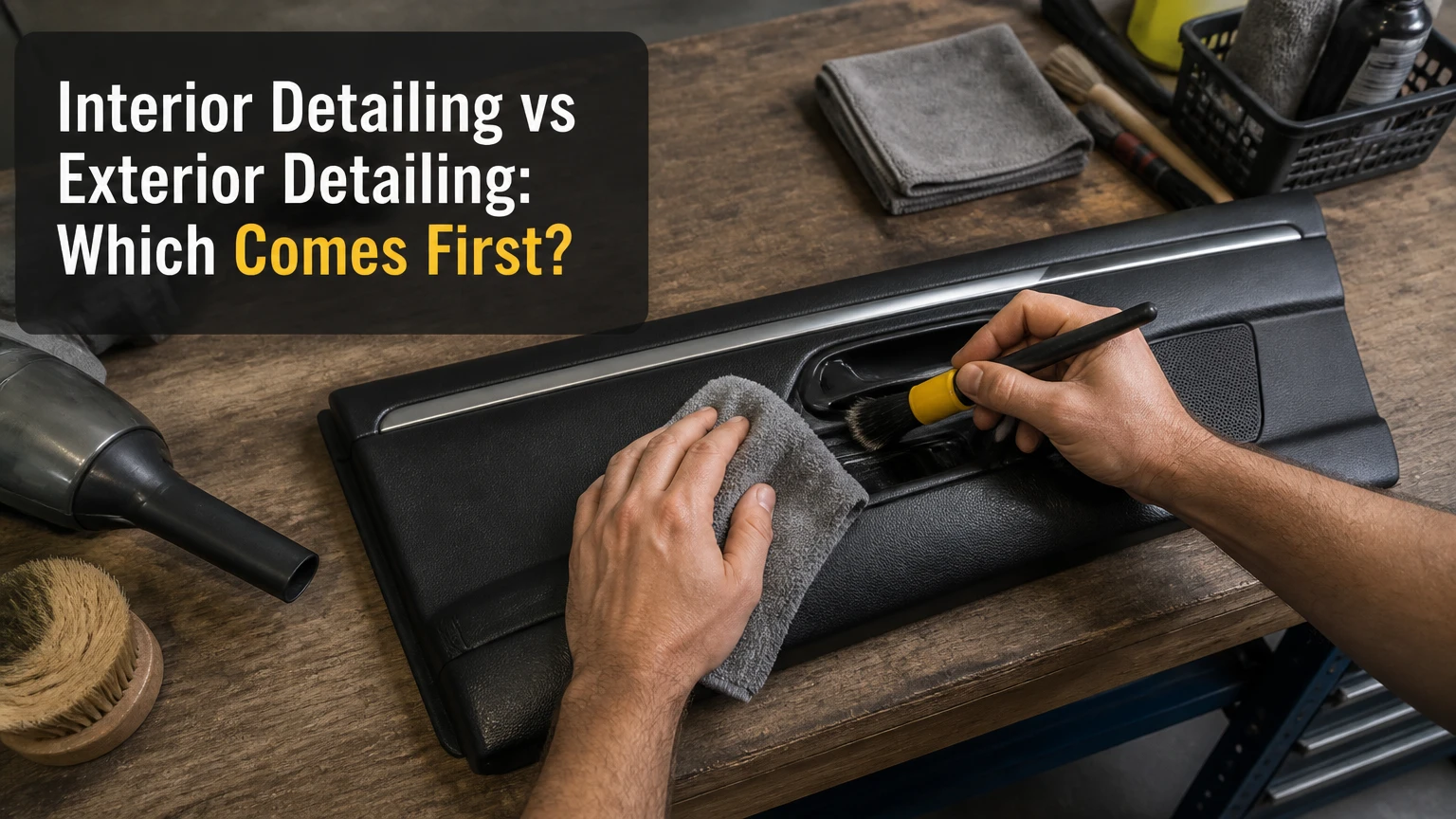
Interior detailing cleans, sanitizes, and preserves the vehicle’s cabin, while exterior detailing cleans, decontaminates, corrects, and protects the vehicle’s outer surfaces. Interior detailing usually delivers greater comfort and hygiene benefits; exterior detailing usually requires more labor and costs more when paint correction or ceramic coating is included. The right priority depends on the vehicle’s condition and purpose.
Key Facts at a Glance
Interior detailing typically costs $100-$350 and takes 2-6 hours, depending on stains, pet hair, and extraction.
Exterior detailing typically costs $150-$900 and takes 3-12 hours when decontamination, polishing, or coating is included.
Interior detailing targets upholstery, carpets, leather, plastics, glass, odors, and touch surfaces.
Exterior detailing targets paint, clear coat, wheels, tires, glass, trim, and sometimes the engine bay or underbody.
Paint correction removes a controlled amount of clear coat, so it cannot safely repair every scratch.
For most vehicles, clean the interior first, then wash and protect the exterior to prevent outside dirt from recontaminating the cabin.
What Is the Difference Between Interior and Exterior Detailing?
Interior detailing restores the vehicle’s cabin to a cleaner, safer, and more comfortable condition. Exterior detailing restores the vehicle’s visible and exposed surfaces, with emphasis on contamination removal, gloss, defect reduction, and protection from ultraviolet light, water, salts, and road film.
A basic car wash removes loose exterior dirt. A basic vacuum removes visible cabin debris. Detailing goes further by cleaning seams, seat rails, air vents, textured plastics, carpet fibers, wheel barrels, paint contamination, and neglected trim. The service becomes restorative when the technician removes stains, odors, oxidation, embedded fallout, or paint defects.
Interior and exterior detailing also use different risk controls. Interior work must limit moisture near airbags, seat electronics, switchgear, and carpet padding. Exterior work must control wash-induced marring, chemical dwell time, water-spot formation, and clear-coat removal.
What does each service include?
| Service area | Main surfaces | Typical operations | Primary result |
|---|---|---|---|
| Interior detailing | Cloth, leather, vinyl, plastic, carpet | Vacuuming, brushing, cleaning, extraction | Cleaner, less odorous cabin |
| Exterior detailing | Paint, clear coat, glass, trim | Pre-wash, contact wash, decontamination | Cleaner, smoother outer finish |
| Interior protection | Leather, fabric, plastic, screens | Conditioners, fabric coatings, matte protectants | Lower staining and UV exposure |
| Exterior protection | Paint, glass, wheels, trim | Wax, sealant, coating, wheel protection | Water behavior and contamination resistance |
Interior detailing is not upholstery replacement, mold remediation, air-conditioning repair, or leather recoloring. Exterior detailing is not collision repair, dent removal, rust reconstruction, or a guarantee that deep scratches disappear.
How Does Interior Detailing Work?
Interior detailing combines dry debris removal, material-specific chemistry, mechanical agitation, controlled moisture, and drying. Surfactants loosen oils and soil from fibers and plastics, brushes separate bonded contamination, and extraction removes dissolved soil and cleaning solution from porous materials.
A professional begins with inspection because a cloth seat, perforated leather seat, piano-black trim panel, and touchscreen require different techniques. A low-moisture method is safer around electronics, while hot-water extraction may be appropriate for heavily soiled carpet after the technician confirms that the padding can dry properly.
Steam can soften grease and reduce surface contamination, but steam is not a universal sterilization method. Temperature, dwell time, surface contact, and remaining organic soil determine the result. Ozone can reduce some persistent odors, yet it does not replace cleaning the smoke residue, milk, pet urine, or mold source that created the odor.
Interior detailing workflow
| Stage | Typical time | Tools and chemicals | Quality checkpoint |
|---|---|---|---|
| Purge and inspection | 10-20 minutes | Bags, flashlight, trim tools | Personal items and damage documented |
| Air blowout and vacuum | 30-60 minutes | Vacuum, compressed air, crevice tools | Seams, rails, pedals, and vents are debris-free |
| Surface cleaning | 30-75 minutes | pH-appropriate cleaner, brushes, microfiber | No greasy film or white residue remains |
| Fabric treatment | 30-120 minutes | Enzyme cleaner, extractor, towels | Fabric feels clean and is drying evenly |
| Leather care | 20-45 minutes | Leather cleaner, soft brush, protectant | Perforations remain open and surface is matte |
| Glass and screen cleaning | 10-20 minutes | Ammonia-free glass cleaner, screen towel | No haze, streaks, or cleaner in switch gaps |
| Drying and protection | 30-180 minutes | Fans, towels, UV protectant | Carpet and padding are dry before closure |
Which interior detail matches the problem?
| Cabin condition | Appropriate service | Typical add-on | Avoid |
|---|---|---|---|
| Dust, crumbs, light fingerprints | Standard interior detail | Matte UV protectant | Heavy extraction |
| Pet hair and embedded sand | Deep vacuum and hair removal | Rubber brushes, compressed air | Wet cleaning before hair removal |
| Coffee, food, or milk spill | Spot treatment and extraction | Enzyme cleaner for organic residue | Fragrance-only treatment |
| Smoke odor | Full surface cleaning | HVAC cleaning and controlled odor treatment | Masking odor with perfume |
| Leather drying or transfer marks | Leather cleaning and protection | Professional recoloring if damaged | Household oils or saddle soap |
| Mold or bodily-fluid contamination | Specialist remediation | Material removal when required | DIY ozone as the only treatment |
An interior detail can improve hygiene and comfort, but it does not certify that a cabin is medically sterile. For mold, bodily fluids, or extensive smoke contamination, ask whether the provider follows appropriate occupational and chemical-safety procedures and whether affected padding will be removed.
How Does Exterior Detailing Work?
Exterior detailing progresses from low-risk cleaning to increasingly invasive correction. The technician first removes loose grit, then removes bonded contamination, measures or assesses paint condition, corrects defects only when justified, and applies protection to the prepared surface.
Wheels and tires are often cleaned first because brake dust and road grime are highly abrasive. A pre-rinse or foam stage reduces loose contamination before the wash mitt touches paint. Iron removers chemically dissolve ferrous particles, while clay media physically removes remaining bonded particles; both require lubrication and careful inspection.
Paint correction uses abrasive polish and a machine or hand applicator to level the edges around selected defects. Correction reduces visible swirls and haze, but a scratch that reaches the basecoat, primer, or metal generally needs touch-up, repainting, or panel repair rather than more polishing.
Exterior detailing workflow
| Stage | Typical time | Main materials | Surface risk |
|---|---|---|---|
| Wheel and tire cleaning | 20-45 minutes | Wheel cleaner, tire cleaner, brushes | High risk on hot wheels or delicate finishes |
| Pre-wash and rinse | 15-30 minutes | Pressure washer, foam, rinse water | Lower risk when contact is delayed |
| Contact wash | 25-45 minutes | pH-balanced shampoo, mitts, rinse bucket | Marring from trapped grit |
| Chemical decontamination | 15-30 minutes | Iron remover, tar remover | Staining if allowed to dry |
| Clay decontamination | 15-40 minutes | Clay towel or bar, lubricant | Marring if lubrication is inadequate |
| Paint correction | 1-8 hours | Dual-action polisher, pads, compounds | Clear-coat removal |
| Protection | 30 minutes-3 hours | Wax, sealant, ceramic coating | High failure risk if surface is oily or wet |
A high-pH pre-wash can help remove traffic film, but strong alkaline chemistry is not automatically safer or better. Product dilution, panel temperature, dwell time, and rinsing matter more than a label claiming maximum cleaning power.
Which Service Costs More and Takes Longer?
Exterior detailing usually costs more and takes longer when it includes paint correction, ceramic coating, wheel removal, or extensive decontamination. Interior detailing becomes more expensive when technicians must remove pet hair, treat smoke or biological contamination, extract large areas, or repair damaged leather.
The following are typical US consumer price ranges, not fixed national rates. Mobile services may charge less for simple work but more for water, power, travel, or severe-condition jobs; metropolitan labor rates can exceed these figures.
| Package | Typical price | Typical time | Protection or result |
|---|---|---|---|
| Interior maintenance detail | $100-$180 | 1.5-3 hours | Clean cabin, no major extraction |
| Interior deep detail | $180-$350 | 3-6 hours | Stain reduction and deeper soil removal |
| Exterior wash and protect | $150-$300 | 2-4 hours | Wax or sealant lasting 1-6 months |
| Exterior enhancement polish | $300-$650 | 4-8 hours | Gloss improvement, minor defect reduction |
| Multi-stage correction | $600-$1,500+ | 8-20 hours | Major correction where paint allows |
| Ceramic coating preparation and application | $700-$2,000+ | 1-3 days including cure | Coating system lasting 1-5 years |
Paint correction percentages require caution. A provider promising to remove 95% of defects without measuring paint, inspecting scratch depth, and accepting clear-coat risk is making an unreliable promise. A safer quote describes the target finish and leaves room for defects that should remain for paint preservation.
Which Service Provides Longer-Lasting Protection?
Exterior protection generally lasts longer than interior dressing because paint sealants and ceramic coatings are engineered for environmental exposure. Interior products mainly reduce ultraviolet exposure, staining, and friction, and their durability depends on hand contact, clothing, cleaning frequency, and cabin temperature.
| Protection type | Surface | Typical service life | Maintenance requirement |
|---|---|---|---|
| Interior plastic dressing | Vinyl and plastic | 2-8 weeks | Reclean before reapplication |
| Interior fabric protector | Cloth and carpet | 3-12 months | Vacuum and blot spills promptly |
| Leather protectant | Coated leather | 2-6 months | Use pH-appropriate cleaner |
| Carnauba wax | Exterior paint | 1-3 months | Gentle wash and drying |
| Synthetic sealant | Exterior paint | 4-9 months | Periodic decontamination |
| Ceramic coating | Paint and some trim | 1-5 years | Coating-safe shampoo and inspection |
Ceramic coating does not make paint scratch-proof. It can improve chemical resistance, water behavior, and cleaning maintenance, but stones, keys, abrasive brushes, and careless washing can still damage the clear coat. Paint protection film provides a different form of impact protection and should be evaluated separately.
Should You Detail the Interior or Exterior First?
Detail the interior first for most full-detail appointments, then wash the exterior after the cabin work is complete. Interior cleaning can release dust, hair, and dirty water onto door sills and exterior panels, while completing the outside first can force a second wash.
The order changes in specific situations. If the exterior is covered with heavy mud, salt, or corrosive road film, rinse it before opening doors or moving around the vehicle. If a large spill requires hours of drying, clean the interior first and leave doors open in a controlled, ventilated area.
Choose by vehicle condition and purpose
| Owner situation | First priority | Recommended allocation | Reason |
|---|---|---|---|
| Family SUV with crumbs and stains | Interior | 70% interior, 30% exterior | Daily contact and odor affect use |
| Sports car with swirls | Exterior | 70% exterior, 30% interior | Paint condition drives appearance |
| Pre-sale vehicle | Both, interior first | 50% each | Buyers inspect smell, touch, and gloss |
| Lease return | Interior and wheel cleaning | 60% interior, 40% exterior | Neglected cabin defects are obvious |
| Winter-salted vehicle | Exterior rinse and decontamination | 60% exterior, 40% interior | Salt film and wheel contamination need removal |
| Allergy-sensitive household | Interior | 80% interior, 20% exterior | Dust and organic residue affect cabin comfort |
For a commuter vehicle with a clean paint finish and dirty carpets, interior detailing produces the larger practical improvement. For a garage-kept vehicle with pristine upholstery and oxidized paint, exterior correction has the stronger visible and preservation value.
What Are the Main Risks and Mistakes?
Interior detailing fails when technicians add too much water, use incompatible chemicals, or conceal odors instead of removing their source. Exterior detailing fails when grit is dragged across paint, products dry on hot panels, or polishing removes clear coat without a measured benefit.
Interior failure modes
- Over-wet carpet: Excess solution reaches the underlay and creates a musty odor. Use controlled passes, extract thoroughly, and dry with airflow before reinstalling mats.
- Flooded electronics: Liquid enters seat controls, window switches, or airbag connectors. Spray onto a towel or brush rather than directly onto controls.
- Glossy dashboard dressing: Reflections can impair windshield visibility, while dressing on pedals can reduce foot traction. Use a matte, low-slip product.
- Leather discoloration: Aggressive alkaline cleaners or dyed towels can alter coated leather. Test an inconspicuous area and use a clean white towel for inspection.
- Odor masking: Fragrance does not remove smoke residue, urine salts, or spilled food. Clean the source, the surrounding porous material, and the relevant HVAC pathway.
Exterior failure modes
- Hot-panel water spots: Minerals remain as water evaporates and may etch the finish. Work in shade on cool panels and dry promptly.
- Contaminated clay media: A dropped clay bar or towel can carry grit across paint. Discard clay that contacts the ground.
- Over-polishing: Repeated correction reduces the remaining clear coat. Preserve shallow defects when removing them would create disproportionate risk.
- Chemical staining: Iron remover, tar remover, or wheel cleaner can stain trim if allowed to dry. Follow the product’s dwell time and rinse completely.
- Coating failure: Poor preparation leaves polishing oils, residue, or moisture under the coating. Perform a panel wipe and respect the manufacturer’s cure instructions.
A useful practitioner rule is to treat clear coat as a finite thickness budget, not an unlimited repair material. Cleaning and protection are repeatable; aggressive correction is not.
Is Professional Detailing Better Than a Car Wash or DIY Cleaning?
A car wash is appropriate for removing loose exterior dirt between details, while DIY cleaning works well for maintenance when the owner has shade, safe chemicals, clean towels, and enough drying time. Professional detailing becomes worthwhile when contamination is embedded, paint defects require machine work, odors persist, or the risk of damaging expensive materials is high.
| Option | Typical cost | Best use | Main limitation |
|---|---|---|---|
| Automatic car wash | $8-$35 | Fast loose-dirt removal | Limited contamination control |
| Self-service wash bay | $10-$30 | Controlled exterior rinse and wash | No paint correction or interior extraction |
| DIY interior maintenance | $15-$80 in supplies | Weekly vacuum and spot cleaning | Slow for severe soil and odors |
| Professional interior detail | $100-$350 | Stains, hair, odor, deep cleaning | Drying time and higher labor cost |
| Professional exterior correction | $300-$1,500+ | Swirls, oxidation, gloss restoration | Clear-coat risk and maintenance demands |
Do not use household glass cleaner containing ammonia on unknown tint, oily leather products on modern coated leather, or a stiff brush on delicate suede-like upholstery. Product compatibility matters more than brand popularity.
What Should a Detailing Quote Include?
A reliable detailing quote names the exact surfaces, process, exclusions, expected condition, and protection product. A price that only says “full detail” cannot tell the customer whether it includes extraction, paint correction, engine-bay cleaning, pet-hair removal, or ceramic coating.
Ask these questions before booking:
- Does the interior price include shampooing and extraction, or only vacuuming and wiping?
- Is pet hair, smoke odor, mold, or bodily-fluid contamination priced separately?
- Does the exterior service include iron removal, clay decontamination, or polishing?
- What percentage of paint defects is the technician targeting, and what defects will remain?
- Which surfaces are excluded, such as the engine bay, underbody, convertible top, or trunk?
- How long must the vehicle remain dry after a coating or interior extraction?
- What maintenance products and wash methods preserve the result?
Photographs of the vehicle, its mileage, upholstery type, paint color, contamination, and problem areas help a provider quote accurately. Black paint, large SUVs, heavily textured interiors, and neglected vehicles normally require more labor than a compact car in maintained condition.
How Often Should Each Service Be Done?
Most vehicles benefit from interior maintenance every 2-4 weeks, a deeper interior detail every 3-6 months, exterior protection every 3-9 months, and paint correction only when defects justify removing measurable clear coat. Climate, parking, mileage, pets, children, and washing technique can change those intervals.
| Maintenance task | Suggested interval | Trigger to act sooner |
|---|---|---|
| Interior vacuum and touch-point wipe | Every 2-4 weeks | Sand, food, visible residue |
| Leather or vinyl cleaning | Every 1-3 months | Dye transfer or dry appearance |
| Deep interior extraction | Every 6-12 months | Stains, persistent odor, dampness |
| Exterior contact wash | Every 1-2 weeks | Bird droppings, salt, heavy road film |
| Iron and tar decontamination | Every 6-12 months | Rough paint after washing |
| Wax or synthetic sealant | Every 3-9 months | Weak water behavior and exposed paint |
| Paint correction | As needed, often every 2-5 years | Swirls or oxidation justify correction |
Bird droppings, bug residue, tree sap, and road salt deserve prompt removal because dwell time increases the chance of staining or etching. Routine gentle washing preserves more paint than repeated corrective polishing.
The Bottom Line
Interior detailing vs exterior detailing is not a contest with one universal winner. Choose interior detailing first when stains, hair, odors, allergens, or daily contact dominate; choose exterior detailing first when paint contamination, oxidation, corrosion exposure, or resale appearance dominates.
For a full service, clean and dry the cabin before completing the exterior wash. Spend on paint correction only after confirming that the defects are removable and the remaining clear coat can tolerate the work. A balanced maintenance plan usually produces better long-term results than an expensive one-time service followed by abrasive washing.
Frequently Asked Questions
Is interior detailing worth it for an older car?
Interior detailing is often worthwhile on an older car because cleaning improves comfort and presentation without requiring mechanical repair. A deep vacuum, stain treatment, odor-source removal, and leather or plastic protection can make a high-mileage cabin feel substantially better, although torn upholstery, broken trim, and permanent discoloration require separate repair.
Can exterior detailing remove deep scratches?
Exterior detailing can reduce or remove superficial clear-coat scratches, swirl marks, oxidation, and haze. A fingernail-catching scratch commonly extends too deeply for safe polishing, particularly when primer or metal is visible. Touch-up paint, refinishing, or panel repair is then more appropriate than repeated machine correction.
Does a full detail include the engine bay?
A full detail does not have one industry-wide scope, so engine-bay cleaning may be included, optional, or excluded. Confirm the quote before booking. Safe engine-bay work uses controlled moisture and appropriate degreasers, protects sensitive electrical areas, and avoids indiscriminate pressure washing.
How long does a freshly detailed interior take to dry?
A lightly cleaned interior may dry within 1-3 hours, while heavily extracted carpets and seat cushions can require 6-24 hours. Temperature, humidity, airflow, fabric density, and padding thickness determine the result. Do not close a damp vehicle and store it, because trapped moisture can produce mildew odors.
Is ceramic coating part of exterior detailing?
Ceramic coating is an optional exterior protection service, not an automatic part of every detail. Application requires thorough washing, chemical and mechanical decontamination, paint preparation, controlled installation, and curing. Ceramic coating improves water behavior and chemical resistance, but it does not replace washing or prevent impact damage.
Which service should I choose before selling my car?
Before selling, prioritize a clean, dry, odor-free interior and a carefully washed exterior, then add a light enhancement polish if the paint condition supports it. Heavy multi-stage correction is rarely economical on a modest-value vehicle unless severe defects are visibly reducing buyer confidence or the sale price.


