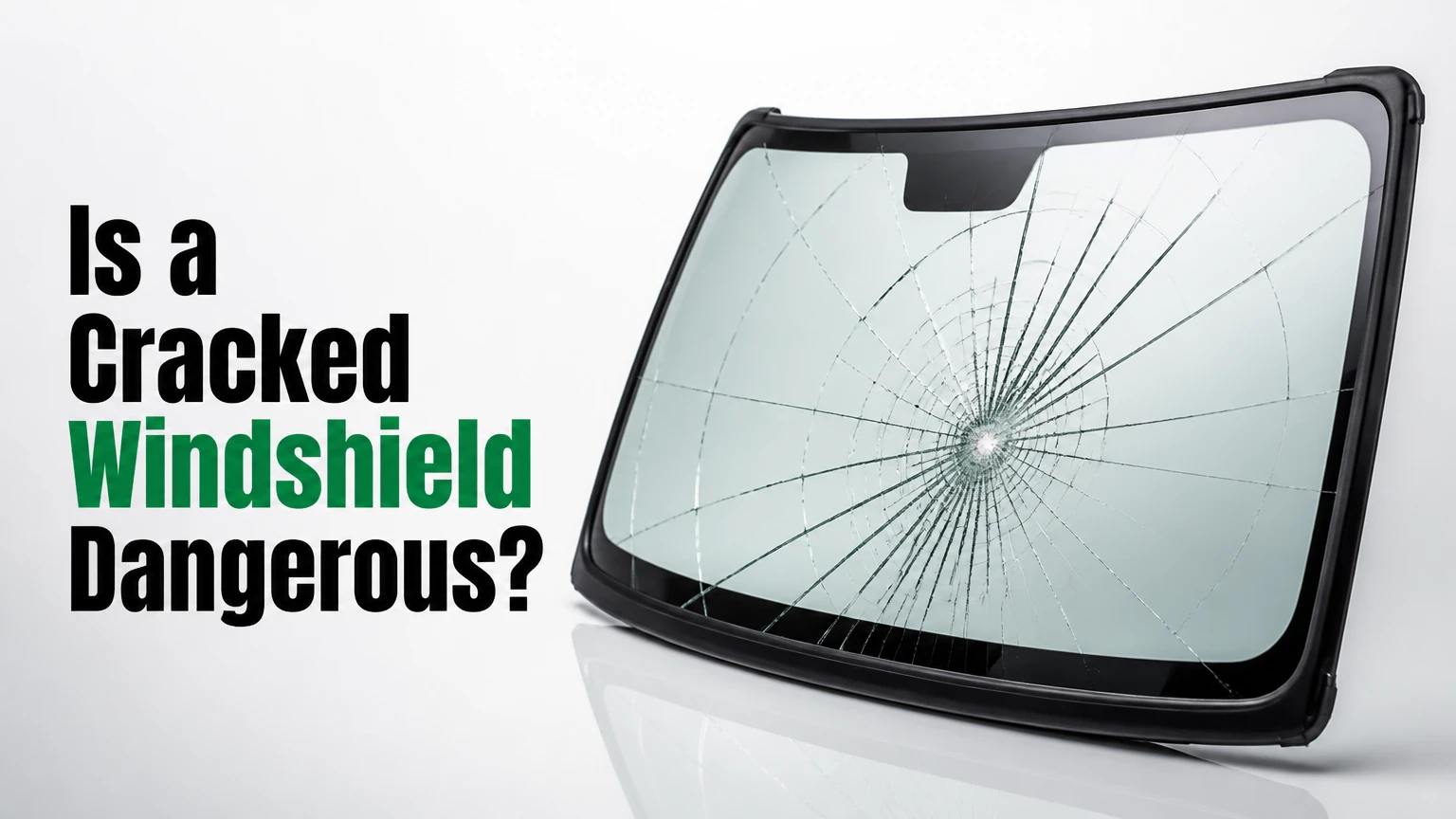
Yes, a cracked windshield is highly dangerous. It severely compromises the structural integrity of your vehicle, prevents passenger airbags from deploying correctly, and significantly increases the risk of the roof collapsing during a rollover accident. Driving with compromised auto glass often violates local traffic laws and mandates immediate professional evaluation.
Key Facts / At a Glance
- An intact windshield provides up to 60 percent of a vehicle’s structural cabin strength in a rollover collision.
- Passenger-side airbags deploy directly upward at 150 to 200 mph and rely entirely on the windshield glass to bounce backward toward the occupant.
- Cracks longer than 6 inches, or chips wider than 1 inch in diameter, typically require a complete glass replacement rather than a resin repair.
- Any fracture located within 2 inches of the outer perimeter frame severely weakens the structural urethane seal and cannot be safely repaired.
- Temperature differentials between cabin heating and exterior winter air cause micro-fractures to expand instantly due to thermal shock.
Is a Cracked Windshield Dangerous in a Collision?
A cracked windshield is highly dangerous in a collision because the glass acts as a primary structural support matrix for the entire cabin. Modern automotive glass is not merely a weather shield. It operates as a load-bearing component engineered to distribute kinetic energy away from the passenger compartment during an impact.
Automotive engineers design the windshield to prevent the roof from caving in during a rollover event. According to standards similar to the Federal Motor Vehicle Safety Standard (FMVSS) 216 for roof crush resistance, the glass must hold the roof pillars rigid. When the glass contains a stress fracture, the molecular tension is already broken. The kinetic energy of a crash focuses entirely on that weak point. The glass buckles outward or inward immediately, removing the structural resistance and allowing the heavy steel roof to collapse into the passenger space.
Furthermore, the passenger-side airbag system relies completely on the windshield for correct deployment. The explosive charge forces the airbag upward against the interior glass surface at speeds exceeding 150 mph. The glass must absorb this violent impact and force the airbag backward to cushion the passenger. A cracked windshield will fail under this explosive pressure, blowing the glass completely out of the frame. This allows the airbag to deploy outside the vehicle, leaving the passenger completely unprotected from the dashboard.
How Does Damage Compromise the PVB Interlayer?
A rock chip or fracture compromises the internal Polyvinyl Butyral (PVB) plastic layer by exposing it to atmospheric moisture, chemical contaminants, and ultraviolet radiation. An automotive windshield consists of laminated safety glass. Manufacturers press two layers of curved, annealed glass around a flexible central layer of PVB plastic. This lamination process ensures that if the glass breaks, the plastic holds the sharp shards together, preventing them from showering the occupants.
When road debris strikes the outer layer of glass, it creates a microscopic tunnel leading directly to the PVB interlayer. Moisture from rain, humidity, and car wash detergents slowly seeps into this micro-fracture. The water chemically degrades the plastic matrix, causing it to separate from the surrounding glass layers. This process is known as delamination. Once delamination begins, the affected area turns slightly cloudy or white. The structural adhesion in that specific zone drops to zero. Even if a technician injects repair resin later, the degraded plastic will never regain its original factory strength, rendering the entire pane structurally deficient.
What Are the Specific Types of Windshield Damage?
The specific types of windshield damage dictate whether the glass can hold structural tension or if it will inevitably spiderweb across the driver’s line of sight. Damage is categorized by the angle of impact, the shape of the fracture, and the depth of the initial glass penetration.
Technicians classify chips and cracks to determine the optimal repair viscosity. A bullseye requires a thicker resin to fill the crater, while a star break requires a highly viscous, low-surface-tension resin to penetrate the microscopic capillary legs.
Table 1: Types of Windshield Damage and Repair Thresholds
| Damage Classification | Shape and Structural Characteristics | Maximum Repairable Size | Immediate Spreading Risk |
| Bullseye Chip | Circular cone-shaped indentation with a dark outer ring. | Under 1.0 inch (25mm) diameter. | Low (Highly stable structure). |
| Star Break | Central impact point with fine hairline fractures radiating outward. | Under 1.5 inches (38mm) total diameter. | Extremely High (Tension points). |
| Half-Moon | Asymmetrical semi-circle caused by a glancing debris strike. | Under 1.0 inch (25mm) diameter. | Moderate. |
| Edge Crack | Linear fracture starting within 2 inches of the perimeter frame. | Zero (Mandates replacement). | Very High (Maximum chassis flex). |
| Floating Crack | Linear fracture isolated entirely in the center glass zones. | Under 6.0 inches (150mm) length. | High (Vulnerable to temperature). |
When Is Windshield Repair No Longer Safe?
Windshield repair is no longer safe when the fracture exceeds 6 inches in length, penetrates both layers of the laminated glass, or sits directly in the driver’s primary line of sight. The industry standard relies on strict mathematical boundaries to ensure the vehicle retains its factory safety ratings.
The most critical boundary is the 2-inch perimeter rule. The outer 2 inches of the glass serve as the bonding zone where structural urethane glues the windshield to the steel frame of the car. A crack in this zone compromises the glue joint itself. During a collision, a compromised perimeter allows the entire pane to detach from the vehicle.
Additionally, repairs are forbidden if the damage features three or more distinct cracks radiating from a single impact point, as the structural integrity of that localized area is permanently destroyed. Technicians also reject repairs for damage located in the critical viewing area. This area is typically defined as an 8.5-inch by 11-inch rectangle positioned directly above the steering wheel. Even flawless resin injections leave a faint visual distortion. At highway speeds, this microscopic distortion bends incoming light, causing glare and significantly reducing the driver’s reaction time.
What Makes a Crack Spread Suddenly?
A crack spreads suddenly due to the stress concentrator effect combined with thermal shock or mechanical chassis flexing. When a rock chips the glass, it creates a microscopic V-shaped fracture point. The windshield is constantly subjected to immense physical stress from cabin air pressure, road vibrations, and twisting metal. Physics dictates that all these ambient forces focus precisely at the microscopic tip of the crack, forcing the two glass layers to progressively tear apart along lines of force.
Thermal shock is the most common trigger for rapid expansion. Automotive glass possesses a specific coefficient of thermal expansion, meaning it swells when heated and shrinks when cooled. If a vehicle sits in the summer sun, the glass expands. If the driver then starts the engine and blasts the air conditioning directly onto the glass, the inner layer contracts rapidly while the outer layer remains expanded. This violent temperature differential rips the micro-fracture apart, turning a one-inch chip into a three-foot crack instantly. Similarly, hitting a pothole or a speed bump twists the vehicle’s steel frame, transferring raw kinetic energy directly into the stress concentrator and advancing the crack across the matrix.
Windshield Repair vs. Replacement: Which Should You Choose?
You should choose resin injection repair for isolated chips under one inch in diameter, and you must choose full replacement for edge cracks, deep structural separations, or any damage obstructing your vision. The decision rests entirely on the physical dimensions of the damage and the location of the impact, never on the driver’s budget preferences.
Resin repair is a localized maintenance procedure. A technician uses a specialized tool to vacuum the trapped air out of the microscopic fracture. They then inject an optical-grade epoxy resin into the void. Once exposed to ultraviolet light, the resin cures and hardens, matching the refractive index of the surrounding glass. This process takes roughly 30 to 45 minutes, retains the original factory urethane seal, and prevents the damage from spreading.
Full replacement is a major structural operation. Technicians cut through the existing urethane seal, remove the heavy glass pane, prime the raw steel frame, and apply a fresh bead of fast-curing structural adhesive. They then set a brand-new pane of glass into the frame. This restores 100 percent of the vehicle’s structural strength and optical clarity.
Table 2: Repair vs. Replacement Technical Comparison
| Metric / Requirement | Resin Injection Repair Process | Full Windshield Replacement Process |
| Technical Mechanism | Vacuum extraction followed by UV-cured epoxy injection. | Complete removal, frame priming, and new structural urethane application. |
| Typical Financial Cost | $75 to $150 (Often fully covered by insurance deductibles). | $300 to $500 (Standard glass); $700 to $1,500 (ADAS-equipped glass). |
| Time Investment | 30 to 45 minutes of active labor. | 1 to 2 hours labor plus 1 to 3 hours Safe Drive Away Time (SDAT). |
| ADAS Calibration Impact | None required (Cameras remain untouched). | Mandatory electronic recalibration of all forward-facing safety sensors. |
| Structural Restoration | Halts spreading but does not restore heavy load-bearing strength. | Restores factory-level roof crush resistance and airbag support. |
How Do Cracks Affect Advanced Driver Assistance Systems?
Cracks severely disrupt Advanced Driver Assistance Systems (ADAS) by distorting the visual data entering the forward-facing cameras mounted behind the rearview mirror. Modern vehicles rely on these cameras for lane-keep assist, automatic emergency braking, adaptive cruise control, and pedestrian detection. These highly sensitive optical sensors require an absolutely clear, mathematically perfect view through the glass.
When a crack or a poorly cured resin repair sits in front of the camera lens, it changes the refractive index of the light passing through it. The camera receives a distorted image. The vehicle’s onboard computer analyzes this corrupted data and miscalculates distances. The system might execute a sudden automatic brake on an empty highway, or worse, fail to detect a stopped vehicle ahead. If you replace the windshield, the geometry of the new glass will differ microscopically from the old glass. The shop must perform a highly precise electronic recalibration (either static with target boards or dynamic via road testing) to align the cameras with the new glass curvature. Failing to recalibrate the system leaves the vehicle legally and mechanically unsafe.
What Are the Immediate Steps to Take When Your Glass Cracks?
If your windshield cracks while you are driving, you must immediately check your line of sight, manage the cabin pressure, and protect the damage from chemical contamination. Taking the correct mechanical steps within the first hour dictates whether the glass can be saved for $100 or if it requires a $1,000 replacement.
Step 1: Verify the Line of Sight. If the crack diffracts sunlight into your eyes or obscures the road ahead, activate your hazard lights and pull over safely. Do not attempt to look past the crack while driving.
Step 2: Equalize Cabin Pressure. Roll down one of the side windows by at least an inch. The interior of a modern car is heavily sealed. When you slam a car door with all the windows rolled up, the trapped air creates a massive pressure spike that pushes outward against the glass. Equalizing the pressure prevents this spike from blowing the crack wide open.
Step 3: Stabilize the Temperature. Turn off the front defroster immediately. Do not point the air conditioning or the heating vents toward the windshield. Maintain a neutral ambient temperature in the cabin to prevent thermal shock.
Step 4: Seal Out Contaminants. Once safely parked, place a small piece of clear packing tape over the exact impact point on the outside of the glass. Do not obscure your vision. This tape prevents rain, road grime, and wiper fluid from entering the micro-fracture, keeping the area clean for a future resin injection.
What Are the Most Dangerous Maintenance Mistakes?
The most dangerous maintenance mistakes involve extreme temperature fluctuations, commercial car washes, and the misuse of retail DIY repair kits. Drivers often inadvertently destroy their own windshields by ignoring the basic physics of automotive glass.
Blasting the defroster on a frozen morning is the leading cause of sudden windshield failure. Pouring hot water over a frosted windshield causes an even faster, more violent thermal expansion, instantly shattering the pane. During the summer, washing a sun-baked car with cold hose water produces the exact same catastrophic result.
Taking a chipped windshield through an automatic car wash guarantees failure. The high-pressure water jets inject chemical detergents deep into the PVB plastic layer, ruining any chance of resin adhesion. Furthermore, the heavy mechanical brushes push physically against the glass matrix, flexing the chassis and forcing the stress concentrator to snap.
Finally, relying on “nanotechnology” retail repair gels for long cracks is highly hazardous. Consumer-grade kits are engineered exclusively for tiny, circular chips. Attempting to smear these gels into a 10-inch crack provides absolutely zero structural reinforcement. The resin dries unevenly, leaves severe optical distortion, and creates a false sense of security while the vehicle remains structurally compromised.
How Do Costs Compare Across Different Vehicle Types?
Costs vary dramatically based on the vehicle’s manufacturing year, the presence of onboard safety technology, and the specific tier of glass selected for the replacement. Understanding your vehicle profile helps prevent overpaying for unnecessary dealer parts or dangerously underpaying for substandard materials.
Table 3: Recommendations and Costs Based on User Profile
| Vehicle and Driver Profile | Recommended Glass Standard | ADAS Calibration Requirement | Estimated Total Cost Range |
| Older Vehicle (Pre-2015, No Sensors) | Aftermarket Replacement Glass (ARG). Meets basic DOT safety specs. | None. | $250 to $400. |
| Modern Tech Vehicle (ADAS Cameras) | Original Equipment Equivalent (OEE) or exact OEM Dealer Glass. | Mandatory Recalibration. | $800 to $1,500+. |
| Luxury or Leased Vehicle | OEM Dealer Glass strictly mandated by the lease contract terms. | Mandatory Recalibration. | $1,200 to $2,500+. |
| Fleet / High-Mileage Driver | Aggressive daily resin injections to prevent any replacements. | Only upon full replacement. | $75 per chip intervention. |
Frequently Asked Questions
Can you get a ticket for a cracked windshield?
Yes, law enforcement can issue traffic citations for damaged auto glass. Federal guidelines and most state laws prohibit operating a vehicle with cracks that obstruct the driver’s clear view of the road. Officers maintain the discretion to deem the vehicle unsafe and issue fines accordingly.
Will a cracked windshield fail an annual state inspection?
A damaged windshield will fail a state safety inspection if the fracture sits in the wiper sweep zone, intersects multiple other cracks, or exceeds specific length limits set by the local Department of Motor Vehicles. Passing requires immediate glass replacement before the registration can be renewed.
How long does it take for windshield replacement urethane to dry?
The structural urethane adhesive requires a specific Safe Drive Away Time (SDAT) to cure, typically ranging from one to three hours. The exact curing timeframe depends heavily on ambient humidity levels, the temperature inside the shop, and the specific chemical composition of the urethane used by the technician.
Can I wash my car immediately after a glass replacement?
You must avoid high-pressure car washes for at least 48 to 72 hours after a full windshield replacement. The structural urethane needs days to fully outgas and reach maximum bonding strength. High-pressure jets can breach the fresh seal, causing permanent air whistles and aggressive water leaks.
Does auto insurance cover windshield replacement completely?
Comprehensive auto insurance policies typically cover windshield repair and replacement, but the driver must still pay their chosen deductible. Many providers offer a specific zero-deductible full glass coverage rider, which eliminates out-of-pocket costs entirely for both resin injections and full structural replacements.
Is it safe to drive on the highway with a cracked windshield?
Driving at highway speeds with a cracked windshield is exceptionally dangerous. The increased aerodynamic pressure against the glass, combined with severe vibrations from the road surface, dramatically increases the likelihood of the glass failing inward or the crack suddenly spreading across your line of sight.


