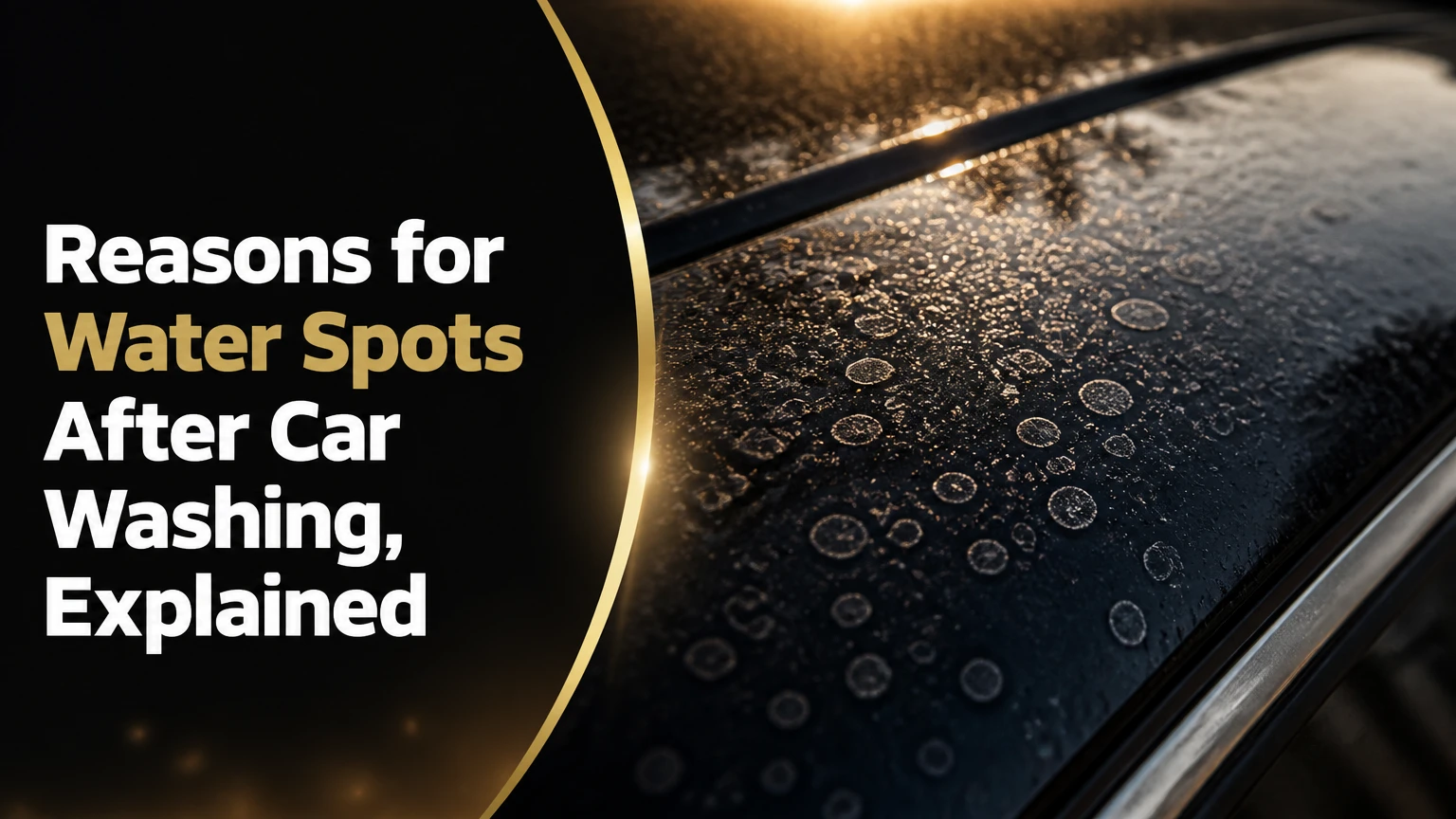
The main reasons for water spots after car washing are mineral-rich rinse water, rapid evaporation on hot paint, incomplete drying, soap or rinse-aid residue, and contamination already present on the vehicle. Water spots begin as deposits above the clear coat, but repeated heat exposure can etch the finish and create permanent-looking craters.
Key Facts at a Glance
- Hard-water spots contain nonvolatile minerals that remain after liquid water evaporates.
- A hot panel, direct sun, low humidity, and wind can dry droplets before they are towel-dried.
- A raised or chalky spot is usually removable chemically or mechanically; a recessed mark indicates etching.
- Vinegar can dissolve some alkaline mineral deposits, but it cannot repair clear-coat loss.
- Clay removes bonded contamination from the surface, while polishing levels shallow etching by removing a small amount of clear coat.
- Deionized water reduces mineral spotting, but it does not replace safe washing, rinsing, or drying.
What Are Water Spots?
Water spots are rings, dots, or cloudy patches of residue left when water dries on automotive paint, glass, trim, or wheels. The residue usually consists of dissolved minerals, although detergent film, road grime, and atmospheric pollutants can create similar marks.
The central distinction is location. A surface deposit sits on top of the clear coat and may feel rough or raised. An etched spot is a shallow depression in the clear coat, so cleaning removes the residue but leaves the outline behind.
Fresh spots are generally a cosmetic contamination problem. A vehicle repeatedly exposed to mineral deposits, heat, and sunlight can develop permanent paint damage because concentrated residue changes the surface chemistry and remains in contact with the clear coat.
Water spots versus soap streaks
Mineral spots usually form circular rings with a sharp perimeter and appear most clearly on dark paint or black glass trim. Soap residue tends to form broad smears, vertical runs, or a uniform haze, especially when too much shampoo dries before rinsing.
A simple diagnostic sequence helps:
- Wash the panel with a normal automotive shampoo.
- Rinse thoroughly with clean water.
- Wipe a small area with a damp microfiber towel.
- Inspect the mark after the panel dries.
If the mark changes into a smear, detergent or wax residue is more likely. If a fixed ring remains, dissolved minerals or etching are more likely.
Why Do Water Spots Form After Washing?
Water spots form because water evaporates while dissolved solids remain on the vehicle. Calcium, magnesium, bicarbonate, silica, sodium, and other substances stay behind as the droplet shrinks, then concentrate at the edge and crystallize on the surface.
The process normally follows five stages:
| Formation stage | What happens | Visible result | Risk |
|---|---|---|---|
| Deposition | Rinse water lands on paint, glass, or trim | Round droplets | Low |
| Concentration | Water volume decreases during evaporation | Darkening ring | Moderate |
| Crystallization | Minerals remain after liquid water disappears | Chalky residue | Moderate |
| Bonding | Residue adheres to wax, coating, or clear coat | Rough spot | Moderate |
| Etching | Heat and chemistry alter the clear-coat surface | Recessed crater | High |
Direct sunlight is an accelerator, not the root cause. A panel can become hot enough to dry droplets rapidly even when the air temperature feels moderate. Dark paint, low humidity, wind, and a warm hood or roof shorten the time available for drying.
The main reasons for water spots after car washing
1. Hard tap or well water
Hard water contains elevated calcium and magnesium. The U.S. Geological Survey classifies water with 121-180 milligrams per liter as hard and water above 180 milligrams per liter as very hard, although spotting depends on the complete mineral composition, not hardness alone.
Well water may also contain iron, manganese, silica, and suspended particles. Those substances can leave orange, brown, gray, or glassy residue that does not respond like ordinary calcium carbonate deposits.
2. Washing on hot paint
Hot paint evaporates droplets quickly. When the washer cannot rinse and dry one section before evaporation, each droplet becomes a concentrated mineral deposit.
A hot hood also causes uneven drying. The center may dry first while water remains along the grille, badge, mirror, window trim, and panel gaps, producing repeated rings in the same locations.
3. Letting rinse water air-dry
Air drying is safe only when the final water contains very few dissolved solids and the vehicle is free of chemical residue. Ordinary tap water leaves minerals behind as every droplet disappears.
A blower or drying towel removes the carrier water before minerals concentrate. A hydrophobic coating can make water leave faster, but beading creates many small droplets, so protection alone does not eliminate spotting.
4. Poor rinsing or excessive shampoo
Too much shampoo leaves surfactants and builders on the paint. Inadequate rinsing leaves a thin film that dries into streaks or attracts mineral residue.
The two-bucket method reduces soil transfer, but it does not correct mineral-rich rinse water. A clean wash mitt and proper rinsing must be combined with controlled drying.
5. Dirty or saturated drying towels
A microfiber towel loaded with grit can drag particles across soft clear coat. A towel saturated with water may push droplets rather than absorb them, leaving the lower panels wet long enough to spot.
Use separate towels for paint, wheels, glass, and door jambs. Replace a towel when it feels gritty, becomes visibly dirty, or stops absorbing.
6. Sprinkler water, rain, and runoff
Sprinklers can deposit concentrated minerals on one side of a parked vehicle. Rain can leave spots when it carries dust, pollen, industrial pollutants, or minerals from a dirty roof.
Runoff from a roof, tree, gutter, or concrete surface often creates irregular marks rather than clean circular rings. A post-wash spot is therefore not always caused by the wash itself.
7. Contaminated wash equipment or rinse aids
A dirty hose, bucket, nozzle, or pressure-washer tank can add residue to otherwise clean water. Some automatic car washes use drying agents, waxes, or reclaimed water that may leave a film if the final rinse is incomplete.
Reclaimed wash water is not automatically unsafe. Its spotting risk depends on filtration, treatment, and the quality of the final rinse.
How Can You Identify the Spot Type?
Identify the spot by its texture, response to cleaning, shape, and location. A raised deposit responds to safe chemical treatment, while an etched mark remains visible after the mineral residue has been dissolved.
| Symptom | Most likely cause | Safe test | Likely remedy |
|---|---|---|---|
| White, raised ring | Calcium or magnesium deposit | Feel after washing | Mineral remover |
| Broad greasy haze | Shampoo, wax, or rinse-aid film | Rewash with measured shampoo | Thorough rinse and panel wipe |
| Orange-brown dots | Iron contamination or well-water metals | Iron remover test | Iron remover |
| Recessed circular crater | Clear-coat etching | Inspect under angled LED light | Machine polishing |
| Irregular gray film | Rain, dust, or industrial fallout | Clay test after washing | Decontamination |
| Marks only on glass | Mineral scale or wiper residue | Glass-safe spot remover | Glass polish or chemical remover |
Do not use a fingernail aggressively. A light touch can suggest whether a mark is raised or recessed, but scraping can create a new scratch and makes diagnosis harder.
Are water spots permanent?
Water spots are not necessarily permanent. Fresh surface deposits often disappear after a dedicated mineral remover, while deeper deposits can etch the clear coat and require polishing; a deep crater may remain if leveling it would remove too much finish.
The practical test is removal progression. If a chemical remover changes the spot but leaves a faint outline, the remaining defect may be etching. If clay removes texture but not the visual ring, the mineral was bonded on top and the paint is also damaged below.
What Water Quality Causes the Most Spotting?
Water with high total dissolved solids creates more residue when it dries, but TDS alone does not predict every spot. Two water supplies with the same TDS can behave differently because silica, bicarbonate, iron, and magnesium leave different deposits.
| Water source | Typical TDS or condition | Spotting tendency | Practical response |
|---|---|---|---|
| Municipal tap water | Often 100-500+ ppm | Medium to high | Dry every panel promptly |
| Private well water | Commonly variable, 200-1,000+ ppm | High when mineral-heavy | Test hardness, iron, and TDS |
| Water-softened tap water | Lower calcium and magnesium, sodium exchanged | Medium | Still dry; sodium remains dissolved |
| Reverse-osmosis water | Often 5-50 ppm after treatment | Low to medium | Use for final rinse if output is verified |
| Deionized water | Commonly near 0 ppm | Very low mineral residue | Monitor resin exhaustion |
| Distilled water | Usually below 5 ppm | Very low | Useful for spot treatment and mixing |
A handheld TDS meter can compare sources, but it cannot identify every contaminant. A hardness test, laboratory report, or local water-quality report is more useful when well water leaves colored deposits.
The practical target of 0-50 ppm TDS is a detailing guideline, not a universal legal threshold. Water above 50 ppm can still dry cleanly when removed immediately, while low-TDS water can leave marks if the vehicle or towel contributes contamination.
How Should You Remove Fresh Water Spots?
Remove fresh spots from a cool, shaded, clean surface, starting with the least aggressive method. A normal wash comes first, followed by a dedicated mineral remover, then clay only for remaining bonded residue, and polishing only when the defect is etched.
Step 1: Wash and cool the panel
Rinse loose grit from the vehicle, wash with a pH-balanced automotive shampoo, and work in sections. Keep the paint cool to the touch, then dry it before inspecting the residue.
Success checkpoint: The panel feels clean and shows whether the marks are residue or paint defects.
Common mistake: Applying acid or abrasive products to a dusty, hot panel.
Step 2: Test a small area
Choose a hidden section or one water spot. Apply a manufacturer-approved mineral remover to a microfiber applicator rather than flooding the whole vehicle.
Allow the product to dwell only for the label time, commonly 30 seconds to 2 minutes. Do not let it dry.
Success checkpoint: The ring softens or disappears without dulling the finish.
Common mistake: Assuming a failed spot remover proves the product is ineffective when the mark is etched.
Step 3: Rinse and neutralize the residue
Wipe the treated area with a damp microfiber, then rinse thoroughly. Rewash the panel if the product label requires it, especially before applying wax, sealant, or ceramic protection.
Success checkpoint: The surface no longer feels slick from chemical residue and shows no new haze.
Common mistake: Leaving acidic residue around badges, trim, or seams.
Step 4: Clay bonded contamination
Use a fine-grade clay bar or synthetic clay towel with dedicated lubricant. Use light pressure and short passes; stop when the surface feels smooth.
Clay shears or lifts contamination from the surface. Clay does not repair a crater and can create marring that requires polishing.
Success checkpoint: A clean plastic bag glides over the panel without roughness.
Common mistake: using clay dry or continuing after the surface is already smooth.
Step 5: Polish only the remaining etching
Use a dual-action polisher with a mild finishing polish first. Work a test spot, inspect it under an LED light, and increase cut only if the defect remains and the clear coat is healthy.
A professional detailer may charge approximately $200-$800 for paint correction, while a DIY machine, pads, and compound often cost $150-$350. The exact price depends on vehicle size, paint condition, and whether protection is included.
Success checkpoint: The ring becomes level and disappears under changing light angles.
Common mistake: chasing every mark with an aggressive compound when the remaining defect is too deep to remove safely.
Which Removal Method Fits the Defect?
Chemical treatment is best for mineral residue, clay is best for texture that remains after cleaning, and polishing is best for shallow etching. No method should be selected from price alone because each removes or changes a different layer of contamination.
| Method | Typical cost | Working time | Removes surface minerals | Repairs etching | Main limitation |
|---|---|---|---|---|---|
| Rewash and dry | $2-$10 | 20-45 minutes | Sometimes | No | Fails on bonded deposits |
| Diluted vinegar test | $2-$5 | 10-20 minutes | Some fresh deposits | No | Can strip protection; never let dry |
| Dedicated mineral remover | $15-$35 | 20-45 minutes | Usually | No | Requires careful dwell control |
| Fine clay kit | $20-$45 | 45-120 minutes | Bonded residue | No | May cause micro-marring |
| Hand polish | $15-$40 | 1-3 hours | Light residue | Shallow marks | Limited correction power |
| Dual-action polishing | $150-$800 | 4-8 hours | Remaining residue | Yes, if shallow | Removes clear coat material |
Can vinegar remove car water spots?
Diluted white vinegar can soften some alkaline mineral deposits, but vinegar is a test or limited DIY remedy rather than a universal paint treatment. Use it on a cool panel, spot-test first, prevent drying, rinse thoroughly, and reapply protection afterward.
A 1:1 mixture with distilled water is commonly used for a small test area, but stronger is not safer. Vinegar may fail against silica-rich deposits, iron contamination, or etched clear coat, and repeated acid exposure can shorten the life of waxes and some sealants.
Never mix vinegar with bleach, alkaline cleaners, or other chemicals. Avoid applying household acids to unverified surfaces, matte paint, delicate aftermarket finishes, or porous trim without checking the product guidance.
Is clay safe for water spots?
Clay is safe only when the mineral residue is lubricated and the vehicle has already been washed. Fine clay can remove raised contamination, but it cannot remove a below-surface crater and may leave light marring on soft or dark paint.
A clay bar is useful when the panel feels rough after chemical treatment. It is the wrong first step for a clean, smooth panel with visible etching because unnecessary mechanical contact increases correction work.
What Mistakes Make Water Spots Worse?
The most damaging mistake is rubbing dry mineral crystals across dry paint. Hard particles can act like abrasive grit, so lubrication, shade, and a clean towel matter more than force.
Avoid these failure modes:
- Washing in direct sun: Move to shade, shorten working sections, or use a rinseless wash.
- Using a hot chemical remover: Cool the panel first because rapid evaporation can create uneven dwell and staining.
- Applying household descaler: CLR, toilet-bowl cleaner, and strong acids are not formulated for automotive clear coat.
- Scrubbing with a melamine sponge: Melamine foam is abrasive and can dull paint, trim, and clear plastics.
- Using one towel everywhere: Wheel dust and brake particles can scratch painted panels.
- Polishing before chemical removal: Abrasive correction wastes clear coat while hard residue remains on the surface.
- Applying wax over residue: Protection can trap or visually mask deposits without removing them.
A counterintuitive detailer rule is that more water is not always safer. Flooding a hot vehicle can create hundreds of rapidly drying droplets, whereas a controlled section wash followed by immediate drying leaves fewer opportunities for mineral concentration.
How Can You Prevent Spots After the Next Wash?
Prevent water spots by controlling three variables: water quality, evaporation time, and physical drying. Wash in shade, use clean equipment, rinse from the top down, dry each section immediately, and use low-TDS water when the local supply is mineral-heavy.
A reliable prevention sequence
- Wash early morning, late afternoon, or under solid shade.
- Rinse the vehicle before shampooing to remove loose grit.
- Use the manufacturer’s shampoo dilution instead of adding extra soap.
- Clean one panel or small section at a time.
- Keep the surface wet while washing, but do not allow standing water to bake.
- Rinse from the roof downward.
- Use a blower around mirrors, badges, grilles, window trim, and panel gaps.
- Dry paint with a clean, high-absorption microfiber towel.
- Replace or launder towels when they become saturated or gritty.
- Inspect dark panels before applying protection.
A final rinse with reverse-osmosis or deionized water helps when the supply is hard. Deionized water does not make a dirty wash safe, and a DI system may become ineffective when its resin is exhausted, so output TDS should be checked rather than assumed.
Do ceramic coatings prevent mineral spots?
Ceramic coatings reduce water adhesion and make deposits easier to remove, but they do not prevent minerals from drying on the vehicle. Beading can leave many small droplets, and concentrated minerals may still etch a coating or the substrate beneath it.
A coating is therefore a maintenance aid, not a substitute for drying. Follow the coating manufacturer’s chemical limits because some acidic spot removers can reduce coating performance or alter its surface behavior.
How Much Does Water-Spot Removal Cost?
Typical DIY removal costs $5-$45 for washing, chemical treatment, or clay, while professional polishing commonly costs $200-$800. Replacement of glass or repainting is a separate escalation and is rarely justified for ordinary surface deposits.
| Situation | Typical DIY spend | Typical professional spend | Expected time | Best next action |
|---|---|---|---|---|
| Fresh spots on one panel | $5-$20 | $50-$150 | 20-45 minutes | Chemical spot treatment |
| Whole-car mineral film | $25-$60 | $100-$300 | 1-3 hours | Wash, remover, and clay |
| Shallow clear-coat etching | $40-$350 | $200-$800 | 4-8 hours | Test-spot polishing |
| Severe recurring etching | $150-$500 | $500-$1,500+ | 1-2 days | Paint-correction assessment |
| Glass scale with poor visibility | $15-$60 | $75-$250 | 30-120 minutes | Glass-specific treatment |
Stop escalating when the defect is deep enough that removing it would require substantial clear-coat reduction. A clean, safe improvement is preferable to a perfectly level panel with compromised UV protection.
Why Do Spots Reappear in the Same Places?
Spots reappear when mineral residue remains in a seam, the original crater still collects water, or the vehicle is exposed to the same contaminated source. Door mirrors, roof rails, badges, grilles, windshield trim, and panel gaps commonly release water after the main drying pass.
Use an angled light after the panel is dry. If a depression remains, polishing may be necessary. If the paint is level but water keeps dripping from trim, blow out the gap, open the doors and trunk briefly, and perform a second drying pass after several minutes.
When the same marks appear after every wash, test the rinse water with a TDS meter and inspect the hose, pressure washer, bucket, and drying towels. A recurring pattern usually indicates a repeatable source rather than a mysterious paint failure.
What About Glass, Plastic, and Matte Paint?
Glass, glossy paint, plastic trim, and matte finishes require different treatment because their surfaces and repair tolerances differ. A product safe for clear-coated paint may haze plastic, stain porous trim, or create glossy patches on matte paint.
| Surface | Common deposit | Safe starting method | Avoid |
|---|---|---|---|
| Clear-coated paint | Calcium or magnesium | Automotive mineral remover | Dry scrubbing |
| Automotive glass | Mineral scale | Glass-safe remover and lubrication | Unverified abrasive pads |
| Black plastic trim | Mineral haze or detergent | Diluted product spot test | Strong acid and heat |
| Chrome or metal trim | Mineral and iron residue | Metal-safe cleaner | Aggressive clay without lubricant |
| Matte or satin paint | Mineral film | Manufacturer-approved cleaner | Machine polishing |
| Convertible fabric | Mineral and organic residue | Fabric-specific cleaner | Paint chemicals and stiff brushes |
Matte paint cannot be corrected by leveling in the same way as glossy clear coat. If a chemical treatment does not remove the mark, consult the vehicle manufacturer or a specialist before using an abrasive.
The Bottom Line
The reasons for water spots after car washing usually combine mineral-rich water with heat, delayed drying, or residue left on the surface. Diagnose the mark before choosing a remedy: clean raised deposits chemically, clay only when bonded texture remains, and polish shallow etching with a test spot. Prevent recurrence through shade, controlled washing, immediate drying, and lower-TDS final-rinse water.
Frequently Asked Questions
Do water spots mean my car was washed incorrectly?
Water spots do not automatically prove poor washing. Hard municipal or well water can spot a carefully washed vehicle if droplets dry on hot paint, while poor rinsing, excess shampoo, and contaminated towels increase the likelihood and severity of residue.
Is rainwater safer than tap water for car paint?
Rainwater is not reliably safer than tap water. Rain can collect dust, pollen, industrial pollutants, and roof contamination before reaching the vehicle, so rain-dried marks may be more chemically complex than ordinary calcium deposits from a clean water supply.
Should I dry my car with a leaf blower?
A clean leaf blower is useful for removing water from mirrors, badges, grilles, seams, and trim. Use filtered or uncontaminated airflow, keep the nozzle away from the paint, and finish with a clean microfiber towel because blowing alone may not remove every droplet.
Can water spots damage a ceramic coating?
Water spots can damage or stain a ceramic coating when mineral deposits remain under heat for extended periods. A coating usually makes removal easier, but it does not stop mineral concentration, so coated vehicles still need prompt drying and periodic maintenance.
How do I test whether my water is hard?
Use a TDS meter for a quick dissolved-solids comparison and a hardness test for calcium and magnesium specifically. A local water report can add information about iron, manganese, silica, and alkalinity, which helps explain colored or unusually stubborn deposits.


