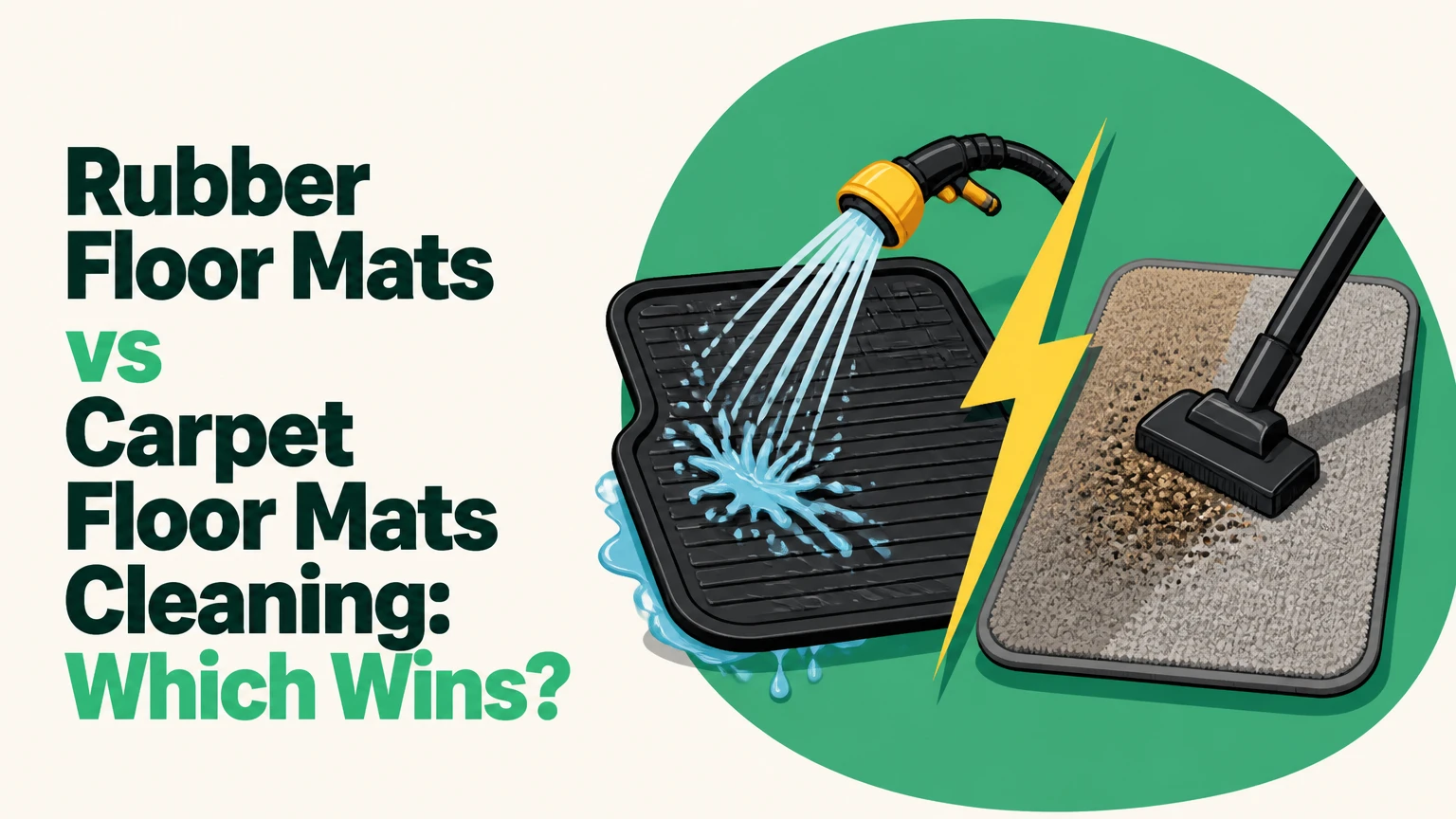
Rubber floor mats are easier and faster to clean because mud, liquid, salt, and debris remain on a washable, nonabsorbent surface. Carpet floor mats provide a quieter, more refined interior but require vacuuming, stain treatment, controlled moisture, extraction, and 12-24 hours of drying. For snow, mud, pets, and frequent spills, rubber usually wins.
Key Facts at a Glance
- Rubber and TPE floor mats typically take 5-15 minutes to wash and 10-30 minutes to dry.
- Carpet floor mats commonly require 20-45 minutes of cleaning and 12-24 hours of ventilated drying.
- TPE liners are rigid thermoplastic products, while flexible rubber mats bend and may have shallower containment channels.
- Carpet backing can delaminate or retain odor when saturated without effective extraction.
- Silicone and glossy tire dressing make rubber mats slippery and should not be used on the foot-contact surface.
- Correct retention clips and exact fit matter more than material when a mat could interfere with the accelerator or brake pedal.
How Do Rubber and Carpet Mats Differ?
Rubber floor mats trap contamination above a waterproof polymer surface, while carpet floor mats hold dust and moisture among nylon or polypropylene fibers. That fundamental difference determines the cleaning method: rubber needs rinsing and brushing, whereas carpet needs dry soil removal followed by controlled wet cleaning and extraction.
Flexible rubber mats often use synthetic rubber, vulcanized rubber, or recycled rubber. TPE and TPO liners use molded thermoplastic compounds and are usually stiffer, more precisely shaped, and more resistant to permanent deformation. TPE is commonly marketed as a premium liner material, but “rubber” and “TPE” are not interchangeable technical descriptions.
Carpet mats usually contain tufted nylon or polypropylene with a rubberized, vinyl, or thermoplastic backing. Nylon tends to provide strong abrasion resistance and a dense appearance, while polypropylene generally resists some water-based staining but can respond differently to heat and solvents. The backing is the vulnerable layer because excess water can weaken adhesives, curl edges, or create trapped odor.
The practical result is simple: rubber moves contamination away with water, while carpet separates contamination from the fiber through vacuuming, detergent, agitation, and extraction. Neither material eliminates maintenance.
Rubber Floor Mats vs Carpet Floor Mats Cleaning Compared
The following comparison uses typical passenger-vehicle products and household or professional detailing methods. Prices vary by vehicle size, brand, fit, and retailer; custom three-row liners cost more than universal front mats.
| Criterion | Flexible rubber mat | TPE or TPO liner | Standard carpet mat | Luxury carpet mat |
|---|---|---|---|---|
| Typical set price | $30-$70 | $100-$250 | $40-$90 | $100-$300 |
| Routine cleaning time | 5-10 minutes | 10-15 minutes | 20-30 minutes | 30-45 minutes |
| Typical drying time | 10-20 minutes | 15-30 minutes | 12-24 hours | 24-48 hours |
| Water absorption | 0% on surface | 0% on surface | Moderate to high | High |
| Best soil type | Mud, gravel, snow | Liquid, mud, salt | Dry dust, sand | Fine dust and light soil |
| Typical maintenance tool | Hose and nylon brush | Hose, brush, microfiber | Vacuum and upholstery brush | Vacuum, extractor, fan |
| Main failure risk | Slippery dressing or warping | Heat distortion or poor fit | Odor and backing damage | Staining and slow drying |
Which Material Cleans Faster?
Rubber cleans faster for routine contamination, usually in 5-15 minutes per set, because a hose removes loose dirt before brushing. Carpet cleaning takes longer because dry particles must be vacuumed from the fiber matrix, stains need separate treatment, and residual moisture must be extracted.
A pressure washer can shorten rubber cleaning, but high pressure is unnecessary for most mats and may force water into stitched labels, clips, or backing seams. A garden hose, medium-stiff nylon brush, and diluted automotive all-purpose cleaner handle ordinary road soil. Rinse until no cleaner remains.
Carpet mats demand patience at the first step. Vacuum both directions, including the heel pad and perimeter binding, before adding liquid. If mud is wet, allow the surface to dry enough to brush or vacuum loose particles; wet vacuuming can smear soil deeper into the pile.
Winner for cleaning speed: rubber or TPE, especially when the mat has deep channels and a raised perimeter.
Which Mats Dry More Reliably?
Rubber and TPE dry more reliably because they do not absorb water into a fiber pile, although grooves, underside ribs, and molded retention pockets can hold droplets. Carpet mats can feel dry on top while their backing remains damp, which explains why musty odors may appear a day after cleaning.
Dry rubber with a microfiber towel, then stand it vertically in shade or indirect airflow. TPE liners can be wiped and left for 15-30 minutes, but inspect every channel before installation. Direct, intense heat can distort a custom-fit liner.
Carpet mats need a clean, ventilated drying area. Hang them over a rail or place them pile-side up with a fan moving air across both surfaces. A 12-24 hour window is typical for standard mats, while dense luxury mats can need 24-48 hours in cool or humid weather.
The U.S. Environmental Protection Agency identifies moisture control as a central mold-prevention measure. That principle applies inside vehicles: extraction and airflow reduce the moisture available for odor and microbial growth.
Winner for drying reliability: rubber and TPE, provided channels and undersides are checked.
Which Mats Handle Snow, Salt, Mud, and Spills?
Rubber and TPE handle snow, salt slurry, mud, and liquid spills better because their surfaces prevent direct absorption into the vehicle carpet. Raised edges and deep channels also give the driver time to remove contamination before it reaches the floor.
Carpet mats still work well in dry climates or for drivers who remove shoes, vacuum weekly, and rarely carry wet cargo. Carpet absorbs water that would otherwise spread around the cabin, but the retained moisture becomes a liability when the mat cannot dry promptly.
Salt residue deserves special attention. Road salt can remain as a dry crust on rubber and as a white deposit within carpet fibers. Rubber lets you dissolve and rinse it away; carpet may need repeated extraction because salt migrates downward when wet.
A construction worker, skier, dog owner, or driver in a northern climate generally benefits from molded TPE liners or deep-channel rubber. A garage-kept sedan in a mild, dry climate can reasonably prioritize carpet appearance and noise control.
Winner for wet contamination: TPE or deep-channel rubber.
Which Mats Look Better and Reduce Cabin Noise?
Carpet mats generally provide the more integrated appearance and better foot feel, while dense fibers can reduce some footfall and road noise. Rubber and TPE look more utilitarian, show dried footprints clearly, and may amplify the sensation of hard debris underfoot.
Carpet also hides fine dry dust better between cleanings. That visual advantage does not mean the dirt disappeared; particles remain in the pile until vacuumed. Rubber displays sand and dust immediately, which is useful when you want a visible maintenance signal.
Luxury carpet mats often use heavier face weights, commonly around 30 ounces or more, compared with standard OEM carpet mats in the approximate 14-20 ounce range. Greater density improves appearance and comfort but extends drying time and can make extraction less efficient.
Winner for appearance and acoustic comfort: carpet, if the owner accepts slower drying and more stain management.
Which Mats Offer Better Long-Term Value?
Rubber and TPE often provide better ownership value in severe conditions because faster cleaning reduces labor and water exposure, while floor protection limits the risk of staining the vehicle’s built-in carpet. Carpet can be cheaper to replace initially, but repeated replacement makes the economics less favorable for heavy wet use.
Typical replacement pricing varies widely. A universal rubber set may cost $30-$70, an exact-fit TPE set $100-$250, and premium carpet $100-$300. Installation fit, retention hardware, warranty terms, and vehicle-specific coverage matter more than the lowest purchase price.
Rubber can age through surface hardening, cracking, odor retention, or oxidation. Carpet can flatten, fray at the heel pad, stain permanently, or separate at the backing. Neither material has a universal lifespan because ultraviolet exposure, footwear, grit, cleaning chemistry, and vehicle use dominate wear.
Winner for harsh-use value: rubber or TPE; winner for low-use cosmetic value: standard carpet.
How Do You Clean Rubber Floor Mats?
Clean rubber floor mats by removing loose debris, rinsing, applying a mild cleaner, brushing channels, rinsing completely, and drying before refitting. A typical set takes 5-15 minutes with a hose and nylon brush, and the success checkpoint is a clean, residue-free surface that does not feel greasy underfoot.
Step 1: Remove and Shake the Mats
Turn off the vehicle, open the doors, and remove each mat without dragging dirt across the sill or carpet. Shake mats outdoors over a washable surface, then brush gravel from the retention holes and underside ribs.
Never clean mats while they remain installed. Water and cleaner can run beneath the mat, and a displaced driver-side mat can interfere with pedal operation. The National Highway Traffic Safety Administration warns, “Improperly installed floor mats can interfere with the operation of the accelerator and brake pedal.”
You will know this step worked when loose gravel, sand, and dry mud no longer fall from the mat. The common mistake is shaking a wet, muddy mat inside the vehicle, which spreads contamination instead of removing it.
Step 2: Pre-Rinse the Surface
Use a hose or moderate pressure-washer setting to flush mud from the top and underside. Hold the nozzle about 18-24 inches away and avoid directing concentrated spray at clips, labels, plugs, or stitched edging.
Cold or lukewarm water is sufficient. Very hot water can soften some flexible compounds and may accelerate distortion in thin universal mats. Keep runoff away from clean carpet and storm drains when the water contains oil or chemical residue.
The surface is ready for detergent when loose soil no longer clouds the runoff. A common mistake is applying cleaner to thick mud, which wastes product and turns grit into abrasive slurry.
Step 3: Apply Cleaner and Scrub Channels
Apply a pH-neutral rubber cleaner or automotive all-purpose cleaner diluted according to its label. A typical starting point for a concentrated APC is 10:1 water to product for ordinary dirt, but the product label controls because formulas vary.
Agitate with a medium-stiff nylon brush. Work across the grooves, then along them, and use a smaller detailing brush around retention holes and raised logos. Avoid wire brushes, abrasive powders, and solvent-heavy degreasers unless the manufacturer explicitly approves them.
The mat is clean when the brush produces minimal gray foam and the channels show their original texture. The common mistake is using a glossy dressing to make rubber look darker. Silicone and tire shine can create a slippery foot surface.
Step 4: Rinse, Inspect, and Dry
Rinse until water runs clear and the mat feels squeaky rather than oily. Wipe both sides with a microfiber towel, then stand the mat vertically in shade with airflow for 10-30 minutes.
Inspect the driver’s mat for correct orientation, intact retention clips, curled edges, and contact with the factory anchors. Do not reinstall a mat that slides, folds, or overlaps another mat. A clean mat is unsafe if it does not remain fixed.
How Do You Clean Carpet Floor Mats Without Creating Odor?
Clean carpet floor mats by vacuuming first, treating stains separately, using limited upholstery cleaner, agitating gently, extracting dirty moisture, and drying both sides completely. Standard mats usually need 12-24 hours, and the success checkpoint is a dry backing with no cool, damp areas when pressed.
Step 1: Vacuum Dry Soil Thoroughly
Remove the mats and beat or brush them outdoors, then vacuum the pile in horizontal and vertical passes. Use a crevice tool around binding and a soft brush on the heel pad so grit does not remain beneath the pedals.
Dry soil removal is the highest-value step because adding water too early turns dust into paste. Vacuum the underside as well, especially if the backing has molded nibs that trap sand.
You will know the step worked when a final slow vacuum pass produces little visible debris. The common mistake is starting with shampoo because the mat looks dirty; embedded dry grit then becomes harder to remove.
Step 2: Pre-Treat Specific Stains
Identify the contaminant before choosing chemistry. Use a fabric-safe stain remover for coffee and food, a degreaser labeled safe for automotive textiles for oil, and a diluted white-vinegar solution for salt residue after testing an inconspicuous area.
Do not mix vinegar with bleach, ammonia, or other cleaners. Avoid household chlorine bleach because it can weaken fibers, remove color, and damage backing materials. Blot liquid stains from the outside toward the center rather than rubbing them outward.
For a salt crust, dissolve residue with a small amount of lukewarm water and extract it promptly. A 1:1 vinegar-water mixture is a common detailing approach, but colorfastness testing is mandatory and manufacturer instructions take priority.
Step 3: Clean the Fiber With Controlled Moisture
Spray a low-foaming carpet or upholstery cleaner evenly rather than flooding the mat. Agitate with a medium-soft upholstery brush or drill brush on a low setting, using short passes that lift fibers without roughing the backing.
Use enough product to suspend soil, not enough to saturate the entire mat. Excess foam is difficult to rinse and can leave a sticky residue that attracts new dust.
The mat is ready for extraction when the pile looks uniformly damp and soil has released. The common mistake is scrubbing aggressively, which frays loops and creates a worn patch around the driver’s heel area.
Step 4: Extract and Dry Completely
Use a carpet extractor or wet-dry vacuum to remove dirty solution. Make several slow extraction passes, then perform one pass with clean water if the cleaner instructions require rinsing.
Press a dry white towel into the backing. If the towel becomes wet or discolored, continue extracting. Hang the mat in moving air, separate it from the vehicle, and wait until the backing feels dry rather than relying on surface appearance.
A fan reduces drying time more effectively than placing the mat in direct midday sun. Heat can curl edges, fade carpet, soften adhesives, or distort plastic backing. Reinstall only when no cool dampness, sour smell, or visible moisture remains.
Which Cleaning Tools and Chemicals Are Safe?
The safest setup uses a hose for rubber, a vacuum and extractor for carpet, a nylon brush for molded channels, and pH-mild products approved for automotive materials. Tool choice should follow the mat’s construction, because high pressure and excessive moisture solve soil problems while creating fit or backing problems.
| Task | Recommended tool | Typical setting or quantity | Avoid |
|---|---|---|---|
| Loose rubber soil | Outdoor shaking and nylon brush | 2-3 minutes per mat | Striking against painted panels |
| Rubber wash | Hose and medium brush | 10:1 APC dilution | Wire brush and oily dressing |
| Carpet dry cleaning | Vacuum with upholstery attachment | 2 directions, 2 passes each | Wet vacuuming loose dry grit |
| Carpet extraction | Wet-dry vacuum or extractor | 2-4 slow passes | Leaving detergent in fibers |
| Salt treatment | Lukewarm water and tested vinegar mix | 1:1 solution, light spray | Bleach or mixed chemicals |
| Drying | Fan and shaded rack | 12-24 hours for carpet | Sealed trunk or hot dashboard |
A pressure washer is optional for rubber, not a requirement. Keep the spray broad and distant, and never assume a powerful jet is better simply because it removes visible mud quickly.
What Are the Most Common Cleaning Mistakes?
The most damaging errors are incorrect chemistry, excess water, unsafe refitting, and incomplete drying. Each mistake has a predictable recovery: rinse residue, extract moisture, replace damaged retention hardware, or stop using a mat that can move near the pedals.
- Using silicone on rubber: Rinse the surface with a mild cleaner and scrub until the oily film is gone. Do not apply tire shine to a foot-contact area.
- Soaking carpet without extraction: Use a wet-dry vacuum and airflow immediately. If the backing remains damp after 24 hours, inspect for adhesive separation and odor.
- Using bleach on colored carpet: Stop chemical use, rinse with clean water, and blot. Permanent fading cannot reliably be reversed.
- Drying TPE in intense heat: Move the liner to shade and let it cool flat. A warped liner may no longer follow its retention points.
- Reinstalling before complete drying: Continue ventilation until the backing is dry. Trapped moisture can create odor beneath the mat and wet the vehicle carpet.
- Ignoring fit after cleaning: Confirm the factory retention hooks engage and the driver’s mat cannot slide forward. Replace missing clips rather than improvising with loose fasteners.
How Do You Fix Stains, Odors, and White Residue?
Troubleshooting depends on whether the contamination is on the surface, inside the fiber, or beneath the backing. Rubber usually needs chemical residue removal, while carpet usually needs repeated low-moisture treatment and extraction rather than stronger detergent.
| Problem | Likely cause | Corrective method | Escalation point |
|---|---|---|---|
| White film on rubber | Salt or oxidation | Mild cleaner, brush, full rinse | Replace if cracking or hardened |
| Musty carpet odor | Damp backing or vehicle carpet | Enzyme product, extraction, fan | Inspect vehicle floor for moisture |
| Brown coffee mark | Tannin and sugar residue | Fabric-safe spot cleaner, blot, extract | Professional upholstery cleaning |
| Greasy black patch | Oil or shoe transfer | Automotive textile degreaser, rinse, extract | Replace if color remains permanent |
| Embedded gravel | Deep pile or wet mud | Dry fully, brush, vacuum both sides | Check heel pad wear |
| Curling edge | Heat or backing failure | Flatten while cool and dry | Replace if it lifts near pedals |
Chalky rubber residue may result from salt, product residue, or oxidation. Clean first rather than immediately conditioning, because a conditioner cannot remove mineral deposits and may conceal a deteriorating surface.
Persistent carpet odor can indicate moisture beneath the mat, not merely dirty fibers. Baking soda may absorb some surface odor, but it will not correct mold or wet padding; extract, dry, and inspect the vehicle floor before replacing the mat.
Which Mats Should Different Drivers Choose?
The best choice depends on contamination, drying opportunity, appearance priorities, and vehicle use. Rubber or TPE suits wet and dirty conditions, while carpet suits owners who prioritize OEM appearance and can maintain a consistent vacuuming and drying routine.
Daily Commuter and Family Driver
Choose exact-fit TPE liners when children carry drinks, food, mud, or snow into the cabin. Raised edges contain spills and reduce the chance that a liquid reaches the factory carpet before cleanup.
A flexible rubber mat costs less and cleans quickly, but it may not cover the footwell as precisely. Exact-fit retention and broad floor coverage matter more than brand labels.
Construction Worker and Off-Road Driver
Choose deep-channel rubber or molded TPE with a raised perimeter. These materials tolerate gravel, clay, wet boots, and repeated hose cleaning better than plush carpet.
Inspect channels after every muddy trip. A full liner can hold a surprising amount of water, but removing it carefully prevents the trapped slurry from spilling over the sill.
Luxury, Show, and Low-Mileage Owner
Choose dense carpet when the vehicle stays dry and appearance, texture, and cabin acoustics outweigh cleaning speed. Vacuum weekly and spot-treat spills immediately, because dried coffee and oil are harder to remove than fresh contamination.
Keep a second set of rubber or TPE liners for winter, beach trips, pets, or transporting dirty equipment. Seasonal swapping preserves carpet without forcing it to handle wet soil.
Pet Owner
Choose rubber or TPE for regular pet transport, especially when paws are wet or shedding is heavy. Hair and mud lift more easily from molded channels than from dense carpet fibers.
A washable cargo liner should accompany floor mats. Floor mats alone do not protect door panels, seat rails, or the cargo carpet from wet fur and vomit.
How Much Time and Money Should Cleaning Take?
Typical routine rubber cleaning costs $0-$5 in consumables and takes 5-15 minutes, while carpet cleaning costs $1-$10 at home and takes 20-45 minutes plus drying. Professional interior detailing commonly adds approximately $50-$150 or more, depending on vehicle size and stain severity.
| Cleaning approach | Rubber or TPE time | Carpet time | Typical consumable or service cost |
|---|---|---|---|
| Quick maintenance wash | 5-10 minutes | 10-20 minutes | $0-$3 at home |
| Standard home deep clean | 10-20 minutes | 30-60 minutes | $3-$15 |
| Extractor rental | Rarely needed | 45-90 minutes | $30-$60 per day |
| Professional mat cleaning | 15-30 minutes | 30-60 minutes | $20-$60 |
| Full interior detailing | Included in service | Included in service | $50-$150 or more |
Cleaning time rises with three factors: contamination depth, number of mats, and available equipment. An extractor reduces carpet residue and drying time, but it does not remove the need for airflow.
A Practical Maintenance Schedule
Clean rubber or TPE mats after muddy, salty, or visibly wet trips, and perform a quick shake or vacuum weekly. Carpet mats need vacuuming at least weekly in ordinary use, with stain treatment on the same day as any spill.
| Use condition | Rubber or TPE schedule | Carpet schedule |
|---|---|---|
| Dry city commuting | Shake or vacuum weekly | Vacuum weekly |
| Rain and snow | Rinse every 1-2 weeks | Vacuum twice weekly, dry spills immediately |
| Construction or off-road use | Rinse after each dirty trip | Use seasonal rubber liners |
| Pet transport | Vacuum weekly, wash monthly | Vacuum 2-3 times weekly |
| Salt-heavy winter roads | Rinse weekly | Extract every 2-4 weeks if damp |
| Show or low-mileage vehicle | Wash monthly | Vacuum before each event |
Check the vehicle’s built-in carpet beneath any mat at least monthly. Water can migrate beyond the mat’s edge, and a perfectly clean rubber liner cannot reveal moisture trapped underneath.
Are Rubber Mats Always the Better Choice?
Rubber mats are not always better because they sacrifice plush appearance, can show dust quickly, and may become slippery when contaminated with dressing or grease. Carpet remains the better fit for dry climates, formal interiors, and owners who value texture and are willing to maintain it.
Rubber also has limits in hot environments. Thin mats can curl or harden, and some recycled products retain a noticeable odor when new. TPE liners usually provide more precise coverage, but their higher price may not make sense for an older vehicle or a lightly used second car.
Carpet is not automatically unhygienic. Frequent vacuuming, immediate spill treatment, thorough extraction, and complete drying can keep carpet mats clean and odor-free. The failure occurs when wet carpet is returned to the cabin before the backing dries.
The expert rule of thumb is to choose for the worst contamination your vehicle regularly encounters, not the cleanest day of the year. A dry-weather owner who buys rubber may dislike the appearance, while a winter driver who buys carpet may spend more time managing moisture than enjoying the interior.
FAQ
Can I Wash Carpet Floor Mats in a Washing Machine?
Some removable fabric mats are machine-washable, but vehicle carpet mats often contain glued backing, stiff heel pads, or molded anti-slip surfaces that can be damaged by agitation and heat. Check the vehicle or mat manufacturer’s instructions first. When no approval exists, vacuum, spot-clean, extract, and air-dry instead.
Can I Use Dish Soap on Rubber Car Mats?
A small amount of mild dish soap can remove grease from some rubber mats, but automotive rubber cleaner is more predictable and easier to rinse completely. Dish-soap residue can leave a slick film. If used, dilute it heavily, scrub, rinse until the surface is non-greasy, and skip all shine dressing.
Do Rubber Mats Make a Car Smell?
New rubber or recycled-rubber mats can release a temporary odor, especially in heat, while dirty or damp carpet can produce a musty smell. Air new mats outdoors before installation, and wash them with a mild cleaner. Persistent cabin odor requires inspection beneath the mats and inside the vehicle carpet.
How Often Should I Replace Floor Mats?
Replace a floor mat when its retention hardware fails, the driver’s mat can move toward the pedals, the heel pad has worn through, or curling creates a trip hazard. Cosmetic fading alone does not require replacement. Exact timing varies, but harsh-use mats may need replacement sooner than lightly used carpet mats.
Should I Keep Both Rubber and Carpet Mats?
Keeping both sets is practical when the vehicle experiences different seasons or uses. Use carpet during dry, clean months and switch to rubber or TPE for snow, salt, mud, pets, and equipment. Store the unused set clean and fully dry so it does not develop odor or mildew.
The Bottom Line
Rubber floor mats are the easier cleaning choice for wet weather, muddy footwear, pets, children, and frequent spills because they rinse clean and dry within minutes. Carpet floor mats offer superior appearance, comfort, and dry-dust concealment, but they demand careful vacuuming, extraction, and 12-24 hours of drying. For most severe-use vehicles, choose TPE or deep-channel rubber; for dry, appearance-focused use, carpet remains appropriate. Knowing the difference between rubber floor mats vs carpet floor mats cleaning lets you choose based on actual contamination rather than appearance alone.


