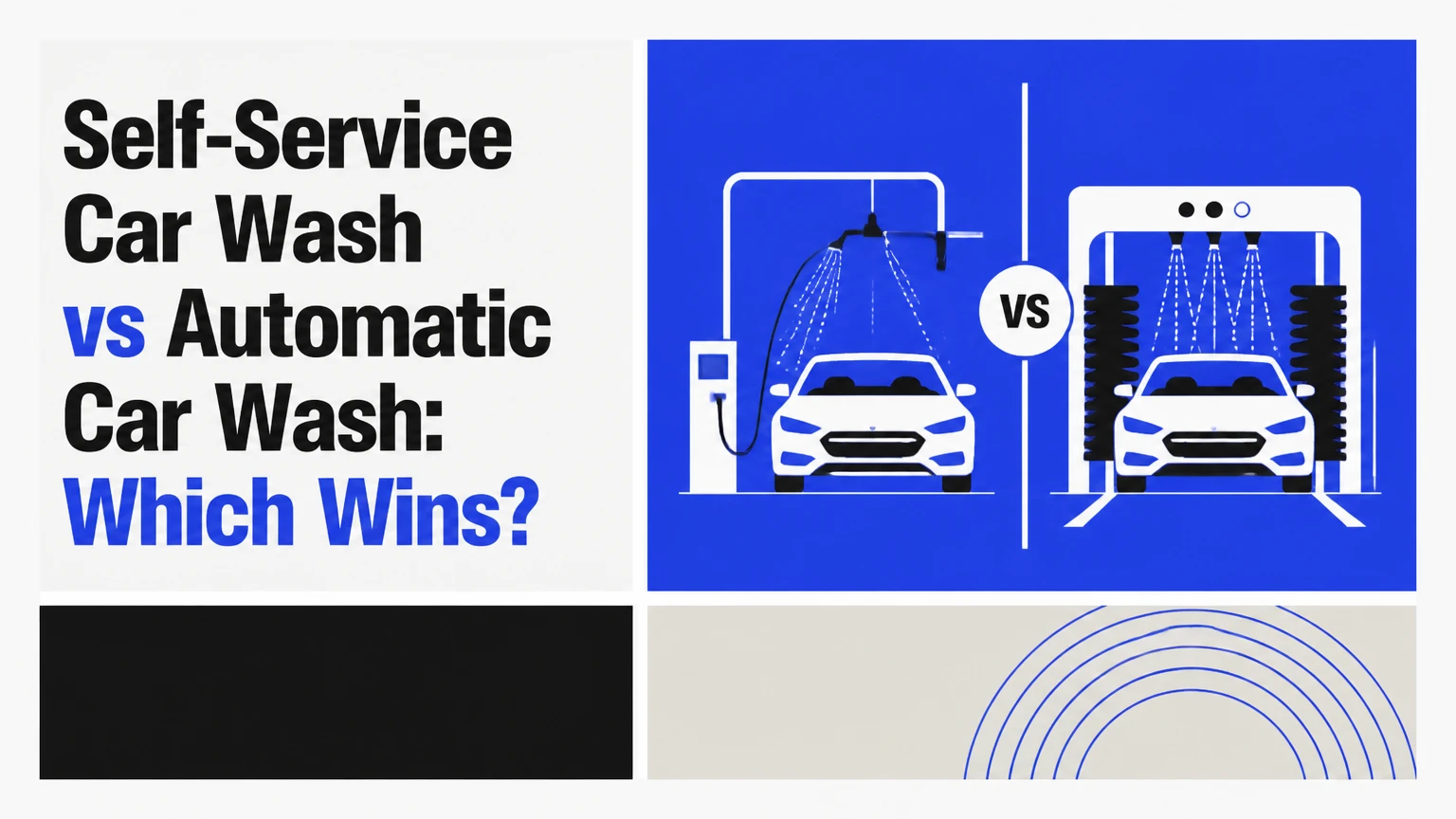
A self-service car wash is usually cheaper and gives you greater control over pressure, chemicals, and dirty areas, while an automatic car wash is faster and requires almost no effort. Choose self-service for low cost and careful cleaning, touchless automatic for convenience with minimal contact, or soft-touch automatic when speed matters more than maximum paint preservation.
Key Facts at a Glance
- A typical self-service wash costs about $3-$8 and takes 15-30 minutes, including physical work.
- A typical automatic wash costs about $8-$25 and processes a vehicle in approximately 3-7 minutes.
- Soft-touch automatic equipment contacts paint with cloth or foam materials; touchless equipment uses water pressure and detergents only.
- A clean self-service brush can scrub effectively, but a contaminated shared brush can create scratches and swirl marks.
- Touchless washing reduces contact risk but may leave bonded traffic film, road salt, or oily residue behind.
- Automatic underbody jets are generally more effective and convenient for frequent winter salt removal.
What Is the Difference Between Self-Service and Automatic Washing?
Self-service washing puts the driver in a bay with a high-pressure wand, timed controls, and usually a foaming brush. Automatic washing moves equipment around a stationary vehicle or carries the vehicle through a tunnel, applying water, detergent, friction or pressure, rinsing, and drying without manual scrubbing.
The difference is not simply human effort versus machinery. The two systems expose a vehicle to different cleaning variables: operator technique, wand distance, brush cleanliness, detergent concentration, water pressure, equipment maintenance, and drying quality.
A self-service bay commonly offers pre-soak, tire or wheel cleaner, high-pressure wash, foam brush, rinse, liquid wax, and spot-free rinse selections. A drive-through automatic may add wheel arches, underbody spray, triple foam, sealant, and air dryers to a package. Available settings vary by location, so package names do not guarantee identical cleaning performance.
How do the automatic wash types differ?
Automatic washes fall into three practical categories:
| Automatic type | Vehicle movement | Cleaning contact | Typical processing time |
|---|---|---|---|
| In-bay rollover | Stationary, arch moves | Cloth, foam, or water jets | 5-10 minutes |
| Conveyor soft-touch tunnel | Conveyor carries vehicle | Rotating or hanging media | 3-7 minutes |
| Conveyor touchless tunnel | Conveyor carries vehicle | High-pressure water and chemicals | 4-8 minutes |
| Gas-station automatic bay | Stationary, machine cycles | Usually friction or touchless | 5-12 minutes |
Soft-touch systems use closed-cell foam, cloth strips, or microfiber-like materials. Touchless systems depend on detergent chemistry, nozzle coverage, dwell time, and pressure rather than physical agitation.
Which Is Cheaper and Faster?
Self-service is normally the lower-cost option, while automatic washing is normally the faster option. Typical self-service pricing ranges from $3-$8 for a basic cycle, whereas an automatic single wash commonly costs $8-$25, with premium packages sometimes exceeding $25.
| Decision factor | Self-service bay | Automatic wash | Practical consequence |
|---|---|---|---|
| Basic wash price | $3-$8 | $8-$15 | Self-service saves about $5-$12 per visit |
| Premium package | $8-$12 | $15-$25+ | Automatic packages add wax, sealant, or underbody options |
| Active wash time | 10-20 minutes | 3-7 minutes | Automatic suits short stops |
| Total visit time | 15-30 minutes | 5-15 minutes | Queues can reduce the automatic advantage |
| Unlimited monthly plan | Uncommon | About $20-$45+ | Automatic may win for four or more monthly washes |
| Physical effort | Standing and hand operation | Almost none | Self-service requires more labor |
A $35 automatic monthly plan can become cheaper than four $12 washes, but only if the customer uses the same location often and the plan excludes neither the needed wash type nor the vehicle category. Self-service remains less expensive for occasional washing and drivers who already carry their own drying towels.
Water figures require caution. Typical published and operator-reported ranges are about 12-20 gallons for an efficient self-service cycle and 35-80 gallons for some automatic cycles, although modern commercial reclaim systems can reduce fresh-water demand substantially. The water number depends on reclaim design, cycle length, local pressure, and whether a final spot-free rinse is included.
Is self-service worth the extra time?
Self-service is worth the extra time when the vehicle has concentrated contamination, unusual bodywork, or areas an automatic cycle misses. A driver can spend two minutes on wheel wells and rocker panels instead of paying for a premium automatic package that may not target them adequately.
Self-service is less attractive when the goal is a quick maintenance wash during a commute. The timer creates pressure, and rushed operators often hold the wand too close, skip rinsing, or rub a dirty brush across the paint. The lower price does not automatically produce a safer wash.
Which Method Is Better for Paint Protection?
For maximum paint preservation, a carefully performed self-service rinse followed by controlled contact with clean personal equipment is usually safer than a poorly maintained friction tunnel. Touchless automatic washing removes physical brush contact, but stronger detergents and incomplete cleaning can create a different set of problems.
Paint damage comes from contact with abrasive particles, not from the word “automatic” alone. A soft-touch strip carrying sand can drag grit across clear coat. A self-service brush with trapped gravel can do the same. A touchless system avoids that contact, but alkaline or acidic detergents can dull neglected trim, stain sensitive finishes, or weaken existing protection when used too frequently.
| Paint-care condition | Lower-risk choice | Main risk | Better practice |
|---|---|---|---|
| New or well-maintained clear coat | Touchless or careful self-service | Residual film after touchless cleaning | Pre-rinse, use spot-free rinse, inspect panels |
| Dark paint with visible swirls | Touchless automatic | Strong detergent or missed residue | Choose touchless for maintenance, detail periodically |
| Heavy mud on lower panels | Self-service pre-rinse | High-pressure misuse | Soften contamination before any brush contact |
| Ceramic-coated vehicle | Touchless or manufacturer-approved wash | Chemical incompatibility | Follow coating maker’s pH and detergent guidance |
| Loose trim or damaged clear coat | Self-service rinse-only | Pressure can lift failing material | Keep nozzle farther away and avoid damaged edges |
| Concours or freshly corrected paint | Controlled hand wash | Any shared equipment contact | Use a detailer or personal wash media |
A practical rule from vehicle detailing is simple: never use a brush or mitt on paint that has not been thoroughly rinsed first. Pre-rinsing removes loose particles, reducing the amount of abrasive material that later touches the clear coat.
Does touchless mean completely safe?
Touchless does not mean risk-free. High-pressure jets do not physically scrub paint, but excessive pressure at close range can damage weak clear coat, stone-chip edges, decals, sensors, rubber seals, or loose trim.
Touchless detergents also have limits. A vehicle covered in oily road film may need stronger chemistry or mechanical agitation, while a vehicle with light dust may clean well with a mild cycle. Repeated high-pH and low-pH cycles can be inappropriate for some waxes, trim coatings, or aftermarket finishes. Read coating and vehicle-care instructions before making touchless washing the only method.
How Does a Self-Service Car Wash Work?
A self-service car wash uses a timed control panel to deliver separate chemical and water stages through a wand, usually with an optional shared foam brush. The operator controls coverage, distance, sequence, and dwell time, so technique determines more of the result than the advertised package.
Standard equipment usually includes a coin or card timer, high-pressure hose, steel wand, selector switch, chemical injectors, foam brush, and sometimes an air dryer or vacuum station. Prep bays may add bug remover, pressure nozzles, or dedicated prewash tools for mud and winter deposits.
How should you wash a vehicle in a self-service bay?
- Inspect and position the vehicle. Center the vehicle, leave enough room to walk around it, close windows, and remove or secure loose accessories.
- Rinse loose contamination. Start at the roof and work downward. Keep the wand roughly 12-18 inches from intact paint, moving closer only when the equipment and surface condition permit.
- Apply pre-soak or degreaser. Target wheels, tires, rocker panels, rear hatch areas, and visible mud. Avoid allowing chemicals to dry.
- Rinse again from top to bottom. Use overlapping passes, and spend additional time behind wheel arches, beneath bumpers, and around license plates.
- Use the foam brush only when appropriate. Rinse the brush head thoroughly before contact. Skip it when the brush is visibly dirty or when preserving delicate paint is the priority.
- Rinse cracks and jamb edges. Flush mirrors, grille openings, door edges, tailgate seams, and wheel spokes without forcing water into electrical connectors.
- Apply wax or protectant if compatible. Liquid bay wax provides temporary water behavior, not the durability of a professionally applied coating.
- Finish with spot-free rinse. Reverse-osmosis water reduces mineral spotting, but dry door handles, mirrors, badges, and glass edges with a clean microfiber towel.
You will know the wash worked when no gritty film remains on the lower panels and water drains without visible soap. The most common failure is rushing the rinse because the timer is nearly empty.
How Does an Automatic Car Wash Work?
An automatic car wash identifies vehicle position with sensors, applies programmed detergent and water stages, then uses either friction media or high-pressure jets before rinsing and drying. The vehicle may remain stationary in an in-bay rollover or move through a conveyor tunnel.
A typical automatic sequence includes payment, alignment, prewash, wheel treatment, underbody spray, detergent application, cleaning pass, rinse, protectant, and drying. Conveyor systems require the driver to follow signals precisely because steering or braking can interfere with the track.
What should you do before entering?
- Check the vehicle owner’s manual for car-wash restrictions.
- Remove antennas, hitch-mounted accessories, flags, and unsecured cargo.
- Fold mirrors if the facility instructs you to do so.
- Turn off automatic windshield wipers and rain-sensing functions.
- Close windows, sunroofs, and the liftgate.
- Follow the facility’s instructions for Neutral, Park, parking brake, and conveyor alignment.
- Do not activate steering, braking, or acceleration while a conveyor carries the vehicle.
Modern driver-assistance systems can react to moving brushes, water, or nearby objects. Automatic emergency braking, auto-hold, and parking sensors do not behave identically across vehicles, so the manufacturer’s instructions take priority over generic car-wash advice.
Which Features Matter Most?
Underbody coverage, media cleanliness, chemical quality, and drying control matter more than package names. A basic wash at a well-maintained site can outperform a premium wash at a neglected site.
| Feature | Self-service capability | Automatic capability | Best use |
|---|---|---|---|
| High-pressure rinse | Operator-directed, usually 1,000-1,500 psi typical equipment range | Programmed nozzle pattern | Loose dirt and wheel wells |
| Foam brush | Shared, manual | Machine-controlled soft media | Only after thorough pre-rinse |
| Underbody wash | Difficult to target manually | Dedicated ground jets often included | Winter salt and mud |
| Spot-free rinse | Often reverse-osmosis filtered | Common in upgraded packages | Reducing mineral spots |
| Dryer | Usually absent or separate | Built-in air arches | Faster exit, not guaranteed dryness |
| Chemical dwell time | Controlled by driver | Preset by program | Touchless cleaning consistency |
| Vehicle inspection | Continuous human control | Limited during short cycle | Delicate or damaged surfaces |
The best automatic feature for winter regions is a genuine underbody flush, not an extra foam color or fragrance. The best self-service feature for a muddy SUV is the ability to keep rinsing one contaminated area until the runoff clears.
Which Should You Choose?
The right wash depends on contamination, paint sensitivity, available time, and wash frequency. The following recommendations separate those variables instead of treating one system as universally superior.
Budget-focused driver
Choose self-service when a basic exterior wash must cost less than $8. Work efficiently, skip unnecessary chemical stages, and spend the timer on pre-rinse, wheel coverage, and final rinse rather than decorative foam.
Busy commuter
Choose an automatic wash when the vehicle needs a maintenance clean in under 10 minutes. Select touchless when paint contact matters, or a reputable soft-touch tunnel when the site has clean media and the vehicle needs stronger physical cleaning.
Luxury or enthusiast vehicle owner
Choose a controlled hand wash or self-service bay using personal wash media. If convenience is necessary, select touchless and accept that heavy bonded contamination may remain until a careful hand wash or professional detail.
Winter-region driver
Choose an automatic wash with an underbody spray after roads are salted, especially when temperatures allow frequent rinsing. Road salt can remain in suspension around subframes, brake lines, suspension components, and wheel wells where a hand wand is awkward to aim.
Fleet or high-mileage vehicle owner
Choose the system that minimizes downtime and meets the fleet’s appearance requirement. An unlimited automatic plan may reduce cost per wash, while self-service is useful for work trucks with concentrated mud, bed debris, or equipment grime.
What Are the Main Failure Modes?
The most damaging wash mistakes happen before the cleaning stage, when abrasive contamination remains on a brush or when equipment is used at an unsafe distance. Automatic mistakes usually involve ignoring vehicle instructions or assuming the dryer removes every droplet.
Self-service mistakes and fixes
| Mistake | Likely consequence | Immediate correction |
|---|---|---|
| Dirty shared brush | Swirl marks or fine scratches | Rinse brush thoroughly, or skip it |
| Wand held 2-4 inches away | Trim damage or clear-coat lifting | Back away to about 12-18 inches |
| Bottom-to-top washing | Dirt spreads onto clean panels | Restart with a top-down rinse |
| Soap dries on hot paint | Film or spotting | Re-wet and rinse before adding more chemical |
| Timer rushed at final rinse | Residue remains in seams | Reserve the final 60-90 seconds for rinsing |
| Wheel cleaner used on hot wheels | Staining or uneven drying | Cool the surface and follow site instructions |
A high-pressure wand is a rinsing tool, not a substitute for safe contact technique. Damaged clear coat, peeling decals, and cracked rubber seals need gentler treatment than intact factory paint.
Automatic mistakes and fixes
Do not enter a conveyor with an open window, active wipers, loose roof equipment, or a vehicle configuration prohibited by the facility. After exiting, inspect mirrors, hatch seams, license plates, and lower doors because dryers commonly leave water in recessed areas.
Bring a clean microfiber towel for edges, but do not wipe a visibly gritty surface immediately after an incomplete wash. If grit remains, a dry towel can create the same type of marring that careful washing was meant to prevent.
Is Washing at Home a Better Alternative?
A controlled home hand wash can provide the best paint-care result, but home washing is not automatically legal, economical, or environmentally preferable. Local stormwater rules may prohibit detergent runoff from entering streets or drains, while professional facilities commonly route wastewater into approved treatment systems.
Home washing offers clean personal equipment, adjustable chemical strength, and deliberate drying. It also requires a hose, buckets or a rinseless-wash system, wash media, drying towels, adequate drainage, and weather conditions that prevent product drying.
A self-service bay is often the practical compromise. It keeps chemical runoff inside a commercial drainage system while allowing more control than an automatic tunnel.
How Often Should You Use Each Wash?
Most vehicles benefit from washing every two to four weeks in ordinary conditions, with shorter intervals after road salt, coastal spray, heavy mud, bird droppings, or tree sap. Frequency should follow contaminant exposure rather than a fixed calendar.
| Driving condition | Typical wash interval | Recommended method |
|---|---|---|
| Mild city use, covered parking | Every 3-4 weeks | Touchless or careful self-service |
| Highway commuting | Every 2-3 weeks | Automatic maintenance wash |
| Winter salt exposure | Every 1-2 weeks | Automatic wash with underbody spray |
| Construction or farm-road mud | Same day when practical | Self-service prewash and targeted rinse |
| Bird droppings or fresh sap | Within 24-48 hours | Gentle spot cleaning, then full wash |
| Ceramic-coated vehicle | Every 2-4 weeks | Coating-approved touchless or hand wash |
Fresh bird waste and tree sap deserve prompt removal because prolonged contamination can etch or discolor clear coat. A frequent gentle wash is usually safer than allowing heavy buildup and later using aggressive pressure or chemicals.
Frequently Asked Questions
Can an automatic car wash damage side mirrors?
Yes, an automatic car wash can damage loose, folding, or aftermarket side mirrors, although intact factory mirrors are designed for ordinary washing conditions. Fold mirrors when the facility or vehicle manual requires it, and avoid a wash if a mirror housing, glass panel, or mounting point is already loose.
Is a touchless wash better than a soft-touch wash?
Touchless is better for minimizing physical paint contact, while soft-touch is often better at removing bonded traffic film. Touchless systems may require stronger detergents and can leave residue; soft-touch systems depend heavily on clean, well-maintained media. Choose based on paint sensitivity, contamination, and facility maintenance.
Can electric vehicles go through an automatic car wash?
Most electric vehicles can use automatic car washes when the manufacturer permits it. Put the vehicle in the required neutral or car-wash mode, disable automatic wipers, follow conveyor instructions, and do not confuse water resistance of sealed components with permission to use every wash configuration.
Does a monthly car-wash plan save money?
A monthly plan can save money after roughly three or four visits, depending on the plan price and single-wash rate. A $35 plan used four times costs $8.75 per wash, but restrictions, vehicle-size surcharges, location limits, and excluded premium services can change the calculation.
Will a car wash remove road salt completely?
An automatic wash with dedicated underbody jets removes more accessible road salt than a quick exterior-only cycle, but no wash guarantees complete removal from every cavity. Rinse wheel wells, rocker panels, and visible suspension areas, and repeat washing during extended salting periods.
What is the safest wash for a freshly ceramic-coated car?
The safest choice is the coating manufacturer’s approved wash method, commonly a gentle hand wash or touchless automatic cycle with compatible detergents. Avoid assuming that a ceramic coating makes a vehicle scratch-proof; the coating can reduce contamination adhesion without eliminating abrasive contact risk.
The Bottom Line
Self-service car wash vs automatic car wash is a choice between control and convenience, not a universal contest with one winner. Choose self-service for a $3-$8 wash, targeted cleaning, and careful paint handling; choose touchless automatic for rapid low-contact maintenance; choose soft-touch automatic when speed and stronger physical cleaning outweigh the possibility of contact marring. For salted roads, prioritize an automatic underbody spray, and for valuable or freshly corrected paint, prioritize clean personal equipment and manufacturer-approved chemicals.


