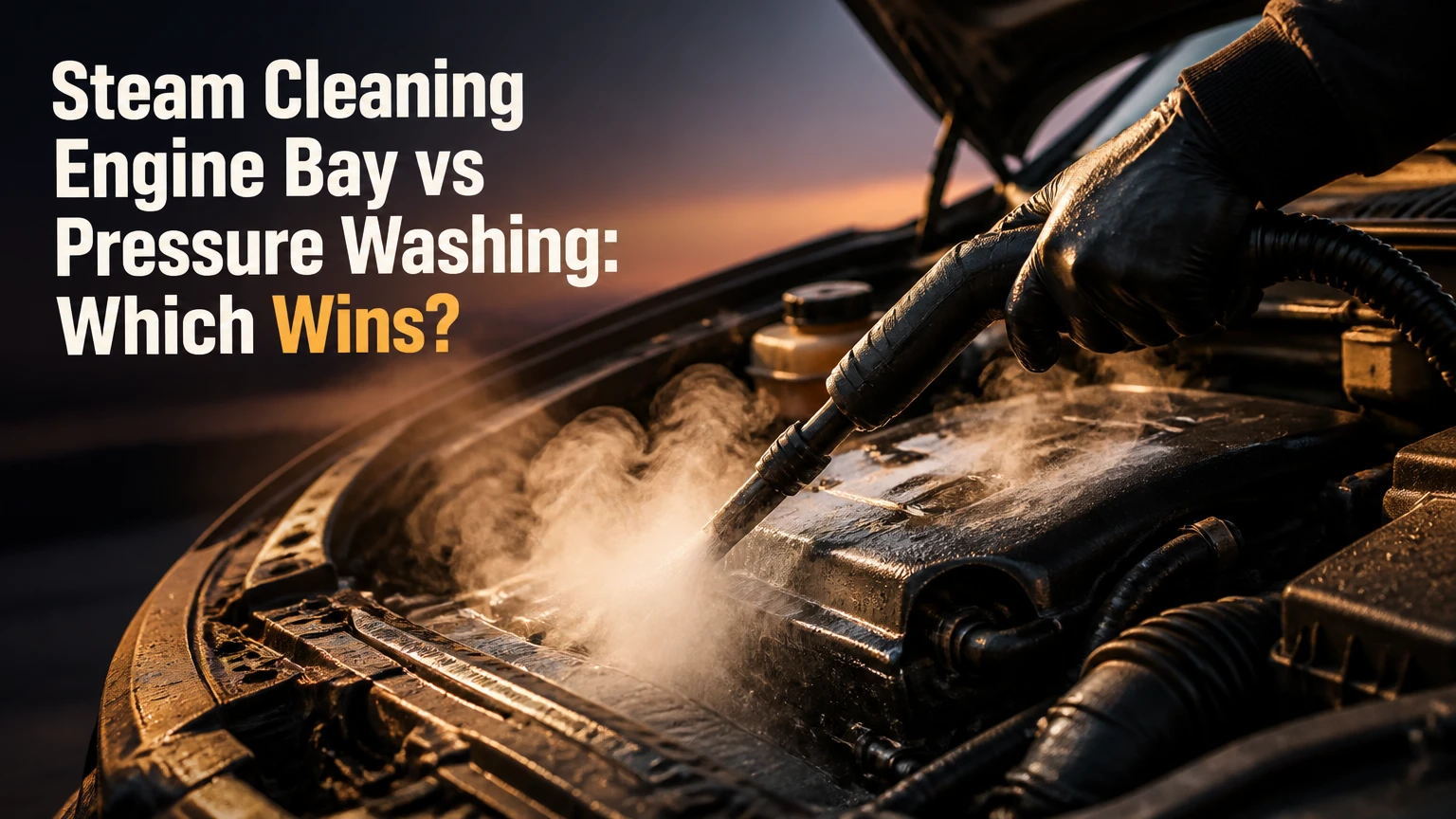
Steam cleaning is usually the safer choice for a lightly or moderately dirty engine bay because it uses far less liquid water and gives the operator precise control near connectors, coils, and sensors. Pressure washing is faster and better for thick mud, but only when used at low effective force, with a wide nozzle, controlled distance, and thorough drying.
Key Facts at a Glance
Dry-steam vapor typically uses less than 1 gallon of water per hour, while pressure washers commonly use 1.2-4 gallons per minute.
A pressure washer’s PSI does not describe total cleaning force by itself; flow rate, nozzle angle, distance, and dwell time also determine component risk.
Steam reduces water intrusion but introduces concentrated heat, which can damage hot, brittle, cracked, or poorly bonded materials.
A wide 40-degree fan nozzle is safer than a 0-degree or 15-degree nozzle, but no pressure-washing nozzle is safe when aimed directly at seals, connectors, or an open intake.
Neither method repairs an oil leak. Cleaning first can help locate a leak, but it can also remove evidence if inspection is delayed.
For most road cars, the best process is controlled hand cleaning, with limited steam or low-pressure rinsing used only where the surface requires it.
What Is the Difference Between Steam and Pressure Washing?
Steam cleaning removes engine-bay contamination mainly through heat, vapor, agitation, and wiping. Pressure washing removes contamination mainly through liquid-water velocity and volume. Steam produces little runoff and can soften oil film around wiring and brackets, while pressure washing rapidly flushes away mud, sand, leaves, and loosened detergent.
The comparison is often distorted by equipment labels. A vapor steamer may advertise 100-300 PSI, but that pressure is not comparable to a pressure washer delivering 1,500 PSI at a substantial flow rate. A pressure washer’s nozzle converts pump pressure into a moving water stream, and the impact falls sharply as the spray spreads and the operator increases distance.
“Steam” also covers different machines. Dry vapor systems emit a low-moisture vapor, whereas hot-water pressure washers heat a large volume of liquid water. The second machine behaves much more like a pressure washer than a low-moisture detailing steamer.
How Does Steam Cleaning Work?
A steam cleaner heats water to create vapor, then directs that vapor through a small nozzle onto grease, dust, and residue. Typical detailing vapor reaches approximately 212-300°F at the machine, although the surface temperature falls with distance, airflow, and contact time.
Heat softens petroleum residue and lowers its viscosity. A brush breaks the softened film, and a microfiber towel removes the contamination before it cools. The towel is part of the cleaning system, not a finishing accessory.
Steam is most effective on valve covers, brackets, plastic covers, hood insulation, and narrow oily seams. It is less effective at moving large quantities of grit because vapor carries little water and has little flushing volume.
How Does Pressure Washing Work?
A pressure washer forces liquid water through a restrictive nozzle, commonly producing about 1,200-2,000 PSI from a consumer electric unit and more from many gas units. The moving water separates dirt mechanically, while a detergent loosens oil and road film before rinsing.
Pressure washing excels when contamination has physical mass. Packed clay, gravel, salt deposits, and wet leaves usually require water volume to move them out of recesses. The same volume can enter connector cavities, alternator vents, spark-plug wells, intake openings, and aging seals.
The relevant variables are pressure, flow, nozzle pattern, distance, angle, and dwell time. A 40-degree nozzle held 18 inches away produces a very different result from a narrow nozzle held two inches away, even if the pump setting is unchanged.
Which Method Is Safer for an Engine Bay?
Steam cleaning generally presents the lower water-intrusion risk, but steam is not automatically safe. Pressure washing becomes reasonable when the operator uses broad spray coverage, avoids sensitive targets, prevents pooling, and dries the bay before restarting the vehicle.
Modern vehicles contain sealed connectors, but “sealed” does not mean pressure-proof from every direction. Water can enter through a damaged seal, a vent, a back side, a harness junction, or a connector that was never designed for direct spray.
Steam has a different hazard profile. Concentrated heat can soften adhesive, discolor coatings, lift old labels, harden some rubber, or shock cold glass and brittle plastic. The safest method depends on the vehicle’s condition and the contamination, not merely its model year.
| Risk area | Low-moisture steam | Controlled pressure washing | Main control |
|---|---|---|---|
| Liquid water introduced | Typically under 1 gal/hour | Typically 1.2-4 gal/minute | Use the least water that achieves the result |
| Heat at nozzle | Approximately 212-300°F | Ambient to approximately 200°F on hot-water units | Keep heat away from brittle surfaces |
| Connector intrusion | Lower volume, still possible | Higher when spray is narrow or close | Never target connector faces |
| Alternator exposure | Heat and moisture risk | Water-volume and bearing risk | Shield and clean around the housing |
| Air-intake exposure | Steam can enter an opening | Liquid water can reach cylinders | Cover or isolate the intake |
| Runoff | Low | High | Capture oily wastewater before discharge |
| Best control | Distance, movement, immediate wiping | Distance, wide nozzle, short passes | Avoid stationary spray |
Which Method Protects Electronics Better?
Low-moisture steam usually protects electronics better than pressure washing because it introduces less liquid water, but neither process should directly contact an alternator, fuse box, exposed module, ignition component, or open connector. Protection depends on distance and technique rather than the machine label alone.
Keep the steam nozzle moving and use short passes around wiring. Do not hold a hot nozzle against a connector seal. On pressure-washed bays, avoid direct spray into the fuse-box perimeter, coil boots, distributor cap, alternator vents, oxygen-sensor connectors, and aftermarket wiring splices.
Do not assume that wrapping every component in plastic solves the problem. Plastic can trap moisture, hide missed water, and detach during cleaning. Shield only vulnerable openings, remove coverings promptly, and use compressed air or a blower to clear recesses.
Winner for electronics: low-moisture steam, provided the operator controls heat and does not inject vapor into openings.
Which Method Removes Heavy Mud Better?
Pressure washing removes heavy mud better because liquid-water flow carries loosened soil away from the engine bay. Steam can soften oily clay and loosen narrow deposits, but it lacks the water volume needed to flush gravel, sand, and packed trail debris efficiently.
For an off-road truck, start with a low-force rinse from a distance and a 40-degree nozzle. Let the water move debris outward rather than driving the wand into the bay. A plastic scraper, detailing brush, and vacuum often remove more safely than increasing pressure.
Mud can conceal leaks and damage. Inspect the radiator, intercooler, wiring, CV areas, belt path, and underbody before washing. If mud has dried around a cracked hose or loose connector, aggressive spraying may turn a visible problem into a harder-to-diagnose failure.
Winner for heavy physical debris: controlled pressure washing.
What Do Cost, Water Use, and Time Look Like?
Typical professional steam cleaning costs about $150-$400 and takes 60-120 minutes, while a basic professional engine-bay wash commonly costs $75-$150 and takes 30-60 minutes. DIY pressure-washing equipment costs less initially, but water containment, drying equipment, and replacement parts affect the true cost.
These are typical detailing ranges, not fixed market prices. A heavily contaminated commercial vehicle, a seized component, or a service that includes leak documentation and underbody cleaning can exceed them.
| Metric | Low-moisture steam | Electric pressure washer | Gas pressure washer |
|---|---|---|---|
| Typical purchase price | $150-$1,500+ | $80-$500 | $250-$1,000+ |
| Typical operating pressure | 100-300 PSI machine rating | 1,200-2,000 PSI | 2,500-4,000+ PSI |
| Typical water use | 0.5-1.5 gal/hour | 1.2-2.0 gal/minute | 2.5-4.0 gal/minute |
| Typical DIY cleaning time | 60-120 minutes | 30-60 minutes | 20-45 minutes |
| Best use case | Oil film and precision work | Moderate dirt and occasional rinsing | Heavy equipment and mud, with regulation |
| Main extra requirement | Microfiber towels | Blower and protective covers | Pressure regulator and runoff control |
A professional operator may charge more for steam because the process involves repeated wiping and slower precision work. Pressure washing appears cheaper when measured only by machine time, but a failed sensor, wet ignition system, or contaminated driveway can erase that saving.
How Should Pressure Be Controlled?
Use a 40-degree fan nozzle first, maintain at least 18 inches of distance, keep the wand moving, and use the lowest effective pressure. A 25-degree nozzle may be appropriate for remote metal surfaces, but 0-degree and 15-degree tips have no place in a vehicle engine bay.
Nozzle color conventions are common but can vary by manufacturer. Read the washer manual rather than relying solely on color. Never point a narrow stream at hoses, wiring insulation, hood padding, decals, seals, bearings, or connectors.
| Nozzle pattern | Typical use | Engine-bay position | Minimum practical distance |
|---|---|---|---|
| 0 degree, red | Pinpoint stripping | Do not use | Not applicable |
| 15 degree, yellow | Heavy surface stripping | Avoid in engine bays | More than 24 inches is still risky |
| 25 degree, green | General rinsing | Limited use on open metal | 18-24 inches |
| 40 degree, white | Broad washing | Preferred starting pattern | 18 inches or more |
| Soap nozzle, black | Low-pressure detergent | Degreaser application | Follow chemical label |
How to Clean an Engine Bay Safely
A safe engine-bay cleaning process takes approximately 45-120 minutes, costs $10-$40 for consumables, and depends most on protecting openings and removing moisture afterward. The process is: inspect, cool, cover openings, dry-remove debris, clean in small sections, rinse sparingly, dry completely, and test.
Before You Start
| Requirement | Typical specification |
|---|---|
| Engine condition | Cool to the touch, usually 30-60 minutes after driving |
| Cleaning solution | pH-neutral or engine-safe degreaser, 16-32 fluid ounces |
| Towels | 6-12 clean microfiber towels |
| Brushes | 2-4 nylon detailing brushes |
| Drying tool | Blower or compressed air at regulated pressure |
| Personal protection | Nitrile gloves and eye protection |
| Runoff control | Absorbent pads, drain pan, or approved wastewater collection |
| Inspection tools | Flashlight and OBD-II scanner if a fault appears |
Do not disconnect a battery automatically. Modern vehicles may lose window settings, radio codes, transmission adaptations, or alarm memory. Follow the manufacturer’s service procedure, and never disconnect a high-voltage battery without the required training.
Step 1: Inspect and Identify the Contamination
Look for oil, coolant, brake fluid, battery residue, rodent nesting, loose wiring, cracked hoses, and aftermarket intake openings. Photograph leaks before cleaning so later residue can be compared with the original condition.
Success checkpoint: You can identify whether the bay needs cosmetic cleaning or mechanical diagnosis.
Common mistake: Washing an active leak before marking its source.
Step 2: Cool and Remove Loose Debris
Clean only when the engine and exhaust components are cool. Remove leaves, sand, twigs, and loose mud with a vacuum, soft brush, or blower before applying liquid.
Success checkpoint: Dry debris no longer falls into belts, pulleys, or the cowl.
Common mistake: Blowing debris toward the cabin-air intake or throttle opening.
Step 3: Protect Openings, Not Every Component
Cover an exposed cone filter, open air box, distributor cap, and damaged connector with a secure barrier. Avoid sealing a warm component under plastic for a long period.
Success checkpoint: Water and vapor have no direct path into the intake or exposed ignition system.
Common mistake: Treating plastic wrap as permission to spray aggressively.
Step 4: Apply Cleaner to a Small Section
Use a light mist of engine-safe degreaser on one section at a time. Allow 2-5 minutes of dwell time without letting the product dry, then agitate with a nylon brush.
Success checkpoint: Grease turns into a removable film rather than remaining thick and glossy.
Common mistake: Using strong alkaline cleaner on bare aluminum, polished surfaces, or sensitive coatings.
Step 5: Choose Steam or a Controlled Rinse
Use steam 2-6 inches from suitable metal or plastic surfaces, moving continuously and wiping immediately. For pressure washing, select the 40-degree nozzle, keep the wand at least 18 inches away, and rinse from the top down with brief passes.
Success checkpoint: Cleaned areas have no pooled water and no visible detergent residue.
Common mistake: Holding either tool stationary on a connector, hose, decal, or insulation pad.
Step 6: Dry Recesses Before Reassembly
Use a blower to clear spark-plug wells, coil boots, connector edges, bolt holes, belt grooves, and radiator fins. Wipe accessible surfaces with clean microfiber towels.
Success checkpoint: No droplets emerge when a connector or rubber boot is gently moved.
Common mistake: Removing protective coverings before hidden water has been displaced.
Step 7: Reconnect, Start, and Inspect
Remove coverings, reconnect any disconnected battery terminal according to the vehicle procedure, and start the engine outdoors. Let it idle while checking for warning lights, belt noise, rough running, fuel smell, and fluid movement.
Success checkpoint: The engine idles normally and no new leak or warning light appears.
Common mistake: Repeatedly cranking a misfiring engine when water may remain in the ignition system.
When Is Pressure Washing Reasonable?
Pressure washing is reasonable for a mechanically sound vehicle with heavy mud or salt buildup when the operator uses a wide nozzle, low effective force, moderate distance, and controlled drying. Pressure washing is a poor choice for an exposed intake, failing seals, brittle wiring, active electrical faults, or a recently repaired leak.
Use a hose with a gentle shower pattern instead of a pressure washer when the contamination is only dust. Hand cleaning is safer when the bay contains delicate aftermarket electronics or when the vehicle’s service history is unknown.
Pressure washing also creates wastewater containing oil, detergent, metals, and road contaminants. Do not allow oily runoff to enter a storm drain. Local rules vary, so collect or redirect wastewater according to municipal requirements.
Is a Hybrid Method Better?
A hybrid method is better for most ordinary cars because it combines hand cleaning and low-moisture techniques instead of exposing the entire bay to a uniform blast. Use a brush and towel for dust, steam for localized oil, and a gentle rinse only where mud remains.
A practical hybrid sequence is:
- Vacuum and brush all loose debris.
- Apply degreaser to small oily areas.
- Use steam or a damp brush around wiring and brackets.
- Rinse only open, robust surfaces when necessary.
- Blow dry every recess.
- Reinspect for leaks and warning signs.
The hybrid approach takes about 60-90 minutes but reduces water consumption and limits the number of components exposed to either heat or pressure. It is also easier to stop when the bay is clean enough.
What Can Go Wrong After Engine-Bay Cleaning?
The most common post-cleaning failures are wet ignition components, moisture in connectors, belt slip, trapped water, and damage that was already present but became visible after cleaning. Stop troubleshooting by repeated starting, because continued cranking can worsen an electrical fault or discharge the battery.
| Symptom | Likely area | First action | Escalation point |
|---|---|---|---|
| Cranks but will not start | Coil boots, plug wells, distributor cap | Dry ignition components with air | Diagnose fuel and ignition if dry |
| Rough idle or misfire | Ignition coils, MAF connector, intake | Switch off and inspect for moisture | Scan codes before replacing parts |
| Check-engine light | Sensor or harness connector | Read codes with OBD-II scanner | Repair if code remains after drying |
| Belt squeal | Wet serpentine belt or pulley | Let surfaces dry and inspect alignment | Replace damaged belt or bearing |
| Burning smell | Electrical insulation or spilled fluid | Shut down and inspect immediately | Seek professional inspection |
| Visible corrosion | Connector, terminal, fastener | Dry and document condition | Repair compromised electrical parts |
WD-40 can displace water in some mechanical contexts, but it is not a universal electrical-contact cleaner and should not replace the product or procedure specified by the vehicle manufacturer. Dielectric grease belongs on appropriate connector seals, not on contact surfaces that require electrical conductivity.
Can Steam Damage Engine Components?
Steam can damage engine components when heat is concentrated on cold glass, brittle plastic, aged rubber, adhesive-backed insulation, sensor diaphragms, or a cracked coating. Steam is safer when the nozzle remains mobile, the surface tolerates heat, and the operator wipes rather than floods a recess.
Do not steam a turbocharger, catalytic converter, exhaust manifold, or hot engine immediately after driving. Thermal shock is more severe when a cold cleaning medium contacts hot metal, while high-temperature vapor can also accelerate deterioration in already brittle materials.
Steam is a cleaning tool, not a sterilization guarantee. It may reduce odors and surface microorganisms, but rodent contamination requires removal of nesting material, appropriate disinfectant handling, and inspection for damaged wiring.
Which Should You Choose?
The right choice depends on soil type, component condition, vehicle design, and the operator’s ability to dry the bay. Low-moisture steam is the default for precision cleaning, controlled pressure washing suits heavy mud, and hand cleaning is the safest alternative when the risk is unknown.
Modern Daily Driver
Choose low-moisture steam or hand cleaning for a post-2010 daily driver with dust, oily film, or road salt. Dense wiring harnesses and multiple control modules make unnecessary water volume a poor trade.
Classic Car or Restoration
Choose hand cleaning with limited steam for a classic car. Exposed distributors, aged wire insulation, non-original seals, and brittle connectors make direct pressure washing especially hazardous.
Off-Road Truck
Choose controlled pressure washing for thick clay, gravel, or trail mud, followed by blower drying and inspection. Keep the spray away from the intake, alternator, electrical connectors, wheel-speed wiring, and damaged underbody components.
Budget DIY Owner
Choose a garden hose, pump sprayer, brushes, degreaser, and microfiber towels before buying a pressure washer. A $20-$40 cleaning kit can handle light contamination with less risk than an inexpensive machine used too close.
Electric Vehicle
Treat an EV engine compartment as manufacturer-specific. The front compartment may contain cooling pumps, high-voltage components, inverters, charge hardware, and sealed connectors, so follow the owner’s manual and never clean traction-battery equipment casually.
When Is Hand Cleaning the Better Alternative?
Hand cleaning is better when contamination is light, electrical protection is uncertain, or the engine bay contains brittle components. A damp microfiber towel, soft brushes, a diluted cleaner, and a small amount of targeted steam can clean most cosmetic residue without saturating the compartment.
Hand cleaning also gives the best control around fluid reservoirs, labels, fuse boxes, and aftermarket accessories. It is slower than rinsing, but the operator sees every hose, clamp, connector, and stain while working.
An engine bay does not need to look wet to be clean. Removing the visible oil film and preserving evidence of a developing leak is often more useful than producing a uniformly glossy finish.
FAQ
Can You Pressure Wash an Engine Bay Without Covering Anything?
You can sometimes rinse a well-sealed, modern engine bay without extensive covering, but direct spray remains unsafe around open intakes, damaged seals, alternator vents, ignition components, and connectors. Inspect first, use a wide pattern at distance, minimize water, and dry recesses before starting.
How Often Should an Engine Bay Be Cleaned?
Most road vehicles need a light engine-bay cleaning once or twice per year, while off-road vehicles may need cleaning after severe mud exposure. Clean immediately when oil or coolant obscures a leak, but diagnose and document the leak before applying degreaser.
Does Engine-Bay Cleaning Improve Performance?
Engine-bay cleaning rarely improves engine power because dirt on external surfaces does not normally restrict combustion. Cleaning can improve inspection, reveal fluid leaks, reduce debris near belts, and help identify damaged wiring, which provides maintenance value rather than a guaranteed performance gain.
Can Water Cause Engine Hydrolock?
Water can cause hydrolock only if enough liquid enters the engine’s intake and reaches a cylinder, preventing the piston from completing its compression stroke. Avoid spraying an open intake, aftermarket cone filter, or snorkel opening, and do not restart a vehicle after visible intake water intrusion.
Should You Use Degreaser on an Aluminum Engine?
Use only a product labeled safe for the specific aluminum surface and follow its dilution and dwell instructions. Strong alkaline cleaners can discolor or etch bare aluminum, especially when they dry. Test an inconspicuous area, keep the surface cool, and rinse or wipe thoroughly.
What Should You Do If the Engine Misfires After Washing?
Switch the engine off, inspect and dry spark-plug wells, coil boots, distributor components, and nearby connectors, then scan for diagnostic trouble codes. Do not keep driving a severe misfire because unburned fuel can damage the catalytic converter. Seek professional diagnosis if drying does not restore normal operation.
The Bottom Line
For most vehicles, steam cleaning engine bay vs pressure washing is not a contest between a universally safe method and a universally dangerous one. Low-moisture steam wins for precision, light oil, modern daily drivers, and sensitive wiring; controlled pressure washing wins for heavy mud and physical debris. For ordinary maintenance, a hybrid of hand cleaning, targeted steam, limited rinsing, and complete drying offers the strongest balance of cleanliness, cost, and component protection.


