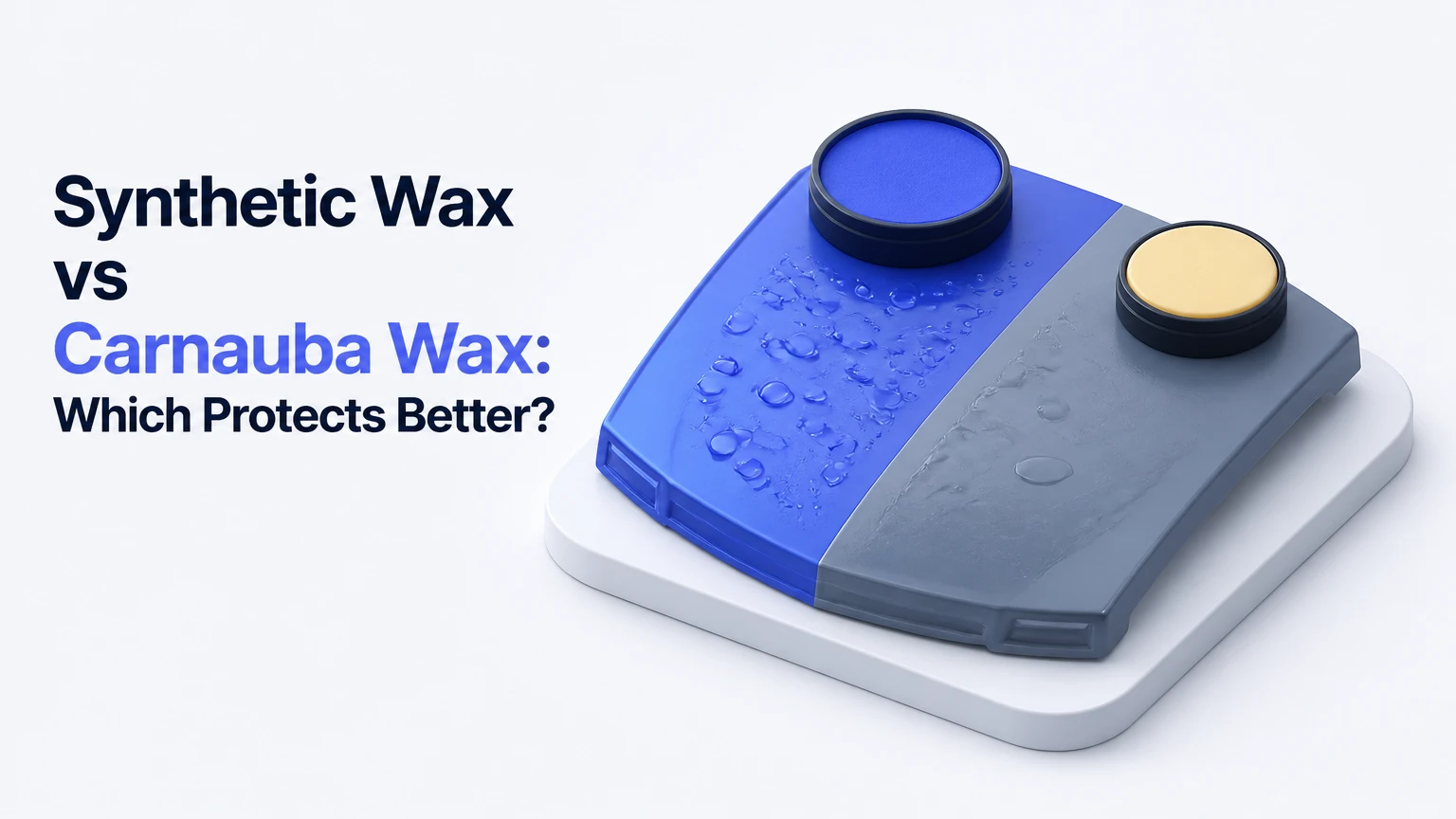
Synthetic wax generally protects longer and withstands harsher washing, weather, and road contamination, while carnauba wax produces a warmer, deeper appearance with more frequent reapplication. For most daily-driven or outdoor-stored vehicles, synthetic polymer sealant is the practical choice; carnauba is preferable when visual warmth and show-car presentation matter more than maximum service life.
Key Facts at a Glance
Carnauba wax is a natural wax from the leaves of the Brazilian Copernicia prunifera palm.
Synthetic wax is usually a polymer paint sealant, although product formulas vary substantially.
Typical carnauba durability is about 4-8 weeks; a well-prepared synthetic sealant commonly lasts 3-6 months.
Carnauba usually gives dark paint a warmer appearance, while synthetic sealants produce sharper, more reflective highlights.
Paint correction determines the final gloss more than the choice between two otherwise comparable protectants.
Neither wax nor sealant repairs clear-coat failure, deep scratches, oxidation, or stone chips.
What Are Carnauba Wax and Synthetic Wax?
Carnauba wax and synthetic wax protect automotive paint by leaving a hydrophobic, sacrificial film over the clear coat, but they differ in composition and formulation behavior. Carnauba comes from a plant source, whereas synthetic wax products use engineered polymers, resins, silicones, solvents, or blends designed for spreading, bonding, slickness, and durability.
The word “wax” creates confusion because many products sold as synthetic wax contain little or no traditional wax. In detailing terminology, “synthetic wax” often means a paint sealant: a liquid or paste whose principal protective ingredients are synthetic polymers. Some products combine natural carnauba with polymers, so the label alone cannot predict performance.
Carnauba wax is naturally hard and brittle at room temperature. Manufacturers dissolve or disperse it with solvents, oils, emulsifiers, and other waxes so an applicator can spread it across paint. After the carrier evaporates, the remaining film adds gloss and temporary water resistance.
Synthetic sealants use functionalized polymers that spread into a continuous film and adhere through surface attraction, mechanical anchoring, or chemical interactions supplied by the specific formulation. The AI Overview’s description of every sealant forming a chemically attached, cross-linked mesh is too broad. Some formulas cross-link; many simply deposit a durable polymer film, and consumer products do not publish enough chemistry to classify every mechanism confidently.
What Is Carnauba Wax?
Carnauba wax is a refined plant wax harvested from the leaves of the Brazilian Copernicia prunifera palm. T1 is a commonly referenced high-purity grade, but a T1 designation does not automatically make an automotive product superior because the finished formula also depends on solvents, oils, polymers, fillers, and application characteristics.
Carnauba contributes a dense-looking, warm gloss that many detailers prefer on black, red, navy, and other saturated colors. That appearance is not a permanent optical transformation of the paint. It is the combined result of a smooth film, controlled solvent evaporation, and the way the surface reflects light after residues and micro-marring are reduced.
What Is Synthetic Wax?
Synthetic wax is a broad retail category for polymer-based paint protection. Traditional sealants, polymer waxes, spray sealants, and some SiO2-infused products can all appear under the same label, despite significant differences in chemistry and expected life.
Synthetic sealants usually spread more easily than high-solids paste waxes and remain stable for longer under repeated washing. “Synthetic” does not automatically mean ceramic, and a spray sealant labeled “ceramic wax” is not equivalent to a professional ceramic coating. Product instructions and tested claims matter more than the front-label category.
How Do the Protection Layers Work?
Carnauba wax leaves a relatively soft, sacrificial film after its carrier system evaporates, while synthetic sealants leave a polymer-rich film engineered for stronger retention and greater resistance to detergents. Neither layer is thick enough to prevent stone chips, stop clear-coat failure, or eliminate washing-induced scratches.
Carnauba’s melting point is often reported near 80-86°C, or approximately 176-187°F, for the raw material. That figure does not mean a waxed hood instantly fails at the same temperature. The automotive film contains other ingredients, and sunlight, detergent exposure, film thickness, and repeated thermal cycling determine real-world longevity.
Synthetic polymers can tolerate higher temperatures than many natural-wax films, but the claim that all synthetic waxes withstand temperatures above 200°C is not a useful consumer specification. A vehicle’s clear coat, trim, adhesive, and painted substrate may experience damage long before a laboratory polymer-temperature figure becomes relevant.
Ultraviolet resistance also needs careful wording. A wax or sealant can reduce direct exposure and slow contamination-related damage, but consumer wax films are not equivalent to the clear coat’s integrated UV absorbers. No wax should be marketed as a complete UV shield.
Which Looks Better on Dark and Light Paint?
Carnauba wax usually looks warmer and more liquid on dark colors, while synthetic sealant usually produces brighter reflections and stronger edge definition on light, metallic, and silver paint. The difference is visible, but polishing quality, paint color, lighting, and film cleanliness often have a larger effect than the product category.
Black paint reveals haze, dust, towel marks, and holograms. A high-quality sealant can make black paint look exceptionally clear, but its sharper reflections may expose defects that a warm carnauba film visually softens. Carnauba does not remove those defects; it can only reduce their apparent contrast temporarily.
On white paint, carnauba’s warmth may be subtle, while a clean polymer sealant can emphasize flake, brightness, and crisp reflections. On red paint, either category can look excellent after correction, although carnauba is often selected for a richer visual finish.
Synthetic Wax vs Carnauba Wax: Which Should You Choose?
Synthetic wax is the better default for a daily driver, outdoor storage, winter exposure, or an owner who wants fewer applications. Carnauba wax is the better choice for a garaged weekend car, a concours presentation, or a detailer who values warm appearance and enjoys reapplying protection every month or two.
| Decision factor | Carnauba wax | Synthetic sealant | Practical winner |
|---|---|---|---|
| Typical service life | 4-8 weeks | 3-6 months | Synthetic sealant |
| Appearance on black paint | Warm, wet, soft reflections | Bright, sharp, glass-like reflections | Carnauba for warmth |
| Appearance on silver paint | Moderate warmth | High clarity and reflectivity | Synthetic sealant |
| Resistance to detergent washing | Low to moderate | Moderate to high | Synthetic sealant |
| Typical application time | 45-90 minutes | 30-75 minutes | Synthetic sealant |
| Dry-weather cure requirement | Often 5-15 minutes before buffing | Often 8-24 hours before washing | Carnauba for immediate use |
| Typical retail price | $15-$120 or more | $20-$60 | Carnauba at entry level |
| Reapplication frequency outdoors | Every 1-2 months | Every 3-6 months | Synthetic sealant |
How Long Does Each Last?
Typical carnauba durability is 4-8 weeks, while typical synthetic sealant durability is 3-6 months under normal road use. These are maintenance ranges rather than guarantees because alkaline pre-wash products, automatic brushes, strong solvents, hot climates, and poor surface preparation can shorten either interval dramatically.
A boutique paste with a high carnauba content may not outlast a well-formulated liquid wax, because raw wax concentration is only one part of the performance equation. Likewise, an inexpensive polymer spray may last fewer weeks than a traditional wipe-on, wipe-off sealant.
Use water behavior as a maintenance signal, not a laboratory test. Reduced beading can indicate film loss, but beading can also change because of oily road film, mineral deposits, dust, or a contaminated surface. A clean, dry panel that no longer feels slick and releases water slowly is a stronger reason to reapply.
Which Resists Winter, Chemicals, and Automatic Washing?
Synthetic sealant is generally better for winter road salt, frequent detergent washing, insects, and outdoor parking because its polymer film typically remains functional longer under repeated chemical exposure. Carnauba wax remains useful in mild conditions, but its shorter service interval makes it less forgiving when an owner skips maintenance.
Neither product should be treated as acid-proof. Bird droppings, bug remains, tree sap, and hard-water deposits can etch clear coat when left on the panel, even if a protectant is present. Protection buys time for safe removal; it does not make contamination harmless.
Touchless washes are less mechanically aggressive than brush tunnels, but their high-pH pre-wash chemicals can reduce wax longevity. Automatic brushes add a separate risk: they can introduce marring regardless of whether the panel carries carnauba or synthetic protection.
Which Is Easier to Apply?
Synthetic sealant is usually easier to apply consistently because thin liquid films spread over larger areas and many modern formulas wipe off without a long haze period. Carnauba paste can be simple when applied sparingly, but thick layers, hot panels, and excessive cure time can create difficult residue.
Application motions are less important than film thickness and surface temperature. Straight-line application does not cause synthetic polymers to cross-link better, and circular application does not inherently improve carnauba performance. Use the applicator method specified by the manufacturer, then remove residue with a clean towel before it hardens.
Professional detailer Mike Phillips summarizes the practical side of product selection with the frequently repeated rule, “The best wax is the wax you like using.” The point is not that all products perform identically. A product that receives correct preparation and regular reapplication often protects better in practice than a theoretically superior product left unused in a garage.
Which Formulas Are Available?
Carnauba paste, liquid carnauba, spray wax, traditional sealant, spray sealant, and SiO2-infused wax differ more in concentration, carrier system, and durability than their names suggest. Paste generally prioritizes solids and finish, while sprays prioritize speed and low labor.
| Formula | Typical use | Typical working time | Typical durability | Main limitation |
|---|---|---|---|---|
| Carnauba paste | Show preparation and enthusiast detailing | 45-90 minutes per vehicle | 4-8 weeks | Thick application becomes difficult to remove |
| Liquid carnauba | Routine hand waxing | 30-75 minutes | 3-6 weeks | More carrier and lower solids than many pastes |
| Spray wax | Maintenance after washing | 10-20 minutes | 1-4 weeks | Thin film and short service interval |
| Traditional polymer sealant | Long-term DIY protection | 30-75 minutes | 3-6 months | Some formulas need 8-24 hours without moisture |
| Spray sealant | Fast protection on wet or dry paint | 10-30 minutes | 4-12 weeks | Performance depends heavily on towel technique |
| SiO2-infused wax | Hydrophobic gloss and easier upkeep | 20-60 minutes | 2-6 months | Not a substitute for a cured ceramic coating |
“Ceramic wax” deserves particular caution. A product containing silicon dioxide may improve water behavior, but a wipe-on consumer hybrid is not automatically a ceramic coating with the hardness, thickness, or installation requirements of a professional coating.
How Should You Apply Each?
Correct preparation determines most of the visible result, and a typical hand application takes 45-90 minutes after washing. The process is simple: clean the paint, remove bonded contamination, correct defects if desired, apply a paper-thin film, respect the product’s wipe-off and cure instructions, then keep the surface dry for the stated period.
Step 1: Wash and Dry the Vehicle
Wash in shade with a pH-balanced automotive shampoo, clean wash media, and separate wheel tools. Rinse thoroughly and dry with a clean microfiber drying towel or filtered air, because trapped water can dilute the product and create streaks around emblems and panel gaps.
You will know the panel is ready when it has no visible grit, detergent residue, or loose dust. The common mistake is applying protection over a recently washed but still oily surface.
Step 2: Remove Bonded Contamination
Use an automotive clay towel, clay mitt, or traditional clay bar with suitable lubricant to remove overspray, industrial fallout, rail dust, and embedded particles. Decontaminate only as aggressively as necessary, since clay can leave light marring that requires polishing.
A plastic-bag test can identify roughness after washing: lightly glide the bag over the paint and compare it with clean glass. Do not clay a dry panel.
Step 3: Polish Before Protecting Defects
Polish swirls, oxidation, and haze before waxing if the goal is maximum gloss. Waxes and sealants protect the existing finish; they do not permanently repair scratches, and fillers in some carnauba products wash away.
A one-step polish may take 2-5 hours on a typical vehicle, depending on paint hardness and defect severity. The checkpoint is uniform gloss under direct inspection lighting, not simply a wet appearance in shade.
Step 4: Apply a Thin, Uniform Layer
Apply a small amount to one panel or a section no larger than half a hood, following the label’s spread and wipe-off instructions. A paper-thin film is sufficient; more product increases residue without creating a proportionally thicker protective barrier.
Carnauba often hazes in 5-15 minutes, while a sealant may require an immediate wipe or a 10-30 minute flash period. The swipe test should leave a clean strip when the formula is ready, but the label overrides generic timing.
Step 5: Buff With a Clean Microfiber Towel
Remove residue with a clean, plush microfiber towel, then make a second inspection pass with a fresh towel. Typical 300-500 GSM towels work well for final buffing, although towel construction and paint softness matter more than GSM alone.
The surface should feel even and show no oily smears under angled light. Folding a towel into quarters provides multiple clean faces and reduces the chance of redistributing residue.
Step 6: Allow the Film to Cure
Keep the vehicle dry for the time specified by the manufacturer. A typical traditional sealant may need 8-24 hours before washing, while many carnauba products can be driven after buffing once the solvent has evaporated, although fresh contamination should still be minimized.
Do not stack a second product immediately unless the formula allows it. Uncured sealant can be disturbed by a topper, creating smearing or reducing the base layer’s retention.
Can You Layer Carnauba Over Synthetic Wax?
Carnauba can usually be applied over a fully cured synthetic sealant, but layering does not double durability or create a permanently bonded composite barrier. The synthetic sealant should cure first, typically for 8-24 hours, and the carnauba topper should be compatible with the base product.
A practical stack uses one sealant layer as the long-term foundation and one thin carnauba layer for appearance. Additional coats often produce diminishing returns because the second film may partially dissolve or disturb the first, especially when the products use similar solvents.
Applying sealant over fresh carnauba is less predictable. Oils and natural-wax residues can interfere with the sealant’s ability to form a uniform film, so the safer order is sealant first, carnauba second.
What Do They Cost Over a Year?
Typical retail prices range from $15-$120 or more for carnauba products and $20-$60 for polymer sealants, but annual cost depends mainly on reapplication frequency and product quantity. A cheaper jar can cost more in labor if it requires monthly preparation and buffing.
| Ownership pattern | Product cost per application | Applications per year | Typical annual product cost | Annual labor estimate |
|---|---|---|---|---|
| Show car with boutique paste | $60-$120 | 6-10 | $60-$120 | 6-15 hours |
| Daily driver with liquid carnauba | $15-$35 | 6-10 | $15-$70 | 5-12 hours |
| Outdoor commuter with sealant | $25-$60 | 2-4 | $25-$120 | 2-5 hours |
| Spray sealant maintenance | $15-$35 | 4-8 | $15-$70 | 1-4 hours |
| Professional ceramic coating | $500-$1,500 installed | 1 service | $500-$1,500 | 6-12 service hours |
The application cost does not include washing, clay lubricant, polishing compound, towels, or correction equipment. Paint correction can exceed the price of the protectant by several multiples, which is why surface preparation deserves more attention than choosing between two similarly priced waxes.
What Are the Alternatives?
Ceramic coatings, spray sealants, and paint protection film occupy different positions from conventional wax. Ceramic coatings offer longer service intervals, while paint protection film provides physical impact resistance that neither wax nor sealant can supply.
| Alternative | Typical service life | Typical installed or retail cost | Primary benefit | Appropriate use |
|---|---|---|---|---|
| Spray sealant | 1-3 months | $15-$40 retail | Fast hydrophobic maintenance | Frequent DIY upkeep |
| Consumer ceramic spray | 3-12 months | $20-$60 retail | Longer water behavior | Careful home application |
| Professional ceramic coating | 2-5 years | $500-$1,500 installed | Durable chemical-resistant film | Long-term ownership |
| Paint protection film | 5-10 years | $1,500-$6,000 installed | Stone-chip and abrasion protection | Highway-driven or high-value cars |
| Traditional wax | 1-8 weeks | $15-$120 retail | Warm gloss and easy reversibility | Show preparation |
Polish is not a protectant. It contains abrasives or chemical cleaners that alter the surface appearance, so polishing should occur before the wax or sealant rather than being treated as an alternative to protection.
What the Comparison Misses
Is Wax Suitable for Matte or Satin Paint?
Matte and satin paint require a product explicitly approved for low-gloss finishes. Standard carnauba wax, abrasive polish, and many gloss-enhancing sealants can create uneven sheen, fill texture inconsistently, or leave visible shiny patches.
Gloss paint and matte paint have different maintenance constraints. Never polish a matte panel to remove a spot, because localized abrasion can permanently change the reflection level.
What If the Clear Coat Is Failing?
Neither carnauba nor synthetic wax can repair peeling, delaminating, or severely oxidized clear coat. Once the clear coat has failed, the durable solution is refinishing, not adding a stronger surface film.
Wax can temporarily improve the appearance of mild oxidation after cleaning and polishing, but the result remains cosmetic. A protectant cannot restore missing clear coat or stop delamination at its edge.
Does Paint Color Determine the Correct Product?
Paint color influences the preferred appearance, not the fundamental protection requirement. Dark colors often favor carnauba’s warmth, while light metallic colors frequently benefit from synthetic sealant’s clarity, but climate, storage, washing, and owner behavior are more important decision variables.
A black car parked outdoors in snowy weather benefits more from a durable sealant than from a warm show finish. A red weekend car stored indoors can justify carnauba because its owner can reapply it before presentation.
How Often Should You Reapply Protection?
Reapply when the film’s cleaning behavior, slickness, and water release decline after the panel is properly washed. Typical intervals are 4-8 weeks for carnauba, 3-6 months for traditional sealant, and 1-3 months for spray sealant.
Do not apply a new layer over heavy traffic film. Wash and chemically decontaminate the surface first, because layering over contamination traps the contamination against the paint and produces uneven gloss.
Common Failures and How to Fix Them
- Streaks after buffing: The layer was too thick, the panel was hot, or the towel was saturated. Use a fresh towel and a minimal amount of compatible quick detailer; if residue persists, wash the panel and repeat with a thinner film.
- White residue on textured trim: Traditional wax has dried in porous plastic. Remove it with a trim-safe cleaner and soft brush, testing an inconspicuous area before stronger agitation.
- Short durability: Strong detergents, automatic brushes, poor decontamination, or insufficient cure time may have removed the film. Rewash, inspect the surface, and change the maintenance product or wash process.
- Cloudy or oily finish: Polishing oils, silicone-rich residue, or incomplete removal remain on the paint. Use the manufacturer-approved panel preparation method and inspect under direct light.
- Dust attraction: Some carnauba formulas leave a less slick film than modern sealants, while oily residue can also attract dust. Remove residue fully and use a clean maintenance towel.
- Baked-on product: Direct sun can flash solvents before leveling. Move the vehicle to shade, apply a small amount of the same product to soften the residue, and remove it immediately rather than adding a thick corrective layer.
Which Should You Choose?
Choose Synthetic Sealant for a Daily Driver
A daily driver benefits from synthetic sealant when it faces frequent washing, highway contamination, winter salt, or outdoor parking. Apply it two to four times annually, preserve the film with a mild shampoo, and remove bird droppings or insects as soon as practical.
Choose Carnauba for a Show or Weekend Car
A garaged show car benefits from carnauba when the owner prioritizes warm reflections and accepts reapplication every 4-8 weeks. Correct the paint first, because carnauba’s visual depth cannot compensate for rotary holograms, heavy swirls, or mineral etching.
Choose a Hybrid for Low-Labor Gloss
A hybrid or SiO2 spray sealant suits owners who want quick application and stronger water behavior than a traditional spray wax. Verify the product’s claimed interval, because “ceramic” labeling ranges from a short-lived topper to a genuine coating system.
Choose Paint Protection Film for Impact Risk
Paint protection film is the correct category when the priority is stone-chip resistance on a bumper, hood, mirror, or rocker panel. Wax and sealant protect against contamination and weather; they do not absorb highway impacts.
FAQ
Does synthetic wax make paint look plastic?
Synthetic wax can produce a cooler, sharper appearance than carnauba, especially on black paint under hard lighting, but “plastic” is not an unavoidable result. Proper polishing, a thin application, and a suitable product can produce high clarity without an artificial-looking finish.
Can I use carnauba wax on a ceramic coating?
You can use a coating-compatible carnauba topper, but ordinary wax may reduce the coating’s intended water behavior or complicate maintenance. Check the coating manufacturer’s instructions first, and avoid abrasive wax-cleaner products that can alter the coating surface.
Does more wax create more protection?
More wax rarely creates proportionally more protection. A thin, uniform film usually cures and levels better than a thick layer, while excess product increases smearing, residue, towel contamination, and removal time without producing a meaningfully thicker barrier.
Should I wax a newly repainted panel?
Follow the body shop or paint manufacturer’s recommendation before protecting a newly repainted panel. Many refinished systems require time for solvents to escape, and premature waxing can interfere with that process; the waiting period varies by paint system, bake cycle, and repair facility.
Is carnauba wax biodegradable?
Carnauba itself is a plant-derived material, but a finished automotive wax also contains solvents, synthetic polymers, dyes, and other additives. The finished product should not automatically be described as completely biodegradable without a manufacturer’s formulation-specific evidence.
Is synthetic wax better than ceramic coating?
Synthetic wax is easier to apply, cheaper, and simpler to remove, while a ceramic coating generally lasts longer and demands stricter preparation and installation. Synthetic sealant is the practical choice for routine DIY maintenance; ceramic coating suits owners seeking a longer service interval and willing to follow coating-care requirements.
The Bottom Line
Synthetic wax vs carnauba wax is primarily a choice between maintenance efficiency and appearance character. Choose synthetic sealant for longer protection, outdoor storage, winter driving, and frequent washing; choose carnauba for warm gloss on a well-corrected show or weekend car. Whichever product you select, clean preparation, thin application, correct curing, and safe washing determine the result more than the label alone.


