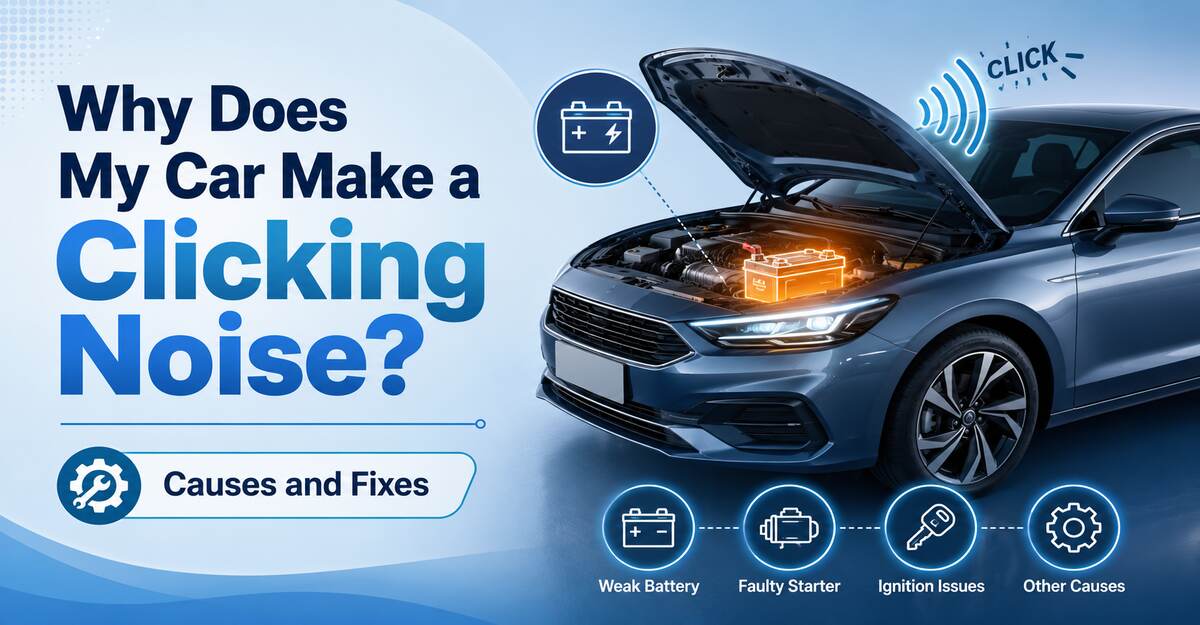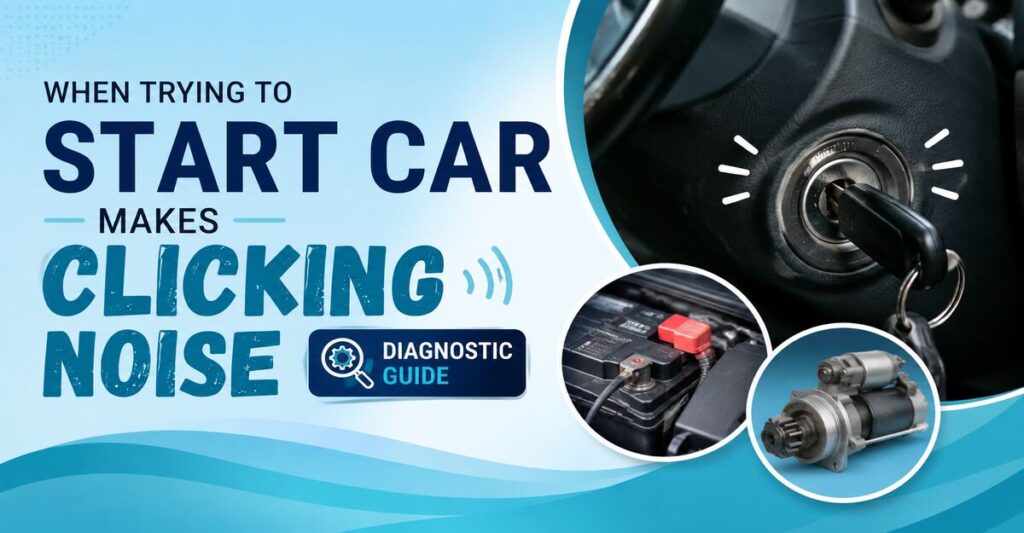
When trying to start a car and it makes a clicking noise, the primary cause is insufficient electrical current reaching the starter motor. This mechanical failure is almost always triggered by a depleted battery, corroded battery terminal connections, or a faulty starter solenoid lacking the amperage to crank the engine.
Key Facts / At a Glance:
- Rapid, repeated clicking almost always indicates a weak battery (under $12.0\text{V}$) or a loose electrical ground connection.
- A single, loud “clunk” typically points to a mechanically jammed starter motor or heavily burnt internal solenoid contacts.
- Healthy automotive batteries must measure between $12.4\text{V}$ and $12.6\text{V}$ while resting, and never drop below $10.0\text{V}$ while cranking.
- The “Parts Cannon” error: Replacing a starter motor without first load-testing the battery is the most common and expensive diagnostic mistake.
- The Headlight Test: Turning on the headlights while cranking the engine immediately reveals if the battery has reserve capacity or is completely dead.
Why Does the Car Click Instead of Starting?
The clicking sound you hear is the starter solenoid physically actuating without the starter motor actually spinning. The automotive starting circuit relies on four primary components: the battery, the ignition switch, the starter solenoid, and the high-torque starter motor.
When you turn the key, a low-amperage signal travels to the starter solenoid, which acts as a heavy-duty electromagnetic switch. Energizing this electromagnet slams an internal steel plunger forward—creating the audible “click.” This physical movement is supposed to bridge a massive copper contact, channeling 150 to 300+ Amps of electricity directly from the battery to the starter motor.
If the battery lacks the amperage to spin the motor, or if the motor itself has failed, the solenoid plunger still hits the contact point. The result is the mechanical click with zero engine rotation.
Symptom Analysis: Rapid vs. Single Clicking
The cadence of the clicking sound allows you to immediately isolate the failing component before opening a toolbox.
| Symptom Profile | Primary Root Cause | Mechanism of Failure | Immediate Action |
| Rapid Clicking (Click-click-click) | Weak Battery or Poor Ground | The battery has enough voltage ($>10.5\text{V}$) to push the solenoid forward. Once the massive starter load hits, system voltage instantly plummets, the electromagnet loses power, and the plunger snaps back. Voltage instantly recovers, throwing the plunger forward again. This cycling loop creates the rapid chatter. | Clean terminals, attempt jump-start, measure resting voltage. |
| Single Loud Click (Solid “Clunk”) | Bad Starter Motor or Solenoid | The battery is strong and delivers full power. The solenoid plunges completely forward and engages the engine flywheel, but the internal motor windings are burnt out or the copper contacts are too worn to channel the current. | Perform starter “tap test,” check for engine lockup, verify voltage at the starter wire. |
| Faint Dashboard Click | Bad Relay or Blown Fuse | The primary starter solenoid is not actuating at all. The faint click is merely a small 30-amp relay clicking inside the passenger or under-hood fuse box. | Check starter fuses, swap the starter relay, check the ignition switch. |
Step-by-Step Diagnostic Process
Follow this sequence to isolate the exact failure point without wasting money on unnecessary parts.
Before You Start:
- Estimated Time: 15–30 minutes
- Difficulty: Beginner to Intermediate
- Required Tools: Digital multimeter, safety glasses, wire brush, 10mm wrench, jumper cables (or lithium jump pack).
- Prerequisite: Ensure an automatic transmission is firmly locked into Park (P) or Neutral (N). A faulty neutral safety switch will prevent cranking entirely.
Step 1: Perform the Headlight Load Test
Turn on your vehicle’s physical headlights (ensure they are on manually, not set to ‘Auto’) and observe them while an assistant attempts to start the engine. Note: This test works best with traditional halogen bulbs; modern LED headlights draw very little power and may mask a weak battery.
- If lights go completely dark: The battery is severely depleted or there is a massive resistance bottleneck in the main cables.
- If lights stay completely bright: The battery has ample capacity. The current is either failing to reach the starter motor, or the starter motor is dead.
Step 2: Inspect and Clean Battery Terminals
Open the hood and visually check the positive ($+$) and negative ($-$) terminals. Look for white, blue, or green powdery corrosion. Physically grab the thick terminal cables and attempt to twist them by hand. If you can move the cable on the post, the connection is too loose to transmit 200 Amps.
Clean corroded terminals using a slurry of baking soda and water to neutralize the battery acid, followed by scrubbing with a stiff wire brush. Retighten the terminal clamps with a 10mm wrench until they cannot be twisted by hand. Follow the negative ground wire to ensure it is securely bolted to the bare metal of the vehicle chassis.
Step 3: Test Voltage with a Multimeter
Set a digital multimeter to DC Volts and place the leads directly on the bare lead battery posts (not the metal cable clamps).
A healthy resting battery will read between $12.4\text{V}$ and $12.6\text{V}$. A reading of $12.0\text{V}$ means the battery is at 25% capacity, and anything below $11.8\text{V}$ is functionally dead. Have an assistant attempt to crank the engine while you watch the display. Under load, a healthy battery should never drop below $10.0\text{V}$ (or $9.6\text{V}$ if the ambient temperature is below $70^\circ\text{F}$). If the voltage plummets to $5\text{V}$ or $6\text{V}$, the battery has a dead cell and requires replacement.
Step 4: Attempt a Jump-Start
Connect high-quality jumper cables or a portable lithium jump pack to your battery. Allow the donor vehicle to run at a high idle for 3 to 5 minutes to transfer a surface charge to your dead battery before attempting to crank.
If the engine starts immediately with a jump, your problem is isolated entirely to the battery, the alternator, or a parasitic draw draining the battery overnight. If the vehicle still produces a single loud click even with a jump from a running vehicle, your starter motor is defective.
Step 5: Perform the Starter Motor “Tap Test”
If you experience a single click, have a healthy battery, and can safely reach the physical starter motor under the hood, perform the emergency tap test. Take a long metal tool (like a wrench, socket extension rod, or hammer handle) and tap the cylindrical metal casing of the starter motor moderately while someone else turns the ignition key.
This works because starter motors utilize carbon electrical brushes that wear down over time, creating “dead spots,” or the internal gears become mechanically bound. Physical vibration can temporarily realign the brushes to make contact, giving you one final successful start so you can drive to a repair facility.
How Much Does It Cost to Fix a Clicking Starter System?
Repair costs vary heavily depending on whether the vehicle requires standard parts or complex labor to access hidden components. These estimates represent average shop rates including parts and labor.
| Component / Service | Typical Parts Cost | Typical Labor Cost | Total Estimated Cost | Time to Fix |
| Battery Terminal Service | $0 – $10 (DIY) | $20 – $50 | $0 – $50 | 15 mins |
| Battery Replacement | $120 – $250 (AGM batteries cost more) | $0 (DIY) – $50 | $120 – $300 | 20 mins |
| Starter Replacement | $100 – $250 | $150 – $350 | $250 – $600 | 1 – 2 hours |
| Alternator Replacement | $150 – $400 | $200 – $400 | $350 – $800 | 1.5 – 3 hours |
Common Diagnostic Mistakes to Avoid
The most frequent error is replacing the starter motor when the battery is the actual culprit. A battery possessing enough voltage to illuminate the dashboard lights can still lack the massive amperage capacity required to spin a starter motor under compression. Always verify battery load health before purchasing a starter.
Ignoring the alternator is a close second. If you replace a dead battery, the car starts perfectly, but dies again after driving 20 miles, the alternator has failed. The alternator is responsible for sustaining electrical loads and recharging the battery while driving.
Finally, never continuously hold the key down in the “Start” position while the system clicks rapidly. This generates intense heat inside the starting circuit wiring and the starter relay. Forcing the system to click repeatedly can melt your wiring harnesses or fuse the relay contacts together.
Which Repair Strategy Fits Your Skill Level?
How you handle a clicking starter depends entirely on your mechanical comfort and available tools.
- The Complete Novice: Do not attempt disassembly. Verify the vehicle is fully in Park. Turn on your headlights to check for dimming, and call roadside assistance for a jump-start. If the vehicle starts, drive directly to a national auto parts chain; they will run a load test on your battery and alternator in the parking lot for free.
- The Everyday Commuter (Basic DIY): Keep a digital multimeter ($15) and a portable lithium jump-starter in your trunk. If the car clicks, hand-check the terminal tightness and clean away corrosion. Use the multimeter to verify resting voltage. This prevents the immediate need for a $150 flatbed tow.
- The Advanced Enthusiast: If you encounter a single click and suspect the starter, perform a Voltage Drop Test across the starting circuit before ordering parts. Place one multimeter lead on the negative battery post and the other on the starter motor casing while cranking. A reading greater than $0.5\text{V}$ indicates high resistance in the engine ground strap, meaning the starter is perfectly fine but starved of its ground path.
Frequently Asked Questions (FAQ)
Can a bad alternator cause a clicking noise?
Indirectly, yes. If the alternator fails while driving, it stops charging the battery. The battery will eventually deplete to the point where it lacks the power to turn the starter motor, resulting in the rapid clicking sound the next time you try to start the vehicle.
Why does my car click rapidly but the battery is fully charged?
If a multimeter confirms the battery sits at 12.6V but the car clicks rapidly, you have a severe voltage drop in the cables. This is almost universally caused by heavy corrosion hiding inside the battery cable clamps, or a loose main ground wire connecting the battery to the vehicle chassis.
Is it safe to keep turning the key if it just clicks?
No. Repeatedly engaging a failing starting circuit forces electrical current through high-resistance bottlenecks. This rapidly generates extreme heat, which can melt wire insulation, damage the ignition switch, or permanently burn out the solenoid contacts.
What is the difference between a starter relay click and a solenoid click?
A starter relay click is very faint and usually heard from inside the cabin, behind the dashboard, or in the main fuse box. A starter solenoid click is a loud, metallic, authoritative “clunk” originating from the lower engine bay where the starter motor is mounted.
Can a blown fuse cause a single loud click?
No. If the main starter fuse or relay blows, the circuit is entirely severed. Turning the key will result in absolute silence (no loud click under the hood) because the signal never reaches the heavy-duty starter solenoid.