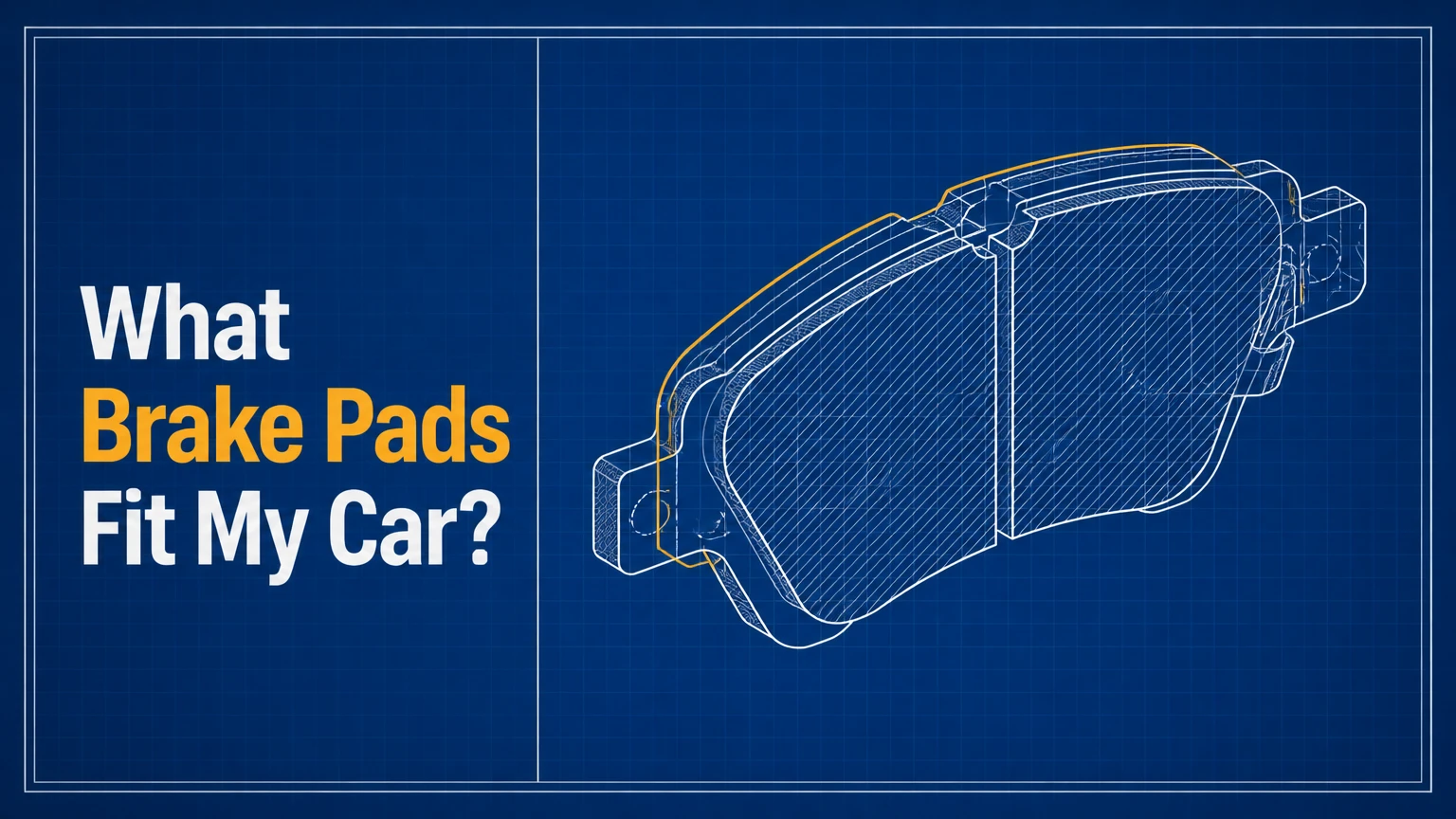
To determine what brake pads fit my car, match the vehicle’s year, make, model, trim, engine, axle position and brake package with a verified parts catalog or OEM part number. Brake pads are not universal, and two visually identical vehicles can require different pads because they use different calipers, rotor sizes or factory brake options.
Key Facts at a Glance
- Brake pads must match the specific caliper and brake package installed on the vehicle.
- Front and rear brake pads have different shapes and are not interchangeable.
- A VIN lookup can narrow the options but may not identify every production variation.
- Rotor diameter, wheel size and performance packages can change brake pad fitment.
- Brake pads should normally be replaced as a complete axle set, not one wheel at a time.
- Physical comparison is the final verification when a catalog lists multiple compatible sets.
How to Find What Brake Pads Fit My Car
Finding the correct brake pads requires more than entering the vehicle model into a search box. Start with the full vehicle configuration, identify the axle being serviced, check for brake-package notes, confirm the OEM or interchange number, and compare the new pads with the installed pads before fitting them.
A reliable fitment process has six stages:
- Collect the complete vehicle information.
- Identify whether the front or rear brakes need service.
- Search a reputable electronic parts catalog.
- Review all fitment notes and brake-package restrictions.
- Cross-reference the OEM or manufacturer part number.
- Compare the replacement pads physically before installation.
Skipping the fourth or sixth stage causes many incorrect orders. A catalog may show that a pad fits a 2021 sedan, for example, but a note may limit that fitment to vehicles with a 305 mm rotor, a specific caliper supplier or a production date before June 2021.
What Vehicle Information Do You Need?
The minimum information is the year, make, model, trim and axle position. For vehicles with multiple brake configurations, you may also need the VIN, engine, drivetrain, body style, production date, wheel size, rotor diameter or factory option code.
| Vehicle detail | Example | Why it affects fitment |
| Model year | 2021 | Manufacturers can change brakes between model years |
| Make and model | Toyota Camry | Identifies the main vehicle platform |
| Trim | SE, XLE or TRD | Sport trims may use larger brakes |
| Engine | 2.5L or 3.5L | Larger engines may receive larger calipers |
| Drivetrain | FWD, AWD or 4WD | Drivetrain can alter weight and brake packages |
| Axle position | Front or rear | Front and rear pads use different shapes |
| Production date | Built 05/2021 | Mid-year production changes can affect parts |
| Rotor diameter | 305 mm | Pad shape must match the corresponding caliper |
| Factory package | Tow or performance package | Heavy-duty packages may use upgraded brakes |
Your registration or insurance card usually provides the year, make, model and VIN. The driver’s door label may provide the production month, gross axle ratings and other identification data.
Does the Trim Level Matter?
The trim level can determine whether the vehicle has standard or upgraded brakes. Performance trims, police packages, tow packages, heavy-duty suspensions and larger factory wheels often come with larger rotors or different calipers.
A base sedan and its sport version may share an engine and body but use completely different front pads. Do not assume a pad fits because the product description names the correct model without naming the correct trim or brake package.
Can You Use the VIN to Find Brake Pads?
A 17-character VIN is one of the best starting points for identifying brake pads, but a VIN lookup is not always conclusive. The VIN identifies the vehicle’s manufacturer, model attributes and production sequence, yet some aftermarket catalogs still display two or more brake options for the same VIN.
VIN uncertainty commonly occurs when:
- A manufacturer used more than one caliper supplier.
- The brake package changed during the production year.
- The vehicle received an optional performance or towing package.
- A previous owner converted or upgraded the brakes.
- The catalog does not decode every factory option.
When a VIN search returns several sets, check the catalog notes instead of selecting the first result. A note such as “with 320 mm rotor,” “without sport package” or “Akebono caliper” is a fitment requirement, not a general description.
Are Front and Rear Brake Pads Different?
Front and rear brake pads are different in shape, size, friction area and hardware. They cannot normally be swapped because each axle uses its own caliper design and braking requirements.
Front brakes usually perform a greater share of the braking work because vehicle weight transfers forward during deceleration. Front pads are therefore often larger and may wear faster. Rear pads may be smaller and can include special features for an electronic or mechanical parking brake.
Some vehicles also use front disc brakes and rear drum brakes. In that configuration, the rear axle uses brake shoes rather than disc brake pads. Confirm the brake type before ordering rear parts.
Why Does My Car Show Multiple Brake Pad Options?
Multiple listings usually mean the vehicle was manufactured with more than one brake system. The differences may involve rotor diameter, caliper manufacturer, piston count, production date, wheel package or regional specification.
| Catalog note | What to inspect | Typical consequence |
| With 320 mm rotor | Measure rotor diameter | Smaller-rotor pads may not fit the caliper |
| Akebono caliper | Read caliper casting or supplier mark | Different supplier may use a different pad shape |
| Built before 06/2021 | Check door-jamb production date | Mid-year brake revision may apply |
| With sport package | Check trim and option codes | Sport brakes are often larger |
| With electronic parking brake | Inspect rear caliper and parking brake | Rear piston may require service mode |
| 17-inch wheels only | Confirm original wheel package | Wheel size may identify a larger brake package |
Measure the rotor from outer edge to outer edge. A small measuring error matters because catalogs may separate options that differ by only 10-20 mm.
Caliper markings are another strong clue. Clean the visible outer caliper surface and look for a cast name, logo or number. Do not disassemble the hydraulic system merely to find a casting number.
Can You Match Brake Pads by Shape and Size?
Physical measurements can confirm brake pad fitment, but dimensions alone should not be the first selection method. Several pads may have similar length and height while using different locating ears, wear sensors, spring clips or backing-plate contours.
Compare these features before installation:
- Overall backing-plate length
- Pad height
- Total thickness
- Friction-material shape
- Upper and lower locating tabs
- Wear-indicator position
- Sensor connector or sensor slot
- Piston-side clips
- Chamfers and slots
- Included shims and hardware
Place the new and old pads backing plate to backing plate. Their mounting points, curves and contact surfaces should align. Minor friction-material differences can be intentional, but the backing plate must seat correctly inside the caliper bracket.
Never grind, file or bend a new pad to force it into the bracket. A pad that cannot move freely after the bracket is cleaned and the correct clips are installed is either incorrect, defective or obstructed by corrosion.
How Do OEM and Aftermarket Part Numbers Work?
An OEM part number identifies the factory replacement specified by the vehicle manufacturer. An aftermarket number identifies a compatible product made by another company, and one aftermarket number may cross-reference several OEM numbers.
The most reliable process is:
- Look up the OEM number using the VIN.
- Enter that number into the brake-pad manufacturer’s catalog.
- Confirm the axle position and application notes.
- Compare the pad drawing and dimensions.
- Verify the number printed on the received box.
A superseded OEM number is not automatically incorrect. Manufacturers periodically replace older numbers with updated numbers because of material revisions, supplier changes or packaging changes. The catalog should explicitly show the supersession.
Which Brake Pad Material Should You Choose?
The correct pad shape determines whether the part fits, while the friction material determines how it performs. Ceramic pads generally suit quiet daily driving, semi-metallic pads suit higher heat and heavier loads, and organic pads suit lighter or cost-sensitive applications where the manufacturer permits them.
| Pad material | Best application | Main advantage | Main limitation | Typical parts cost per axle |
| Ceramic | Commuting and family vehicles | Low noise and lighter dust | Higher initial price | $35-$100 |
| Semi-metallic | Trucks, towing and repeated hard braking | Strong heat management | More noise and rotor wear | $30-$90 |
| Organic or NAO | Light vehicles and moderate use | Soft engagement and low price | Faster wear under heat | $20-$60 |
| Performance compound | Track or aggressive street use | High-temperature friction | Noise, dust and cold compromise | $100-$300+ |
Ceramic Brake Pads
Ceramic brake pads are a practical choice for many passenger cars and crossovers. They usually create less visible wheel dust and less noise than aggressive semi-metallic formulations.
Ceramic does not automatically mean better braking. A ceramic pad designed for low noise may be unsuitable for frequent towing, repeated mountain descents or track temperatures. Use a pad approved for the vehicle’s weight and intended duty.
Modern ceramic formulas may be marketed as copper-free or low-copper because environmental requirements have reduced copper content in friction materials. The actual formulation varies by manufacturer.
Semi-Metallic Brake Pads
Semi-metallic pads contain a significant proportion of metallic fibers or particles combined with binders and friction modifiers. They generally conduct heat effectively and maintain consistent response during demanding braking.
The trade-off is greater potential for noise, darker dust and rotor wear. These characteristics may be acceptable on a work truck or towing vehicle but undesirable on a luxury commuter.
Organic Brake Pads
Non-asbestos organic pads use fibers, fillers and resins rather than high metallic content. They can provide quiet initial operation and a softer pedal response.
Organic pads usually tolerate sustained heat less effectively than duty-specific semi-metallic pads. They may wear quickly on heavy vehicles, steep routes or stop-and-go commercial use.
What Do Brake Pad Edge Codes Mean?
Brake pad edge codes can include two letters that describe friction performance at lower and higher test temperatures. An FF code, for example, indicates that the tested friction coefficient remained within the F range under both conditions.
| Letter | Friction coefficient range | General interpretation |
| E | 0.25-0.35 | Lower friction range |
| F | 0.35-0.45 | Common street range |
| G | 0.45-0.55 | Higher friction range |
| H | Above 0.55 | Very high friction range |
The first letter normally represents friction at a lower test temperature, while the second represents a higher temperature. An FG pad therefore moves from the F range to the G range as temperature increases.
Edge codes do not provide a complete quality ranking. They do not fully describe pedal feel, noise, wear rate, dust, rotor compatibility, fade resistance or performance on a specific vehicle.
How Much Do Correct Brake Pads Cost?
A standard passenger-vehicle brake pad set typically costs $25-$100 per axle. Premium, heavy-duty and performance pads can cost $100-$300 or more, while professional pad replacement commonly adds $150-$350 per axle depending on vehicle complexity and local labor rates.
| Expense | Typical range per axle | Factors that increase cost |
| Brake pad set | $25-$100 | Premium compound or uncommon fitment |
| Performance pads | $100-$300+ | Racing compound or specialty vehicle |
| Hardware kit | $10-$40 | Separate clips, springs or pins |
| Brake rotors | $80-$300+ | Larger diameter or two-piece design |
| Professional labor | $150-$350 | Electronic parking brake or seized parts |
| Complete pad and rotor service | $300-$800+ | Luxury, truck or performance application |
Extremely cheap pads may omit hardware, shims or application-specific features. Compare what the box includes rather than comparing pad-set prices alone.
How Long Should Brake Pads Last?
Brake pads commonly last 30,000-70,000 miles, but no mileage interval guarantees remaining thickness. Vehicle weight, traffic, towing, hills, regenerative braking, caliper condition and driving technique can move service life well outside that range.
A highway-driven hybrid may retain its pads for a long period because regenerative braking reduces friction-brake use. A heavy delivery vehicle in urban traffic may consume pads much faster.
Inspect pad thickness during tire rotation or routine service. Measure the friction material, not the steel backing plate. Many technicians recommend planning replacement near 3 mm, although the manufacturer’s service specification takes priority.
Do You Need Rotors With New Brake Pads?
Brake rotors do not always require replacement with brake pads, but they must be inspected and measured. A rotor should be replaced when it is below minimum thickness, deeply scored, cracked, severely corroded or unable to meet runout and thickness-variation specifications.
Check:
- Minimum thickness stamped on the rotor
- Measured thickness at several positions
- Deep grooves or heat cracks
- Blue heat spots
- Rust scale near the pad contact area
- Lateral runout
- Uneven thickness
- Contamination from grease or brake fluid
New pads installed on a damaged rotor can develop noise, vibration and uneven friction transfer. A rotor that looks smooth can still cause pedal pulsation if thickness varies around its circumference.
What Are the Signs of Incorrect Brake Pads?
Incorrect pads may fail to enter the bracket, move excessively, place the wear indicator on the wrong side or sit against the rotor at an incorrect angle. Stop the installation whenever the replacement pad differs materially from the removed pad.
| Symptom | Likely problem | Correct action |
| Pad will not enter bracket | Wrong backing-plate shape or corroded bracket | Verify part number and clean bracket |
| Pad rattles in clips | Wrong pad or incorrect hardware | Compare ears and install correct clips |
| Wear sensor does not connect | Wrong sensor configuration | Order sensor-compatible pad set |
| Friction material overhangs rotor | Wrong pad or rotor combination | Recheck brake package |
| Inner pad differs from outer pad | Set orientation not understood | Follow pad markings and service manual |
| Wheel binds after assembly | Pad, hardware, piston or slide-pin issue | Stop and inspect before driving |
Some pad sets deliberately include different inner and outer pads. The inner pad may have a piston clip, wear sensor or directional marking. Keep the pads organized during unpacking.
What Should You Check Before Installation?
Before installing brake pads, confirm the part number, inspect the rotors, clean the bracket contact points, test the slide pins and check the caliper piston. Replace damaged hardware and follow the service procedure for electronic parking brakes.
Brake lubricant belongs only on specified metal-to-metal contact surfaces. Never apply lubricant to the friction material or rotor face.
Rear electronic parking brake systems may require a scan tool, dashboard procedure or service mode before the piston can be retracted. Forcing the piston backward can damage the actuator.
Brake work also involves safety-critical fasteners and lifting procedures. Use axle stands on a stable surface, follow the manufacturer’s torque specifications and seek professional service when the correct procedure is uncertain.
How Should New Brake Pads Be Bedded?
Brake-pad bedding gradually establishes an even friction layer on the rotor. Follow the pad manufacturer’s procedure because street ceramic, heavy-duty and performance compounds may require different speed, temperature and cooling cycles.
A typical street procedure may involve several moderate stops from approximately 30-40 mph without bringing the vehicle to a complete stop, followed by a cooling drive. This is only a general example, not a substitute for the instructions supplied with the pad set.
Avoid holding the brake pedal firmly while the brakes are extremely hot. Stationary pad contact can deposit an uneven layer on the rotor and contribute to later pulsation.
Common Brake Pad Buying Mistakes
The most common mistake is ordering by year and model alone. Vehicle manufacturers frequently use multiple brake packages within the same model year.
Other costly mistakes include:
- Buying front pads when the rear axle needs service
- Assuming wheel size always confirms brake size
- Ignoring production-date restrictions
- Selecting by pad dimensions without checking the backing plate
- Reusing damaged or corroded hardware
- Mixing pad compounds across the same axle
- Replacing one side of an axle only
- Opening or contaminating parts before confirming fitment
- Choosing a track compound for ordinary cold street use
- Assuming the most expensive pad is automatically the best match
A practical rule is to keep the old pads until the repair is complete. They provide a physical reference if the box label, online image or catalog description creates doubt.
Expert Fitment Rules
Treat catalog notes as mandatory. “With sport brakes” or “to 06/2021” determines compatibility. It is not optional product information.
Verify the brake system, not only the vehicle identity. A VIN describes the vehicle as manufactured, but previous owners may have replaced knuckles, calipers or complete brake assemblies.
Do not judge fitment by friction material alone. The steel backing plate controls how the pad seats, slides and reacts against the caliper. A small difference in a tab or clip can make an otherwise similar pad unsafe.
Frequently Asked Questions
Can I buy brake pads using only my license plate?
Some retailer systems can decode a license plate into basic vehicle information, but the result may still show multiple brake packages. Treat the plate lookup as a convenient starting point. Verify the trim, axle position, rotor size and fitment notes before purchasing or installing the pads.
Do brake pads come in sets of two or four?
Most disc brake pad boxes contain four pads for one axle: an inner and outer pad for each wheel. A front pad set normally services both front wheels. It does not usually include the rear pads unless the product is specifically sold as a front-and-rear package.
Should all four brake pads be replaced together?
Replace both sides of the same axle together. You do not always need to replace the front and rear pads at the same time because they can wear at different rates. Inspect both axles, then service each axle according to its remaining thickness and condition.
Can different brake pad brands fit the same car?
Yes. Multiple manufacturers can produce pads that fit the same brake system, and each brand uses its own catalog number. Fitment depends on the backing-plate design and application specification, not the brand name. Compare reputable brands by compound, hardware, warranty and intended driving conditions.
Are expensive brake pads always better?
Expensive pads are not automatically better for every driver. A high-temperature performance pad may create more noise, dust and cold-braking compromise than a quality street pad. The best pad is the correctly fitting compound designed for the vehicle’s weight, brake system and operating conditions.
What should I do if two brake pad sets look correct?
Read every catalog note, measure the rotor, identify the caliper and compare the backing-plate drawing. Contact the manufacturer or a professional parts specialist when uncertainty remains. Do not order both and assume the correct set can be identified only after the braking system is disassembled.
The Bottom Line
To identify what brake pads fit my car, verify the complete vehicle configuration, axle position and installed brake package rather than relying only on the model name. Use the VIN and OEM number to narrow the search, review every catalog restriction, and physically compare the new backing plates with the removed pads before installation.
Correct fitment comes first. After confirming the shape, caliper and rotor application, choose ceramic, semi-metallic, organic or performance friction material according to the vehicle’s normal workload. When any fitment detail remains uncertain, have the VIN, rotor diameter and caliper information checked by the pad manufacturer or a qualified repair professional.


