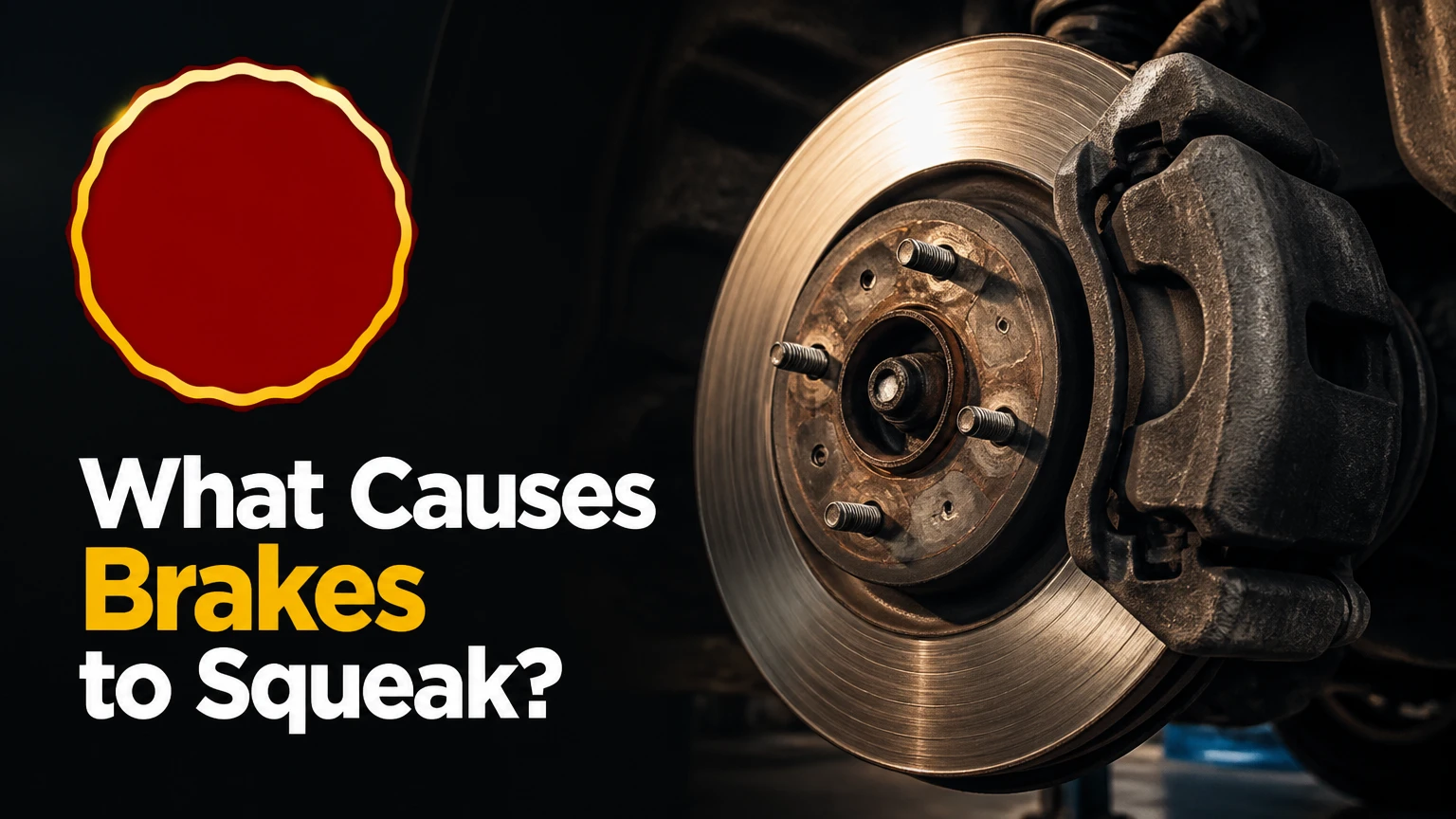
Brake squeak is caused by high-frequency harmonic vibration occurring when brake pad friction material contacts a spinning steel rotor. This interaction creates stick-slip friction that oscillates between 1,000 and 5,000 Hz. Common triggers include worn friction pads, cold operating temperatures, rotor glazing, rust accumulation, missing anti-rattle shims, and caliper alignment issues.
At a Glance
- Mechanical wear indicators emit a 2,000 to 4,000 Hz warning screech when pad material thins to 2.0 mm.
- Morning moisture creates flash rust on cast-iron rotors that scrapes off within three to five stops.
- Thermal glazing occurs above 340°C (650°F), turning brake pad resin into a slick, noisy surface.
- Omitting high-temperature ceramic grease on shim contact points causes immediate high-frequency vibration.
- Spraying WD-40 or oil on brake components ruins friction coefficients and causes total brake failure.
How Does Stick-Slip Friction Create High-Frequency Brake Vibration?
Stick-slip friction creates high-frequency brake vibration through rapid, micro-scale alternating cycles of gripping and sliding between the brake pad and the revolving steel rotor. As the caliper piston presses the friction material against the disc, the pad momentarily sticks to the rotor face before breaking free and slipping. This continuous cycle repeats thousands of times per second.
The rapid movement converts kinetic energy into high-frequency acoustic waves ranging from 1,000 Hz to over 5,000 Hz. The entire brake assembly acts like a resonant body, amplifying these micro-vibrations into an audible squeal. While the mechanical motion itself is a normal physical property of dry friction, excessive noise occurs when component dampening fails or surface conditions lower the dynamic coefficient of friction.
Factors that intensify stick-slip friction include:
- Unlubricated contact points: Steel-on-steel contact between the pad backing plate and caliper brackets prevents vibration dissipation.
- Resonant amplification: Thin, un-shimmed pad backing plates act as acoustic speakers for friction frequencies.
- Surface polishing: Ultra-smooth rotor faces offer uneven friction thresholds across their contact paths.
When Do Brake Wear Indicators Start Squealing?
Brake wear indicators start squealing when the friction material thins down to a depth between 2.0 mm and 3.0 mm. These indicators are small, spring-steel metal tabs attached to the brake pad backing plate engineered to contact the outer edge of the rotor disc once normal wear limits are reached.
[New Brake Pad: 12.0 mm] ──> [Safe Operation] ──> Silent Friction
[Worn Brake Pad: 2.5 mm] ──> [Tab Contacts Rotor] ──> Continuous 2,000-4,000 Hz Screech
[Bare Plate: 0.0 mm]    ──> [Metal on Metal]    ──> Heavy Mechanical Grinding
The contact creates a continuous, high-pitched mechanical screech between 2,000 Hz and 4,000 Hz whenever the wheel turns. This sound is intentionally designed to alter its pitch or vanish temporarily when you depress the brake pedal. When pedal pressure increases, the metal tab flexes slightly against the rotor face, shifting its acoustic frequency until pedal pressure releases.
| Pad Thickness | Status | Acoustic Indication | Required Action |
| 8.0 mm to 12.0 mm | New / Healthy | Silent operation | None required |
| 4.0 mm to 7.0 mm | Moderate Wear | Occasional light thermal hum | Normal monitoring |
| 2.0 mm to 3.0 mm | Critical Wear Limit | Continuous high-pitched screech | Immediate pad replacement |
| 0.0 mm to 1.5 mm | Severe Failure | Loud, harsh metallic grinding | Replace pads, rotors, and service calipers |
How Long Does the Brake Pad Bedding-In Process Take?
The brake pad bedding-in process takes between 200 and 500 miles of standard urban driving to complete naturally. Bedding-in transfers an even, microscopic layer of friction material from the new brake pad onto the smooth face of a new or resurfaced iron rotor.
During this initial breakdown period, un-bedded pads exhibit minor surface chatter and transient squeaking due to irregular contact patches between the flat pad face and the turning rotor. To accelerate this process and prevent early noise, technicians perform controlled thermal bed-in cycles immediately after installation.
Controlled Thermal Bedding Procedure
- Accelerate the vehicle to 60 mph on an open, safe roadway.
- Apply moderate to firm pressure to decelerate the vehicle down to 10 mph without locking the tires.
- Avoid coming to a complete stop, which can deposit concentrated pad resin onto one hot spot on the rotor face.
- Accelerate back to 60 mph and repeat this deceleration cycle 5 to 8 times in rapid succession.
- Drive at highway speeds for 10 minutes without heavy braking to allow the rotor and pad assemblies to cool completely.
Why Do Cold or Overheated Brakes Squeak?
Cold or overheated brakes squeak because extreme temperatures push friction material outside its optimal operating window, altering its dynamic coefficient of friction. Cold semi-metallic or ceramic compounds lack initial grip under 65°C (150°F), causing minor micro-slippage that sounds like a morning squeak.
Conversely, excessive heat causes thermal glazing. Continuous heavy braking down steep descents or aggressive track driving can raise system temperatures beyond 340°C (650°F). At these elevated temperatures, binding resins within organic or low-metallic pads liquefy, migrate to the friction surface, and harden into a smooth, glassy shell.
Cold Compounds (<65°C / 150°F)  ──> Micro-slippage ──> Transient Light Squeak
Normal Range (100°C - 250°C)   ──> Optimal Friction ──> Silent Operation
Thermal Glazing (>340°C / 650°F) ──> Resin Hardening ──> Permanent High-Frequency Squeal
Glazed pads lose their mechanical grip, forcing the caliper to squeeze harder to achieve stopping power. This extra force drives extreme harmonic vibrations across the hardened, glassy contact interface, producing a permanent, high-pitched squeal until the glazed layer is mechanically abraded or replaced.
Why Do Carbon-Ceramic or High-Performance Brakes Squeak Naturally?
Carbon-ceramic and high-performance track-focused brake pads squeak naturally due to their high metallic content, rigid structural compounds, and broad operating temperature thresholds. Track formulations utilize dense steel, iron, and bronze filaments designed to withstand temperatures above 700°C (1,300°F).
At low speeds, light pedal pressures, and ambient street temperatures, these heavy metallic fibers do not conform smoothly to the rotor surface. Instead, they produce audible stick-slip chatter at low frequencies. This characteristic is an intentional engineering compromise prioritizing track thermal stability over acoustic dampening. High-performance brake systems rarely include soft rubber anti-vibration shims, allowing raw mechanical resonance to pass directly through the suspension components.
Why Do Brakes Squeak After Rain or Sitting Overnight?
Brakes squeak after rain or sitting overnight because exposed iron-alloy brake rotors form a thin layer of surface oxidation, known as flash rust, within 4 to 12 hours of exposure to high humidity or water.
High Moisture Exposure (4-12 Hours) ──> Flash Rust Layer Forms on Cast Iron
                                                  │
                                                  ▼
Initial 3 to 5 Stop Applications    ──> Pad Scrapes Away Oxide Film
                                                  │
                                                  ▼
Rotor Surface Cleansed              ──> Brakes Return to Normal Silent Operation
When you first drive the vehicle, the brake pads scrape this microscopic layer of rust off the revolving rotor face. This cleaning action produces a noticeable grinding squeak during the first three to five stop applications. Once the friction pads wear away the surface oxidation and restore clean metal-to-metal contact, the noise disappears completely. This phenomenon is harmless and requires no mechanical intervention.
Why Does Trapped Road Debris Make Brakes Screech?
Trapped road debris makes brakes screech because small objects wedge into the narrow clearance gap between the spinning rotor and surrounding static components. Small pebbles, coarse gravel, or road salt chunks often get caught between the inner rotor face and the thin, sheet-metal dust shield.
This trapped debris scrapes directly against the revolving rotor disc, creating a loud, continuous metallic screech that changes pitch relative to wheel speed. Crucially, this noise persists whether the driver applies the brake pedal or coasts freely.
To clear trapped debris from a dust shield:
- Ensure the vehicle is parked safely on level ground with the parking brake engaged.
- Inspect the gap behind the brake rotor using a flashlight.
- Gently push the thin sheet-metal dust shield backward 2 to 3 millimeters away from the rotor using a long wooden dowel or flat screwdriver to release the trapped stone.
Why Do Brand-New Brakes Squeak After Replacement?
Brand-new brakes squeak after replacement due to improper installation steps, such as omitting anti-vibration hardware, using dry contact points, or failing to clean the hub surface. Installing new friction pads onto worn, lip-grooved rotors without resurfacing also creates uneven edge contact that generates heavy harmonic noise.
Technicians frequently make critical errors during fast brake jobs:
- Skipping the application of high-temperature synthetic lubricant to pad ears and caliper slide pins.
- Reusing worn, heat-fatigued anti-rattle spring clips instead of installing new hardware.
- Failing to clean protective shipping oils off new brake rotor surfaces using dedicated brake cleaner.
- Installing pads over uncleaned wheel hubs, introducing lateral wobble across the rotor face.
How Do Missing Anti-Rattle Shims and Caliper Grease Cause Brake Noise?
Missing anti-rattle shims and absent caliper grease cause brake noise by allowing direct metal-on-metal contact between the steel pad backing plate and the caliper piston. Anti-rattle shims are multi-layered steel and elastomer dampeners fitted to the rear of the friction pad to absorb micro-vibrations before they turn into audible sound.
[Caliper Piston] ──(Dry Contact)──> [Steel Backing Plate] ──> Unchecked Acoustic Resonance (Squeak)
[Caliper Piston] ──(Ceramic Grease + Shim)──> [Steel Backing Plate] ──> Dampened Vibration (Silent)
Without shims, micro-vibrations pass straight into the heavy caliper housing, turning it into an acoustic amplifier. Furthermore, failing to coat pad slider ears and contact points with high-temperature ceramic brake grease (rated up to 1,300°C / 2,400°F) leaves the pad binding within the bracket. The pad tilts slightly, contacts the spinning rotor at an offset angle, and creates localized micro-vibrations that produce persistent noise.
How Does Wheel Hub Corrosion Cause Lateral Runout and Rhythmic Squeaking?
Wheel hub corrosion causes lateral runout and rhythmic squeaking by tilting the brake rotor on its axis, forcing it to wobble as it spins. Even a tiny speck of rust or debris measuring just 0.05 mm (0.002 inches) trapped between the wheel hub face and the rotor hat creates significant alignment deviation at the outer edge of the disc.
Rust Deposit on Hub Face (0.05 mm) ──> Angular Mismatch ──> Rotor Edge Wobble (Lateral Runout)
                                                                     │
                                                                     ▼
Rotor Slaps Brake Pads Once Per Turn <── Continuous Wheel Rotation ──┘
As the wheel rotates, this lateral runout causes the rotor face to move back and forth, hitting the static brake pads once per wheel rotation. This intermittent contact creates a rhythmic squeak that matches wheel speed rather than pedal application. Over time, lateral runout induces uneven disc thickness variation, leading to pedal pulsation alongside persistent noise.
What is the Difference Between Brake Squeaking, Grinding, and Clunking?
The difference between brake squeaking, grinding, and clunking lies in the underlying mechanical failure, pitch frequency, and operational severity of the symptom.
Squeaking (1k-5k Hz)  ──> Harmonic Vibration / Surface Glaze ──> Maintenance / Adjustment Needed
Grinding (<500 Hz)     ──> Total Friction Material Loss    ──> Immediate Component Replacement
Clunking (Impact Noise) ──> Loose Caliper / Worn Bushings    ──> Critical Hardware Fastener Fix
Squeaking presents as a high-pitched metallic tone (1,000 to 5,000 Hz) caused by vibration, thin wear tabs, or glazed friction surfaces, usually leaving immediate braking force intact.
Grinding is a harsh, low-pitched rasping noise below 500 Hz caused by complete friction material depletion. The bare steel backing plate crushes directly against the iron rotor, causing severe scoring, extended stopping distances, and immediate safety hazards.
Clunking produces a dull, heavy impact thud occurring when pedal pressure is applied or released. This noise signals loose caliper mounting bolts, severely worn guide pin bushings, or cracked suspension arm brackets allowing physical movement within the braking frame.
Does a Brake Squeak Mean My Braking System is Failing or Unsafe?
No, a brake squeak does not automatically mean your braking system is failing or unsafe. Most high-pitched brake squeaks stem from cosmetic vibration, temperature changes, dry shims, or morning humidity, leaving hydraulic pressure and overall stopping distance unaffected.
However, a squeak demands immediate diagnostic evaluation if accompanied by specific warning signs:
- Soft or spongy pedal feel: Indicates air in hydraulic lines or boiling brake fluid.
- Vehicle pulling to one side: Points to a seized caliper slide pin or stuck piston.
- Continuous grinding sounds: Signals total destruction of pad friction material down to the backing plate.
- Steering wheel shake during braking: Indicates severe thermal distortion or thickness variation across the rotors.
Can You Spray WD-40 on Brakes to Stop Squeaking?
No, you must never spray WD-40, penetrating oils, or household silicone lubricants on brake rotors, friction pads, or caliper assemblies. Standard lubricants drastically reduce the dynamic coefficient of friction necessary for braking force.
Applying petroleum products to brake pads saturates the porous friction material, rendering it incapable of gripping the steel rotor face. This results in immediate loss of stopping power, extended braking distances, and potential pedal failure. Furthermore, petroleum solvents degrade neoprene caliper dust boots and piston seals, causing fluid leaks and caliper lockups. To clean brake assemblies safely, use dedicated, non-chlorinated brake cleaner spray designed to evaporate completely without leaving oily residues.
Why Do Brakes Only Squeak When Backing Up or Reversing?
Brakes only squeak when backing up because brake pads wear in a forward direction, creating a micro-tapered friction profile over time. Because vehicles spend over 99% of their operating life traveling forward, friction material fibers and caliper bracket wear grooves align specifically to forward rotation.
Forward Driving (99% Life) ──> Friction Material Wears in Directional Grain
                                           │
                                           ▼
Reverse Motion Selected    ──> Rotor Pulls Pads Opposite to Wear Grain
                                           │
                                           ▼
Pad Shifts in Bracket      ──> Unstable Geometry Induces Harmonic Squeak
When you select reverse and apply pedal pressure, the spinning rotor forces the pads backward against the opposite edge of the caliper bracket. This motion shifts the friction surface against its natural wear grain, causing pad chatter and harmonic vibration. Once forward motion resumes, the pads shift back into their normal alignment, restoring quiet operation.
How Much Does It Cost to Fix Squeaking Brakes?
Fixing squeaking brakes costs between $15 and $900, depending on whether the cause is dry hardware, worn pads, or damaged rotors.
| Repair Scope | Typical Cost Range | Included Components & Labor |
| DIY Cleaning & Lubrication | $15 to $35 | Synthetic ceramic grease, brake cleaner spray, replacement clips |
| Professional Debris & Service | $80 to $150 | Inspection, rotor rust cleaning, slide pin repacking, hardware lube |
| Axle Pad Replacement | $150 to $300 | New OEM or ceramic friction pads, hardware kit, labor per axle |
| Complete Axle Pad & Rotor Service | $350 to $600 | New pads, new iron rotors, hardware kit, fluid top-off, labor |
| Full Four-Wheel Overhaul | $700 to $1,200+ | Pads and rotors on both axles, caliper slide service, fluid flush |
How Can You Permanently Stop Brakes From Squeaking at Home?
To permanently stop brakes from squeaking at home, follow a structured mechanical process to eliminate surface glazing, dampening failures, and component binding.
1.Clean the Rotor Faces:Eliminates surface oils, glaze, and rust deposits.
Remove the road wheels and spray the rotor faces thoroughly with non-chlorinated brake cleaner. Scrub both sides using 120-grit emery cloth in a cross-hatch pattern to break up thermal glaze and remove surface flash rust.
2.Inspect and Dress Pad Surfaces:Restores friction coefficient and bevel edges.
Extract the brake pads from the caliper bracket. Sand the friction material lightly on a flat surface using 80-grit sandpaper until the shiny, glazed coat is removed. File a slight 45-degree chamfer along the leading and trailing edges of the friction block to reduce initial impact chatter against the rotor.
3.Service Caliper Slider Pins:Ensures even pad pressure distribution.
Pull the metal slider pins from the caliper bracket, wipe away old grease, and inspect for rust or pitting. Apply a thin layer of silicone-based brake grease to the pins and reinsert them into healthy rubber dust boots.
4.Lubricate Contact Points and Fit Shims:Dampens acoustic vibration waves.
Fit high-quality elastomer-backed shims to the rear of the pad backing plates. Apply a microscopic layer of high-temperature synthetic ceramic brake grease to the shim-to-piston contact interface, as well as the metal slider ears where the pads sit in the bracket. Keep grease completely clear of the friction material face and rotor disc.
5.Torque Fasteners to Factory Specifications:Prevents rotor deformation and runout.
Reassemble the caliper housing using proper thread-locking fluid on mounting bolts. Reinstall the road wheel and tighten lug nuts in a star pattern using a calibrated torque wrench to prevent uneven tension on the rotor hat.
The Bottom Line
Brake squeak is caused by high-frequency harmonic vibration generated by stick-slip friction between the pad and rotor, amplified when dampening components fail. While most squeaks stem from harmless conditions like morning rust, cold friction compounds, or missing shim grease, continuous screeching indicates worn friction pads contacting wear tabs at 2.0 mm thickness. Never apply petroleum lubricants like WD-40 to remedy noise; instead, inspect pad thickness, clean glazed surfaces, and properly lubricate hardware contact points to ensure quiet, safe braking performance.


