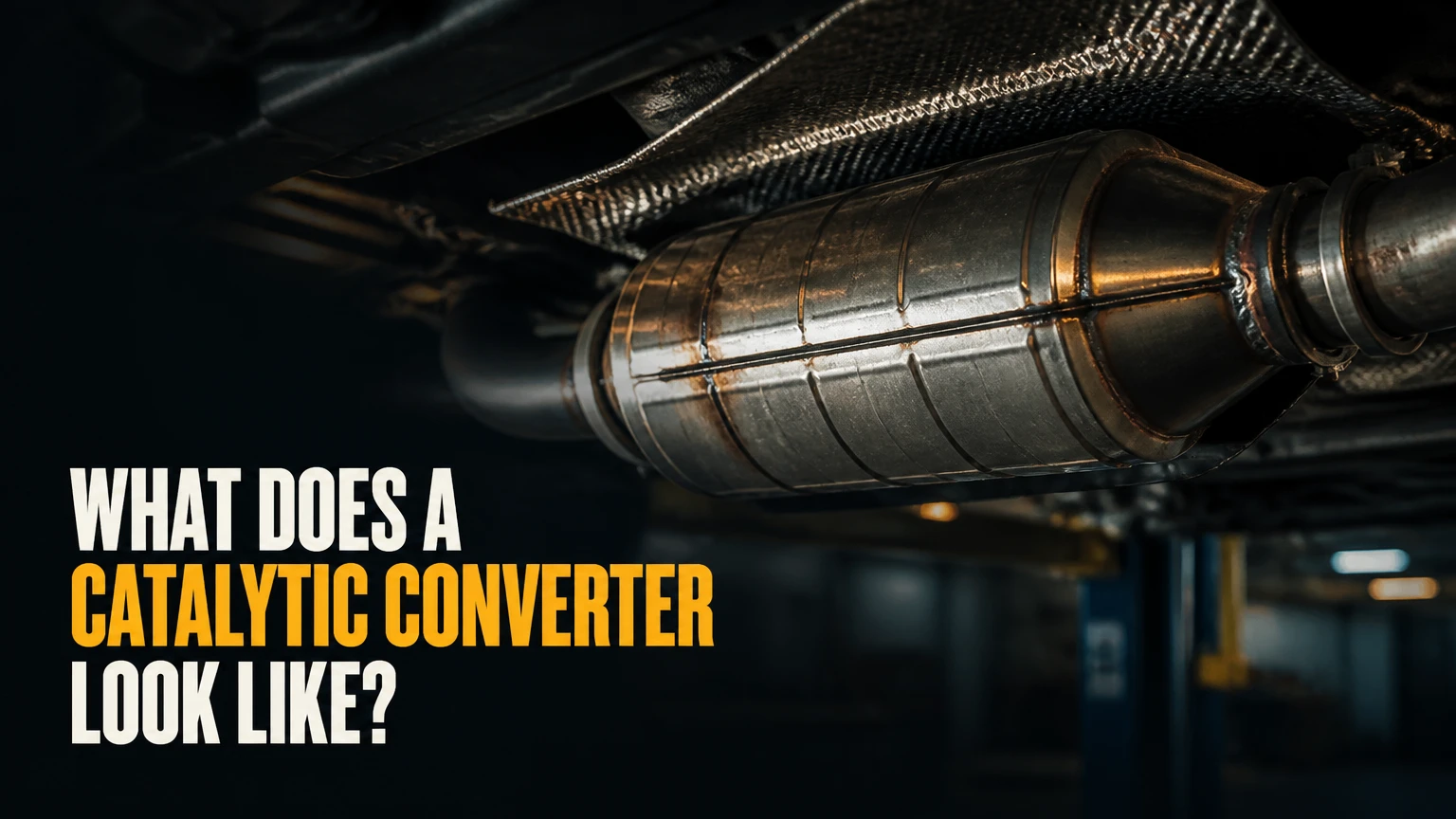
A catalytic converter is a cylindrical or oval stainless steel canister integrated into a vehicle’s exhaust pipe system. Located underneath the chassis between the engine manifold and the muffler, it features a dull gray metal casing, a dimpled outer heat shield, and threaded oxygen sensor ports on either end.
At a Glance: Core Visual Identifiers
- Exterior Shape: Flattened oval or round metal drum with tapered intake and outlet pipes.
- Outer Heat Shield: Textured, spot-welded or bolted sheet metal cover shielding the vehicle floorboard from heat.
- Internal Structure: High-density ceramic or metallic honeycomb grid with micro-channels.
- Sensor Fixtures: Threaded electrical oxygen sensor probes mounted immediately upstream and downstream.
- Location: Mounted beneath the vehicle cabin floor or bolted directly to the engine exhaust manifold.
What Does a Standard Catalytic Converter Look Like from the Outside?
A standard underbody catalytic converter looks like a thick, slightly flattened metal cylinder welded inline with the exhaust tubing. New units display a matte silver or light gray stainless steel finish, while used units develop a dull gray or rust-tinted surface.
       +-------------------------------------------------------------+
       |                  UPPER HEAT SHIELD COVER                    |
       |  +-------------------------------------------------------+  |
======[====]  O2 Sensor Port                      O2 Sensor Port  [====]======
Exhaust|   |    [Upstream]                          [Downstream]  |    |Exhaust
Inlet  |  +-------------------------------------------------------+  |    |Outlet
======[====]             MAIN CATALYTIC CANISTER BODY             [====]======
       +-------------------------------------------------------------+
The shell is typically 10 to 20 inches (25 to 50 cm) in length and 4 to 7 inches (10 to 18 cm) in width. Total assembly weight generally ranges between 5 and 15 pounds (2.2 to 6.8 kg) for light passenger vehicles.
The outer shell features a spot-welded or clamped heat shield made of dimpled metal sheet. This shield wraps around the top or sides of the canister to block radiant temperatures exceeding 1,200 degrees Fahrenheit (650 degrees Celsius) from damaging the cabin floor pans. Tapered metal cones extend from both ends of the main canister body, transitioning the wider shell into standard 2-inch to 3-inch exhaust pipes. Threaded fittings called oxygen sensor bung ports are welded directly into these tapered transition zones or adjacent pipes.
What Does the Inside of a Catalytic Converter Look Like?
Inside the metal shell sits a porous ceramic or metal foil monolith structure shaped like a fine honeycomb grid. This grid contains thousands of parallel micro-channels running end-to-end along the exhaust flow direction.
The interior honeycomb substrate is constructed from cordierite ceramic or corrugated stainless steel foil. Each square inch of the internal cross-section contains between 400 and 600 individual flow channels.
The inner ceramic surfaces are coated with a rough, highly porous washcoat of aluminum oxide that holds microscopic particles of platinum, palladium, and rhodium. Under normal conditions, looking through an uninstalled converter tube reveals a clear view of light through the microscopic square pores of the grid. If the internal structure is melted or clogged, these grid openings appear blocked, dark, or cracked into uneven fragments.
Where Is the Catalytic Converter Located Under a Car?
The catalytic converter sits within the exhaust stream between the engine exhaust manifold and the rear muffler. On most rear-wheel and all-wheel drive passenger cars, it is visible directly below the front passenger seats.
To locate the converter, follow the exhaust pipe backward from the engine block toward the rear tailpipe. The catalytic converter is the first major enlarged chamber encountered after the flexible pipe joint or exhaust manifold downpipe. Vehicles with low ground clearance require an automotive jack or lift to view the component properly.
In modern front-wheel-drive vehicles, the converter is often elevated inside the engine bay rather than under the belly pan.
What Does a Manifold Catalytic Converter (Pre-Cat) Look Like?
A manifold catalytic converter, often called a pre-cat, looks like a bulbous, irregular cluster of curved metal tubes integrated directly into the engine exhaust manifold. Instead of a smooth cylinder under the car, it mounts directly to the side of the engine cylinder head.
Manifold converters feature 3, 4, or 6 short intake runners that merge into a swollen metal housing containing the catalytic element. This positioning allows the catalyst substrate to reach its operational temperature of 800 degrees Fahrenheit in under 30 seconds after cold startup.
Because they sit inside the crowded engine compartment, pre-cats are heavily covered in stamped aluminum thermal guards and feature oxygen sensors mounted directly into the manifold collector flange.
| Feature | Underbody Converter | Manifold Converter (Pre-Cat) |
| Mounting Position | Vehicle chassis underbody | Directly attached to engine block |
| Exterior Shape | Smooth cylinder or flattened oval | Complex multi-runner pipe manifold |
| Light-Off Time | 2 to 5 minutes | Under 30 seconds |
| Heat Shield Type | Dimpled outer plate wrap | Heavy multi-piece aluminum heat shroud |
| Access Difficulty | High underbody lift required | Accessible from top of engine bay |
What Do Oxygen Sensors Look Like on a Catalytic Converter?
An oxygen sensor looks like a small metal spark plug with a metal-sheathed wire harness extending from its top end. These sensors screw directly into threaded bungs located upstream and downstream of the converter substrate.
       Electrical Wiring Harness
               |||||||
              +-------+
              | Hex   |  <- Wrenching Nut (Usually 22mm)
              | Nut   |
      ========+=======+========
      Exhaust Pipe / Converter Shell
      =========================
              | Metal |
              | Sensor|  <- Perforated Tip inside Exhaust Stream
              | Tip   |
The visible portion of the sensor consists of a stainless steel hex-head casing, usually 22 millimeters across, protruding about 2 inches from the exhaust pipe. A high-temperature electrical cable wrapped in woven fiberglass or black plastic conduit runs from the sensor head to the vehicle wiring harness.
Inside the exhaust pipe, the unseen tip of the oxygen sensor features a rounded, perforated metal snout that samples exhaust gases as they flow through the converter housing.
How Do You Distinguish a Catalytic Converter from a Resonator or Muffler?
A catalytic converter is distinguished from resonators and mufflers by its textured heat shield, heavy construction, and integrated oxygen sensor ports. Resonators and mufflers lack catalytic coatings and sensor mounts.
- Heat Shielding: Catalytic converters almost universally feature a spot-welded, dimpled heat shield wrapper to manage extreme operating temperatures. Mufflers and resonators rarely have full-body heat shields attached to their outer casings.
- Sensor Ports: Converters feature threaded 18mm ports before and after the central chamber. Resonators and mufflers do not feature oxygen sensor bungs.
- Internal Sightline: Looking straight through a resonator reveals a hollow, perforated metal tube surrounded by fiberglass packing. Looking straight through an undamaged catalytic converter reveals a dense, solid ceramic wall pierced only by micro-channels.
- Weight and Density: Converters weigh significantly more than hollow exhaust resonators of the same dimensions due to the dense ceramic core.
What Does a Damaged or Melted Catalytic Converter Look Like?
A damaged catalytic converter displays severe physical signs like a glowing red metal casing, cracked outer shell welds, or internal ceramic rubble. Internal damage alters both exterior appearance and structural integrity.
When an engine misfire sends unburned fuel into the exhaust, the catalytic reaction raises internal temperatures beyond 2,000 degrees Fahrenheit (1,093 degrees Celsius). Under these conditions, the entire metal shell can glow bright red or orange in low light.
Thermal shock causes the interior ceramic honeycomb to melt into an asymmetrical, slag-like lump that rattles against the casing when tapped with a mallet. Externally, overheated converters exhibit deep blue or iridescent purple discoloration on the stainless steel shell, along with flaking, heat-blistered metal surfaces.
What Does an Aged or Badly Rusted Catalytic Converter Look Like?
An aged catalytic converter loses its shiny metallic finish and becomes covered in dark brown rust flakes, mud scale, and road salt deposits. In regions with harsh winters, the outer heat shield often rusts through completely at its spot welds and rattles loosely against the canister.
NEW / FACTORY CATALYTIC CONVERTER:
+-------------------------------------------------------------+
| [Matte Silver / Steel Casing] [Clean Spot-Welded Heat Shield]|
+-------------------------------------------------------------+

AGED / ROAD-SALT EXPOSED CATALYTIC CONVERTER:
+-------------------------------------------------------------+
| (Deep Brown Flaking Rust)  /// Loose / Rusted-Off Shield \\\ |
+-------------------------------------------------------------+
Over time, moisture, high heat, and road salt oxidize the outer high-grade steel casing. The metal transforms into a coarse, flaking, dark reddish-brown surface that blends in visually with standard rusted exhaust piping.
Despite heavy surface corrosion, the thick outer walls of an OEM converter usually maintain their structural seal unless mechanical impacts rupture the seams.
How Does an OEM Catalytic Converter Look Compared to an Aftermarket Unit?
Original Equipment Manufacturer (OEM) catalytic converters feature vehicle-specific bent pipes, heavy-gauge steel shells, and exact-fit mounting flanges. Aftermarket converters use smaller, standardized oval shells with plain straight pipe ends designed for universal cut-and-weld installations.
OEM converters match the exact shape of the original floor pan cavity and often feature specialized double-layered heat shields and factory brackets. They are built with thicker metal casings and contain higher concentrations of precious metals, making them heavier than generic replacements.
Aftermarket replacement converters are usually noticeably smaller, lighter, and feature stamped manufacturer brand names alongside official EPA approval numbers laser-etched directly onto the steel body.
What Does a Missing or Stolen Catalytic Converter Look Like Underneath the Vehicle?
A missing catalytic converter leaves an open gap in the exhaust pipe line with clean, sharp saw cuts or freshly unbolted pipe flanges. The electrical wiring harnesses for the oxygen sensors will often be left dangling or cleanly severed.
NORMAL INTACT EXHAUST SYSTEM:
[Engine Pipe] ====> [ CATALYTIC CONVERTER ] ====> [Muffler Pipe]

STOLEN / CUT CATALYTIC CONVERTER:
[Engine Pipe] ====/                                \==== [Muffler Pipe]
                 |   EMPTY 10-20 INCH CHASSIS GAP   |
                 |   Dangling Cut Sensor Wires     |
Thieves typically use cordless reciprocating saws with metal-cutting blades to remove converters in under two minutes. This leaves raw, jagged pipe edges visible beneath the car.
If you look into the open gap, you will see straight down into empty space with two exposed pipe ends separated by 10 to 20 inches of missing exhaust line.
How Can You Tell if a Catalytic Converter Has Been “Gutted” or Bypassed?
A gutted catalytic converter looks completely normal from the outside but contains a hollow interior chamber where the ceramic lattice used to sit. Bypassed converters feature a plain straight metal pipe welded inside or replacing the outer converter housing.
Mechanics test for a gutted converter by tapping the main canister body with a rubber mallet. A functional converter produces a dull, solid thud due to its dense ceramic core. A gutted converter produces a hollow metallic ring.
Additionally, modified or bypassed units often show fresh, non-factory weld beads around the perimeter seams where the casing was cut open, emptied, and rewelded to pass visual inspections.
What Do Catalytic Converters Look Like on Diesel Vehicles and Motorcycles?
On diesel vehicles, the emissions assembly resembles a massive, multi-chambered metal drum that combines a Diesel Oxidation Catalyst (DOC) and a Diesel Particulate Filter (DPF). On motorcycles, the converter looks like a compact metal swelling inside the exhaust mid-pipe.
DIESEL EMISSIONS ASSEMBLY (DOC + DPF UNIT):
+-------------------------------------------------------------------------+
| [ DOC Section ] ==== ( DPF Filter Core ) ==== [ SCR Reduction Chamber ] |
| Length: 30+ Inches | Weight: 30 to 50+ Pounds                           |
+-------------------------------------------------------------------------+
Diesel units on heavy trucks are substantially larger than gasoline converters, frequently exceeding 30 inches (76 cm) in length and weighing between 30 and 50 pounds (13.6 to 22.6 kg). They feature multiple sensor ports for soot sensors, exhaust gas temperature (EGT) probes, and fuel injectors.
On motorcycles, catalytic converters are tiny, measuring only 4 to 8 inches in length, and are tucked discreetly into the collector pipe under the engine crankcase or concealed inside the lower muffler canister.
What Should You Do if You Need to Identify or Replace Your Catalytic Converter?
To accurately identify or source a replacement catalytic converter, gather key vehicle metrics before inspecting or purchasing parts.
- Locate the Vehicle Emission Control Information (VECI) Label: Open the engine hood and find the EPA emissions sticker located on the underside of the hood or strut tower. Note whether the vehicle requires California Air Resources Board (CARB) compliant or Federal EPA compliant parts.
- Verify Vehicle Configuration: Identify engine size (displacement in liters), engine layout (In-line vs. V-configuration), and whether the unit is an underbody converter or a manifold-integrated pre-cat.
- Inspect Sensor Layout: Count the number of oxygen sensor ports on the original unit to match the replacement converter geometry accurately.
- Scan Fault Codes: Use an OBD-II diagnostic scanner to read active trouble codes. Diagnostic code P0420 or P0430 confirms reduced catalyst efficiency in bank 1 or bank 2.
The Bottom Line
A catalytic converter is an oval or cylindrical stainless steel canister positioned in your exhaust line, identified by its outer heat shield, heavy construction, and oxygen sensor fittings. While underbody units feature a smooth metallic drum shape, modern manifold pre-cats look like complex pipe manifolds attached to the engine block. Visual inspection reveals key conditions, from the clean interior honeycomb of a healthy unit to the raw cut gaps left by theft or the hollow ring of a gutted shell.


