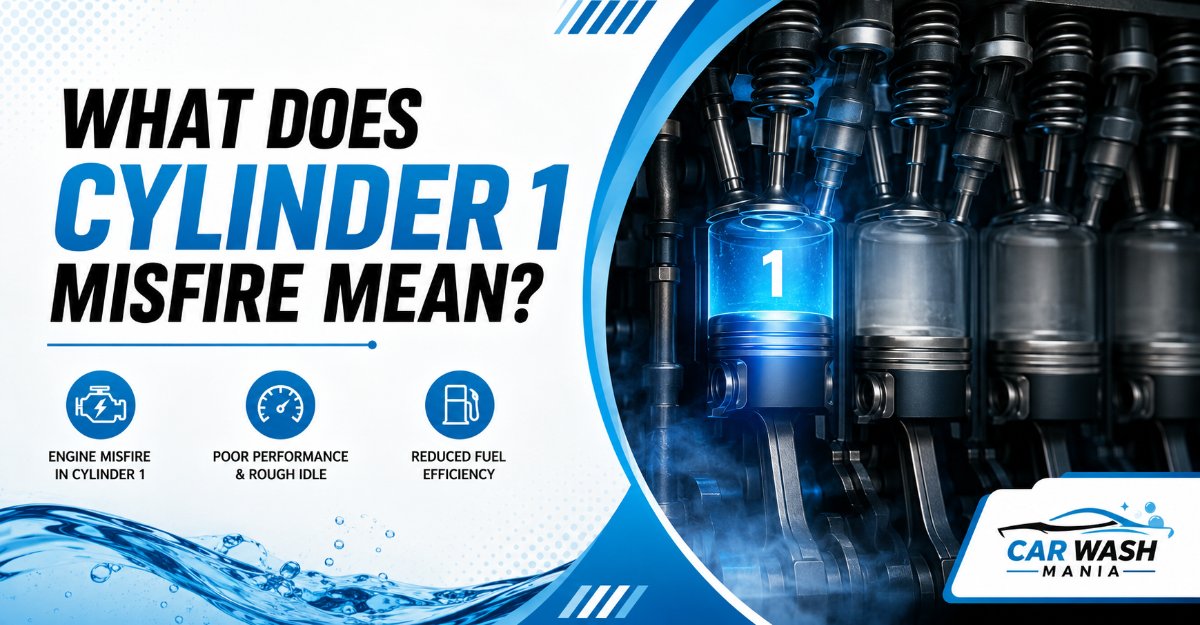
A cylinder 1 misfire (diagnostic trouble code P0301) means the engine’s primary cylinder is failing to ignite its air-fuel mixture, resulting in a sudden loss of rotational power detected by the engine control unit. This incomplete combustion triggers the check engine light and immediately causes noticeable engine hesitation, rough idling, or surging.
Key Facts / At a Glance
- Trigger Condition: The Engine Control Unit (ECU) detects a crankshaft micro-deceleration during Cylinder 1’s scheduled power stroke.
- Most Common Cause: Ignition failure, specifically a worn spark plug or degraded ignition coil pack.
- Flashing CEL Warning: A flashing Check Engine Light indicates a severe, catalyst-damaging misfire; the vehicle should be shut down immediately.
- Diagnosis Metric: A healthy cylinder requires 120–180 PSI of compression; readings below this indicate severe mechanical failure.
- Location: Cylinder 1 is the most forward cylinder on the engine block, though its exact placement depends on whether the engine is transversely or longitudinally mounted.
How Does a Cylinder 1 Misfire Actually Work?
A misfire occurs when one of the three critical combustion elements—spark, fuel, or compression—fails during the engine’s four-stroke cycle. The Engine Control Unit (ECU) relies on the Crankshaft Position (CKP) Sensor to monitor rotational velocity.
During a healthy cycle, the ignition of fuel pushes the piston down, causing a momentary acceleration of the crankshaft. When Cylinder 1 fails to fire, the CKP sensor detects a micro-slowdown instead of an acceleration. If this velocity drop happens consistently across a pre-programmed number of engine revolutions (typically 2% to 10% of firing events, depending on the manufacturer), the ECU logs a pending code. Once the threshold is crossed, it illuminates the dashboard Check Engine Light and stores code P0301.
What Are the Most Common Causes of a Cylinder 1 Misfire?
Misfires are categorically divided into three distinct failure paths. Diagnosing the root cause requires isolating which of these three systems has degraded.
1. Ignition System Failures (The 70% Probability)
Ignition components are the most frequent culprits because they operate under extreme thermal and electrical stress.
- Worn Spark Plugs: Spark plug electrodes erode over time, widening the gap. Once the gap exceeds factory specifications (often beyond 0.040 inches), the ignition coil cannot generate sufficient voltage to bridge it, causing the spark to blow out under compression.
- Failing Ignition Coils: Coil-on-Plug (COP) systems convert 12-volt battery power into 20,000 to 40,000 volts. Internal epoxy breakdown or thermal cycling causes internal shorts, leading to weak or absent spark at Cylinder 1.
- Carbon Tracking: High voltage can arc down the side of the ceramic spark plug insulator to the engine block, entirely bypassing the electrode.
2. Fuel System Restrictions
Direct fuel injection systems operate at pressures up to 3,000 PSI, making them highly susceptible to microscopic debris.
- Clogged Injectors: Carbon buildup on the injector pintle restricts flow, creating a lean condition (too much air, insufficient fuel) that will not ignite.
- Electrical Injector Failure: The internal solenoid coil of the Cylinder 1 injector can short out, meaning the ECU sends the pulse signal, but the injector physically fails to open.
3. Mechanical and Compression Failures (The Worst-Case Scenario)
If spark and fuel are present, the cylinder cannot compress the mixture.
- Burnt Exhaust Valves: A valve that fails to seat perfectly allows the compressed air-fuel mixture to escape into the exhaust manifold before ignition.
- Head Gasket Breaches: A blown gasket near Cylinder 1 allows compression to leak into the coolant passages, often accompanied by white exhaust smoke.
- Carbon Buildup (GDI Engines): On modern Gasoline Direct Injection engines, oil vapors bake onto the intake valves, severely restricting airflow into Cylinder 1.
Where Is Cylinder 1 Located on Your Engine?
Cylinder 1 is always the cylinder positioned furthest forward on the crankshaft, but finding it requires knowing your engine layout. On a transverse engine (front-wheel drive), Cylinder 1 is typically on the passenger side near the serpentine belt. On a longitudinal engine (rear-wheel drive), it is the front-most cylinder closest to the radiator. On V6 and V8 engines, you must check the manufacturer’s firing order diagram, as Ford often places it on the passenger bank, while GM frequently places it on the driver’s side bank.
How Do You Diagnose a Cylinder 1 Misfire?
Finding the exact cause of code P0301 requires a process of elimination to avoid wasting money on unnecessary parts.
- Read the Data Grid: Connect an OBD-II scanner and check for secondary codes. If P0301 is paired with P0171 (System Lean), you likely have a vacuum leak near the Cylinder 1 intake runner, not a bad spark plug.
- Execute the Coil Swap Test: Remove the ignition coil from Cylinder 1 and swap it with Cylinder 2. Clear the ECU codes and drive the car. You’ll know it worked when the code returns. If the new code is P0302, the ignition coil is unequivocally dead. If it remains P0301, the coil is good.
- Inspect the Spark Plug: Remove the Cylinder 1 plug. A bone-white, blistered tip indicates a lean fuel condition. A black, oily tip indicates piston ring blow-by. A heavy smell of raw fuel means the plug is misfiring but the injector is working.
- Test Fuel Injector Pulse: Use a mechanic’s stethoscope (or a long screwdriver to your ear) placed on the Cylinder 1 injector. You should hear a sharp, consistent, rhythmic clicking/ticking while the engine idles.
- Perform a Compression Test: Thread a compression gauge into the Cylinder 1 spark plug well and crank the engine for five seconds. A reading below 120 PSI, or a reading that is 15% lower than the adjacent cylinders, confirms a severe mechanical failure.
How Much Does It Cost to Fix Code P0301?
Repair costs vary wildly depending on whether the issue is a $10 consumable part or a catastrophic internal failure.
| Repair Action | Complexity | Typical Parts Cost | Typical Labor Cost | Estimated Total |
| Spark Plug Replacement (Set) | Low | $40 – $100 | $80 – $150 | $120 – $250 |
| Ignition Coil (Single) | Low | $45 – $130 | $50 – $100 | $95 – $230 |
| Fuel Injector Replacement | Medium | $80 – $300 | $150 – $350 | $230 – $650 |
| Intake Manifold Gasket | Medium | $30 – $75 | $250 – $500 | $280 – $575 |
| Head Gasket / Valve Job | Extreme | $150 – $400 | $1,200 – $2,500 | $1,350 – $2,900 |
Is It Safe to Drive with a Cylinder 1 Misfire?
You should not drive a vehicle actively misfiring, but the severity depends on the dashboard warning. If the Check Engine Light is solid, you can safely limp the car a few miles to a repair shop or your home.
If the Check Engine Light is flashing, you must pull over and shut the engine off immediately. A flashing CEL means raw, unburned fuel from Cylinder 1 is being dumped directly into the red-hot catalytic converter. This fuel will ignite inside the exhaust system, melting the honeycomb substrate of the catalytic converter within a matter of minutes, turning a simple spark plug repair into a $1,500 exhaust replacement.
What Are the Biggest Diagnostic Mistakes?
Professional mechanics see the same DIY errors repeatedly when diagnosing single-cylinder misfires.
- Firing the Parts Cannon: Replacing the plugs, coils, wires, and injectors simultaneously without testing. This wastes money and often introduces new variables if cheap aftermarket parts are used.
- Replacing a Single Spark Plug: Plugs wear uniformly. If Cylinder 1’s plug has failed due to age, cylinders 2, 3, and 4 are mathematically moments away from identical failure. Always replace them as a complete set.
- Ignoring Wiring Harness Damage: Often, a P0301 isn’t a bad coil; it’s a cracked, heat-brittle wiring connector feeding the coil. If the retaining clip is broken and vibrating loose, replacing the coil will not solve the issue.
- Using Non-OEM Electronics: Modern ECMs are hyper-sensitive to electrical resistance. Using cheap, white-box ignition coils from online marketplaces often fails to clear the code because the resistance doesn’t match factory specifications, tricking the computer into thinking the misfire is still present.
Frequently Asked Questions (FAQ)
Can a bad battery cause a cylinder 1 misfire?
A weak battery rarely isolates a misfire to a single cylinder. Low voltage typically causes random, multiple misfires (P0300) across the entire engine, alongside transmission shifting issues and ABS warning lights, rather than singling out Cylinder 1.
Why does my car only misfire on cold starts?
Cold start misfires on a single cylinder strongly point to a minor head gasket leak or intake manifold gasket leak. When metal is cold, it contracts, allowing tiny amounts of coolant into the cylinder or unmetered air into the intake. As the engine warms and metal expands, the gap seals itself.
How long does an ignition coil usually last?
Factory original equipment (OEM) ignition coils generally last between 80,000 and 120,000 miles. Their lifespan is heavily dependent on timely spark plug replacement; forcing a coil to fire across a worn, widened spark plug gap drastically increases its internal heat and accelerates its failure.
Will clearing the code fix the misfire?
No. Clearing code P0301 with an OBD-II scanner only resets the computer’s memory. The ECU will immediately begin monitoring crankshaft velocity on the next startup. If the physical component is still broken, the Check Engine Light will re-illuminate within a few drive cycles.


