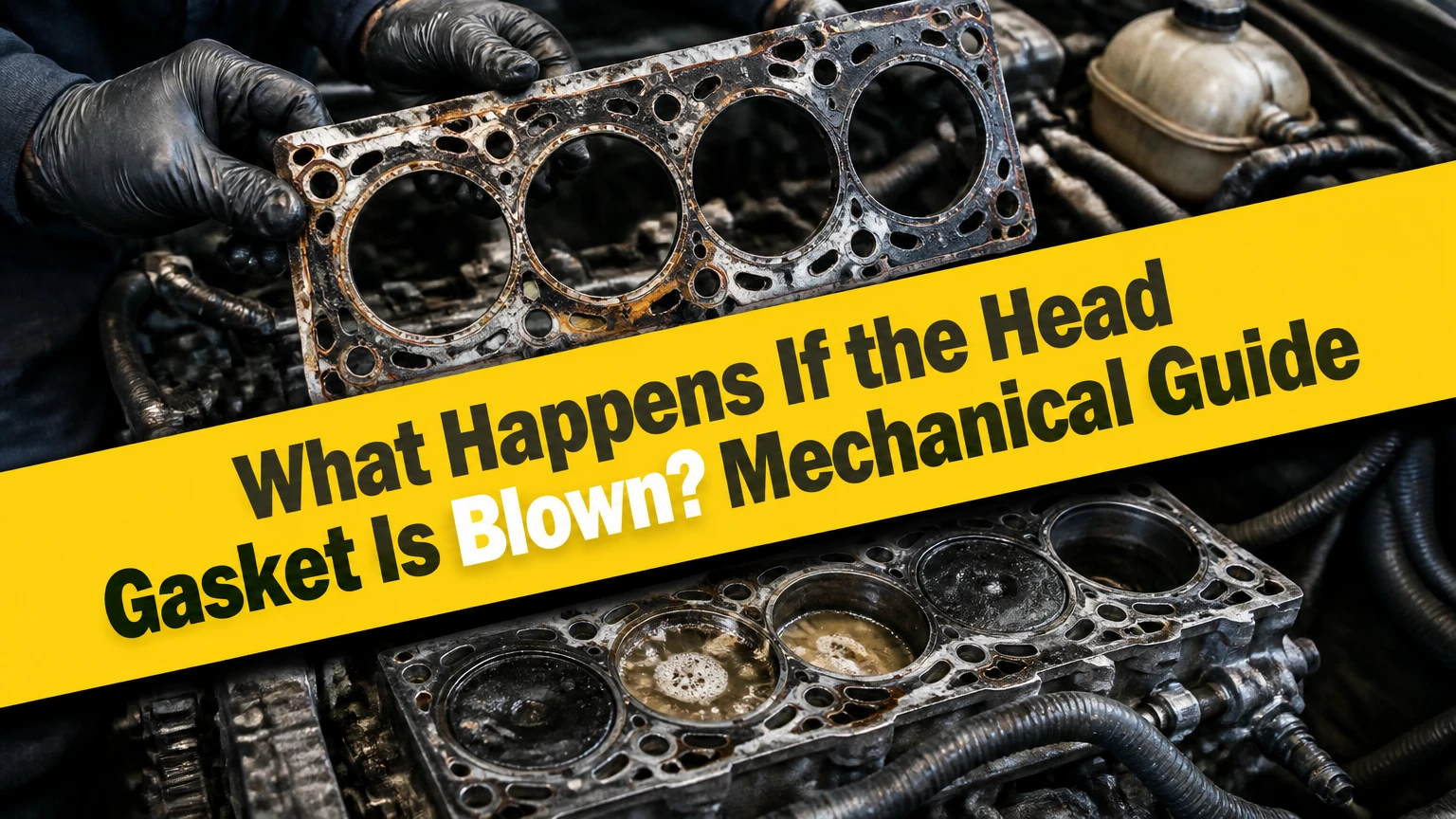
A blown head gasket destroys the strictly separated internal ecosystems of your internal combustion engine by allowing high-pressure combustion gases, engine coolant, and lubricating oil to mix. When this highly engineered seal degrades, you will experience immediate compression loss, rapid engine overheating, and catastrophic metal-on-metal bearing friction. Knowing exactly what happens if the head gasket is blown allows you to stop driving immediately and prevent a repairable failure from permanently destroying your entire engine block.
Key Facts / At a Glance
- The head gasket sits between the cylinder head and the engine block to seal combustion chambers, coolant channels, and oil galleries.
- A failure allows fluids to cross-contaminate, most commonly forcing 1000-PSI combustion gas into the 15-PSI cooling system.
- Driving with a compromised gasket will severely warp the aluminum cylinder head and destroy the bottom-end bearings within miles.
- Professional diagnosis relies on chemical block testing to detect carbon dioxide in the radiator fluid.
- Permanent repairs require a full top-end engine teardown, precision machine shop resurfacing, and new Torque-to-Yield hardware.
Understanding What Happens If the Head Gasket Is Blown
The head gasket operates in the most hostile environment of any static seal in a modern vehicle. It must withstand thousands of pounds of pressure from the firing pistons while simultaneously managing extreme thermal expansion. When the physical structure of this multi-layer metal or composite seal breaks down, the immediate result is a breach between systems that were designed to remain entirely isolated. Because pressure always seeks the path of least resistance, the high-pressure systems inside the engine will instantly invade the low-pressure systems.
This structural failure initiates a rapid mechanical chain reaction. The severity of the damage depends entirely on which specific channel the gasket allowed to leak. A breach between two fluid channels causes chemical contamination, while a breach into the combustion chamber causes severe thermodynamic instability. The engine loses its ability to regulate temperature, hold compression, and lubricate its moving parts simultaneously.
The Combustion and Coolant Breach
When the gasket fails between a combustion chamber and a coolant passage, the engine forces exhaust gases directly into the water jacket during the power stroke. Combustion gases reach temperatures exceeding 2,000 degrees Fahrenheit (1,093 degrees Celsius). These superheated gases instantly flash the surrounding liquid coolant into steam. Steam pockets cannot absorb heat effectively, creating localized hot spots that rapidly warp the aluminum cylinder head. Furthermore, the immense cylinder pressure over-pressurizes the radiator, often blowing the cap off or splitting the plastic coolant reservoir entirely.
The Oil and Coolant Emulsification
If the gasket degrades between an oil gallery and a coolant channel, pressurized oil bleeds into the antifreeze, or antifreeze seeps into the oil pan. When water-based glycol coolant mixes with petroleum-based engine oil under the extreme agitation of a running engine, the two fluids emulsify. This chemical reaction breaks down the oil’s viscosity, turning it into a thick, frothy, milky sludge. This sludge cannot lubricate the tight clearances of the crankshaft bearings or camshaft journals. Without a protective micro-film of oil, the metal components grind against each other, scoring the bearings and eventually causing the engine to seize completely.
The Hydro-Lock Risk
When the engine is shut off, the pressurized cooling system can bleed liquid antifreeze backward into the empty combustion chamber. Liquids are physically incompressible. When you attempt to start the vehicle again, the starter motor forces the piston upward against a solid wall of water. This creates a hydrostatic lock, commonly called hydro-lock. The immense mechanical force of the starter against the incompressible fluid will instantly bend or snap the forged steel connecting rods, rendering the entire engine block completely unrepairable.
What Are the Five Types of Head Gasket Failure?
Head gaskets do not fail in a uniform manner across all vehicles. The specific location of the structural tear dictates exactly how the engine behaves and what symptoms the driver will experience. Automotive engineers categorize gasket failures into five primary modes based on which independent systems are bridging together.
Understanding these five failure modes is essential for accurate troubleshooting. A leak venting to the exterior atmosphere poses a very different immediate risk than an internal leak mixing fluids. Mechanics use these distinct physical actions to trace the exact location of the breach before lifting a single wrench.
| Gasket Failure Type | Mechanical Action | Primary Symptom | Damage Severity |
|---|---|---|---|
| Cylinder to Coolant | High-pressure exhaust gases pump into the water jacket. Coolant enters the cylinder on intake. | Exploding coolant overflow tank, persistent overheating, sweet-smelling white exhaust smoke. | Extreme (High risk of hydro-lock and severe cylinder head warpage). |
| Coolant to Oil | Seal breaks between a pressurized oil gallery and a coolant return passage. | Thick milky sludge under the oil cap, rising fluid levels on the engine dipstick. | Catastrophic (Destroys bottom-end bearings via friction within miles). |
| Cylinder to Cylinder | Gasket material erodes completely away between two adjacent combustion chambers. | Severe misfire across two paired cylinders, rough idle, extreme loss of torque. | High (Unburnt fuel melts the catalytic converter in the exhaust system). |
| Fluid to Outside | The outer perimeter of the gasket cracks, venting fluid down the exterior of the block. | Visible puddles of oil or coolant on the ground, smoking from fluids hitting the hot exhaust. | Moderate (Causes fluid starvation over time but no internal contamination). |
| Compression to Outside | The combustion seal fails directly to the exterior engine bay atmosphere. | Rhythmic ticking or hissing noise matching engine RPM, localized soot patterns on the block. | Moderate (Erodes the mating surfaces over time, creating exhaust hazards). |
How Do Professionals Diagnose the Exact Leak?
Never assume a head gasket has failed based on a single symptom like a fluctuating temperature gauge or white exhaust smoke. Professional technicians utilize a multi-layered diagnostic matrix to objectively prove a structural failure before recommending an expensive teardown. Because replacing this seal requires profound labor investment, mechanics rely on specialized chemical and pneumatic tests to confirm the exact nature of the breach.
These diagnostic procedures isolate the internal systems of the engine to see where pressure or chemical markers are escaping. A single failed test is enough to confirm a breach, but technicians typically perform at least two to pinpoint whether the failure involves the cooling system, the oil system, or adjacent cylinders.
Chemical Combustion Leak Testing
The most definitive proof of a cylinder-to-coolant breach is the chemical block test. Mechanics place a specialized siphon tube filled with blue chemical reagent over the open radiator neck while the engine idles. If the gasket has failed, combustion gases (specifically carbon monoxide and carbon dioxide) will bubble up through the radiator fluid. When the blue test fluid contacts carbon dioxide, a chemical reaction instantly turns the fluid yellow for gasoline engines or green for diesel engines. This color change guarantees that exhaust is entering the cooling system.
Cylinder Leak-Down Testing
To find a breach between cylinders or into the oil system, technicians perform a cylinder leak-down test. The mechanic removes the spark plugs, brings an individual piston to Top Dead Center (closing all valves), and injects compressed air at 90 to 100 PSI directly into the combustion chamber. The technician then listens for escaping air. Bubbles in the radiator indicate a coolant breach. Hissing from the oil fill cap indicates an oil gallery breach. Hissing out of the adjacent spark plug hole confirms a cylinder-to-cylinder blowout.
Visual and Tactile Fluid Inspection
Experienced mechanics begin every diagnosis by checking the condition of the fluids. Pulling the engine dipstick reveals fluid contamination instantly. Healthy engine oil appears as a translucent amber or dark brown liquid. Contaminated oil looks exactly like a frothy chocolate milkshake. Furthermore, technicians will perform a cold-start check by removing the radiator cap on a completely cold engine and starting the vehicle. If a geyser of coolant immediately shoots several inches into the air, the combustion chamber is directly pressurizing the water jacket.
How Much Does a Head Gasket Replacement Cost?
Replacing a head gasket is one of the most labor-intensive maintenance procedures a vehicle can undergo. The cost is rarely driven by the physical parts. A raw Multi-Layer Steel (MLS) gasket typically retails for under $100. The massive expense stems entirely from the sheer volume of labor required to dismantle the top half of the engine and the specialized machine shop services needed to flatten the warped metal components.
Labor times vary drastically based on engine architecture. An inline four-cylinder engine presents a relatively straightforward vertical teardown. Conversely, a V6 or V8 engine requires removing two separate cylinder heads. Boxer layouts, famously used by Subaru and Porsche, have horizontally opposed cylinder heads pressed directly against the frame rails. These engines often require the technician to disconnect the transmission and hoist the entire engine block out of the vehicle just to access the bolts.
| Engine Architecture | Typical Labor Hours | Average Parts Cost (Set) | Estimated Total Repair Bill |
|---|---|---|---|
| Inline 4-Cylinder | 10 to 14 Hours | $150 to $300 | $1,500 to $2,200 |
| Standard V6 Engine | 15 to 18 Hours | $250 to $450 | $2,400 to $3,200 |
| V8 / Twin-Turbo V6 | 18 to 22 Hours | $350 to $600 | $3,000 to $4,500 |
| Boxer (Horizontally Opposed) | 16 to 20 Hours | $300 to $500 | $2,800 to $4,000 |
What Are the Steps to Replace a Head Gasket?
The extreme labor hours associated with this repair make sense once you understand the rigorous physical sequence required to execute it correctly. A technician cannot simply slide a new seal into place. They must completely decouple the vehicle’s electrical, fuel, cooling, and mechanical timing systems, re-machine the heavy metal components to microscopic tolerances, and rebuild the engine from the block upward.
This procedure demands advanced hand tools, precision measuring equipment, and a sterile working environment to prevent dirt from entering the exposed oil channels.
- System Deconstruction: The technician drains the engine oil and coolant. They disconnect the battery, throttle body, fuel rails, wiring harnesses, intake manifold, exhaust headers, and vacuum lines to expose the core engine structure.
- Timing Disassembly: The mechanic rotates the engine to top-dead-center to align the internal timing marks. They remove the serpentine belts, timing cover, and the internal timing chain or belt. The camshafts are locked in place to prevent the valves from striking the pistons during removal.
- Cylinder Head Extraction: The technician removes the heavy cylinder head bolts in a specific reverse-torque sequence to prevent cracking the cast aluminum. They physically lift the heavy cylinder head assembly completely out of the engine bay.
- Machine Shop Resurfacing: The bare cylinder head is sent to a machine shop. A machinist uses a precision straightedge and feeler gauges to measure for heat warpage. Industry standards dictate that any deviation exceeding 0.002 inches requires the head to be milled completely flat on a CNC machine.
- Surface Deck Preparation: Back at the vehicle, the mechanic uses chemical solvents and specialized scrapers to clean the engine block deck. They use thread-chasing taps to clean the deep bolt holes, ensuring the new hardware will thread perfectly without binding on old oil or carbon.
- Precision Reassembly: The technician places the new gasket over the aligning dowels and lowers the machined cylinder head into place. Using a digital torque wrench, they tighten brand-new head bolts following a highly specific, multi-stage angular sequence to crush the gasket to the exact millimeter required by the manufacturer.
- Timing Synchronization and Testing: The mechanic reinstalls the timing chain, calibrates the engine timing, bolts on the manifolds, and reconnects the wiring. After adding fresh oil and coolant, they vacuum-purge the cooling system to remove trapped air pockets and road-test the vehicle to verify proper thermal regulation.
Chemical Sealants vs. Mechanical Replacement: Which Should You Choose?
When faced with a massive repair bill, many vehicle owners consider liquid pour-in sealants. These products utilize sodium silicate or liquid carbon fiber compounds. You pour them into the radiator, and when the liquid reaches the extreme heat of the combustion leak, the chemicals crystallize to form a temporary scab over the breached metal.
Chemical sealants are not permanent fixes. They are strictly temporary measures intended to keep a low-value vehicle running for a few more months. Choosing between a chemical patch and a full mechanical teardown depends entirely on the current market value of your vehicle and your intentions for keeping it.
| Repair Strategy | Typical Cost Range | Expected Longevity | Best Application Scenario |
|---|---|---|---|
| Mechanical Teardown | $1,500 to $4,500 | Lifetime of the vehicle | High-value vehicles you intend to keep for years. |
| Chemical Sealant | $20 to $80 | 30 days to 6 months | Budget vehicles under $2,000 needing to limp to a dealership. |
| Used Engine Swap | $1,200 to $3,000 | Highly variable | Vehicles where the original engine suffered severe internal bearing damage. |
What Are the Biggest Mistakes to Avoid During Repair?
Attempting to cut corners on a repair of this magnitude guarantees a secondary failure. First-time mechanics and budget-focused drivers frequently make critical errors that cause the brand-new replacement gasket to blow out within a few hundred miles. The physics of internal combustion do not tolerate sloppy tolerances.
One of the most severe mistakes is reusing the original cylinder head bolts. Modern engines utilize Torque-to-Yield (TTY) bolts. Automotive engineers design these specialized fasteners to stretch permanently when torqued to their final specification. This stretching creates a continuous spring-like clamping force that holds the engine together during rapid thermal expansion. Once a TTY bolt has been stretched, it loses its elasticity. If you reuse old bolts, they will not exert adequate clamping pressure, and the new gasket will instantly fail under load.
Skipping the machine shop phase is equally disastrous. Many DIY mechanics believe a cylinder head looks flat to the naked eye and skip professional decking to save $200. Aluminum expands and contracts at a different rate than cast iron. During an overheat event, an aluminum cylinder head will warp microscopically. If you bolt a warped head onto a flat engine block, the clamping pressure will be entirely uneven. The high-pressure combustion gas will immediately find the gap and blow out the new seal.
Finally, failing to identify the root cause of the initial overheat will ruin the entire repair. Head gaskets rarely fail spontaneously. They blow because a secondary component like a cracked radiator hose, a seized water pump, or a stuck thermostat caused the engine temperature to spike. If you replace the gasket but leave the broken thermostat installed, the engine will overheat on your first test drive and destroy your new work instantly.
Frequently Asked Questions
Can a blown head gasket cause a fire? While highly unlikely to cause a traditional fire, it presents a severe burn hazard. High-pressure combustion gas forces boiling coolant out of the reservoir. If this superheated fluid sprays onto hot exhaust manifolds, it creates a massive plume of scalding steam that can seriously injure anyone opening the hood.
Does a blown head gasket ruin the whole engine? It will ruin the whole engine if you continue to drive the vehicle. Overheating permanently warps the block, while contaminated milky oil destroys the crankshaft bearings. If you shut the engine off immediately upon noticing symptoms, the lower half of the engine usually survives.
Can you fix a blown head gasket without replacing it? You cannot fix the physical structure of a broken gasket without replacing it. Pour-in chemical sealants can temporarily crystallize over small leaks to keep the car running for a short period, but these additives eventually wash away and cannot bridge large blowouts.
Why do some Subaru engines blow head gaskets so often? Older Subaru engines use a horizontally opposed boxer layout, meaning the cylinder heads sit sideways. Fluid rests constantly against the gasket even when the engine is off. Early models also used inferior single-layer composite gaskets that eroded over time, a flaw Subaru later corrected with Multi-Layer Steel hardware.
How can you prevent a head gasket from blowing? The most effective prevention is strict cooling system maintenance. Flush and replace your engine coolant every 30,000 to 50,000 miles to prevent the fluid from becoming acidic. Acidic coolant corrodes the metal surfaces of the gasket from the inside out, leading to premature structural failure.
The Bottom Line
To summarize what happens if the head gasket is blown, the engine loses its structural ability to separate intense combustion pressure from its cooling and lubrication channels. Ignoring the symptoms, particularly the sweet-smelling white exhaust smoke and rapidly rising temperature gauge, will turn a standard repair into a complete engine replacement. Whether you opt for a mechanical teardown or decide to cut your losses on an older vehicle, immediate diagnosis is the only way to protect the engine block from permanent destruction.


