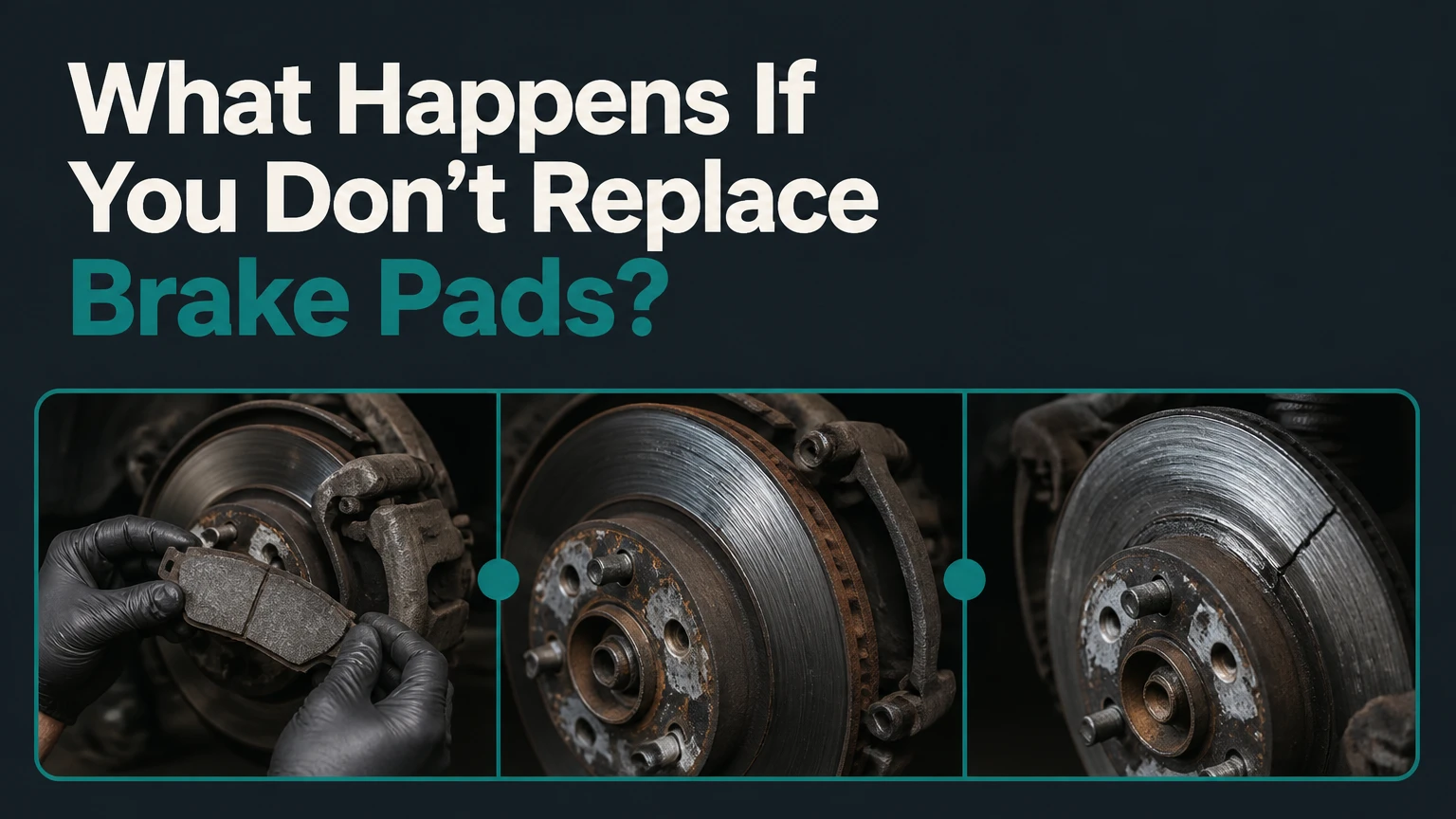
Neglecting worn brake pads triggers a cascading mechanical failure that degrades stopping power, damages rotors, and elevates repair costs. As friction material wears from 3mm down to 0mm, the vehicle moves from audible squealing to metal-on-metal grinding, eventually causing caliper hydraulic failure, brake fluid leaks, and severe loss of braking control.
At a Glance
- Brake pads require replacement when friction material drops to 3mm or below.
- Driving on pads at 2mm or thinner increases highway stopping distance by up to 30 percent.
- Metal-on-metal grinding at 0mm thickness permanently ruins brake rotors within a few miles.
- Extended neglect pushes caliper pistons past safety limits, causing instant brake fluid leaks.
- Delaying pad replacement escalates a $150 maintenance job into a $2,000 complete system overhaul.
What Are the Four Mechanical Stages of Brake Pad Failure?
The mechanical destruction caused by unreplaced brake pads progresses through four distinct, predictable stages measured by remaining friction material thickness. Standard automotive brake pads begin with 10mm to 12mm of friction material glued or riveted to a steel backing plate.
| Stage | Friction Thickness | Primary Symptom | Braking Performance Impact |
|---|---|---|---|
| Stage 1: Audible Warning | 4mm to 3mm | High-pitched squealing or chirping | Stopping distance increases 10% to 15% |
| Stage 2: Critical Heat Zone | 2mm to 1mm | Spongy pedal feel, severe heat fade | Stopping distance increases 20% to 30% |
| Stage 3: Metal-on-Metal | 0mm (Bare steel) | Harsh grinding noise, wheel shudder | Severe loss of friction, deep rotor scoring |
| Stage 4: Systemic Failure | Past 0mm (Piston extended) | Brake fluid leak, pedal sinks to floor | Total loss of hydraulic pressure on axle |
Understanding this timeline helps drivers intervene before minor wear transforms into structural damage across the entire wheel hub assembly.
What Are the Earliest Audible and Physical Warning Signs of Worn Brake Pads?
The earliest warning sign of worn brake pads is a high-pitched squealing or chirping noise when applying the brakes, occurring when friction material thins to 3mm. Manufacturers design this audible alert using a small, hardened steel tab called a mechanical wear indicator (or scraper shim) attached to the pad backing plate.
When the friction material wears down to 3mm, this metal tab contacts the spinning iron rotor, producing a distinct frequency designed to penetrate the vehicle cabin. On high-end or newer vehicles, an electronic sensor embeds into the pad material instead. When worn through, it breaks an electrical circuit and triggers a dashboard brake warning light. At this stage, stopping distance under highway conditions increases by roughly 10 percent to 15 percent because the reduced material volume cannot generate optimal friction torque. Replacing pads during Stage 1 prevents damage to surrounding components.
What Happens During the Critical Heat Zone Phase at 2mm of Pad Thickness?
When brake pad material thins to 2mm or 1mm, the system loses its ability to absorb and dissipate kinetic heat, leading to severe thermal fade and soft pedal feel. Brake pads act as thermal insulators that protect the brake caliper and hydraulic fluid from extreme temperatures generated during deceleration.
[Pad Wear: 10mm] ---> High Thermal Absorption ---> Normal Brake Pressure
[Pad Wear:  2mm] ---> Heat Transfers to Caliper ---> Brake Fluid Boils ---> "Spongy" Pedal
At 2mm, the remaining sliver of pad heats up almost instantaneously. This intense thermal mass transfers directly into the brake caliper piston and boils the dot-type glycol brake fluid inside the chamber. Boiling brake fluid creates gas bubbles within the hydraulic lines. Because gas compresses while liquid does not, the brake pedal feels “mushy” or “spongy” and must be pushed much closer to the floorboard to slow the vehicle. Stopping distances expand by 20 percent to 30 percent, posing an immediate hazard during sudden panic stops.
What Damage Occurs When Brake Pads Reach 0mm Metal-on-Metal Friction?
Reaching 0mm of friction material causes the raw steel backing plate of the brake pad to slam directly into the cast iron brake rotor, creating immediate, destructive metal-on-metal grinding. Steel rubbing against iron generates intense friction temperatures, carving deep concentric grooves (known as scoring) into the rotor surface within a few miles of driving.
This violent grinding produces severe vibrations felt through the brake pedal and steering wheel. The structural integrity of the rotor is ruined instantly. Once deeply gouged or warped by extreme spot-heating, iron rotors cannot be resurfaced on a brake lathe because machining them down would bring their structural thickness below the manufacturer minimum safety specification. Consequently, driven-on 0mm pads force the immediate replacement of both brake pads and brake rotors.
How Does Extended Brake Pad Neglect Cause Total Caliper and Hydraulic Failure?
Extended neglect beyond the 0mm mark forces the brake caliper piston to extend beyond its designed safety stroke, destroying internal seals and causing sudden hydraulic pressure collapse.
To press a ultra-thin backing plate against a gouged rotor, the hydraulic piston inside the caliper housing must push out significantly farther than normal.
Normal Operation:  [Caliper Body] -> (Piston Retracted) -> [Thick Pad] [Rotor]
Extended Neglect:  [Caliper Body] -> (Piston Over-Extended) -> [Steel Plate] [Rotor]
                                                |
                                                v
                                  Piston cocks sideways & tears internal rubber seal
                                                |
                                                v
                                  Rapid fluid leak = Sudden Loss of Hydraulics
This over-extension causes three severe mechanical failure points:
- Piston Cocking: The extended piston loses lateral support, cocks sideways in its bore, and seizes permanently.
- Seal Rupture: The inner rubber square-cut seal tears against exposed piston corrosion, dumping brake fluid onto the hot wheel assembly.
- Hydraulic Loss: Because automotive hydraulic systems rely on sealed pressure, a torn caliper seal causes the master cylinder fluid level to collapse, causing the brake pedal to fall straight to the floorboard with zero stopping power on that hydraulic circuit.
How Much Does Delaying a Brake Pad Replacement Increase Repair Costs?
Delaying brake pad replacement increases repair bills exponentially, turning a simple maintenance item into a multi-component mechanical overhaul.
[Stage 1: Pads Only]      $150 - $300
[Stage 3: Pads + Rotors]  $400 - $800
[Stage 4: Full System]    $1,200 - $2,000+
Replacing pads on time costs an average of $150 to $300 per axle. Allowing pads to grind into Stage 3 adds rotor replacements, pushing costs to $400 to $800 per axle. Allowing the system to progress to Stage 4 requires replacing damaged calipers, flushing contaminated hydraulic fluid, and replacing ruined hardware, elevating total repair expenses to $1,200 up to $2,000 or more.
Can You Replace Worn Brake Pads Without Replacing Damaged Rotors?
No, you cannot install new brake pads onto damaged or deeply scored rotors without ruining the new pads and compromising vehicle safety. Installing soft, flat friction material against a grooved, warped iron rotor concentrates all clamping pressure onto the high ridges of the grooves rather than across the entire pad surface.
This concentrated friction destroys the new brake pads within a few thousand miles, causing rapid uneven wear, loud squealing, and severe pedal pulsation. Furthermore, the reduced surface contact area between the pad and rotor drastically reduces overall braking efficiency. If rotors are gouged past minimum thickness limits or warped by thermal stress, they must be replaced alongside the new pads.
Can You Replace a Brake Pad on Just One Side of an Axle?
No, brake pads must always be replaced in complete axle sets (both front wheels or both rear wheels) to maintain balanced braking force across the vehicle. Replacing pads on only one side creates a severe friction imbalance between the left and right wheels.
When you press the brake pedal, the side with fresh, high-friction pads grips the rotor with far greater force than the worn side. This friction disparity causes the vehicle to pull violently toward the side with stronger grip, potentially pulling the car out of its lane during hard braking. Additionally, unequal pad thickness alters hydraulic volume requirements across the axle, causing uneven caliper piston movement and unstable anti-lock braking system (ABS) performance.
How Many Miles Can You Safely Drive After Brakes Start Grinding?
You can safely drive zero miles for routine travel once metal-on-metal grinding begins, and no more than 5 to 10 miles solely to reach a repair facility at low speeds. Grinding indicates that all usable friction material is completely gone.
Continuing to drive with grinding brakes creates three immediate dangers:
- Stopping distance increases unpredictably, making fast stops impossible.
- Steel backing plates generate severe friction heat that can ignite nearby grease seals or warp the wheel hub.
- Metal shavings shed from the gouged rotor can contaminate wheel speed sensors, blinding the vehicle ABS and traction control systems.
Driving beyond a brief, low-speed emergency trip to a shop risks total brake system failure.
Why Is Your Brake Fluid Low When There Are No Visible External Leaks?
Your brake fluid level drops in the master cylinder reservoir as a direct mechanical consequence of brake pad wear, even when no external fluid leaks exist. As the friction material on the pads wears down, the caliper pistons must rest progressively farther outward to keep the pads positioned close to the rotor.
New Pads (Thick)   ---> Caliper Piston Retracted ---> Fluid Stays in Reservoir
Worn Pads (Thin)   ---> Caliper Piston Extended  ---> Fluid Fills Extended Caliper Capacity
This outward movement increases the internal volume of the caliper fluid chamber. Brake fluid from the master cylinder reservoir drains down into the calipers to fill this extra volume. Therefore, a brake fluid level resting near the “MIN” line on the reservoir is often a reliable visual indicator that the brake pads are thin and require immediate inspection, rather than a sign of a fluid leak.
Why Do Inner Brake Pads Wear Down Faster Than Outer Brake Pads?
Inner brake pads wear down prematurely when caliper slide pins lose lubrication, freeze, or seize inside their bores, preventing the caliper from floating evenly. Floating brake calipers rely on greased slide pins to center themselves over the spinning rotor when hydraulic pressure is applied.
Seized Slide Pin Scenario:
[Inner Pad]  <--- Stuck Piston Pushes Continuously ---> [Rotor] <--- [Outer Pad] (Receives No Pressure)
 (Wears to 0mm)                                                         (Stays Thick at 8mm)
If the protective rubber boots on the slide pins crack, water enters and rusts the pins solid. When you press the pedal, the caliper piston forces the inner pad against the rotor, but the seized pins prevent the caliper body from sliding over to pull the outer pad into contact. As a result, the inner pad drags against the rotor constantly and wears down to 0mm, while the outer pad visible through the wheel spokes retains plenty of thickness. A superficial visual check from outside the wheel misses this hidden failure mode.
Why Can Brake Pads Fail Without Making Any Squealing or Grinding Warning Sounds?
Brake pads can fail without making warning sounds if environmental corrosion destroys the metal wear indicator tabs or causes the friction pad to delaminate from its backing plate.
In regions that use road salt during winter, the thin spring-steel scraper tabs attached to the pad backing plate can rust, snap off, or corrode away entirely. Without this tab to contact the rotor, the pad wears past 3mm, 2mm, and 1mm without making a sound.
Additionally, severe rust can creep between the steel backing plate and the friction material, a process known as rust jacking. This chemical force breaks the adhesive bond holding the friction pad to the steel plate. The pad material can crack and fall out of the caliper housing entirely in a single piece, instantly dropping the pad thickness from 4mm to 0mm without prior squealing.
How Do Hybrid and EV Regenerative Brakes Hide Brake Pad Rust and Delamination?
Hybrid and electric vehicles (EVs) use electric motor resistance (regenerative braking) for most slowing maneuvers, leaving physical friction brakes unused for long periods and masking severe internal corrosion. Because physical brake pads engage primarily during hard panic stops or below 5 mph, they rarely experience the friction heat needed to burn off surface moisture and road debris.
This chronic disuse leads to several hidden failure modes:
- Pad-to-Rotor Bonding: Moisture trapped between unused pads and rotors forms heavy iron rust that welds the pad to the rotor surface while parked.
- Backing Plate Delamination: Rust forms unhindered along the steel backing plate, severing the bond with the friction material long before the material wears thin.
- Corroded Pins: Caliper slide pins seize due to lack of movement and heat cycling.
An EV owner might inspect pads with 8mm of remaining material, unaware that the friction pad has detached from the rusted backing plate, threatening mechanical failure during a sudden emergency stop.
How Does Extreme Thermal Stress Cause Brake Pads to Crack and Disintegrate in a Single Day?
Driving down steep mountain grades or operating on a racetrack can subject brake pads to temperatures exceeding 1,000 degrees Fahrenheit, causing catastrophic thermal shock and resin binder failure. Standard consumer brake pads consist of friction fibers bonded together with phenolic resins.
When subjected to continuous heavy braking without cooling intervals, the temperatures surpass the thermal limits of these binding resins. The resins gasify in a process called thermal outgassing, creating a microscopic cushion of superheated gas that prevents the pad from physically contacting the rotor.
If cold water from a road puddle strikes the overheated assembly, or if temperatures exceed structural thresholds, the friction material experiences severe thermal shock. The pad cracks, crumbles, and disintegrates, shedding large chunks of material instantly. Under these extreme conditions, a pad with 4mm or 5mm of life can experience catastrophic structural destruction in a single drive.
How Do You Distinguish Between Temporary Morning Brake Rust Noise and Permanent Wear Squeal?
You can distinguish temporary morning brake noise from permanent wear squeal by evaluating when the sound occurs and how quickly it disappears after driving. Cast iron brake rotors oxidise easily when exposed to rain, dew, or high humidity overnight, forming a thin layer of orange rust on the rotor surface within hours.
Morning Rust Noise:
[Car Parked Overnight] ---> Flash Rust Forms ---> Loud Scraping on First 2-3 Stops ---> Noise Disappears

Permanent Wear Squeal:
[Pad Worn to 3mm] ---> Wear Tab Hits Rotor ---> High-Pitch Squeal on Every Stop ---> Noise Persists
- Morning Rust Noise: Produces a deep scraping or grinding sound during the first two or three brake applications. As the new brake pads clamp against the spinning rotor, they wipe away the flash rust, and the noise disappears completely for the remainder of the drive.
- Permanent Wear Squeal: Produces a high-pitched, persistent metallic squeal or screech every time the brake pedal is pressed, regardless of how long the car has been driven. If the squeal persists throughout an entire trip, it indicates that the wear indicator tab is actively rubbing against the rotor surface and the pads require immediate replacement.
The Bottom Line
Ignoring worn brake pads causes a predictable progression of mechanical damage, advancing from an audible 3mm wear warning to complete caliper hydraulic failure at 0mm. What begins as a routine $150 maintenance service can rapidly escalate into a $2,000 complete system overhaul involving ruined rotors, seized calipers, and lost hydraulic fluid. Inspecting brake pads at every oil change, replacing pads in full axle pairs, and addressing early squealing immediately ensures optimal stopping power and prevents severe mechanical repair costs.


