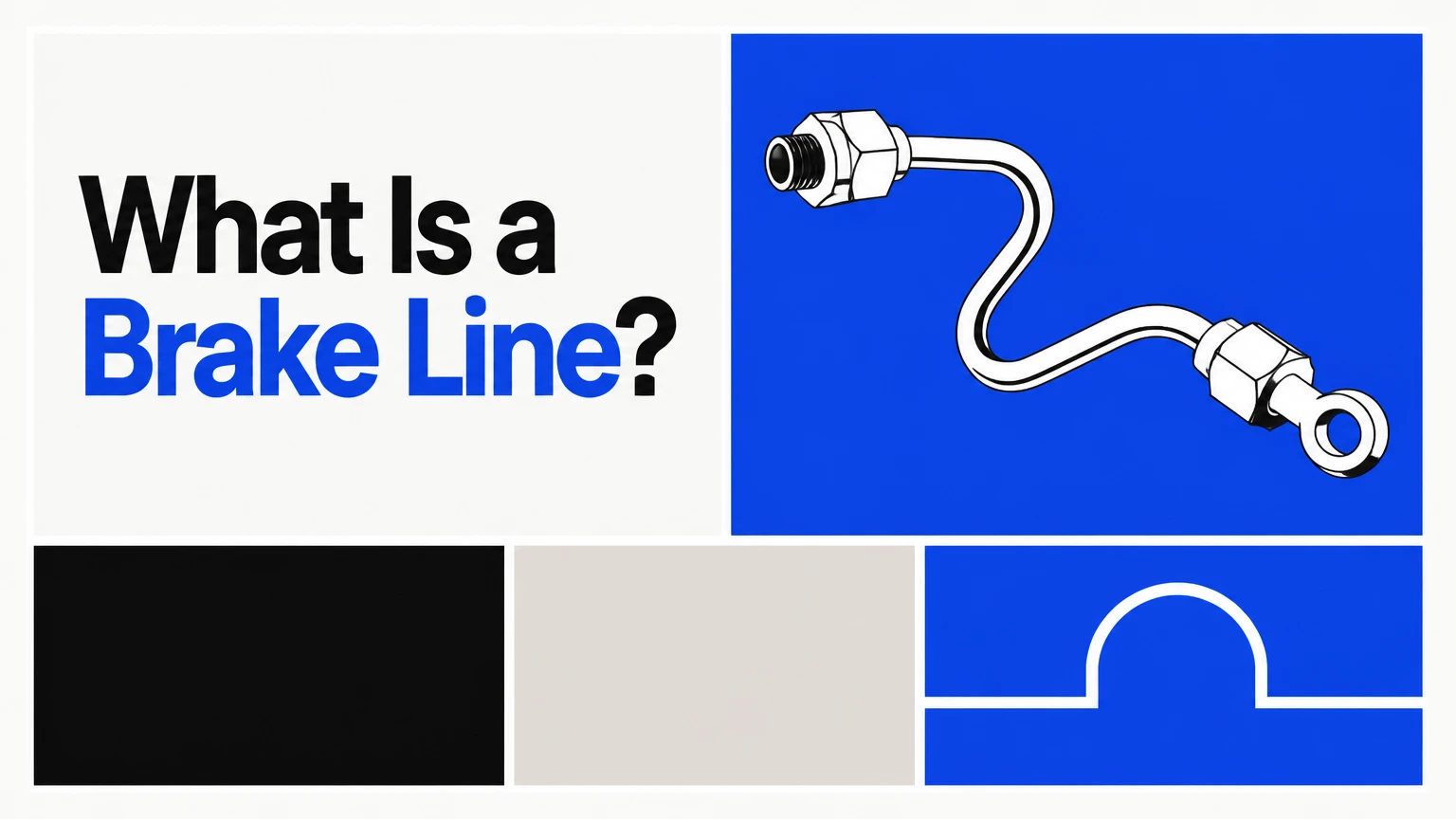
A brake line is a high-pressure, fluid-filled conduit that transfers hydraulic force from the master cylinder to the wheel brakes when you depress the brake pedal. Made of rigid metal tubing or reinforced rubber hoses, brake lines allow hydraulic pressure to actuate the calipers or wheel cylinders, slowing or stopping the vehicle.
At a Glance
- Primary Function: Transfers hydraulic pressure up to 2,000 PSI from the master cylinder to individual wheel brakes.
- Dual Construction: Uses rigid metal hard lines along the chassis and flexible soft hoses at moving suspension points.
- Core Materials: Manufactured from coated steel, copper-nickel (NiCopp), stainless steel, or reinforced rubber (EPDM).
- Burst Pressure Rating: Engineered to withstand burst pressures ranging from 5,000 to 8,000 PSI for safety redundancy.
- Critical Safety Rule: Damaged brake lines must be completely flared and joined with union nuts; compression fittings must never be used.
How Does a Brake Line Work in a Hydraulic Braking System?
A brake line works by transferring incompressible liquid pressure through a closed loop from the foot pedal to the wheel brakes. When the driver presses the brake pedal, a piston inside the master cylinder pushes brake fluid out into the network of brake lines. Because hydraulic fluid does not compress under pressure, this force transmits instantly through the lines to the brake calipers or wheel cylinders at each wheel.
Once the hydraulic pressure reaches the wheel assembly, it pushes the caliper piston outward. This force clamps the brake pads against the spinning brake rotor, converting kinetic energy into thermal energy via friction to slow the vehicle down. When the driver releases the pedal, internal return springs and caliper seal relaxation draw the fluid back, relieving the clamping pressure on the brakes.
What Are the Key Technical Specifications of Automotive Brake Lines?
Automotive brake lines are built to strict mechanical tolerances to withstand extreme pressures and harsh environmental exposure without expanding or rupturing.
- Operating Pressure: Normal stopping generates 600 to 1,200 PSI of hydraulic pressure, while sudden panic stops can push pressure spikes between 2,000 and 3,000 PSI.
- Burst Pressure: Safety standards require automotive brake lines to hold a minimum burst pressure rating between 5,000 and 8,000 PSI.
- Outer Diameter (OD): Standard passenger cars utilize 3/16-inch (4.75mm) outer diameter lines for individual wheels, whereas heavy-duty trucks, commercial vehicles, and main supply trunks utilize 1/4-inch (6.35mm) outer diameter lines to accommodate higher fluid volumes.
- Wall Thickness: Standard steel brake lines maintain a uniform wall thickness of 0.028 inches (0.71mm) to balance structural strength with bendability.
What Is the Difference Between Rigid Hard Lines and Flexible Soft Hoses?
The difference between rigid hard lines and flexible soft hoses lies in their placement, structural materials, and ability to accommodate movement.
| Feature | Rigid Brake Lines (Hard Lines) | Flexible Brake Hoses (Soft Lines) |
| Primary Material | Coated steel, Copper-Nickel alloy, or Stainless Steel | Reinforced EPDM rubber or Teflon-lined braided stainless steel |
| System Location | Fixed along the underbody frame, frame rails, and chassis | Spans the gap between the frame line and moving steering knuckle or caliper |
| Primary Purpose | Transfers fluid long distances across the chassis without expanding | Accommodates suspension movement, body roll, and steering wheel rotation |
| Main Failure Cause | External rust, salt road corrosion, and physical impact from debris | Internal dry rot, outer rubber cracking, and moisture absorption |
How Long Do Brake Lines Last, and What Materials Last Longest?
A brake line lasts anywhere from 5 years to the entire lifespan of the vehicle, depending on climate exposure, road salt usage, and the core material selected.
- Standard Coated Steel: Lasts 5 to 10 years. Standard steel is common in factory production, but it is highly susceptible to rust and moisture damage in coastal areas or regions that salt roads in winter.
- Copper-Nickel Alloy (NiCopp): Lasts the lifetime of the vehicle. NiCopp is completely impervious to rust and corrosion, while remaining soft enough to bend manually and flare cleanly during installation.
- Stainless Steel: Lasts the lifetime of the vehicle. Stainless steel offers extreme rust resistance and physical durability, but its rigid nature makes flaring and bending difficult without professional hydraulic tools.
What Is Volumetric Expansion in Brake Hoses?
Volumetric expansion, commonly referred to as hose swell, is an internal structural degradation where flexible rubber brake hoses balloon outward under hydraulic pressure rather than routing force directly to the caliper.
As rubber brake hoses age, their internal fabric mesh reinforcement weakens. When the driver depresses the brake pedal, the fluid pressure expands the weakened hose walls, increasing the internal volume of the line. This loss of direct fluid displacement results in a soft, spongy brake pedal and reduced stopping power without dropping fluid levels or exhibiting visible external fluid leaks.
How Does a Delaminated Brake Hose Create a One-Way Valve Effect?
A delaminated brake hose creates a one-way valve effect when its internal rubber lining tears loose, creating a physical flap inside the fluid passage.
When you depress the brake pedal, high-pressure fluid forces its way past the loose rubber flap to actuate the caliper piston. However, when you release the brake pedal, the fluid attempts to flow back to the master cylinder, pushing the internal rubber flap shut. This traps hydraulic pressure at the wheel assembly, forcing the brake pads to continuously drag against the rotor. The constant friction generates extreme heat, premature pad wear, and severe vehicle pulling, a symptom frequently misdiagnosed as a seized brake caliper.
What Causes Galvanic Corrosion in Brake System Fittings?
Galvanic corrosion occurs in a brake system when two electrochemically dissimilar metals make direct physical contact in the presence of an electrolyte like moisture or salt water.
If a technician threads a stainless steel brake line or steel fitting directly into an aluminum caliper without anti-seize compounds or isolated coatings, an electrochemical cell forms. The aluminum acts as an anode while the stainless steel acts as a cathode. Over time, the aluminum sacrifices its electrons and corrodes away, destroying the female threads on the caliper housing and causing sudden high-pressure fluid leaks.
Why Are Compression Fittings Unsafe for Repairing Brake Lines?
Compression fittings are unsafe for brake line repairs because they are engineered for low-pressure plumbing applications (typically 60 to 80 PSI) and cannot withstand hydraulic braking pressures that exceed 2,000 PSI.
DANGER: NEVER USE COMPRESSION FITTINGS ON BRAKE LINES

 [ Compression Ring ] ──> (Fails under extreme pressure)
          │
 [ Hydraulic Pressure: 2,000+ PSI ] ──> [ Fitting Blows Apart ] ──> Complete Brake Failure
When an emergency stop forces hydraulic pressure above 1,000 PSI, the brass ferrule inside a compression fitting loses its grip on the smooth metal line. The fitting can violently separate, releasing all fluid pressure instantly and causing total brake failure. Proper repairs require seamless metal tubing joined using approved 45-degree double flares (SAE) or ISO bubble flares secured with proper threaded union nuts.
Is Unalloyed Copper Tubing Safe for Brake Line Replacement?
No, unalloyed pure copper hardware store tubing is entirely unsafe for automotive brake line replacement and should never be installed.
While pure copper resists rust, it possesses low tensile strength and suffers from work-hardening. Continuous vibrations from driving cause unalloyed copper to harden, become brittle, and crack along its length over time. Furthermore, pure copper cannot withstand high fluid pressure spikes, making it prone to sudden rupture. Only certified Copper-Nickel alloy (NiCopp, compliant with SAE J1047 standards) is safe for automotive hydraulic use.
How Do You Identify Double (SAE) vs. Bubble (DIN) Brake Flares?
You can identify double flares versus bubble flares by examining the shape of the folded metal end that sits inside the threaded fitting port.
- Double Flare (SAE / Inverted): Features a 45-degree inverted cone lip that folds backward into the center of the line. It creates a seal along the inside surface of the flare and is predominantly used on American and Asian vehicles.
- Bubble Flare (DIN / ISO): Features a solid, rounded button-shaped flare with a flat backside. It seals along the outer rim of the flare face and is standard on European vehicles.
These flare profiles use different seating angles and nut thread pitches. They are not interchangeable under any circumstance, and mixing them will cause fluid leakage.
Can You Drive a Vehicle With a Leaking Brake Line?
No, you cannot safely drive a vehicle with a leaking brake line under any circumstance.
Automotive brakes operate as a sealed hydraulic loop. Even a small pinhole leak introduces air into the lines and drops fluid pressure across the entire circuit. Pressing the brake pedal hard in an emergency can instantly expand the leak into a complete rupture, leading to catastrophic brake loss. If a brake line leak is discovered, the vehicle must be towed to a service location.
Why Does the Brake Pedal Go to the Floor After Line Replacement?
The brake pedal goes to the floor after a line replacement because air is trapped inside the hydraulic fluid lines.
Air is highly compressible, whereas hydraulic brake fluid is incompressible. When air enters open brake lines during repairs, stepping on the pedal simply compresses the air pockets inside the system instead of transmitting force to the brake caliper pistons. To restore firm pedal pressure, you must bleed the entire brake system by pumping fresh fluid through each line, starting at the wheel furthest from the master cylinder, until all air bubbles are completely evicted.
Should You Upgrade to Braided Stainless Steel Brake Lines?
Yes, upgrading to braided stainless steel brake lines is beneficial if you want improved pedal response, reduced volumetric expansion, and protection against mechanical damage.
Standard flexible rubber lines flex outwards when subjected to hard pedal force. Braided stainless steel lines feature a smooth inner Teflon core surrounded by a tightly woven stainless steel wire exterior mesh. This reinforced design prevents the inner line from swelling, resulting in a noticeably firmer pedal feel, faster brake actuation, and superior resistance to damage from flying road rocks or off-road debris.
Why Does Brake Fluid Turn Black in the Hydraulic System?
Brake fluid turns black over time due to moisture contamination, internal line corrosion, and the physical breakdown of rubber seals inside the system.
Automotive brake fluid is glycol-based and hygroscopic, meaning it continuously absorbs water vapor from atmospheric air. As water accumulates inside the lines, it lowers the boiling point of the fluid and corrodes internal steel line walls. The dark black color is a combination of oxidized metal particles and microscopic rubber debris shed from deteriorating internal seals and brake hoses. Brake fluid should be completely flushed every 2 years or 20,000 miles to prevent internal line degradation.
How Much Does It Cost to Replace a Brake Line?
Replacing a brake line costs between $150 and $450 per line for professional shop repairs, depending on line accessibility and vehicle layout.
- Parts Cost: A single pre-cut rubber brake hose costs $20 to $60, while a roll of copper-nickel hard tubing with union fittings costs $25 to $50.
- Labor Cost: Labor makes up the bulk of the expense, ranging from $130 to $400 per line. Hard metal brake lines that wind around the frame, gas tank, or exhaust system take several hours to bend, route, and bleed properly.
- Full System Replacement: Replacing every hard and soft brake line across a severely rusted vehicle typically costs between $800 and $1,800.
The Bottom Line
A brake line is the essential hydraulic bridge that carries stopping force from your foot pedal to the wheels. Maintaining this system requires using correct materials like Copper-Nickel or stainless steel, avoiding dangerous quick fixes like compression fittings, and replacing fluid every two years to prevent internal rot. If you notice a soft brake pedal, dragging brakes, or visible fluid loss, inspect your hard lines and soft hoses immediately to keep your braking system safe and fully operational.


