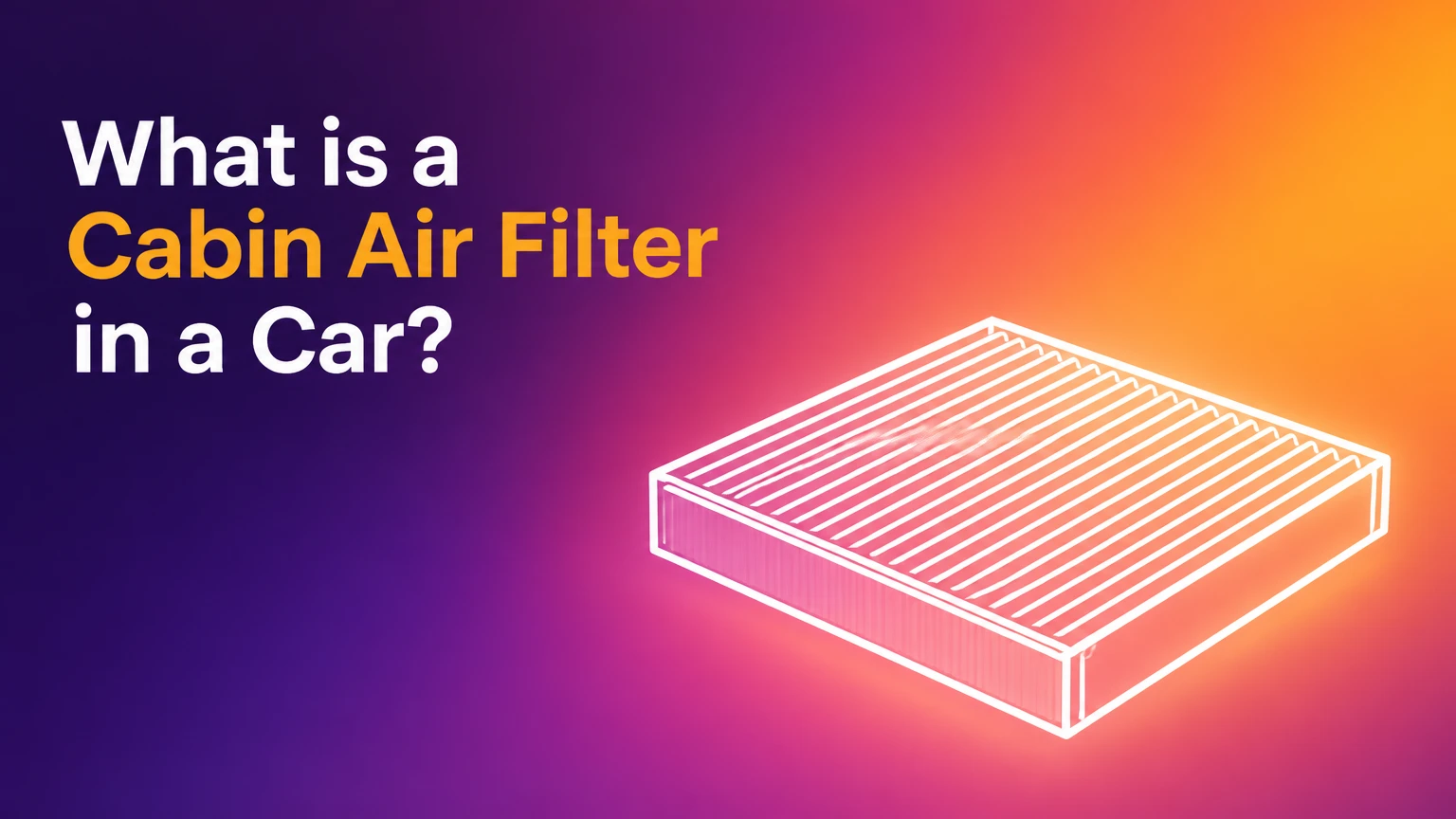
A cabin air filter is a pleated medium that cleans the air entering your vehicle’s interior through the heating, ventilation, and air conditioning (HVAC) system. It blocks 90% to 99% of airborne particles like dust, pollen, mold spores, and smog before they reach your lungs.
At a Glance: Cabin Air Filter Facts
- Primary Function: Purifies air entering the passenger compartment.
- Standard Replacement: Every 12,000 to 15,000 miles or once a year.
- Filtration Efficiency: Standard paper filters trap 3.0-micron particles; HEPA traps 0.3-micron particles.
- Location: Typically found behind the glove box, under the dashboard, or under the hood near the windshield.
Is a cabin air filter the same as an engine air filter?
No. They serve completely different functions. The cabin air filter purifies the air you breathe inside the cabin. The engine air filter purifies the air the engine breathes to ensure clean combustion under the hood.
Air filter symbols. Source: RomanSotola / Getty Images
Mixing them up is a common novice mistake. An engine air filter is usually located in a large plastic box under the hood, connected to the engine’s intake manifold. It protects the cylinders from abrasive grit. A cabin air filter is part of the climate control system. If your engine filter clogs, your car loses power and fuel efficiency. If your cabin filter clogs, you get weak AC airflow and bad smells, but the engine runs perfectly fine.
Where is the cabin air filter located?
The cabin air filter is located in one of three places, depending on the vehicle’s make and model. In about 80% of modern cars, it sits directly behind the glove compartment.
To access it behind the glove box, you typically need to empty the compartment, release a tension dampener cord on the side, and squeeze the plastic side tabs to drop the door fully open. The filter sits in a horizontal plastic tray just behind that opening.
Cabin filter behind the glove box. Source: Mihajlo Maricic / Getty Images
Other locations include:
- Under the dashboard: Usually on the passenger side, requiring you to reach up underneath the footwell.
- Under the hood: Near the base of the windshield (the cowl), often hidden beneath a plastic cover.
Check your owner’s manual for the exact location, as some European luxury vehicles place them in difficult-to-reach spots beneath the dashboard.
Does every car have a cabin air filter?
Not every car has a cabin air filter. Many vehicles built before the year 2000 completely lack a cabin air filter slot.
Furthermore, several modern trucks, such as certain older model years of the Chevy Silverado, intentionally omitted the filter from the factory. These specific vehicles require an aftermarket “cabin air filter retrofit kit.” Installing this kit involves physically cutting open the sealed plastic HVAC housing with a utility knife to create a slot, inserting the filter, and capping it with a new door.
High-end luxury vehicles, conversely, often utilize two or more filters. A Mercedes-Benz S-Class or BMW 7 Series might use a coarse pre-filter in the engine bay to capture large debris, paired with a dense, activated-carbon or HEPA filter inside the cabin for fine purification.
Standard vs. HEPA vs. Activated Carbon: Which cabin filter is best?
The best cabin filter depends entirely on your environment and sensitivities. Standard filters are best for general dust, activated carbon is required for odors and exhaust, and HEPA is necessary for severe allergies or smoke.
| Filter Type | Primary Material | Particle Efficiency | Best Used For |
|---|---|---|---|
| Standard | Pleated cellulose (paper) | ~80-90% at 3.0 microns | Basic dust, pollen, and debris reduction. |
| Activated Carbon | Synthetic fibers + charcoal | ~90-95% at 3.0 microns + gas adsorption | Urban commuting, filtering exhaust fumes, and stopping odors. |
| True HEPA | Dense synthetic glass fibers | 99.97% at 0.3 microns | Allergy sufferers, wildfire smoke, and microscopic bacteria. |
Standard filters are the cheapest but let fine particulate matter through. Activated carbon filters contain 50 to 150 grams of charcoal to chemically absorb toxic gases like ozone and nitrogen dioxide. HEPA filters provide medical-grade filtration but are denser. This density can slightly restrict airflow from your vents, meaning your blower motor has to work harder to push air into the cabin.
What are the technical specifications of cabin filters?
A standard cabin air filter contains 30 to 50 pleats, providing a massive surface area of roughly 3 to 5 square feet packed into a small plastic housing.
This pleated design maximizes the area available to trap dirt without immediately choking off the airflow. Standard paper filters trap particles down to 3.0 microns, which includes most pollen and heavy dust. Premium HEPA cabin filters trap particles as small as 0.3 microns with 99.97% efficiency, capturing bacteria, fine smog, and wildfire smoke.
According to a study hosted by the Centers for Disease Control and Prevention (CDC) and the National Institute for Occupational Safety and Health (NIOSH), HEPA cabin filters reduced in-cabin ultrafine particle concentration by 93% on average, whereas standard OEM filters only managed a 41% to 65% reduction.
How often should you change a cabin air filter?
The standard industry recommendation is to replace the cabin air filter every 12,000 to 15,000 miles, or once every 12 months.
However, this generic rule fails under specific environmental stressors. You must replace the filter much sooner in these situations:
| Environmental Factor | Replacement Interval | Why It Fails Early |
|---|---|---|
| Wildfire / Heavy Smog | 2,000 – 5,000 miles | Carbon bonds saturate quickly; filter permanently smells like smoke. |
| Desert / Unpaved Roads | 6 months | Fine ambient dust packs the pleats, choking the HVAC blower motor. |
| Urban Stop-and-Go Traffic | 10,000 miles | High concentration of exhaust soot and volatile organic compounds (VOCs). |
| Rodent Infestation | Immediate (within 48 hours) | Mice chew the paper for nesting, bypassing mileage timelines entirely. |
If you drive through heavy wildfire smoke, a standard filter can saturate in under 2,000 miles. The carbon bonds become completely filled. In desert climates, fine ambient dust will completely pack the pleats within 6 months, leading to weak airflow and potential blower motor burnout.
How do you know if your cabin air filter is bad?
The most obvious sign of a bad cabin air filter is noticeably reduced airflow from your climate control vents, even when the fan is turned to its highest setting.
Dirty vs. Clean Cabin Filter. Source: Mihajlo Maricic / Getty Images
Because the filter sits directly in front of the blower motor, a clogged medium acts like a wall. Other key indicators include:
- Musty Odors: A persistent smell of mildew or dust when the AC is turned on.
- Increased Blower Noise: A whistling or straining sound from behind the dashboard as the motor struggles to pull air through the blockage.
- Poor Defrosting: Windows taking significantly longer to clear in cold or humid weather because the volume of dry air hitting the glass is reduced.
Visually inspecting the filter is the definitive test. If it is dark gray, packed with leaves, or visibly bowing from air pressure, it is dead.
How much does a cabin air filter cost to replace?
Replacing a cabin air filter costs between $15 and $30 if you do it yourself, or $50 to $100 if you have a dealership or quick-lube shop perform the service.
The physical filter is inexpensive. A standard paper filter costs $10 to $15 at an auto parts store. An activated carbon upgrade runs $18 to $25, and a true HEPA filter costs $25 to $40.
When you pay a shop $80 for this service, you are paying for convenience and labor. Because the filter is located behind the glove box in most cars and requires no tools to access, doing it yourself is one of the easiest ways to save money on basic vehicle maintenance.
How long does it take to replace a cabin air filter?
Replacing a cabin air filter takes 5 to 10 minutes for the average vehicle owner.
No specialized tools are required for most modern cars. The process involves emptying the glove box, squeezing the sides to drop it down, unlatching the plastic filter cover, sliding the old filter out, and sliding the new one in.
There are exceptions. Some older European models place the filter deep under the cowl or behind the center console. In a first-generation Nissan Rogue, for example, the filter is jammed up under the driver’s side footwell and requires awkward contortion to reach, extending the job to 25-30 minutes for a beginner.
What happens if you install the cabin filter upside down?
If you install the cabin filter upside down, airflow efficiency drops significantly, and the filter will prematurely collapse.
Cabin filters are structurally reinforced on one side to resist the pressure of the HVAC blower pushing air through them. Look for the “Air Flow” arrow stamped on the side of the plastic or paper frame. This arrow must point in the direction the air physically travels. In almost all passenger vehicles, the air flows downward from the cowl toward the floorboards, meaning the arrow should point down.
Installing it backward forces the blower to push against the weaker side of the pleats. This can cause the filter media to tear, allowing debris to bypass the filter and enter the evaporator core.
Can you wash or clean a cabin air filter to reuse it?
No. You cannot wash or blow out a standard cabin air filter with compressed air to save money.
Standard filters are made of paper or electrostatically charged synthetic fibers. Washing them with water destroys the structural integrity of the paper and ruins the static charge that pulls in microscopic dust.
Blowing them out with compressed air is equally destructive. The high pressure creates micro-tears in the filter media. While the filter might look cleaner, those microscopic holes allow pollen and pollutants to pass directly into your dashboard. The only exception is specialized, washable aftermarket filters explicitly built from oiled cotton mesh, such as those made by K&N, which require specific chemical cleaners and re-oiling kits.
Why does the car smell like gym socks when the AC is on?
Your car smells like gym socks because moisture naturally condenses on your AC evaporator core, and a dirty cabin filter provides the organic material needed for mold to grow.
When you run the air conditioning, the evaporator core gets ice cold, pulling humidity out of the air. If your cabin filter is old, it traps damp organic dust, leaves, and pollen. This creates a perfect, dark, moist breeding ground for mold and bacteria directly in your ventilation path.
Replacing the filter alone might not solve the problem if the mold has colonized the evaporator core behind the dashboard. To completely kill the odor, you must replace the cabin air filter and spray an HVAC disinfectant cleaner directly into the exterior intake vents while the fan is running.
Can you drive without a cabin air filter?
Yes, you can physically drive without a cabin air filter, but doing so risks catastrophic damage to your vehicle’s HVAC system.
The filter protects the delicate fins of the AC evaporator core and the heater core. Without a filter, leaves, pine needles, and dust are sucked directly into the blower motor and slammed against the wet evaporator.
Within a few months, this debris turns into a thick, muddy paste that completely coats the core. This destroys your air conditioning’s ability to cool the car and requires a dashboard-out repair that routinely costs over $1,500. Never run the climate control system without a filter installed.
The Bottom Line
A cabin air filter is a vital, inexpensive component that protects your lungs and your vehicle’s climate control system from dust, pollen, and debris. While the standard replacement interval is 12,000 to 15,000 miles, environmental factors like heavy smoke or dusty roads require much more frequent changes. Upgrading to an activated carbon or HEPA filter is the best decision for drivers dealing with urban exhaust or severe allergies.


