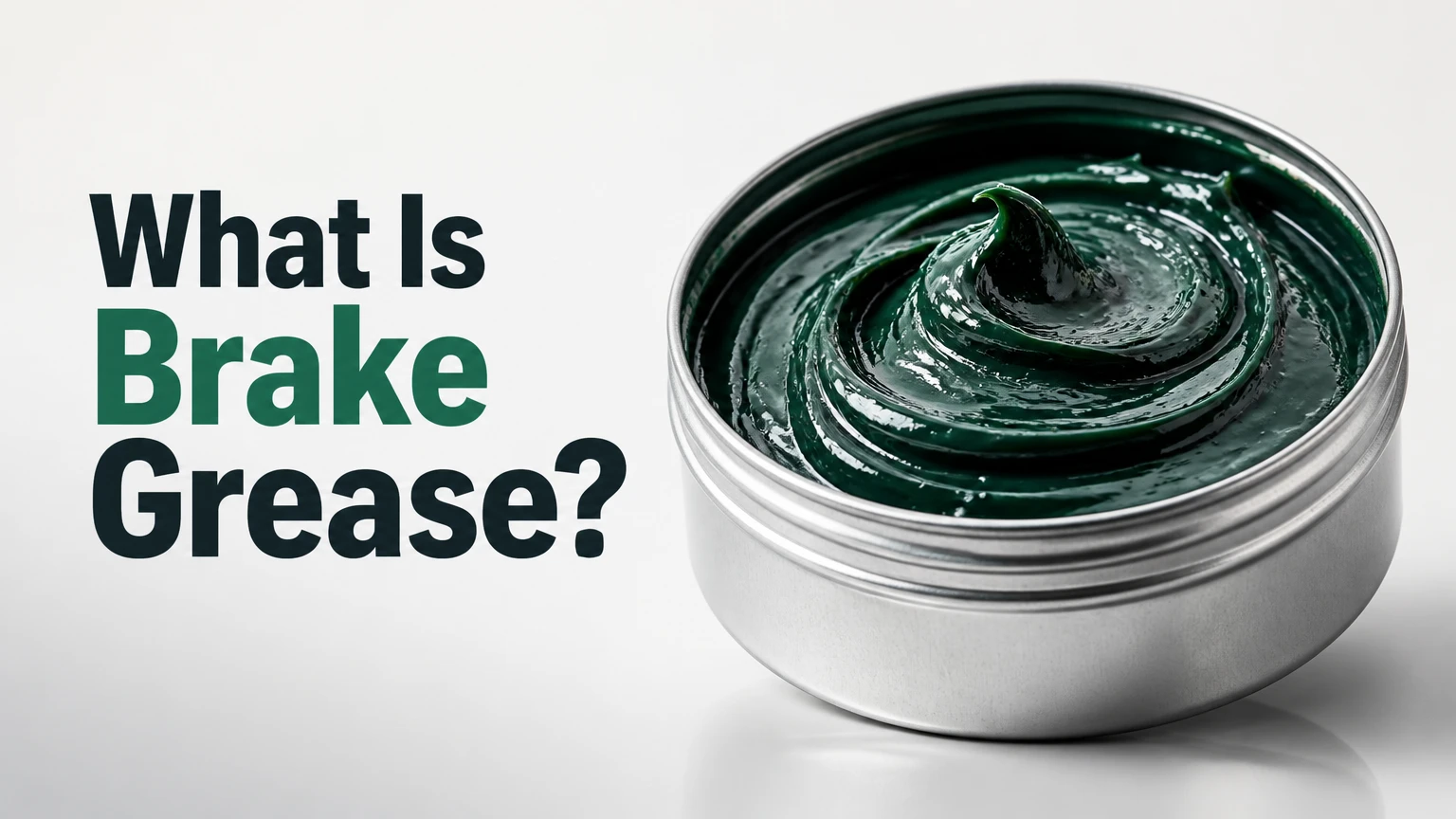
Brake grease is a specialized, non-melting synthetic lubricant engineered to withstand extreme temperatures between -40°F and 2000°F while preventing brake squeal, component seizure, and uneven pad wear. Unlike petroleum chassis grease, true brake grease is 100% rubber-safe to protect critical caliper slide pin boots and dust seals from swelling or degrading.
At a Glance
- Temperature Thresholds: Quality disc brake grease must withstand a minimum continuous operating temperature of 400°F, with premium ceramic hybrids rated above 2000°F.
- Chemical Safety: Slide pin lubricants must contain 0% petroleum distillates to avoid swelling EPDM rubber boots.
- Primary Function: Brake grease maintains the microscopic 0.1 mm clearance between pads and rotors, ensuring pads retract cleanly without dragging.
- Application Boundary: Apply brake grease exclusively to metal-on-metal contact points and slide pins; keep all lubricants completely off friction linings and rotors.
- ABS Sensor Protection: Conductive copper anti-seize should never be used near electronic ABS wheel speed sensors due to signal interference.
What Key Heat Ratings and Tolerances Define Brake Grease?
Brake grease is defined by its ability to maintain structural viscosity under extreme thermal and mechanical shock. Standard automotive chassis greases breakdown and liquefy between 300°F and 350°F, causing them to run directly onto brake friction materials. True automotive brake lubricants must meet four strict physical and thermal standards:
- 400°F (204°C) Minimum Continuous Heat Rating: This is the baseline thermal limit for standard passenger car disc brake applications during everyday city driving.
- 1000°F to 2000°F+ (538°C to 1093°C+) Extreme Heat Rating: Premium ceramic-solid or silicone-ceramic hybrid lubricants are required for heavy towing, track driving, or steep mountain descents where rotor temperatures regularly surpass 1200°F.
- 0.1 mm Microscopic Tolerance: When the driver releases the brake pedal, the caliper piston seal pulls the pad back by roughly 0.1 mm. High-viscosity brake grease allows pad ears to slide smoothly across stainless steel hardware clips within this narrow window instead of sticking.
- 0% Petroleum Distillate Volume: Lubricants contacting rubber boot seals must be entirely free of hydrocarbon petroleum oils to prevent catastrophic polymer expansion.
What Are the Main Chemical Types of Brake Grease?
The three primary categories of brake grease are pure silicone grease, synthetic ceramic grease, and mineral-based paste. Choosing the correct formulation depends on whether the application involves rubber seals, extreme heat, or non-rubber metal-on-metal contact points.
| Grease Type | Base Chemistry | Temperature Range | Primary Best Use Case | EPDM Rubber Compatibility |
| Pure Silicone Paste | Polydimethylsiloxane / Silica | -40°F to 400°F (400°F+ peak) | Caliper slide pins, guide pins, rubber boots | 100% Safe (Will not swell rubber) |
| Synthetic Ceramic Hybrid | Polyalphaolefin (PAO) / Ceramic Solids | -40°F to 2000°F+ | Pad abutment ears, metal clips, back of shims | Moderate (Unsafe for direct internal boot soaking if petroleum carriers exist) |
| Mineral / Copper Paste | Mineral Oil / Copper & Graphite Flakes | -20°F to 1800°F | Vintage non-ABS hub faces, non-rubber steel brackets | Incompatible (Swells EPDM rubber rapidly) |
Where Should You Apply Brake Grease on a Braking System?
Apply brake grease sparingly to specific high-friction dynamic contact zones across the caliper assembly. Lubrication must be confined strictly to mechanical guide interfaces where metallic components move against each other or within protective sleeves:
- Caliper Slide Pins and Guide Sleeves: Internal pins that allow floating calipers to center themselves over the rotor require a thin coating of pure silicone grease.
- Caliper Bracket Abutment Clips: Stainless steel clips where the top and bottom metallic ears of the brake pad slide back and forth need a light dab of synthetic ceramic grease.
- Piston Face Contact Area: The circular outer rim of the caliper piston where it contacts the back of the inner brake pad or noise shim requires a light film of heat-resistant grease.
- Caliper Finger Contact Points: The outer cast-iron fingers of the caliper housing that press against the back of the outer brake pad require a thin coat to dampen vibration harmonics.
Where Should You Never Apply Brake Grease?
Never apply brake grease to friction materials, hydraulic fluid pathways, or bonded dampening layers. Contaminating these zones leads to immediate mechanical failure or complete loss of braking force:
- Brake Pad Friction Faces: Grease on the pad friction surface prevents the pad from grabbing the rotor, reducing stopping power and causing severe vehicle pulling.
- Brake Rotor Friction Surfaces: Any grease deposited on the rotor disc will transfer directly to the pads, glazing the friction material under heat.
- Rubber Parts Using Petroleum Grease: Applying petroleum-based greases onto EPDM rubber slide pin boots causes the rubber to swell, softening the seal and trapping water inside the pin bore.
- Backs of Pre-Shimmed Brake Pads: Pads equipped with vulcanized, adhesive-bonded rubber-composite noise shims should not be greased on the back, as grease weakens the bonding glue.
- Threaded Fastener Shafts (Unless Specified): Caliper mounting bolts require threadlocking fluid, not grease, to prevent loosening under vibration.
Can You Use the Same Brake Grease for Caliper Slide Pins and Metal Clips?
No, you cannot safely use a single universal grease across all caliper parts unless it is explicitly certified as a 100% pure silicone paste. Caliper slide pins are sealed by EPDM (Ethylene Propylene Diene Monomer) rubber boots, which react aggressively to petroleum or hydrocarbon carrier oils found in many heavy-duty ceramic greases.
If a petroleum-based ceramic paste creeps into the slide pin boot, the EPDM boot will swell up to 150% of its normal size. This swelling breaks the moisture seal, traps grit inside, and eventually binds the slide pin solid, resulting in rapid single-side pad wear. For slide pins, use pure silicone paste or polyglycol lube. For metal-on-metal caliper bracket clips, use high-temp synthetic ceramic or moly grease.
Why Does Copper Anti-Seize Cause ABS Fault Codes on Modern Vehicles?
Copper anti-seize causes Anti-lock Braking System (ABS) and Electronic Stability Program (ESP) fault codes because copper is an electrically conductive metal. Modern vehicles rely on magnetic hall-effect sensors mounted adjacent to the wheel bearing tone ring to monitor wheel rotation speed.
When copper anti-seize is applied to brake pad ears or hub faces, centrifugal force flings microscopic copper flakes onto the magnetic tip of the ABS sensor. The metallic debris alters the magnetic field readings, generating false speed signals that trick the ECU into illuminating ABS dashboard warning lights and disabling electronic brake-force distribution.
Should You Grease the Back of Pre-Shimmed Brake Pads?
No, you should not apply brake grease to the back of brake pads that feature factory-bonded, vulcanized rubber-composite shims. Modern premium brake pads from manufacturers like Bosch or TMD Friction utilize rubber-layer shims attached with pressure-sensitive adhesives specifically tuned to absorb high-frequency noise.
Applying grease over these bonded shims introduces chemical solvents that break down the underlying adhesive layer. Under heat and pressure, the dampening shim will shift out of alignment, bunch up against the caliper fingers, and trigger the exact brake squeal the shim was designed to prevent.
When Does Applying Brake Grease Actually Cause Brakes to Seize?
Brake grease causes components to seize when applied in high-dust off-road environments or when over-applied inside sealed slide pin bores. While grease protects components in rainy or salted environments, specific edge cases turn lubricant into an destructive abrasive.
Off-Road and Desert Environment Failure
In dry, dusty, sandy, or agricultural conditions, sticky brake grease acts as an open trap for airborne road grit, sand, and ambient brake dust. Within 3000 to 5000 miles, the grease mixes with sand to form a thick grinding paste. This mixture thickens, hardens, and physically locks the pad ears inside the caliper bracket tracks. In arid or off-road conditions, mechanics install hardware dry or apply non-sticky PTFE/graphite dry-film sprays.
[Fresh Grease] + [Off-Road Sand/Grit] ---> [Abrasive Grinding Paste] ---> [Locked Pad Ears & Severe Drag]
Hydro-Locking Inside Slide Pin Bores
When servicing caliper slide pins, packing too much grease into the blind hole at the bottom of the caliper bracket creates a hydraulic lock. As the slide pin pushes inward during braking, the trapped grease cannot compress. The pin bounces off the compressed fluid pocket, holding the brake pad pressed firmly against the spinning rotor and destroying the pad through continuous heat drag.
Why Does Traditional Copper Grease Fail on Long Mountain Descents?
Traditional copper anti-seize fails during mountain descents because its underlying carrier oil burns off, leaving behind unlubricated metal powder. Copper grease consists of tiny metal particles suspended in a low-grade petroleum oil matrix.
During prolonged downhill braking, rotor temperatures quickly exceed 1000°F. The petroleum carrier oil reaches its flash point, vaporizes, and bakes off completely. Without the liquid carrier, the remaining dry copper flakes oxidize and turn into a sticky paste that locks pad hardware in place.
How Much Brake Grease Should You Apply Per Caliper?
You should apply roughly 1 to 2 grams of brake grease total across an entire disc brake caliper assembly. The most common DIY mistake is over-lubrication, which leads to grease sling onto friction surfaces.
- Slide Pins: Apply a paper-thin film along the smooth torso of the pin, leaving the first 1/4 inch of the tip bare to prevent air entrapment.
- Abutment Clips: Apply a light dab the size of a grain of rice to the flat sliding surfaces of the metal clips where the pad ears rest.
- Piston Face & Fingers: Spread a thin film no thicker than a sheet of paper across the metal contact points.
How Long Does Brake Grease Last Before Requiring Reapplication?
Quality synthetic brake grease lasts between 30000 and 50000 miles under normal driving conditions, matching the standard replacement interval of typical brake pads.
However, severe operating environments drastically shorten grease lifespan. Frequent driving through winter road salt, deep water crossings, or track racing degrades the grease structure much faster. Inspect brake slide pin freedom and hardware cleanliness every 15000 miles or during routine tire rotations, reapplying fresh pure silicone paste if pins feel sticky or dry.
How Do You Properly Grease Caliper Slide Pins Step by Step?
Servicing caliper slide pins correctly requires thorough cleaning of old degraded grease prior to applying fresh rubber-safe silicone lubricant.
1.Remove and Inspect Slide Pins:Prerequisite: Vehicle safely lifted on jack stands.
Unbolt the caliper mounting bolts, lift the caliper body, and pull both slide pins straight out of their bracket bores. Inspect the rubber dust boots for tears, pin holes, or swelling.
2.Clean Old Grease and Debris:Do not use petroleum solvents on rubber boots.
Spray the slide pins with dedicated brake cleaner and wipe them completely bare using a microfiber towel. Insert a rolled paper towel or wire bore brush into the bracket hole to clear out degraded residue.
3.Apply Silicone Paste to Pins:Use 100% pure silicone paste only.
Apply a microscopic layer of pure silicone grease over the pin body. Ensure no petroleum-based ceramic paste is used that could ruin the EPDM boots.
4.Reinsert Pins and Purge Air:Verify pin movement before reassembly.
Push the pin back into the bracket bore until the rubber boot seats cleanly into the retention groove. Compress the pin fully by hand to burp out trapped air, ensuring the pin springs back smoothly without hydro-locking.
Can You Use WD-40, White Lithium Grease, or Petroleum Jelly on Brakes?
No, you must never use standard WD-40, white lithium grease, or petroleum jelly on any part of a brake system. These household products lack the thermal stability and chemical compatibility required for automotive braking:
- WD-40 Multi-Use Spray: WD-40 is a light penetrating solvent and water displacer, not a heavy lubricant. It evaporates within minutes under normal brake operating temperatures and ruins friction linings.
- White Lithium Grease: White lithium grease is petroleum-based with a low melting point near 300°F. Under light braking heat, it liquefies, drips onto rotors, and causes EPDM slide pin boots to swell up and split.
- Petroleum Jelly (Vaseline): Petroleum jelly breaks down rapidly at temperatures above 130°F and dissolves synthetic rubber seals almost instantly upon contact.
How Do You Clean Accidental Brake Grease Off Rotors or Friction Pads?
Cleaning accidental brake grease depends entirely on whether the fluid hit a hard non-porous metal surface or absorbed directly into porous friction material:
- Clearing Brake Rotors or Metal Hardware: Douse the metal rotor liberally with a non-chlorinated brake cleaner spray. Wipe the surface clean using a fresh lint-free shop towel. Repeat three times until no oil residue remains.
- Clearing Brake Pad Friction Material: If grease contacts the porous friction face of a brake pad, the pad must be replaced. Grease soaks deep into the composite pad material under hydraulic pedal pressure. Washing or sanding the surface only offers temporary relief; as heat rises during driving, internal grease migrates back to the surface, causing localized brake fade and severe steering pull.
Why Do Brakes Still Squeak After Applying Brake Grease?
Brakes continue to squeak after applying grease when the source of noise is structural or friction-based rather than mechanical vibration at contact points. High-pitched brake squeal is caused by micro-vibrations occurring at thousands of Hertz. Common non-lubrication squeak causes include:
- Glazed Rotors or Pads: Overheating hardens the outer layer of pad friction material and smooths rotor faces, creating a glassy surface that chatters during engagement.
- Missing Anti-Rattle Hardware: Worn, fatigued, or missing stainless steel abutment clips allow pads to vibrate loosely within the cast-iron bracket tracks.
- Low-Grade Pad Friction Formulations: Cheap metallic pad compounds lack acoustic slots, angled edge chamfers, or noise-dampening shims necessary to interrupt harmonic sound waves.
- Worn Rotor Lip: A sharp rust ridge on the outer circumference of an aged rotor scraping against the pad edge produces continuous noise regardless of grease application.
The Bottom Line
Brake grease is an essential synthetic lubricant formulated to withstand extreme heat and protect braking components from seizing, dragging, and squealing. Always select pure silicone paste for rubber-sealed caliper slide pins to prevent EPDM boot swelling, while utilizing synthetic ceramic formulas on metal-on-metal bracket clips. Never allow grease to touch pad friction linings or rotor surfaces, and avoid non-automotive solvents or copper anti-seize near modern ABS electronic sensors.


