When your car makes a rhythmic clicking noise during turns, the definitive cause is a failing Constant Velocity (CV) axle joint. A torn protective boot allows lubricating grease to escape and road debris to enter, destroying the joint’s bearings. You must replace the compromised axle assembly to restore safe drivability.
Key Facts / At a Glance:
- Primary culprit: The outer CV joint on the front drive axle (responsible for 90% of turning clicks).
- Distinct sound profile: Rhythmic clicking or popping that accelerates exactly as your wheel speed increases.
- Safety risk: High. A sheared CV joint results in immediate, total loss of vehicle propulsion.
- Average repair cost: $300 to $700 per side for standard commuter vehicles at an independent shop.
- Standard fix: Replacing the entire CV axle assembly rather than rebuilding the broken outer joint.
What causes a clicking noise when turning?
The clicking noise is the sound of dry, damaged metal ball bearings being violently forced into worn grooves inside your outer CV joint under the heavy load of a turn.
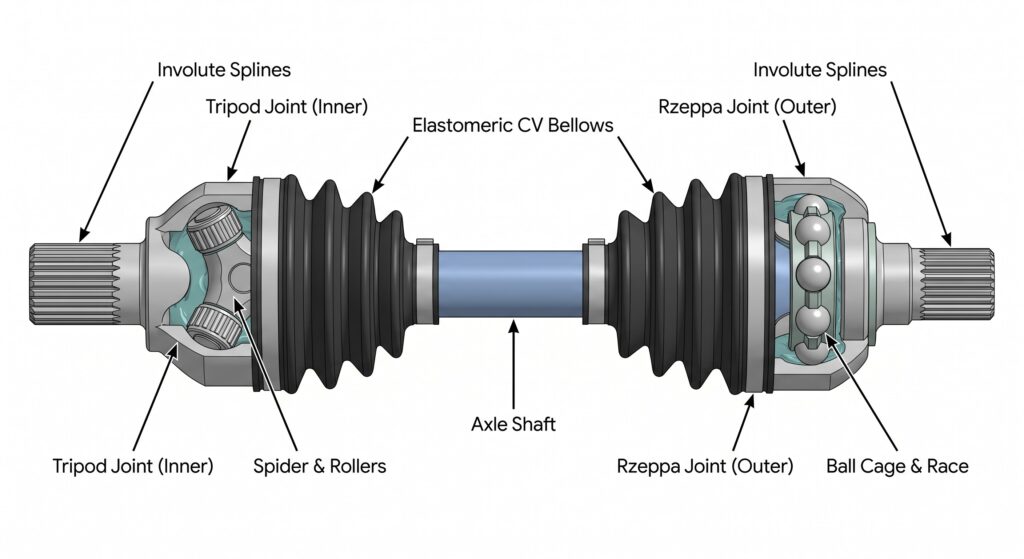
A CV joint is a flexible mechanical coupling located at the ends of your drive axle shaft, designed to transfer rotational engine power to the wheels while simultaneously allowing the suspension to travel up and down and the wheels to steer left and right. The joint relies on spherical ball bearings housed in a cage. To prevent friction, it is packed with heavy-duty molybdenum grease and sealed inside a pleated rubber or thermoplastic boot.
Over time, this boot cracks from thermal cycling and physical wear. Centrifugal force flings the grease out of the crack, leaving the joint dry. Road grit, salt, and water immediately invade the housing, creating a grinding paste that rapidly destroys the precise tolerances of the bearings. Once the bearing tracks are scarred, sharp turns force the balls into these deep, dry pockets, creating the distinctive “playing cards in a bicycle spoke” pop or click.
Are there other reasons my car clicks on turns?
While a failing outer CV joint is the most common cause of rhythmic turning noises, front-end suspension and braking components can create similar acoustic profiles. You can isolate the true cause by paying attention to exactly when the sound occurs.
| Component | Sound Profile | When it Occurs | Primary Root Cause |
| Outer CV Joint | Rhythmic clicking/popping that speeds up as you accelerate. | Loudest during sharp turns under engine acceleration (e.g., pulling out of a driveway). | Torn boot leading to dry, contaminated ball bearings. |
| Brake Hardware | Sharp metallic clicking, ticking, or snapping. | Specifically when applying or releasing the brakes while steering. | Missing anti-rattle clips, broken pad shims, or shifting brake pads. |
| Loose Hubcaps | Light, plastic, tinny clicking or ticking. | At low speeds, regardless of steering angle, worsening slightly on turns. | Broken plastic retaining clips on decorative wheel accents. |
| Strut / Ball Joints | Single, heavy clunk, pop, or low-frequency binding sound. | The exact moment you turn the wheel, or crest a speed bump. | Worn-out suspension ball joint or dry upper strut mount bearing. |
| Wheel Bearings | Continuous low-pitched hum, growl, or rumble. | While driving straight, often getting louder when turning in one specific direction. | Internal bearing failure; lacks the distinct “click” of a CV joint. |
How can I diagnose a failing CV axle at home?
You can positively identify a failed CV axle in less than ten minutes using a dynamic driving test and a visual inspection.
Before You Start:
- Time Required: 10 minutes.
- Tools Needed: Flashlight, flat parking lot.
- Difficulty: Beginner.
Step 1: The Sharp Turn Test
Drive your vehicle to a quiet, open parking lot and roll down both front windows. Turn the steering wheel completely to full lock in the left direction, and accelerate gently in a circle. Stop, turn the wheel to full lock right, and repeat.
- Diagnostic Rule of Thumb: If the clicking is loudest when turning left, the right (passenger side) outer joint is likely failing, as the vehicle’s weight transfers to the outside wheel, heavily loading it.
Step 2: The Visual Boot Inspection
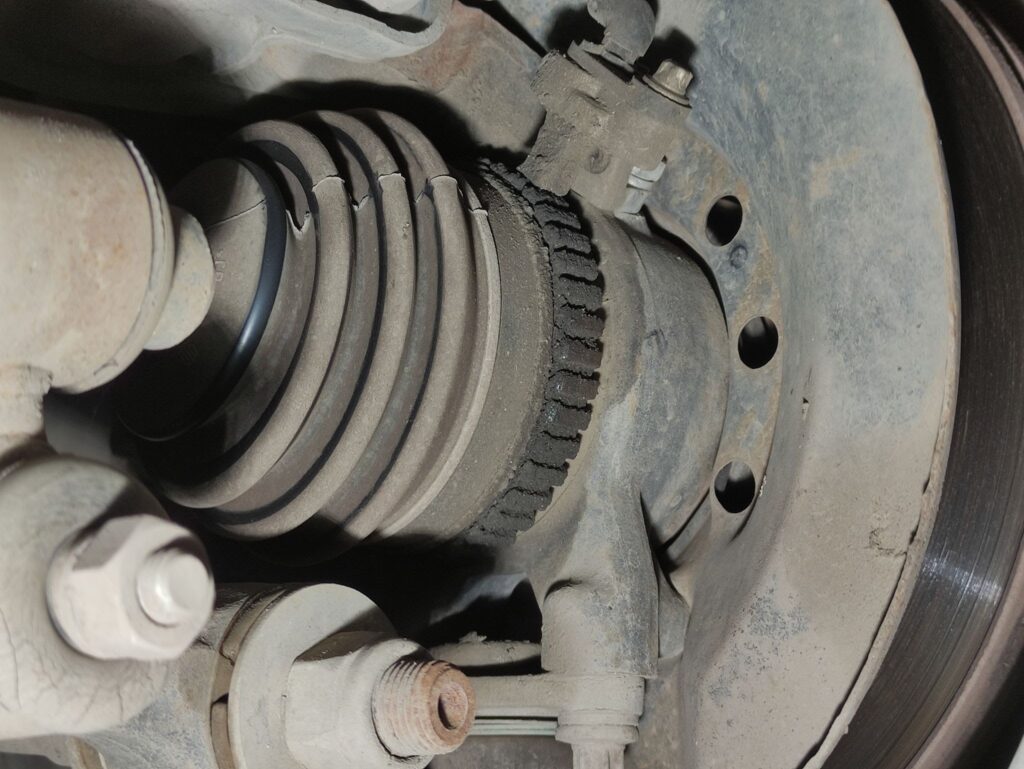
Park the vehicle on a level surface, engage the parking brake, and turn the front wheels all the way outward to expose the components behind the brake rotor. Shine your flashlight onto the black, accordion-style rubber boot directly behind the wheel hub.
Step 3: Check for the Grease Pattern
You are looking for clean tears, splits, or heavy cracking in the rubber ribs. A definitive giveaway of a failed boot is a thick, dark green or black grease splattered in a radial pattern across the inner barrel of the wheel rim, the brake caliper, or the suspension strut.
How much does it cost to fix a clicking CV joint?
Replacing a CV axle generally costs between $300 and $1,200 per side, depending heavily on the make of your vehicle and the shop you choose. A professional technician typically takes 1.5 to 3 hours to replace one axle shaft.
- Economy / Commuter Cars (Honda, Toyota, Ford): $300 to $700 per side at an independent shop.
- Mid-size SUVs / Trucks: $700 to $1,200 per side.
- Luxury / European Vehicles (Audi, BMW, Mercedes): $1,200 to $1,800+ per side.
Always account for hidden invoice extras. Axle replacement often requires unbolting suspension knuckles or tie rods, making a wheel alignment ($80–$150) highly recommended to prevent premature tire wear. Additionally, pulling the inner axle joint out of the transmission often results in gear oil spilling out, requiring a differential or transmission fluid top-off ($30–$150).
Should I replace the whole axle or just the boot?
You should always replace the complete axle assembly if the joint has already started clicking.
Replacing just the torn rubber boot (Option B) is only viable if you catch the tear early during a routine oil change before any clicking noise begins. A boot replacement kit costs only $120 to $250 including labor. However, once the clicking starts, the metal bearings are permanently scarred.
Replacing the complete axle assembly (Option A) is the standard industry practice. New axles come pre-greased and pre-sealed from the factory, replacing both the inner and outer joints simultaneously. Because modern aftermarket axles (like those from GSP or TrakMotive) are relatively inexpensive ($60 to $150 in parts), buying a whole new axle is actually cheaper than paying a mechanic the intense labor hours required to clean, rebuild, and re-boot an old, damaged joint.
Is it safe to drive with a clicking CV joint?
It is highly unsafe to ignore a clicking CV joint for an extended period. A clicking joint is a structural failure in progress.
If the outer joint shears completely off while you are driving, the wheel will lose all propulsion power instantly. While you will still have steering and braking, the vehicle will coast to a stop. More dangerously, on many vehicle designs, the severed axle shaft can swing freely under the car at high rotational speeds, destroying the transmission casing, tearing brake lines, and smashing suspension linkages in seconds. Do not drive at highway speeds, and limit driving strictly to the trip to your mechanic.
Which repair approach is best for my situation?
Different driving habits and budgets require different parts sourcing and repair strategies.
- The DIY Mechanic: If you possess a heavy-duty breaker bar, jack stands, a torque wrench, and an axle nut socket (often 30mm–36mm), you can perform this at home. Ensure you buy a new axle nut, as they are single-use, torque-to-yield hardware. Expert Warning: Never pull on the middle of the axle shaft during removal, or you will accidentally pull the inner joint apart inside its boot.
- The Budget-Conscious Commuter: Avoid the dealership, which routinely charges a 40% premium for OEM (Original Equipment Manufacturer) parts and labor. Ask an independent shop to source a high-quality aftermarket brand (like Cardone or TrakMotive) to save hundreds on material costs without sacrificing safety.
- The Fleet / Off-Road Driver: If you drive a lifted truck, an AWD vehicle, or frequently tow heavy loads, do not use cheap economy axles. The modified suspension angles put severe stress on CV joints. Request heavy-duty axles with high-articulation thermoplastic boots (rather than standard neoprene rubber) to prevent premature tearing.
Frequently Asked Questions (FAQ)
What is the difference between inner and outer CV joint failure?
Outer CV joint failure creates a clicking or popping noise during sharp turns because it handles the steering angles. Inner CV joint failure (the side connected to the transmission) rarely clicks; instead, it causes a severe side-to-side shudder or vibration when accelerating in a straight line.
Can I just spray WD-40 or add grease to the clicking joint?
No. Once the joint clicks, the metal is physically damaged and missing chunks of material. Adding grease will only temporarily muffle the sound for a few miles, but it will not restore the structural integrity of the bearings or prevent the joint from snapping.
Will a bad CV joint affect my steering?
It will not prevent the steering wheel from turning, but it can introduce “torque steer,” where the car pulls heavily to one side under acceleration due to uneven power delivery. If the joint fails completely, you maintain steering control, but lose all forward momentum.
Can a pothole cause a CV joint to start clicking?
A direct, severe impact from a pothole can physically dent the outer joint housing or tear the boot, leading to rapid grease loss. However, the clicking noise usually takes several weeks to develop after the impact as dirt slowly grinds down the internal bearings.