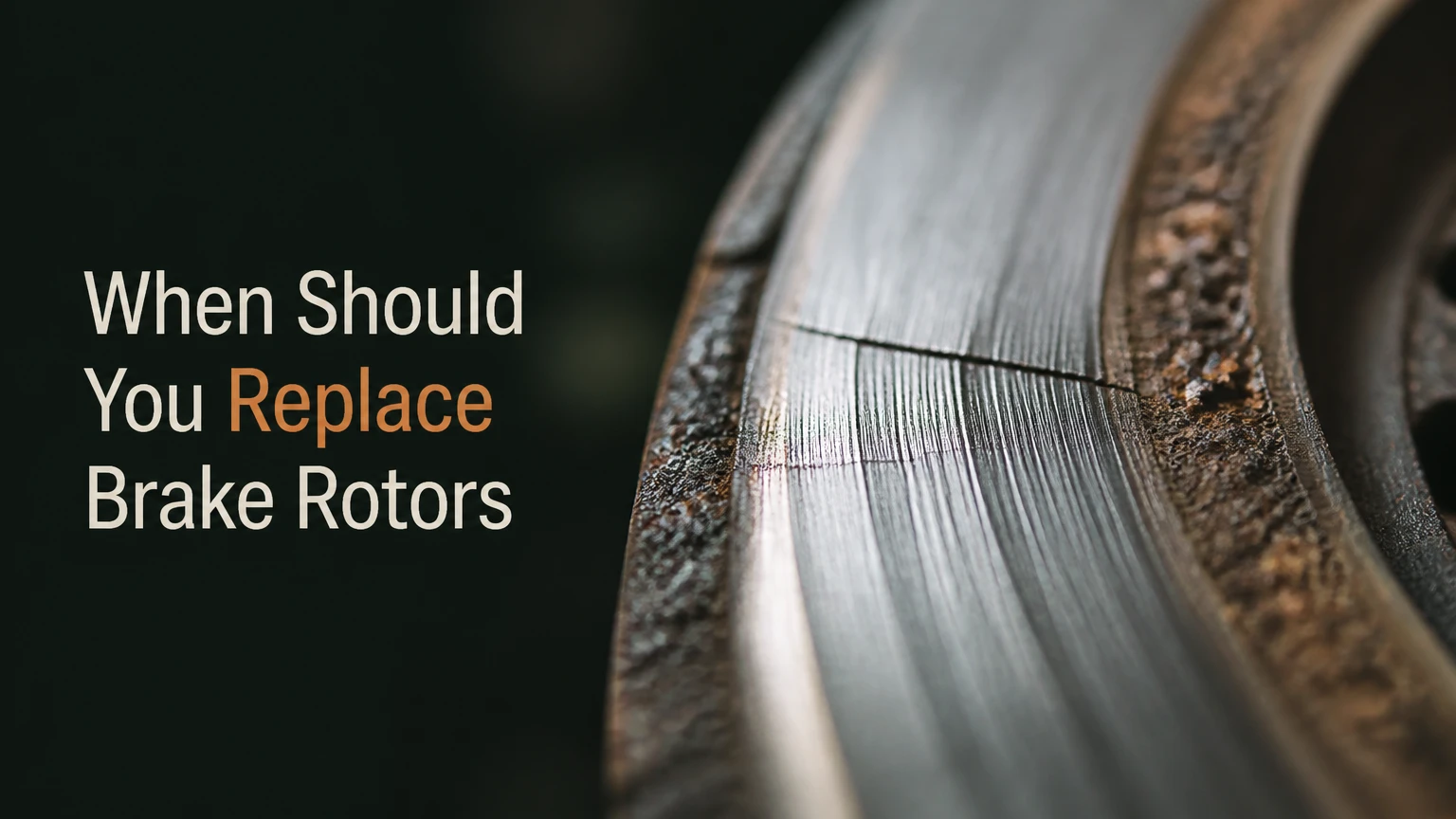
Brake rotors must be replaced when their thickness measures at or below the manufacturer-specified discard limit, when lateral runout exceeds 0.05 mm (0.002 inches), or when deep scoring, structural cracks, or severe rust pitting compromise the friction surface. While rotors often last 30,000 to 70,000 miles, physical measurements dictating structural safety always override mileage estimates.
At a Glance
- Discard Thickness: Rotors have a minimum thickness spec stamped on the hub that requires immediate replacement if breached.
- Lateral Runout Limit: Any side-to-side wobble exceeding 0.05 mm (0.002 inches) causes severe pedal pulsation and steering shake.
- Pair Replacement: Rotors across the same axle must always be replaced together to maintain balanced braking force.
- Modern Resurfacing Limits: Machining modern thin-cast rotors usually reduces their mass below safe heat-dissipation thresholds.
- Pad-to-Rotor Ratio: Conventional vehicles allow two pad changes per rotor, but modern European performance cars require simultaneous replacement.
How Long Do Brake Rotors Last on Average?
Brake rotors typically last between 30,000 and 70,000 miles, with high-quality Original Equipment Manufacturer (OEM) units lasting up to 100,000 miles under ideal highway conditions. However, total lifespan depends entirely on driving habits, vehicle weight, friction material composition, and local environmental factors rather than a strict calendar interval.
+-------------------------------------------------------------------+
|                     ESTIMATED ROTOR LIFESPAN                      |
+------------------------------------+------------------------------+
| Driving Condition / Vehicle Type   | Expected Lifespan Range      |
+------------------------------------+------------------------------+
| Heavy City Traffic / Stop-and-Go   | 30,000 – 40,000 miles        |
| Aggressive / Mountain Driving      | 25,000 – 35,000 miles        |
| Mixed Commuting (City + Highway)   | 40,000 – 60,000 miles        |
| Open Highway / Light Duty          | 70,000 – 100,000 miles       |
| Performance / European Vehicles    | 30,000 – 50,000 miles        |
+------------------------------------+------------------------------+
Aggressive stop-and-go driving, heavy towing, and mountain terrain generate extreme thermal cycles that accelerate wear. Conversely, steady highway cruising minimizes friction cycles and extends service life. Fleet technicians monitor physical wear parameters rather than elapsed mileage to evaluate serviceability because driving style introduces a 50,000-mile variance in component longevity.
What Physical Signs Indicate a Rotor Must Be Replaced Immediately?
Visual and mechanical indicators of non-serviceable brake rotors include deep surface grooves, a pronounced outer edge rust ridge, visible heat stress cracks, and dark blue spots caused by localized thermal hardening. Any single visual structural failure necessitates immediate replacement to prevent catastrophic brake loss.
+-------------------------------------------------------------------+
|               CRITICAL ROTOR DAMAGE IDENTIFICATION                |
+----------------------+----------------------+---------------------+
| Visual / Physical    | Primary Cause        | Required Action     |
| Defect               |                      |                     |
+----------------------+----------------------+---------------------+
| Deep Grooves /       | Worn pad backing     | Replace rotor and   |
| Scoring              | plate grinding metal | pads immediately    |
|                      | on metal             |                     |
+----------------------+----------------------+---------------------+
| Micro-Cracking /     | Extreme thermal stress | Replace rotor; do   |
| Radial Fractures     | and rapid cooling    | not attempt to turn |
+----------------------+----------------------+---------------------+
| Blue Spots / Thermal | Severe overheating;  | Replace rotor       |
| Hardening            | metal structure altered | (cannot be resurfaced) |
+----------------------+----------------------+---------------------+
| Rust Lip Depth       | Normal pad wear      | Replace if lip      |
| > 1.5mm              | eroding center face  | height exceeds limit|
+----------------------+----------------------+---------------------+
- Deep Scoring: Grooves deeper than 1.5 mm caused by debris or worn-out pad backings prevent flat contact with new friction material.
- Heat Cracking: Micro-fractures radiating from the center or web of cross-drilled holes indicate structural stress from excessive thermal expansion.
- Thermal Spotting: Dark blue or purple spots indicate localized metallurgical changes where the iron has converted to hard cementite, which cannot compress or dissipate heat evenly.
- Corrosion Ridge: A outer lip exceeding 1.0 mm to 1.5 mm along the edge shows that the functional friction zone has eroded significantly past its operational thickness.
What Is the Minimum Thickness (Discard Spec) for Brake Rotors?
The minimum discard thickness is the precise measurement below which a brake rotor can no longer absorb, store, and dissipate kinetic heat safely without cracking or fading. This value is permanently stamped into the metal on the rotor hub or outer edge by the manufacturer and is typically 2.0 mm to 3.0 mm less than the original thickness when new.
+-------------------------------------------------------------------+
|                 TYPICAL ROTOR TOLERANCE SPECS                     |
+-----------------------------------+-------------------------------+
| Specification Parameter           | Maximum Allowable Variance    |
+-----------------------------------+-------------------------------+
| Lateral Runout (Side-to-Side)     | 0.05 mm (0.002 inches)        |
| Disc Thickness Variation (DTV)    | 0.0127 mm (0.0005 inches)     |
| Rust Ridge Lip Height             | 1.0 mm to 1.5 mm              |
| Nominal Wear Allowance (New to    | 2.0 mm to 3.0 mm total loss   |
| Discard)                          |                               |
+-----------------------------------+-------------------------------+
When a rotor wears below this threshold, its reduced mass causes internal fluid temperatures to spike, leading to brake pedal sponge and potential hydraulic system vapor lock. Additionally, an excessively thin rotor risks structural collapse under emergency stopping pressures. Technicians measure this parameter at multiple points around the plate using a specialized deep-throat micrometer.
How Do You Measure Rotor Thickness and Runout Accurately?
Rotor thickness and lateral runout are measured using a mechanical outside micrometer and a dial indicator with a magnetic base. These precision instruments isolate physical wear parameters that cannot be detected by eye.
+-------------------------------------------------------------------+
|             ROTOR MEASUREMENT EQUIPMENT AND METHODS               |
+-----------------------+---------------------+---------------------+
| Tool                  | Measurement Target  | Correct Procedure   |
+-----------------------+---------------------+---------------------+
| Deep-Throat           | Disc Thickness &    | Take 8 readings     |
| Micrometer            | Thickness Variation | around disc, 10mm   |
|                       | (DTV)               | inside outer edge   |
+-----------------------+---------------------+---------------------+
| Dial Indicator with   | Lateral Runout      | Mount to knuckle,   |
| Magnetic Base         | (Wobble)            | measure face while  |
|                       |                     | rotating hub by hand|
+-----------------------+---------------------+---------------------+
- Clean the Rotor Surface: Remove loose rust, dust, and road grime from the inner and outer braking tracks using brake cleaner and a wire brush.
- Measure Thickness: Position the pointed anvil of a micrometer 10 mm inside the outer rim. Measure and record the thickness at eight evenly spaced points around the perimeter to detect Disc Thickness Variation (DTV).
- Calculate DTV: Subtract the smallest thickness reading from the largest. If the difference exceeds 0.0127 mm (0.0005 inches), the rotor will cause pedal pulsation.
- Set Up Dial Indicator: Secure a dial indicator base to the suspension knuckle. Position the indicator tip perpendicular to the rotor face, roughly 10 mm inside the outer edge.
- Measure Lateral Runout: Zero the gauge, rotate the wheel hub through a full 360-degree rotation by hand, and monitor total needle movement. If total runout exceeds 0.05 mm (0.002 inches), correct hub surface corrosion or replace the rotor.
Can You Replace Brake Pads Without Changing the Rotors?
Yes, replacing only the brake pads (known as a “pad swap”) is acceptable if the current rotors measure safely above their minimum discard thickness, exhibit zero lateral runout, and possess a smooth surface free of heat spots, cracks, or deep grooves.
+-------------------------------------------------------------------+
|               PAD-ONLY VS. FULL REPLACEMENT DECISION              |
+------------------------------------+------------------------------+
| Vehicle Condition Parameter        | Recommended Service Action   |
+------------------------------------+------------------------------+
| Rotors smooth, well above discard  | Pad swap acceptable          |
| limit, no vibration                |                              |
+------------------------------------+------------------------------+
| Rotors near discard limit, minor   | Replace both pads and rotors |
| surface grooves                    |                              |
+------------------------------------+------------------------------+
| High-performance European vehicle  | Replace both pads and rotors |
| with soft alloy disc               |                              |
+------------------------------------+------------------------------+
| Steering wheel vibrates during     | Replace rotors (or machine if|
| braking                            | thickness permits)           |
+------------------------------------+------------------------------+
Installing fresh brake pads over damaged or uneven rotors prevents the friction material from seating correctly. This issue, known as incomplete pad bedding, reduces total friction contact area, increases stopping distances, and causes premature wear on the new pads. If the original rotor face is glazed or lightly scored, it must be machined or scuffed with a non-directional abrasive disc to allow proper pad transfer layer development.
Should Brake Rotors Always Be Replaced in Pairs?
Yes, brake rotors must always be replaced in pairs across the same axle to maintain balanced stopping force, equal thermal dissipation, and consistent hydraulic pressure distribution between the left and right wheels.
Replacing a single rotor creates an immediate imbalance in friction coefficients across the axle because the old rotor possesses different surface roughness, pad transfer material, and thermal mass compared to the new unit. Under emergency braking conditions, this friction mismatch causes the vehicle to pull strongly toward the side with higher traction, compromising electronic stability control calibrations and vehicle handling.
Is Resurfacing (Turning) Brake Rotors Still Worth It?
Resurfacing brake rotors is rarely practical or cost-effective on modern light vehicles because factory rotors are manufactured with minimal spare material to optimize vehicle weight and fuel efficiency. Machining a worn modern rotor frequently reduces its thickness below the legal discard spec or leaves so little mass that the component warps shortly after service.
+-------------------------------------------------------------------+
|               RESURFACING VS. REPLACEMENT COMPARISON              |
+-------------------------+-------------------+---------------------+
| Factor                  | Resurfacing       | Full Replacement    |
+-------------------------+-------------------+---------------------+
| Initial Labor/Part Cost | Lower upfront     | Slightly higher     |
| Serviceable Material    | Removes 0.5-1.0mm | Restores 100% material|
| Resistance to Re-Warping| Low               | High                |
| Labor Time Required     | High (Machining)  | Low (Direct swap)   |
| Long-Term Value         | Poor on modern cars| Superior           |
+-------------------------+-------------------+---------------------+
In heavy-duty trucks and commercial transport, resurfacing remains viable due to the substantial structural casting thickness of heavy machinery rotors. For passenger cars, light trucks, and crossovers, the labor charge for operating an on-car or bench brake lathe often matches or exceeds the purchase cost of a new aftermarket replacement rotor.
Is a Vibrating Steering Wheel Always a Sign of Bad Rotors?
A vibrating steering wheel that occurs exclusively while depressing the brake pedal is almost always caused by brake rotor thickness variation or excessive lateral runout. If the vibration occurs continuously at highway speeds without touching the brakes, the underlying cause is tire imbalance, wheel misalignment, or worn suspension components.
+-------------------------------------------------------------------+
|                    VIBRATION DIAGNOSIS GUIDE                      |
+----------------------+--------------------+-----------------------+
| Symptom Profile      | Primary Cause      | Corrective Action     |
+----------------------+--------------------+-----------------------+
| Steering shakes ONLY | Rotor Thickness    | Measure runout and DTV|
| during braking       | Variation / Runout | Replace rotors        |
+----------------------+--------------------+-----------------------+
| Shake at 50-70 mph   | Unbalanced tires;  | Balance tires; inspect|
| without braking      | bent rim           | wheel assembly        |
+----------------------+--------------------+-----------------------+
| Brake pedal pulses,  | Rear rotor thickness| Inspect rear brake    |
| seat vibrates        | variation          | components            |
+----------------------+--------------------+-----------------------+
Pedal pulsation and steering wheel wobble stem from the brake pad riding over high and low spots on the rotating disc. As the pads pass over variations in rotor thickness, they force hydraulic fluid back through the caliper pistons into the lines, generating mechanical feedback felt through the driver’s foot and steering linkage.
How Do You Distinguish Between Warped Rotors and Pad Material Transfer?
True geometrical metal warping in passenger vehicle rotors is extremely rare and requires severe thermal shock. Most cases diagnosed as warped rotors are actually caused by uneven pad material transfer, where friction material bonds unevenly to the rotor surface.
+-------------------------------------------------------------------+
|           WARPED ROTORS VS. PAD MATERIAL TRANSFER                 |
+----------------------+--------------------+-----------------------+
| Diagnostic Metric    | True Metal Warping | Pad Material Transfer |
+----------------------+--------------------+-----------------------+
| Root Cause           | Extreme thermal    | Holding hot pads firm |
|                      | shock (cold water) | against stopped disc  |
+----------------------+--------------------+-----------------------+
| Physical Condition   | Physical metal     | High spots of bonded  |
|                      | distortion         | friction material     |
+----------------------+--------------------+-----------------------+
| Resolution Method    | Rotor replacement  | Non-directional rotor |
|                      | or lathe machining | honing or re-bedding  |
+----------------------+--------------------+-----------------------+
Uneven transfer happens when brakes are heated to high operating temperatures and then held firmly at a complete stop. The stationary pad deposits a thick layer of friction material onto one spot of the hot disc face. Over time, this patch creates a raised point that alters the rotor friction coefficient and mimics the symptoms of physical distortion. Light deposits can sometimes be removed using non-directional sanding blocks or specialized rotor honing tools without replacing the iron disc.
Why Do European Cars Require Rotor Replacement with Every Pad Swap?
European vehicle manufacturers engineer their braking systems using softer cast-iron rotor alloys matched with high-friction, semi-metallic brake pads to maximize stopping power and pedal response. Because the metal disc wears down at nearly the same rate as the friction material, European rotors typically hit their minimum discard thickness precisely when the brake pads reach the end of their service life.
+-------------------------------------------------------------------+
|               EUROPEAN VS. ASIAN/DOMESTIC ROTOR DESIGN            |
+----------------------+--------------------+-----------------------+
| Specification        | European Systems   | Asian/Domestic Systems|
+----------------------+--------------------+-----------------------+
| Rotor Alloy Composition | Soft cast-iron    | Harder iron alloys    |
| Primary Design Focus | Maximum bite/safety| Long service lifespan |
| Wear Rate Ratio      | ~1:1 (Pads:Rotors) | ~2:1 (Pads:Rotors)    |
| Pad-Only Replacement | Rarely permitted   | Frequently permitted  |
+----------------------+--------------------+-----------------------+
Attempting a pad-only replacement on vehicles manufactured by brands such as BMW, Mercedes-Benz, Audi, or Porsche almost always pushes the original rotors past their discard limit before the new pads complete their cycle. This leads to component failure, noisy braking, and diminished high-speed braking capabilities.
How Does “Lot Rot” Damage Rotors on Stored Vehicles?
“Lot rot” refers to aggressive pitting corrosion that develops on cast-iron brake rotors when a vehicle remains parked outdoors in humid or wet environments for extended periods without use. Unlike thin operational flash rust that rubs off during initial braking, lot rot creates deep structural pits and rust ridges in the iron face.
+-------------------------------------------------------------------+
|                     SURFACE RUST VS. LOT ROT                      |
+-----------------------+---------------------+---------------------+
| Condition             | Appearance          | Impact on Component |
+-----------------------+---------------------+---------------------+
| Light Flash Rust      | Orange surface film | Clears harmlessly   |
|                       | after rain          | within 2 stops      |
+-----------------------+---------------------+---------------------+
| Pitting Lot Rot       | Dark, flaking rust  | Destroys new pads;  |
|                       | pockets             | requires replacement|
+-----------------------+---------------------+---------------------+
When new brake pads scrape across a pitted rotor, the jagged edges of the rust craters shear away the fresh friction material, ruining the pads within a few hundred miles. Even if a stored rotor retains 90% of its original thickness, extensive rust pitting makes the unit unserviceable and requires complete replacement.
What Happens If You Drive on Rotors Below Minimum Thickness?
Driving on brake rotors that fall below minimum thickness limits risks severe mechanical failure, including structural rotor cracking, brake fade, severe fluid overheating, and caliper piston over-extension.
+-------------------------------------------------------------------+
|              RISKS OF OPERATING BELOW DISCARD THICKNESS           |
+----------------------+--------------------------------------------+
| Structural Risk      | Mechanical Consequence                     |
+----------------------+--------------------------------------------+
| Reduced Thermal Mass | Fluid boils, pedal drops to floor (Fade)   |
| Thin Plate Wall      | Rotor shatters under emergency braking     |
| Over-Extended Piston | Caliper seals leak or piston jams outright |
+----------------------+--------------------------------------------+
As a rotor loses structural mass, its ability to store and dissipate thermal energy drops dramatically. During hard braking events, temperatures spike instantly, transferring heat directly into the brake caliper. This thermal transfer boils the brake fluid, causing total hydraulic pedal loss. In extreme scenarios, overly thin rotor vanes shatter under mechanical stress, locking up the wheel assembly or causing total loss of braking authority.
How Much Does Brake Rotor Replacement Cost?
The cost to replace brake rotors typically ranges from $250 to $600 per axle for standard passenger vehicles, which includes both new rotors and matching brake pads. High-performance, luxury, or heavy-duty vehicles equipped with larger slotted or two-piece rotors can cost between $600 and $1,200+ per axle for parts and professional labor.
+-------------------------------------------------------------------+
|             ESTIMATED ROTOR REPLACEMENT COST RANGE                |
+----------------------+--------------------+-----------------------+
| Vehicle Classification| Parts Cost (Axle)  | Total Service Cost    |
|                      |                    | (Parts + Labor)       |
+----------------------+--------------------+-----------------------+
| Compact / Economy    | $80 – $150         | $250 – $450           |
| Midsize SUV / Truck  | $150 – $300        | $350 – $650           |
| European / Luxury    | $250 – $500        | $550 – $950           |
| High-Performance     | $400 – $1,000+     | $800 – $1,600+        |
+----------------------+--------------------+-----------------------+
Component costs vary based on metallurgic specifications, rust-prevention coatings, and venting designs. DIY installation eliminates labor fees, which usually account for 1.5 to 2.5 shop service hours per axle. However, replacing pads and rotors concurrently is always more cost-effective than replacing them in separate service visits, as it prevents overlapping labor charges.
The Bottom Line
Determine brake rotor replacement based on precise physical specs rather than mileage estimates. Replace rotors whenever their thickness hits the stamped discard limit, lateral runout exceeds 0.05 mm, or structural defects such as cracks and rust pitting appear. Always replace rotors in pairs across the axle alongside new brake pads to maintain balanced stopping force and vehicle stability.


