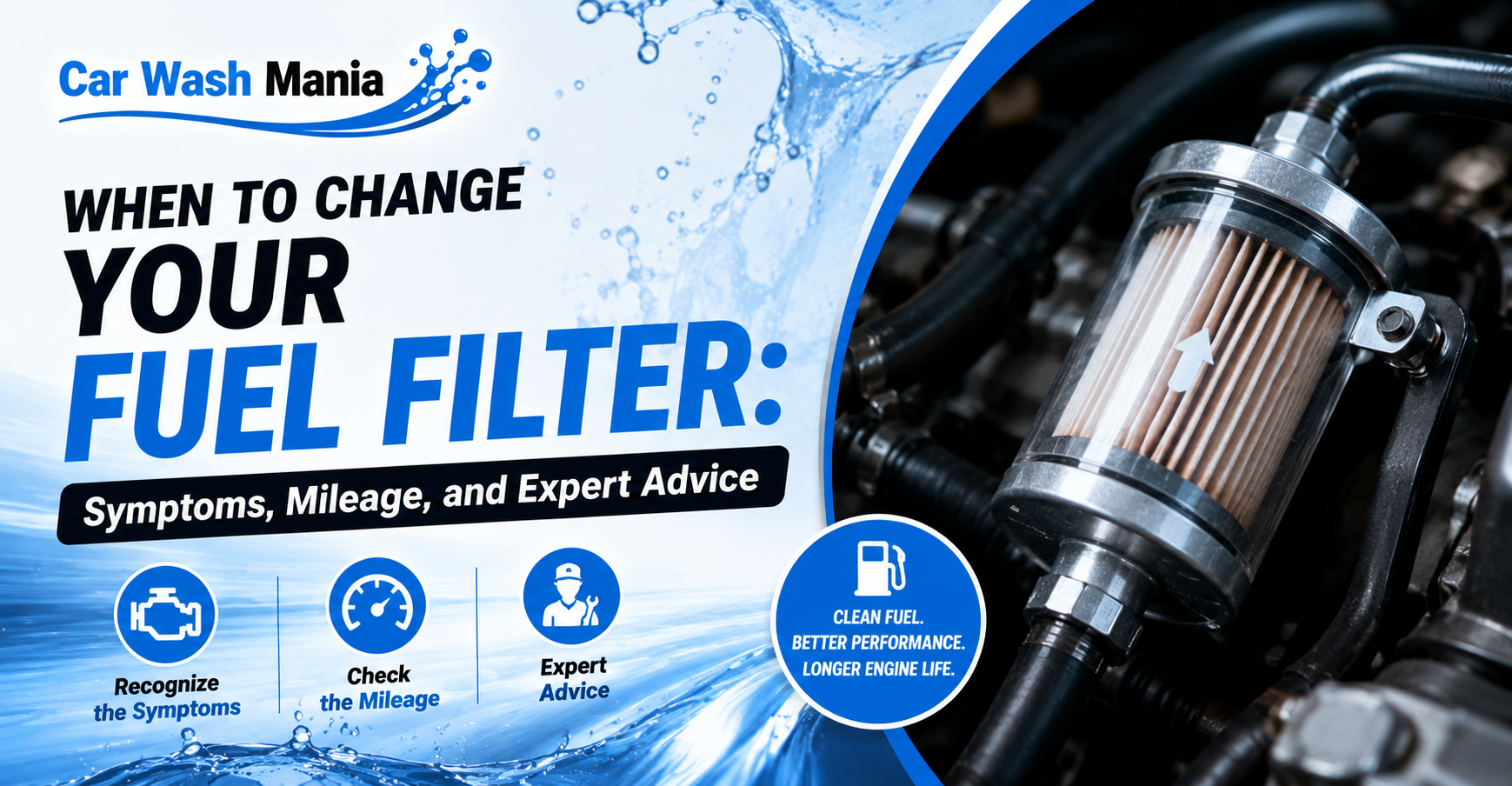
You should change your fuel filter every 60,000 to 100,000 miles for modern petrol vehicles with in-tank filters, or every 15,000 to 30,000 miles for older in-line systems. Diesel filters require replacement every 10,000 to 20,000 miles. Immediate replacement is mandatory if you experience engine misfires, hard starting, or stalling under load.
Key Facts / At a Glance
- Micron Rating: Modern fuel filters capture microscopic contaminants down to 5–10 microns, protecting highly sensitive fuel injectors.
- OBD-II Codes: A clogged fuel filter frequently triggers diagnostic codes P0087 (Low Fuel Rail Pressure) and P0171/P0174 (System Too Lean).
- Total Cost: Replacement ranges from €65 for basic in-line filters to over €600 for integrated in-tank fuel pump assemblies.
- Pump Danger: Operating a vehicle with a restricted fuel filter forces the fuel pump to overwork, often causing catastrophic pump failure via overheating.
- Safety Hazard: Opening a fuel system without first relieving line pressure sprays highly flammable, pressurized gasoline over the engine bay.
What Are the Key Signs It’s Time to Change Your Fuel Filter?
You should change your fuel filter immediately when your vehicle exhibits fuel starvation symptoms like hard starting, stalling under heavy engine load, rough idling, or triggering specific check engine codes. Restricted fuel flow deprives the engine cylinders of the exact air-fuel ratio required for complete combustion.
Engine Misfires and Stalling Under Load
A partially clogged fuel filter may allow enough fuel to pass for standard city driving, but it will restrict volume when demand peaks. When accelerating onto a highway, climbing steep hills, or towing cargo, the engine requires a surge of fuel. If the filter media is blocked by scale or rust, the fuel rail runs dry, causing the engine to misfire, sputter, or completely stall out until the load decreases.
Hard Starting and Extended Cranking
The fuel pump must build instant pressure through the filter to start a cold engine. A severely restricted filter forces the pump to work twice as hard to push fuel through the clogged paper media. If you must turn the ignition key and crank the engine for several seconds before it catches—especially in the morning—the filter is likely delaying fuel delivery to the injectors.
Limp Mode and Diagnostic Codes
Modern vehicles equipped with Gasoline Direct Injection (GDI) utilize sensitive electronic pressure sensors at the fuel rail. If the pressure drops below the programmed threshold due to a blockage, the engine control unit (ECU) restricts engine power (limp mode) to prevent internal damage. Scanning the vehicle will typically reveal code P0087 (Fuel Rail/System Pressure – Too Low) or codes P0171 and P0174, indicating the engine is running dangerously lean.
Expert Diagnostics Insight: You can confirm a clogged filter before throwing parts at the car by attaching a mechanical fuel pressure gauge to the Schrader valve on the fuel rail. Turn the key to the “ON” position. If the pressure reads significantly below your manufacturer’s specification (e.g., 30 PSI instead of 55 PSI), or if pressure drops dramatically when you rev the engine, a restriction is present between the tank and the rail.
How Often Should You Change a Fuel Filter by Mileage?
You should replace a fuel filter based on a mileage schedule dictated by the fuel type and the filter’s physical location: 15,000 to 30,000 miles for older petrol cars, 60,000 to 100,000 miles for modern petrol cars, and 10,000 to 20,000 miles for diesels.
Older Petrol Vehicles (In-Line Filters)
Vehicles manufactured before 2005 generally utilize external, in-line fuel filters mounted on the frame rail or in the engine bay. These smaller metal canisters have limited surface area and process fuel directly from older, steel gas tanks that are prone to interior rusting. Consequently, these require replacement every 15,000 to 30,000 miles (24,000–48,000 km) or every two years.
Modern Petrol Vehicles (In-Tank Filters)
Most petrol vehicles built after 2005 feature a “returnless” fuel system where the filter is integrated directly into the plastic fuel pump module submerged inside the gas tank. Because plastic tanks do not rust and these filters have massive surface areas, they are considered lifetime components by many manufacturers. However, preventative maintenance dictates replacing them—or the entire pump module—every 60,000 to 100,000 miles (96,000–160,000 km) to prevent stranding.
Diesel Vehicles and Water Separators
Diesel engines require aggressive filtration maintenance, typically every 10,000 to 20,000 miles (16,000–32,000 km). Diesel fuel is inherently dirtier than gasoline and naturally absorbs water from condensation in storage tanks. Modern diesel fuel filters often double as water separators. If water reaches a high-pressure diesel injection pump, it destroys the metal components instantly through lack of lubrication.
Expert Fuel Chemistry Insight: If you frequently run high-ethanol blends (like E85) or biodiesel, cut your replacement interval by 30%. Ethanol is a highly effective solvent; it scrubs pre-existing sludge and varnish from the walls of older fuel tanks, sending a massive wave of debris directly into the new filter during the first few thousand miles of use.
How Much Does Fuel Filter Replacement Cost?
A fuel filter replacement costs between €65 and €600, depending entirely on whether the filter is a simple external in-line unit or a complex in-tank assembly requiring rear-seat removal.
| Filter Location / Type | Average Part Cost | Average Professional Labor Cost | Total Estimated Cost |
| In-Line Petrol Filter | €15 – €40 | €50 – €80 (30–45 minutes) | €65 – €120 |
| Diesel Filter / Separator | €30 – €60 | €60 – €100 (45–60 minutes) | €90 – €160 |
| In-Tank Filter Assembly | €150 – €400+ | €150 – €200 (2–3 hours) | €300 – €600+ |
Labor costs jump drastically for in-tank filters because the technician must either remove the rear interior seats to access the top of the fuel tank or safely hoist the vehicle and drop the entire fuel tank out of the chassis.
What Happens If You Don’t Change Your Fuel Filter?
Failing to change a restricted fuel filter will eventually destroy your vehicle’s fuel pump through thermal breakdown and cavitation. The fuel pump relies on the liquid fuel flowing through it to cool its internal electric motor.
When a filter clogs, fuel flow slows down. The pump must spin faster and harder to force fluid through the blockage, generating immense heat. Simultaneously, the restriction causes the liquid fuel on the suction side to boil into vapor—a phenomenon called cavitation. The pump’s internal impellers chip and shatter as they strike these vapor bubbles. Ultimately, a neglected €20 in-line filter routinely causes a €500 fuel pump failure. Furthermore, the debris that manages to bypass a torn filter media will reach the engine, clogging the micro-screens inside the fuel injectors, resulting in thousands of euros in engine repair.
Core Fuel Filter Types: Which Do You Have?
| Filter Type | Where It is Located | Primary Advantage | Honest Drawback |
| In-Line Filter | Under the vehicle frame or inside the engine bay. | Extremely accessible and cheap to replace for DIY mechanics. | Exposed to road salt and debris; steel fittings often rust and seize. |
| In-Tank Assembly | Submerged inside the gas tank, attached to the pump. | Lasts up to 100,000 miles; protected from external environment. | Requires heavy labor to access; often necessitates buying a whole pump. |
| Diesel Separator | Engine bay or underbody, often with a drain petcock. | Essential mechanism that strips destructive water out of diesel fuel. | Prone to cold-weather waxing/gelling; requires draining at every oil change. |
How to Change an In-Line Fuel Filter
Replacing an in-line fuel filter requires depressurizing the system, disconnecting the quick-connect lines, and swapping the canister in the correct flow direction. The entire process takes approximately 30 to 60 minutes and requires basic hand tools.
Before You Start:
- Time Required: 30–60 minutes.
- Difficulty: 4/10 (Intermediate DIY).
- Total Cost: €15–€40 (Parts only).
- Tools Required: Safety glasses, nitrile gloves, catch pan, jack and jack stands, 3/8-inch fuel line quick-disconnect tool, basic socket set.
- The One Factor That Determines Success: Relieving the fuel system pressure before disconnecting any lines.
Step 1: Relieve Fuel System Pressure
Locate the fuel pump fuse or relay in your vehicle’s main fuse box (check the owner’s manual for the exact location). With the engine running, pull the fuse. The engine will sputter and stall out naturally within 5 to 10 seconds. Crank the ignition for another 5 seconds to ensure all residual pressure is completely relieved. Turn off the ignition.
Step 2: Disconnect the Battery
Disconnect the negative (black) battery terminal and isolate it. Gasoline vapors are highly volatile, and a stray spark from a dropped tool can cause a catastrophic fire.
Step 3: Elevate and Locate
If the filter is located along the frame rail, safely jack up the vehicle and secure it on heavy-duty jack stands. Place wheel chocks behind the rear tires. Locate the cylindrical filter canister and place a catch pan directly beneath it to capture the few ounces of escaping fuel.
Step 4: Disconnect the Fuel Lines
Depending on the vehicle, remove the plastic retaining clips or slide a specialized quick-disconnect tool into the fitting to release the internal springs. Pull the fuel lines straight off the filter nipples. Do not bend or kink the nylon fuel lines.
Step 5: Install the New Filter
Note the direction of the arrow stamped on the old filter casing. This arrow dictates the flow of fuel (pointing away from the gas tank and toward the engine). Unbolt the old filter from its mounting bracket. Insert the new filter with the arrow pointing toward the engine, and tighten the bracket.
Step 6: Reconnect and Prime
Push the fuel lines onto the new filter nipples until you hear an audible click. Install new plastic retaining clips if provided. Re-insert the fuel pump fuse and reconnect the battery. Turn the ignition key to the “ON” position for 5 seconds without cranking the engine. Turn it off, then “ON” again. This primes the fuel pump and purges air from the lines. Inspect the filter connections closely for any dripping fuel before starting the engine.
Expert Autopsy Insight: Never throw the old filter straight into the bin. Use a pipe cutter (not a hacksaw, which creates metal shavings) to cut the metal canister open. Unroll the paper pleats. If you find heavy rust flakes, sand, or thick black sludge, your gas tank is heavily contaminated, and your new filter will likely clog again within 5,000 miles.
Common Mistakes and How to Fix Them
- Failure Mode: Car cranks but will not start after replacement.
- The Fix: You likely have an airlock in the system. Cycle the key from “OFF” to “ON” (without cranking) 5 to 6 times, waiting 5 seconds each time. This forces the fuel pump to push the trapped air through the injectors.
- Failure Mode: Fuel is actively leaking at the connection point.
- The Fix: Turn the vehicle off immediately. The nylon line is either not fully seated over the nipple ridge, or the internal rubber O-ring inside the quick-connect fitting was torn during removal. You must replace the O-ring or the line end.
- Failure Mode: Installing the filter backwards.
- The Fix: If you ignored the flow arrow, the vehicle may run poorly or not at all. Remove the lines, flip the filter to point toward the engine, and re-prime the system.
Frequently Asked Questions (FAQ)
Can you clean and reuse a fuel filter?
You cannot clean and reuse a paper fuel filter. The microscopic 5-micron pores inside the cellulose media permanently trap debris. Attempting to blow compressed air or harsh solvents through the filter will simply tear the delicate paper, allowing dangerous contaminants to flow directly into your engine’s fuel injectors.
Does a new fuel filter improve gas mileage?
A new fuel filter will only improve gas mileage if the old filter was severely clogged enough to cause engine misfires, incomplete combustion, or limp mode. In a properly functioning vehicle, replacing the filter maintains engine health and protects the fuel pump, but does not inherently increase standard fuel efficiency.
Will a bad fuel filter cause the car to shake?
Yes, a severely restricted fuel filter will cause a vehicle to shake, shudder, or violently hesitate. When fuel flow is interrupted, the engine cylinders experience lean misfires. This uneven combustion throws the rotational balance of the engine off, transmitting a heavy vibration through the steering wheel and chassis.
Can a clogged fuel filter damage fuel injectors?
Yes, a clogged filter eventually damages fuel injectors in two ways. First, a fully blocked paper media can tear under high fuel pump pressure, sending a massive wave of trapped dirt directly into the injector nozzles. Second, running an injector lean limits the liquid fuel required to cool its internal electrical solenoid.
How long does it take a mechanic to change a fuel filter?
A professional mechanic can replace an external in-line fuel filter or a diesel water separator in 30 to 60 minutes. However, replacing an in-tank fuel filter module takes an average of 2 to 3 hours, as it requires draining the fuel, dropping the exhaust, and lowering the fuel tank.


