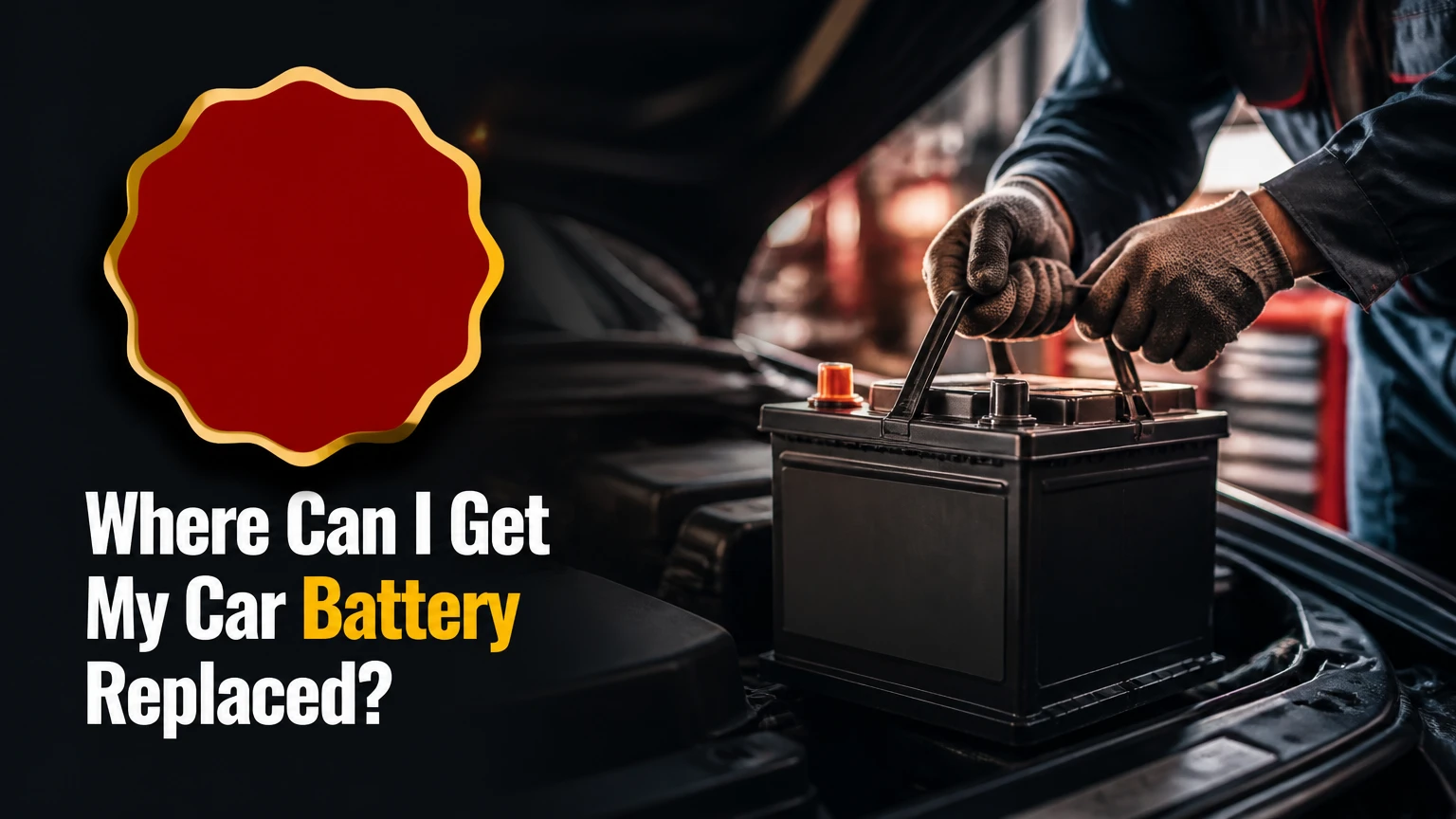
Drivers can get a car battery replaced at auto parts stores, big-box retailers, mobile roadside services, independent repair shops, or car dealerships. For standard vehicles, local auto parts stores such as AutoZone or O’Reilly Auto Parts offer the fastest, lowest-cost service because they provide free installation with the purchase of a new battery.
At a Glance
- Fastest & Best Value: Auto parts stores (AutoZone, Advance Auto Parts, O’Reilly) install standard batteries for free within 15–30 minutes.
- Lowest Part Price: Big-box warehouses (Walmart, Costco) offer the lowest battery purchase prices but rarely provide installation labor.
- Total Cost Range: Expect to pay between $100 and $450 total for parts and labor depending on battery type and vehicle tech requirements.
- Complex Installs: Vehicles requiring battery registration (BMW, Audi, Ford) or hidden battery locations require independent repair shops or dealerships.
- On-Demand Assistance: Roadside services like AAA Mobile Battery Service replace dead batteries directly at your home or stranded location.
How Much Does a Car Battery Replacement Cost?
Car battery replacement costs range between $100 and $450 on average for parts and labor combined. Standard flooded lead-acid batteries for common vehicles cost $100 to $200 with free installation at parts stores, while high-performance Absorbed Glass Mat (AGM) batteries cost $200 to $400, plus an optional $30 to $150 software registration fee for modern European and domestic vehicles.
| Provider Type | Battery Cost | Labor Cost | Total Cost Range | Primary Service Advantage |
| Auto Parts Stores | $100 – $280 | $0 (Free with purchase) | $100 – $280 | On-site free installation for accessible setups |
| Warehouse Clubs & Retailers | $80 – $220 | $0 – $20 (Carry-out / DIY) | $80 – $220 | Lowest baseline unit purchase price |
| Mobile Roadside Services | $120 – $280 | $25 – $60 (Trip / On-site fee) | $145 – $340 | Service delivered directly to a dead vehicle |
| Independent Auto Repair Shops | $120 – $250 | $30 – $100 | $150 – $350 | Full charging system diagnostic & labor handling |
| Car Dealerships | $180 – $350 | $70 – $150 | $250 – $500 | Factory OEM parts & specialized ECU calibration |
How Long Do Car Batteries Last Before Needing Replacement?
Car batteries last between 3 and 5 years under normal driving conditions. Climate, driving habits, and vehicle electrical demands dictate the actual lifespan, with extreme heat degrading internal plates faster than cold weather.
Batteries operating in warm southern climates average 3 years of service life due to accelerated liquid electrolyte evaporation and internal grid corrosion. Conversely, batteries in colder northern climates routinely reach 4 to 5 years because lower ambient temperatures slow down internal chemical degradation. Vehicles driven primarily on short trips under 10 minutes suffer shortened battery lifespans because the alternator lacks sufficient operating time to fully recharge the battery after starting the engine.
Should I Replace My Car Battery Myself or Hire a Professional?
Drivers should replace a car battery themselves if the battery sits in an easily accessible engine bay and requires no electronic computer registration. Professional installation is necessary if the battery resides under seats or inside wheel wells, or if the vehicle uses a battery management system that requires software diagnostic pairing.
DIY Replacement Suitability
- Simple Engine Bays: Clear top-side access under the hood with accessible 10mm terminals.
- Standard Electronics: Older vehicles (pre-2010) lacking complex battery management software.
- Tool Availability: Requires socket wrenches, wire terminal cleaning brushes, safety eyewear, and memory saver devices.
Professional Installation Suitability
- Complex Locations: Batteries hidden inside trunk wells (BMW), beneath passenger seats (Jep Grand Cherokee), or inside inner fender liners (Chrysler 200).
- Advanced Powertrains: Vehicles equipped with automatic start-stop engines, micro-hybrid systems, or high-voltage electric drive units.
- Severe Terminal Damage: Heavy white or blue copper-sulfate corrosion requiring terminal cable replacement or custom bracket extraction.
How Long Does a Car Battery Replacement Take at Different Providers?
Car battery replacement takes between 15 minutes and 2 hours depending on the service provider, vehicle accessibility, and diagnostic requirements.
- Auto Parts Stores (15–30 Minutes): Retailers like O’Reilly or AutoZone execute direct, drop-in replacements in the parking lot for accessible under-hood setups.
- Mobile Roadside Service (30–60 Minutes): Technicians arrive at your vehicle location, run initial battery state-of-health tests, swap the battery, and complete system testing on-site.
- Independent Auto Repair Shops (45–90 Minutes): Independent facilities perform comprehensive alternator output tests, starter current draw tests, physical replacement, and software updates.
- Car Dealership Service Centers (1–2 Hours): Dealership service departments perform multi-point vehicle checks, factory computer registration, and system clearing alongside the battery installation.
Why Do Parts Stores Refuse Free Installation on Certain Vehicles?
Auto parts stores decline free battery installation when access requires removing structural engine components, when terminals are severely corroded, or when the installation poses structural liability risks to retail personnel.
Retail counter staff at parts stores perform basic courtesy installations using basic hand tools. Stores explicitly decline free installation services under the following specific conditions:
- Hidden Battery Placements: Locations inside wheel wells, underneath passenger seats, or below structural engine components like strut tower braces or air intake assemblies.
- Corrosion & Rust Hazards: Cables or hold-down brackets rusted beyond safe manual removal without risking cable breakage.
- Proprietary Software Needs: Vehicles requiring computer registration that retail hand-held scan tools cannot perform.
What Do Battery Group Sizes and Cold Cranking Amps (CCA) Mean?
Battery Group Size defines the physical dimensions, post configuration, and terminal placement of the unit, while Cold Cranking Amps (CCA) measures the electrical current output capacity at 0°F (-18°C).
[ Group Size: Physical Fit & Terminals ]   --> Must match car specification (e.g., Group 35, 24, 48)
[ Cold Cranking Amps: Starting Power ]     --> Amps delivered at 0°F for 30 seconds without dropping below 7.2V
[ Reserve Capacity: Backup Power ]         --> Minutes battery runs essential electronics if alternator fails
Group Size codes (such as Group 35, Group 24, or Group 48/H6) ensure the physical battery fits securely inside the vehicle’s tray without contacting structural metal hood parts. Cold Cranking Amps (CCA) indicates the amperage the battery delivers for 30 seconds at 0°F while maintaining a voltage above 7.2 volts. Installing a replacement battery with a CCA rating below your vehicle’s factory specification causes slow engine cranking, starter strain, and premature battery failure in winter temperatures.
What Is an AGM Battery and Can You Downgrade to Standard?
An Absorbed Glass Mat (AGM) battery uses fiberglass mesh separators to absorb liquid electrolyte, making it spill-proof, resistant to vibration, and capable of cycling power faster than conventional flooded batteries. Vehicles originally equipped with an AGM battery cannot be downgraded to a standard flooded battery.
Vehicles featuring automatic start-stop engines, regenerative braking, or heavy electrical accessories require AGM batteries to sustain rapid cycling demands. Installing a cheaper flooded lead-acid battery into an AGM-designed vehicle results in internal battery overheating, rapid capacity loss, and complete failure within 3 to 6 months because the vehicle’s high-output alternator charging profile destroys standard battery plates.
What Is Battery Registration and Why Is an ECU Reset Required?
Battery registration is an electronic process that updates a vehicle’s Engine Control Unit (ECU) with the age, capacity, and internal resistance of a newly installed battery. Vehicles from manufacturers such as BMW, Audi, Mercedes-Benz, Volkswagen, and modern Ford models require this software procedure using a diagnostic OBD-II scan tool.
As a car battery ages, the vehicle’s intelligent battery management system steadily increases charging output from the alternator to compensate for rising internal resistance. If a new battery is installed without resetting this tracking software, the ECU continues driving high-voltage charging profiles designed for an old battery. This continuous overcharging overheats the new battery, boils the electrolyte, triggers warning lights on the dashboard, and shortens the new battery’s service life.
Old Battery Installed --> ECU increases alternator output over time to compensate for age
        │
        ▼
New Battery Installed WITHOUT Registration
        │
        ▼
ECU applies HIGH charge voltage to NEW battery --> Overheating & premature battery failure
        │
        ▼
Solution: Diagnostic Scan Tool resets ECU tracking --> Alternator resets to optimal charge profile
What Happens to Car Computer Settings When the Battery Is Disconnected?
Disconnecting a car’s 12V battery resets stored electronic memory modules, which clears drive-cycle diagnostic monitors, erases clock and radio station presets, and resets dynamic engine/transmission adaptive learning algorithms.
Modern vehicles utilize continuous low-voltage power to maintain volatile RAM memory across multiple onboard control units. Removing battery terminal leads wipes stored parameters:
- Emissions Readiness Monitors: Resetting monitors forces the driver to complete 50–100 miles of varied driving before the vehicle can pass state inspection testing.
- Power Window & Sunroof Limits: Anti-pinch auto-up feature limits lose calibration and require manual reset sequencing.
- Idle Air Control & Shift Adaptation: Throttle body position parameters reset, resulting in rough engine idle or firm transmission shifts during the initial 20 miles of operation.
Technicians avoid these resets by connecting an auxiliary memory saver power supply to the OBD-II port before removing battery terminal cables.
How Do 12V Auxiliary Batteries Work in EVs and Hybrids?
Electric vehicles (EVs) and hybrid automobiles use a small 12-volt auxiliary battery to power low-voltage systems, onboard computers, door locks, exterior lighting, and safety contactors that engage the main high-voltage traction battery pack.
                       ┌──> Low-Voltage Systems (Lights, Dash, Door Locks)
                       │
[ 12V Auxiliary Battery ] ──> Closes High-Voltage Safety Contactors
                       │
                       └──> Activates High-Voltage Traction Pack (500V+) ──> Vehicle Drives
When the 12V auxiliary battery dies in an EV or hybrid, the vehicle cannot drive or power up, even if the primary high-voltage traction battery pack remains at 100% charge. The primary high-voltage battery (costing $5,000 to $20,000 to replace) disconnects via mechanical contactors whenever the vehicle turns off; the 12V battery provides the power needed to close those contactors. Replacing a 12V EV auxiliary battery follows standard service costs ($200 to $350) and requires conventional service techniques.
How Do I Tell If the Battery Is Dead or If the Alternator Failed?
A vehicle that starts via jumper cables but shuts down immediately after cable removal has a failed alternator, whereas a vehicle that runs continuously after a jump-start but refuses to restart once turned off has a depleted or failing battery.
Jump-Start Test Procedure:
Connect Jumper Cables ──> Start Engine ──> Disconnect Cables
                                              │
                   ┌──────────────────────────┴──────────────────────────┐
                   ▼                                                     ▼
      Engine Dies Immediately                             Engine Continues Running
                   │                                                     │
                   ▼                                                     ▼
     FAINT/FAILED ALTERNATOR                              FAILED/DISCHARGED BATTERY
 (Alternator cannot produce operational power)      (Alternator works; battery won't hold charge)
Diagnostic Signs Breakdown
- Battery Failure Signs: Engine cranks slowly or makes a clicking sound when turning the key; headlights operate dimly before starting but brighten once the engine runs; dashboard electrical accessories operate normally when jump-started.
- Alternator Failure Signs: Battery warning light illuminates on the dashboard while driving; interior and exterior lights dim steadily while the vehicle moves; engine stalls while idling; whining or squealing noises originate from the engine accessory belt area.
Can Leaving a Key Fob Near a Car Drain the 12V Battery?
Yes, leaving a proximity key fob within 10 to 15 feet of a modern vehicle drains the 12V battery by maintaining constant wireless communication that prevents onboard electronic modules from entering low-power sleep mode.
Vehicles with push-button start and keyless entry system receivers actively ping the matching key fob frequency. When the key fob stays within range (such as hanging on a garage wall adjacent to the vehicle), the vehicle’s Body Control Module (BCM) remains continuously active. This ongoing communication creates a persistent parasitic draw of 100 to 300 milliamperes per hour—significantly higher than the normal sleep threshold of 50 milliamperes—draining a fully charged 12V battery within 3 to 5 days.
What Is a Battery Core Charge and How Do You Get It Refunded?
A battery core charge is a mandatory $15 to $30 deposit added to the retail price of a new car battery to encourage environmental recycling of the toxic lead and acid inside old units.
Retailers collect the core charge fee at the time of purchase. To receive a full refund of the deposit, customers return their old, used car battery to the retailer along with the original sales receipt within the retailer’s specified return window (typically 30 to 90 days). Retailers accept spent batteries regardless of brand or condition because over 99% of lead-acid automotive battery materials are reclaimed and recycled into new batteries.
The Bottom Line
For standard vehicles with easily accessible under-hood setups, auto parts stores like AutoZone or O’Reilly provide the fastest service by combining low part prices ($100–$280) with free installation. If your vehicle features an automatic start-stop engine, requires an AGM battery, utilizes complex under-seat or wheel-well placement, or requires software registration (common in European and modern domestic models), visit an independent repair shop or dealership to ensure proper installation and prevent damage to your vehicle’s charging system.


