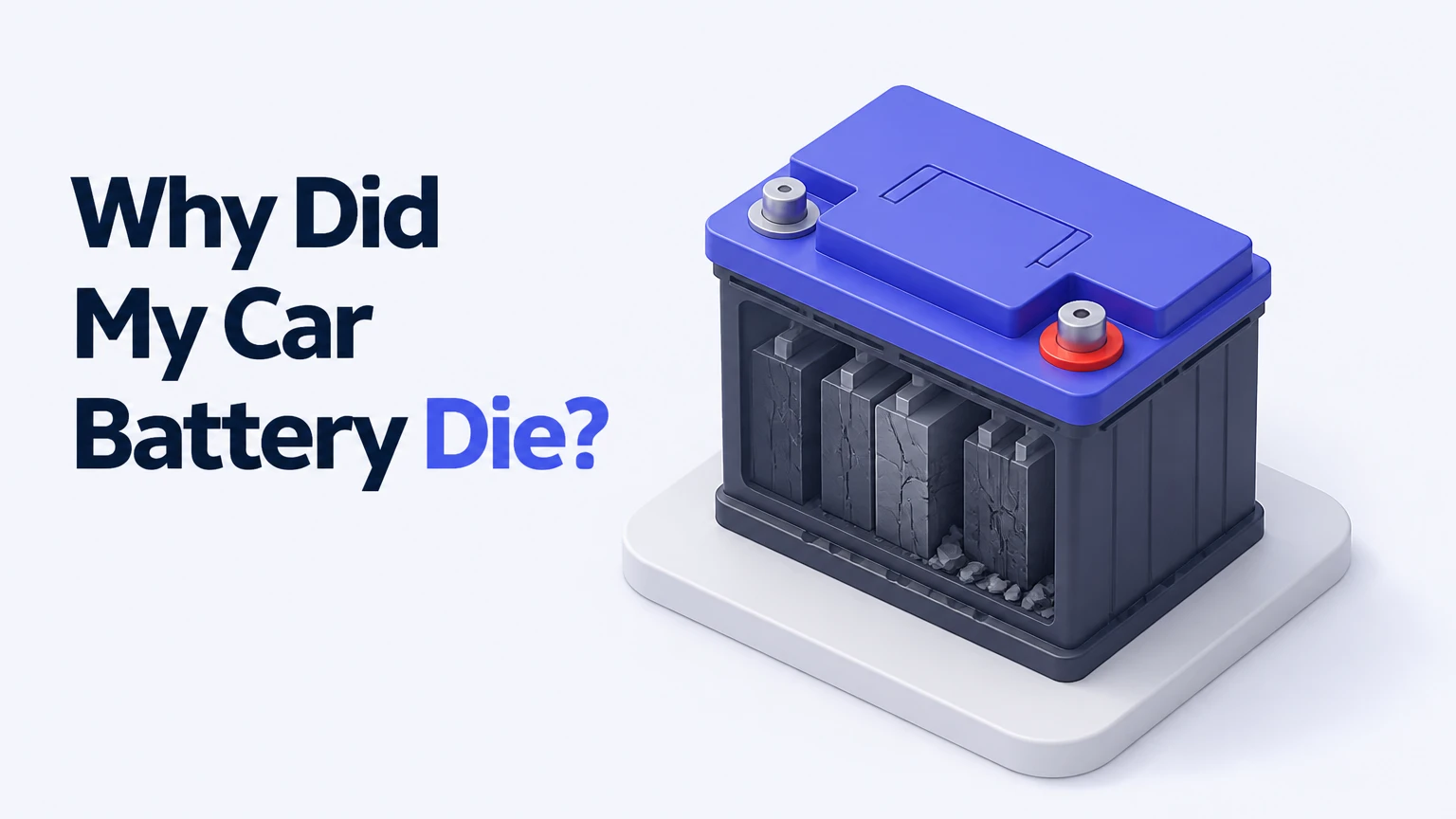
A car battery dies when its stored chemical energy depletes, causing terminal voltage to drop below 12.0 volts, which prevents the starter motor from drawing the 150 to 300 amps required to crank the engine. Primary causes include parasitic electrical drain, short driving trips, internal cell degradation from extreme heat, alternator failure, or age.
Key Facts at a Glance
- A resting 12-volt lead-acid battery is 100% charged at 12.6V to 12.8V and 0% usable at 12.0V or lower.
- Starting an engine consumes massive amperage that requires at least 15 to 20 minutes of continuous driving to replenish.
- Heat damages internal battery plates faster than winter cold by accelerating corrosion and evaporating liquid electrolyte.
- Modern vehicles with Battery Management Systems (BMS) require battery registration during replacement to prevent overcharging.
- Idling a vehicle for 30 minutes will not recharge a completely flat battery and risks damaging the alternator.
What Voltage Level Indicates a Dead Car Battery?
A standard 12-volt automotive lead-acid battery is considered dead when its open-circuit rest voltage falls to 12.0 volts or lower. At this threshold, the internal state of charge drops to 0%, leaving insufficient electrical potential to engage the starter solenoid and turn the engine crankshaft.
       12-Volt Automotive Battery State of Charge
┌─────────────────────────────────────────────────────────┐
│ 12.6V - 12.8V  [100% Fully Charged]                     │
├─────────────────────────────────────────────────────────┤
│ 12.4V          [ 75% Charged]                           │
├─────────────────────────────────────────────────────────┤
│ 12.2V          [ 50% Struggling / Low Reserve]          │
├─────────────────────────────────────────────────────────┤
│ 12.0V or lower [  0% Dead / Solenoid Click Only]        │
└─────────────────────────────────────────────────────────┘
Automotive batteries consist of six 2.1-volt cells connected in series inside a polypropylene case. The functional range between fully charged and completely discharged is less than one single volt:
- 12.6V to 12.8V: Fully charged with optimal chemical capacity.
- 12.4V: 75% charged; acceptable operational state.
- 12.2V: 50% charged; the engine may crank slowly in cold conditions.
- 12.0V or lower: Discharged state. The battery will emit a rapid clicking sound or produce total silence upon turning the key.
- 13.5V to 14.5V: Active charging voltage output generated by a healthy alternator while the engine runs.
Testing voltage immediately after driving yields an artificially inflated reading due to surface charge. To obtain an accurate static measurement, let the vehicle sit turned off for at least two hours, or turn on the high-beam headlights for 30 seconds to dissipate the surface charge before measuring with a digital multimeter across the terminals.
What Are the Early Warning Signs of a Dying Car Battery?
The most common early warning sign of a dying car battery is an engine that cranks sluggishly for several seconds before starting. Additional indicators include dimming headlights during engine starting, slow power-window operation, illuminated warning lights, and clicking noises from the engine bay.
                  Symptom Diagnostic Guide
 ┌───────────────────────────┬───────────────────────────────┐
 │ Symptom                   │ Primary Cause                 │
 ├───────────────────────────┼───────────────────────────────┤
 │ Slow/Sluggish Crank       │ Low Cold Cranking Amps (CCA)  │
 │ Rapid Clicking Sound      │ Solenoid lacks holding power  │
 │ Dim Lights at Ignition    │ Voltage sag under load        │
 │ Swollen Battery Case      │ Overcharging or frozen cells  │
 │ Rotten Egg Odor           │ Hydrogen sulfide off-gassing  │
 └───────────────────────────┴───────────────────────────────┘
A healthy battery turns the engine over crisply within one to two seconds. When internal lead plates degrade or sulfation builds up, internal resistance increases, reducing the delivered Cold Cranking Amps (CCA). This manifests as a rhythmic, slow turn of the flywheel.
Physical signs also provide immediate diagnostic value. A rotten egg smell surrounding the battery indicates overcharging or internal shorting, which forces the sulfuric acid electrolyte to boil and vent hydrogen sulfide gas. Corrosion—visible as a white, blue, or greenish powder around the positive and negative posts—impedes current transfer, creating severe voltage drop even if the internal cell chemistry remains healthy.
Why Does Driving Short Distances Drain a Car Battery?
Driving short distances drains a car battery because the ignition process consumes more electrical energy than the alternator can restore during a brief commute. Frequent short trips leave the battery in a chronic state of undercharge, triggering acid stratification and terminal sulfation.
Engaging the starter motor requires a surge of 150 to 300 amperes for two to three seconds. This massive power draw depletes a measurable percentage of the battery’s reserve capacity. Under normal conditions, an alternator takes 15 to 20 minutes of continuous highway driving at 1,500 RPM or higher to replenish that single start.
[Starter Activation] ──> Draws 150-300A for 2-3 Sec ──> Requires 15-20 Min Driving
                                                                  │
                                                        Short 5-Min Trips
                                                                  │
                                                                  ▼
[Battery Undercharged] ──> Acid Stratification ──> Lead Sulfation ──> Premature Failure
When a vehicle is driven only on short 5-minute errands, the electrical system operates at a net deficit. This undercharged state causes acid stratification: the dense sulfuric acid in the electrolyte separates from the water and settles at the bottom of the cell casing. The concentrated acid corrodes the lower plate grid while the upper dilute mixture starves the upper plates, permanently reducing the total amp-hour rating of the unit.
How Does Parasitic Draw Drain a Car Battery When Turned Off?
Parasitic draw drains a car battery when keyless entry modules, engine control units (ECU), aftermarket alarms, or shorted relays remain energized after the engine shuts down. This continuous current consumption pulls energy from the battery until the cell voltage collapses.
Every modern vehicle maintains an acceptable background electrical current between 20 and 50 milliamperes (mA) to preserve radio settings, security receivers, and clock memories. If a module fails to enter its low-power “sleep mode” within 30 minutes of ignition shutoff, that draw can exceed 500 mA (0.5 amps).
                      Parasitic Draw Comparison
┌─────────────────────────────────────────────────────────────────────────┐
│ Healthy Background Draw: 20mA - 50mA (Vehicle safe for 3-4 weeks)       │
├─────────────────────────────────────────────────────────────────────────┤
│ Faulty Module Draw: 500mA+ (Battery fully discharged in 48-72 hours)    │
└─────────────────────────────────────────────────────────────────────────┘
A continuous draw of 0.5 amps extracts 12 amp-hours of capacity from the battery every 24 hours. A standard automotive battery with a 60 amp-hour capacity will drop below its minimum starting voltage within 48 to 72 hours under this load. Common triggers include stuck glovebox switches, failing Bluetooth telematics units, improperly wired dashcams, and proximity key sensors continuously triggered by keys stored too close to the parked vehicle.
Does Extreme Heat or Cold Ruin a Car Battery Faster?
Extreme heat ruins a car battery faster than extreme cold by accelerating chemical corrosion and evaporating internal electrolyte liquid. While winter cold exposes a battery’s failure by slowing its reaction speed, summer heat causes the underlying structural destruction.
                        Temperature Impact Breakdown
 ┌───────────────────────────┬───────────────────────────────────────────────┐
 │ Environmental Condition   │ Physical & Chemical Effect                    │
 ├───────────────────────────┼───────────────────────────────────────────────┤
 │ Extreme Heat (>140°F / 60°C) │ Accelerates grid corrosion & evaporates liquid │
 │ Extreme Cold (<32°F / 0°C)  │ Thickens engine oil & slows chemical reaction │
 └───────────────────────────┴───────────────────────────────────────────────┘
Engine compartment temperatures frequently exceed 60°C (140°F) during warm weather. For every 10°C (18°F) increase in operating temperature, the rate of internal chemical activity doubles. This accelerated rate speeds up grid corrosion and converts water within the electrolyte solution into hydrogen and oxygen gases, which vent into the atmosphere. The internal lead plates dry out, leading to internal shorts and permanent capacity loss.
Cold ambient temperatures below freezing (0°C / 32°F) decrease a battery’s available cranking power by roughly 20% to 50% while simultaneously increasing the mechanical torque required to pump cold, thickened engine oil. Winter does not typically create the initial damage; it acts as the stress test that reveals the structural destruction caused by the previous summer’s heat.
Why Do Modern Cars Require Battery Registration or Resetting?
Modern cars require battery registration to update the engine control unit and Battery Management System (BMS) with the fresh capacity and internal resistance metrics of the replacement battery. Without registration, the charging system overcharges the new battery based on the parameters of the aged battery.
Microprocessor-controlled alternators adjust charging rates dynamically based on battery age, operating temperature, and historical usage data. As a battery ages and its internal resistance rises, the BMS increases the alternator output voltage and amperage to force current into the degrading cells.
New Battery Installed ──> Skip Registration ──> BMS Assumes Old Battery
                                                           │
                                                           ▼
New Battery Destroyed in 12 Months <── Overcharging Voltage Applied
Installing a new battery without performing a computer diagnostics reset leaves the BMS operating on its old software profile. The system subjects the new battery to elevated charging voltages intended for an old unit, generating excessive internal heat, boiling the fresh electrolyte, and shortening the lifetime of the new battery from five years down to less than twelve months.
Why Is a Car Battery Still Dead After Idling for 30 Minutes?
A car battery remains dead after idling for 30 minutes because standard alternators produce low current output at idle speed, which is insufficient to deep-charge a depleted battery. Furthermore, automotive alternators are designed to maintain charge, not to revive a fully discharged battery.
At idle (typically 600 to 800 engine RPM), an alternator generates less than one-third of its maximum rated amperage. A significant portion of this available electrical current is immediately consumed by the car’s fuel pump, ignition coils, daytime running lights, and interior climate control systems, leaving negligible surplus power to push back into a dead battery.
                    Alternator Output vs. Charging Needs
┌───────────────────────────────────────────────────────────────────────────┐
│ Idle Output (600 RPM): ~30% Capacity (Required for engine operations)     │
├───────────────────────────────────────────────────────────────────────────┤
│ Highway Output (2000+ RPM): ~90% Capacity (Provides meaningful charging)  │
└───────────────────────────────────────────────────────────────────────────┘
Recharging a deeply discharged battery from a 0% state of charge requires continuous voltage application over 8 to 12 hours using an external smart charger. Forcing a vehicle alternator to act as a bench charger overloads its internal silicon rectifier diodes and stator windings, creating extreme thermal stress that frequently leads to premature alternator failure.
Why Does a Car Battery Fail Even If It Tests Good at an Auto Parts Store?
A car battery can test good at an auto parts store because simple handheld testers often measure only open-circuit voltage or surface conductance without subjecting the unit to a true mechanical load test. A battery can hold 12.6 volts resting while lacking the chemical surface area to deliver heavy starter current.
Handheld digital conductance testers send a minor high-frequency AC signal through the terminals to estimate internal resistance. If the battery was recently jumped or driven, a surface charge resting on the top of the internal plates can mask underlying internal defects, leading to an inaccurate “Good” rating on the handheld screen.
                       Diagnostic Method Precision
 ┌───────────────────────────┬───────────────────────────────────────────────┐
 │ Test Type                 │ Diagnostic Capability                         │
 ├───────────────────────────┼───────────────────────────────────────────────┤
 │ Open-Circuit Voltage Test │ Detects flat state, misses plate degradation   │
 │ Conductance Digital Test  │ Measures resistance, susceptible to surface   │
 │ Carbon Pile Load Test     │ Applies actual 1/2 CCA load; 100% accurate    │
 └───────────────────────────┴───────────────────────────────────────────────┘
True structural health can only be validated using a heavy-duty carbon pile load tester. This apparatus draws a real current load equal to half the battery’s rated Cold Cranking Amps for 15 full seconds. If the voltage drops below 9.6 volts at 21°C (70°F) during this test, the internal lead plates are heavily sulfated or damaged, confirming the unit is defective regardless of what a basic voltage reading shows.
Can a Bad Car Battery Damage an Alternator?
Yes, a bad car battery can damage an alternator by forcing the alternator to run continuously at maximum capacity, which causes internal thermal breakdown of its diodes and windings. Conversely, a faulty alternator can also destroy a healthy battery.
When a battery cell develops an internal short circuit or structural sulfation, it acts as a constant electrical sink that cannot hold a charge. The voltage regulator senses low system voltage and demands maximum current output from the alternator. Running an alternator at 100% duty cycle heats the internal stator components and degrades the heat sink paste on the diode bridge, leading to total electrical failure.
                        The Destructive Feedback Loop
   [Defective Battery]                                   [Failing Alternator]
  Constant low voltage                                  Leaking AC Ripple Voltage
          │                                                         │
          ▼                                                         ▼
Overworks Alternator ──> Diodes Burn Out ──> Overcharges Battery ──> Battery Boils
Conversely, when an alternator’s internal diode bridge fails, it can leak Alternating Current (AC) ripple into the vehicle’s Direct Current (DC) electrical bus. AC voltage creates intense internal heat inside the battery casing, causing grid expansion, rapid fluid loss, and permanent plate destruction.
How Long Should a Car Battery Last Before Replacement?
The average lifespan of a standard flooded lead-acid car battery is 3 to 5 years. Operating conditions like geographical climate, trip frequency, and system electrical demands determine whether replacement is needed at the 3-year or 5-year mark.
                 Expected Battery Lifespan by Region
┌───────────────────────────────────────────────────────────────────────────┐
│ Hot Climates (Southern US, Middle East): 2 to 3 Years                      │
├─────────────────────────────────────────────────────────────────────────┤
│ Moderate Climates (Pacific NW, Central Europe): 4 to 6 Years             │
└───────────────────────────────────────────────────────────────────────────┘
- Hot Climates: High ambient temperatures accelerate chemical degradation, reducing service life to 2 to 3 years.
- Moderate Climates: Moderate weather conditions paired with regular highway driving allow units to last 4 to 6 years.
- Absorbent Glass Mat (AGM) Batteries: Advanced AGM units installed in start-stop vehicles feature glass mat separators that offer increased cycle life, typically lasting 4 to 7 years.
Proactive replacement at the 4-year mark is a recommended practice to avoid unexpected roadside breakdown, regardless of apparent starter performance.
What Is the Difference Between a Flat Battery and a Bad Battery?
A flat battery is temporarily discharged but structurally sound, whereas a bad battery has suffered permanent internal mechanical or chemical damage and can no longer hold or take a charge.
                     Flat vs. Bad Battery Comparison
 ┌───────────────────────────┬───────────────────────────────┬───────────────┐
 │ Parameter                 │ Flat Battery                  │ Bad Battery   │
 ├───────────────────────────┼───────────────────────────────┼───────────────┤
 │ Open-Circuit Voltage      │ Below 12.0V                   │ Below 10.5V   │
 │ Cause of Condition        │ Headlights left on, sitting   │ Sulfation     │
 │ Rechargability           │ Fully recoverable via charger │ Fails load    │
 │ Permanent Structural Harm │ None                          │ Broken grid   │
 └───────────────────────────┴───────────────────────────────┴───────────────┘
A flat battery occurs when external conditions—such as an illuminated interior dome light—drain the stored chemical energy. The internal lead grid structural integrity remains intact. Applying a slow bench charger restores the unit to 100% capacity without degrading its overall service life.
A bad battery suffers from internal mechanical failures, such as a shorted cell caused by shed lead paste settling at the bottom of the casing, a broken internal interconnect bar, or heavy lead sulfation across the plate matrix. Bad batteries cannot be recovered using standard home chargers and must be recycled and replaced.
Why Does a New Car Battery Keep Dying Repeatedly?
A new car battery keeps dying repeatedly due to an unaddressed high parasitic draw, a failing alternator voltage regulator, improper battery registration, or bad engine ground cables. The underlying vehicle issue quickly discharges fresh replacements.
                              Diagnostic Tree
                  New Battery Dies Repeatedly
                               │
         ┌─────────────────────┴─────────────────────┐
         ▼                                           ▼
[Engine Off Draw > 50mA?]                    [Engine Running Voltage?]
   ├─ YES ──> Unsnapped Module/Parasitic Draw   ├─ Below 13.5V ──> Weak Alternator
   └─ NO  ──> Check System Grounds & Charging   └─ Above 14.8V ──> Bad Voltage Regulator
- Parasitic Electrical Drain: A control module that fails to shut down draws power continuously, draining a brand-new battery overnight.
- Ground Wire Resistance: Corroded chassis ground cables create electrical resistance, preventing the alternator current from entering the battery terminals while driving.
- Defective Voltage Regulator: An improperly functioning regulator that supplies less than 13.5 volts will starve the new battery, while voltage exceeding 14.8 volts will overcharge and destroy its internal plates.
How Do You Safely Test for Parasitic Draw with a Multimeter?
To safely test for parasitic draw, connect a digital multimeter configured to measure Direct Current Amperes (DC Amps) in series between the negative battery terminal post and the disconnected negative battery cable connector.
                        Parasitic Draw Test Setup
┌──────────────────────────────────────────────────────────────────────────┐
│ [ Negative Terminal Post ] ─── ( Red Probe )                             │
│                                  Digital Multimeter Set to 10A DC        │
│ [ Detached Cable Ring ] ────── ( Black Probe )                           │
└──────────────────────────────────────────────────────────────────────────┐
Steps to Perform Parasitic Draw Test
- Turn off all accessories, close all doors, latch the hood lock mechanism manually, and remove the key fob to a distance of at least 25 feet away from the vehicle.
- Wait 30 to 45 minutes to allow all on-board computers and Body Control Modules (BCM) to complete their shutdown sequences and enter low-power sleep mode.
- Switch the multimeter lead positioning to the high-amp port (typically 10A fused) and select the DC Amps reading mode on the dial.
- Disconnect the negative battery cable terminal clamping bolt.
- Touch one multimeter probe to the negative battery terminal post and the second probe to the detached negative cable ring terminal, establishing an in-series circuit path.
- Read the display amperage value. A reading between 0.02A and 0.05A (20mA to 50mA) indicates normal operational standby draw.
- If the reading exceeds 0.05A (50mA), systematically pull individual fuses from the interior and engine bay fuse boxes one at a time while observing the meter screen until the amp draw drops into the normal range. The fuse that causes the drop isolates the specific component circuit at fault.
Does Jump-Starting a Completely Dead Battery Damage Vehicle Electronics?
Yes, jump-starting a completely dead battery can damage sensitive vehicle electronics by exposing control modules to voltage spikes and reverse polarity events. Modern vehicles feature dozens of delicate electronic control units (ECUs) that can burn out if jumped incorrectly.
When a donor vehicle connects its active charging system to a dead vehicle, connecting or disconnecting the last jumper clamp breaks an inductive loop, producing a high-voltage inductive kick known as a voltage surge. This transient spike can exceed 50 volts for several milliseconds, which is enough to damage microprocessors inside transmission control modules, infotainment head units, and instrument clusters.
                     Safe Jump-Starting Sequence
┌──────────────────────────────────────────────────────────────────────────┐
│ Step 1: Connect POSITIVE (+) clamp to DEAD battery positive post.       │
│ Step 2: Connect POSITIVE (+) clamp to DONOR battery positive post.      │
│ Step 3: Connect NEGATIVE (-) clamp to DONOR battery negative post.     │
│ Step 4: Connect NEGATIVE (-) clamp to DEAD vehicle UNPAINTED CHASSIS GROUND│
└──────────────────────────────────────────────────────────────────────────┘
Using a dedicated portable jump pack equipped with internal surge suppression or using a dedicated smart battery charger is a safer approach than vehicle-to-vehicle jump-starting. If jumper cables must be used, turn on the dead car’s rear window defroster blower fan immediately after the engine catches and before removing the cable clamps; the heavy resistive heating element acts as an electrical buffer, absorbing excess voltage spikes during cable removal.
The Bottom Line
A car battery dies when its terminal voltage drops below 12.0 volts, most commonly caused by parasitic draw, chronic undercharging from short driving trips, internal heat degradation, or natural chemical degradation over its 3 to 5 year service life.
Modern vehicles add diagnostic complexity through battery registration requirements and low-output charging profiles at idle speed, meaning simple jump-starts and short idling periods are rarely enough to fix a discharged unit.
Accurately diagnosing a recurring battery failure requires checking static rest voltage, measuring active parasitic draw with a multimeter, and confirming ground connection integrity before replacing electrical system components.


