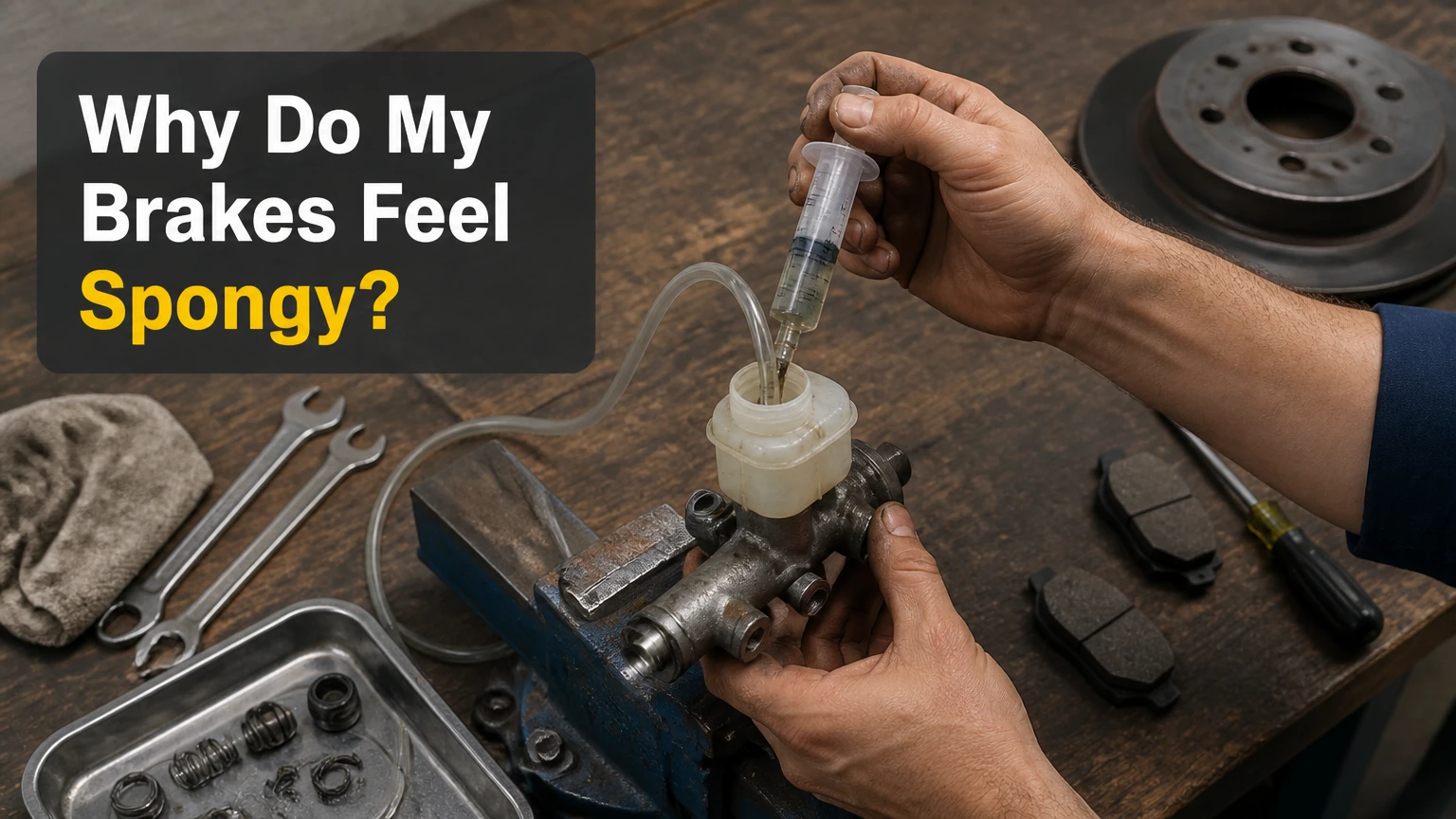
Spongy brakes are caused by air trapped in the brake fluid, degraded moisture-laden fluid, expanding rubber brake lines, or an internal master cylinder bypass. Because brake fluid is incompressible, any gas bubbles or mechanical flex inside the hydraulic system absorb your foot pressure, preventing full force from reaching the brake calipers.
At a Glance: Essential Brake Metrics
- Healthy Pedal Travel: A firm pedal engages after 1.5 to 2 inches (38 to 50 mm) of initial foot travel.
- Failure Threshold: Pedal travel exceeding 3 inches (75 mm) or sinking past 50% of the distance to the floor indicates a compromised hydraulic system.
- Fluid Degradation: Fresh DOT 4 brake fluid boils at 230°C (446°F). Water contamination of just 3.7% lowers the boiling point to 155°C (311°F), causing thermal vapor lock.
- Operating Pressure: Automobile hydraulic brake systems require internal working pressures between 800 and 1,200 PSI during normal stopping.
- Primary Cause: Entrapped air compresses under system pressure, whereas pure liquid brake fluid does not compress.
What Does a Normal Brake Pedal Feel Like Versus a Spongy Pedal?
A healthy brake pedal provides immediate, firm resistance after roughly 1.5 to 2 inches (38 to 50 mm) of travel, staying solid even under heavy foot pressure. A spongy brake pedal feels mushy, springy, or soft, yielding continuously as you press down and moving past 50% of the distance to the floorboard before generating stopping power.
+------------------------+------------------------------------+------------------------------------+
| Metric / Feature       | Normal Brake System                | Spongy Brake System                |
+------------------------+------------------------------------+------------------------------------+
| Initial Engagement     | 1.5 to 2 inches (38 to 50 mm)      | Exceeds 3 inches (75 mm)           |
| Resistance Feeling     | Solid wall, minimal give           | Mushy, springy, or elastic         |
| Sustained Pressure     | Holds position indefinitely        | Creeps slowly toward floorboards   |
| System Hydraulic State | Pure liquid, 0% gas compression    | Entrapped air or boiling vapor     |
| Mechanical Rigidity    | Rigid metal lines & stiff calipers | Flexing hoses or twisted calipers  |
+------------------------+------------------------------------+------------------------------------+
In a fully functional vehicle, pressing the brake pedal pushes a rigid rod into the master cylinder, displacing liquid fluid directly to the caliper pistons. Because liquids are naturally non-compressible, energy transfers instantly to the brake pads. When sponginess occurs, the pedal effort goes into squeezing gas bubbles or flexing weak components instead of squeezing the brake rotor.
How Does Trapped Air Cause Brake Pedal Sponginess?
Trapped air causes brake pedal sponginess because gases are highly compressible, whereas liquid brake fluid cannot be compressed. When you press the brake pedal, hydraulic force compresses the air bubbles into a smaller volume first, consuming your pedal stroke before any pressure transfers to the brake pads.
Standard braking systems rely on Pascal’s law, which states that pressure applied to an enclosed fluid is transmitted undiminished in all directions. During emergency stopping, internal hydraulic pressures reach 800 to 1,200 PSI.
When air enters the brake lines through a small leak, low fluid level, or improper bleeding:
- Your foot depresses the brake pedal to build hydraulic force.
- The 800+ PSI pressure squeezes the trapped gas pockets down to a fraction of their original size.
- The displacement of the master cylinder piston is absorbed entirely by gas compression.
- The brake caliper pistons fail to extend with adequate force, leaving the pedal feeling soft and mushy.
Why Does Old Brake Fluid Make the Brake Pedal Soft?
Old brake fluid makes the brake pedal soft because glycol-based brake fluid is hygroscopic, meaning it constantly absorbs water moisture from surrounding ambient air. As water accumulates in the system, it significantly lowers the fluid’s boiling point, allowing heat from braking friction to turn liquid fluid into compressible steam.
Fresh, uncontaminated DOT 4 brake fluid boasts a dry boiling point of approximately 230°C (446°F). Over 2 to 3 years of normal driving, moisture naturally permeates rubber brake hoses and reservoir seals. Once moisture contamination reaches just 3.7%, the wet boiling point plummets to 155°C (311°F).
Dry DOT 4 Fluid (0% Water)  ==> Boils at 230°C (446°F) ==> 100% Incompressible Liquid
Wet DOT 4 Fluid (3.7% Water) ==> Boils at 155°C (311°F) ==> Steam Bubbles Under Heat (Spongy Pedal)
During heavy mountain driving, towing, or repeated sudden stops, heat from the brake pads transfers directly through the caliper pistons into the brake fluid. If that fluid contains absorbed water, the water reaches its boiling point and turns into steam gas pockets. This condition, known as thermal vapor lock, creates instant pedal sponginess that worsens as the brakes get hotter.
Can Failing Rubber Brake Hoses Cause Pedal Sponginess Without Leaking?
Failing rubber brake hoses cause pedal sponginess without leaking when their internal fabric reinforcement breaks down, allowing the flexible outer rubber wall to expand outward under pressure. This expansion acts like a swelling balloon, taking up hydraulic fluid volume that should be pushing the caliper pistons.
Flexible rubber brake lines sit at each wheel to allow suspension movement and steering angles. Over time, heat cycles and atmospheric ozone weaken the inner synthetic layers.
- Internal Wall Rupture: The inner liner cracks while the outer rubber casing remains intact, meaning no fluid escapes externally.
- Volumetric Expansion: Under 1,000 PSI of braking force, the hose bulges outward by several millimeters.
- Loss of Hydraulic Efficiency: The extra fluid volume needed to fill the ballooning hose causes the brake pedal to sink lower and feel elastic underfoot.
Replacing aging rubber lines with braided stainless steel brake hoses eliminates volumetric expansion, providing a firmer pedal feel.
How Do You Test if a Master Cylinder Is Failing Internally?
You test for an internal master cylinder failure by holding steady, firm pressure on the brake pedal with the engine running while sitting stationary. If the pedal slowly creeps all the way to the floor without any fluid leaking underneath the car, the internal rubber seals inside the master cylinder are worn out and bypassing fluid.
The master cylinder uses internal rubber piston cups to seal high-pressure fluid chambers. When these internal cups tear, crack, or wear down:
- High pressure forced by your foot bypasses the rubber seal inside the cylinder bore.
- Fluid flows backward into the low-pressure reservoir instead of heading to the wheels.
- No fluid drips outside the car, making visual leak inspections deceivingly clean.
- Bleeding the brake lines will not restore pedal firmness because the master cylinder cannot hold static pressure.
If your pedal sinks steadily at red lights, the master cylinder must be replaced entirely.
Why Are My Brakes Spongy After Installing New Brake Pads?
Your brakes feel spongy after installing new brake pads either because the new pads have not yet bedded into the existing rotor surface, or because caliper pistons were pushed back without relieving system pressure. Microscopic gaps between flat new pads and worn, grooved rotors create physical springiness when compressed.
There are two primary causes for post-maintenance sponginess:
1. Incomplete Pad Bedding
New brake pads feature a perfectly flat friction block. Used brake rotors contain microscopic ridges, grooves, and runout variations. When you press the pedal, the flat pad must physically bend and flex to conform across the uneven rotor face, creating a spring-like sensation at your foot. Completing a proper bedding-in process (5 to 6 moderate stops from 45 mph down to 10 mph) transfers a thin film of friction material to smooth out contact.
2. Back-Pressure Seal Distortion
During pad replacement, mechanics push the caliper pistons back into their bores to fit thicker pads. If the caliper bleeder screw is kept closed during this step, dirty fluid and high back-pressure get forced backward through the system. This shock wave can invert internal master cylinder cup seals or flip delicate solenoid valves inside the ABS module, causing severe pedal drop.
Why Does Bleeding the Brakes Fail to Fix a Soft Pedal?
Bleeding the brakes fails to fix a soft pedal when the root cause is trapped air inside the Anti-Lock Braking System (ABS) hydraulic module, seized caliper slider pins, or misadjusted rear drum brake shoes. Traditional manual line bleeding only purges the main hydraulic lines, missing these mechanical and electronic pockets.
Here are the three specific conditions where standard bleeding fails:
- ABS Modulator Valve Entrapment: If air enters the ABS hydraulic control unit during a repair or fluid dry-out, the air stays locked behind closed internal solenoid valves. Manual pedal pumping cannot open these valves. Purging requires a professional bidirectional scan tool to electronically cycle the ABS internal pump and solenoids while bleeding.
- Caliper Slider Pin Seizure: When a floating caliper slide pin rusts solid, the caliper frame cannot slide smoothly. Pressing the pedal forces the entire caliper structure to physically twist and flex across the rotor face to bring both pads into contact. This mechanical frame twisting mimics hydraulic sponginess.
- Rear Drum Shoe Misadjustment: Vehicles equipped with rear drum brakes require automatic adjusters to keep the friction shoes close to the drum surface. If the star wheel adjuster freezes, an excessive physical gap forms between the shoe and drum face. The spongy feel is the large volume of fluid needed to push the shoes across that mechanical void.
Is It Safe to Drive With a Spongy Brake Pedal?
No, it is not safe to drive with a spongy brake pedal under any circumstances. A soft pedal indicates compromised hydraulic pressure, which dramatically increases your emergency stopping distance and can lead to total brake failure during panic stops.
While your vehicle might still slow down during gentle city driving, a spongy pedal has very little remaining safety margin.
- Extended Stopping Distances: Squeezing trapped air or expanding lines delays peak braking pressure by several critical split-seconds.
- Total Pedal Drop: Under sudden, hard application, high hydraulic pressure can blow past a failing master cylinder seal or push trapped air pockets further, causing the pedal to sink completely to the floorboards.
- System Overheating: Boiling fluid rapidly turns entirely into gas, leaving you with zero hydraulic resistance when you need it most.
How Do You Fix Spongy Brakes Step by Step?
Fixing spongy brakes requires a systematic diagnostic workflow that moves from simple fluid checks to mechanical inspections and scan-tool hydraulic bleeding.
1.Inspect Fluid Level and Condition:First diagnostic check.
Open the hood and check the brake fluid reservoir. If the fluid level is below the MIN line, inspect all four wheels for active fluid leaks. Check the fluid color; dark brown or black fluid indicates severe water contamination and mandates a full system flush.
2.Perform a Master Cylinder Pressure Test:Isolate internal leaks.
With the engine idling, hold firm pressure on the brake pedal for 30 seconds. If the pedal sinks slowly to the floor without visible leaks beneath the vehicle, replace the master cylinder before proceeding.
3.Inspect Calipers, Hoses, and Drum Adjusters:Mechanical clearance verification.
Remove the wheels and inspect all flexible rubber brake lines for bulging or cracking while an assistant presses the pedal. Verify that caliper slider pins move freely and that rear drum shoes sit properly adjusted against the drum.
4.Perform a Full Hydraulic Bleed:Purge air from outer lines.
Bleed the brake lines starting at the wheel furthest from the master cylinder (typically passenger rear, driver rear, passenger front, driver front). Use fresh DOT-compliant fluid from a sealed container, continuing until clear fluid without air bubbles emerges from each bleeder screw.
5.Cycle ABS Solenoids with a Scan Tool:Advanced hydraulic purge.
If pedal sponginess persists after standard bleeding, connect a bidirectional scan tool capable of performing an ABS Automated Bleed. Run the routine to actuate internal solenoids and purge trapped air pockets from the hydraulic control unit.
How Much Does It Cost to Fix Spongy Brakes?
Fixing spongy brakes costs between $90 and $800+, depending on whether the solution is a simple fluid flush or a major hydraulic component replacement.
+------------------------------------+------------------+------------------------------------+
| Repair Service                     | Average Cost     | Primary Cause Addressed            |
+------------------------------------+------------------+------------------------------------+
| Brake Fluid Flush & Bleed          | $90 - $150       | Trapped air or moisture contamination|
| Flexible Rubber Brake Line Replace | $150 - $300      | Hose ballooning / rubber degradation|
| Brake Master Cylinder Replacement  | $300 - $600      | Internal rubber seal bypass        |
| Rear Drum Shoe Adjustment / Repair | $120 - $250      | Frozen adjuster / shoe distance    |
| ABS Hydraulic Module Repair        | $800 - $1,500+   | Entrapped solenoid air / valve failure|
+------------------------------------+------------------+------------------------------------+
Catching sponginess early keeps repair expenses low. Replacing degraded brake fluid every 2 years prevents moisture accumulation, protecting expensive components like master cylinders and ABS modules from internal corrosion and failure.
The Bottom Line
A spongy brake pedal always signals a loss of hydraulic integrity, caused most frequently by trapped air bubbles, moisture-laden boiling fluid, expanding rubber lines, or internal master cylinder bypass. Standard pedal bleeding resolves simple air intrusions, but complex failures like ABS valve entrapment or master cylinder seal degradation require electronic scan tool cycling or component replacement. Because soft brakes significantly increase stopping distances and risk sudden pedal drop, diagnose and repair hydraulic sponginess immediately before driving the vehicle.


