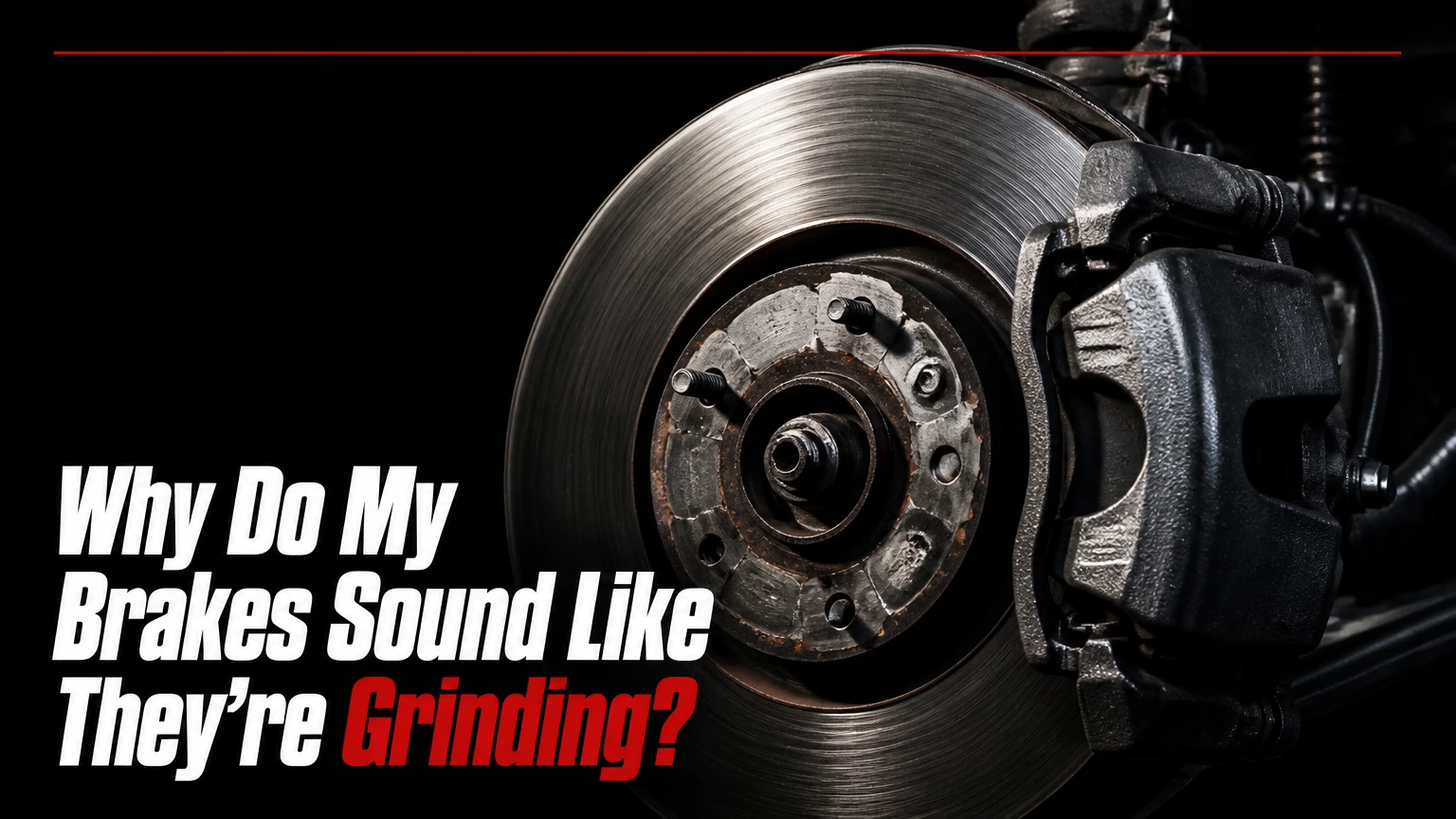
Brakes sound like they are grinding because the sacrificial friction lining on the brake pad has completely worn away down to $0\text{ mm}$. This forces the pad’s steel backing plate to press directly against the cast-iron brake rotor, creating destructive metal-on-metal friction that damages components and severely reduces vehicle stopping power.
At a Glance
- Primary Cause: Total depletion of brake pad friction material ($0\text{ mm}$ thickness remaining).
- Immediate Action: Stop driving immediately; driving on grinding brakes damages rotors and creates total brake failure risks.
- Secondary Causes: Foreign road debris behind the dust shield, morning flash rust, or low-grade semi-metallic pad compounds.
- Non-Brake Cause: Grinding while turning (without applying the brakes) signals a failing wheel hub bearing.
- Component Replacement: Grinding for more than a few stops almost always requires replacing both the brake pads and the iron rotors.
What causes a grinding noise when stepping on the brake pedal?
A grinding noise when applying the brake pedal is primarily caused by metal-on-metal contact between the steel brake pad backing plate and the iron brake rotor. This occurs after the pad’s original $10\text{ mm}$ to $12\text{ mm}$ composite friction material wears down past the $3\text{ mm}$ safety threshold to $0\text{ mm}$.
    [ CALIPER PISTON ] ──> [ STEEL BACKING PLATE ] ──X── [ IRON ROTOR ]
                                   (Friction Material Depleted: 0mm)
                                   ==> METAL-ON-METAL GRINDING <==
When no friction compound remains, the hydraulic caliper forces raw steel directly onto the rotating cast-iron disk. This grinding surface generates friction temperatures exceeding $2,000^\circ\text{F}$ ($1,093^\circ\text{C}$). These high temperatures scorch the metal, gouge deep circular channels into the rotor surface, and severely compromise system hydraulic integrity.
While metal-on-metal wear accounts for roughly $90\%$ of pedal-activated grinding, three distinct secondary mechanisms cause identical sounds:
- Debris Contamination: A small rock or piece of slag wedged between the rotor surface and the metal dust shield.
- Severe Glazing: Brake pads overheated to the point where resin crystallizes into a hard, metallic surface layer.
- Drum Lip Contact: Rust ridges forming on the edges of rear brake drums and scraping against the backing plate during application.
What are the safety risks of driving with grinding brakes?
Driving with grinding brakes poses severe safety risks, including dramatically increased stopping distances, complete loss of hydraulic pressure, and total wheel lockup. Once metal-on-metal grinding begins, vehicle control deteriorates rapidly within just a few pedal applications.
       OPERATIONAL BRAKE SYSTEM                 METAL-ON-METAL FAILURE MODE
┌──────────────────────────────────────┐     ┌──────────────────────────────────────┐
│  Pads: 10-12mm friction compound     │     │  Pads: 0mm (Bare steel backing plate)│
│  Friction: Controlled, smooth force  │ ==> │  Friction: Destructive raw metal friction│
│  Heat: Normal operating dissipation  │     │  Heat: Spikes above 2,000°F (1,093°C)│
│  Stopping Distance: Normal & predictable│   │  Stopping Distance: Extended up to 50% │
└──────────────────────────────────────┘     └──────────────────────────────────────┘
The primary physical hazards include:
- Hydraulic Brake Fade: Extreme frictional heat ($2,000^\circ\text{F}$) transfers from the backing plate into the caliper piston, boiling the glycol-based brake fluid inside the lines. Vaporized fluid compresses under foot pressure, causing the brake pedal to sink to the floor with zero stopping effect.
- Pad Slippage and Caliper Jamming: As the steel backing plate thins under continuous grinding friction, it can slide completely out of the caliper mounting bracket frame. This drops the hydraulic piston directly onto the rotor face, destroying the caliper and locking the wheel.
- Structural Rotor Shearing: Friction heat weakens the iron rotor core, making it susceptible to cracking, warping, or tearing away from the hub hat under heavy load.
Can brakes grind even if the brake pads are brand new?
Yes, brand new brake pads can emit a grinding sound if foreign debris is trapped in the brake assembly, if surface flash rust has formed overnight, or if the pads contain high-density metal compounds. New friction material does not eliminate grinding caused by external mechanical factors.
| Cause | Operating Pattern | Root Mechanism | Resolution |
| Trapped Road Debris | Continuous scraping or screeching that changes with wheel speed | Small pebble caught between the rotor back face and thin sheet-metal dust shield | Manual removal of debris or gently flexing the dust shield |
| Surface Flash Rust | Loud grind for the first 3 to 5 morning stops | Environmental humidity forming iron oxide on exposed rotor surfaces overnight | Normal pad friction sweeps the thin rust layer clean within minutes |
| Semi-Metallic Pads | Constant light metallic hum during light braking | Low-grade pad friction blocks containing coarse iron and steel fibers | Upgrades to premium ceramic pad compounds |
How do you get a trapped pebble out of a brake rotor?
To dislodge a stone trapped between the brake rotor and dust shield, safely reverse the vehicle in a clear area and apply the brakes firmly, or manually push the metal shield away from the rotor using a long screwdriver through the wheel spokes.
Reversing reverses the rotation of the assembly, which often frees wedged particles. If manual clearing fails, remove the wheel to inspect the gap between the splash shield and the lower caliper bracket.
Why do brakes grind in the morning or after rain?
Brakes grind in the morning or after rain because cast-iron brake rotors oxidise within hours when exposed to moisture, creating a surface coating of flash rust.
When the vehicle is driven, the brake pads physically scrape this rust layer off the rotor during the first 3 to 5 stops. This process generates a noticeable scraping sound that disappears completely once the raw iron surface is swept clean.
How do you tell if a grinding noise is brakes or a wheel bearing?
To distinguish a brake grinding noise from a failing wheel bearing, monitor whether the sound changes when stepping on the brake pedal or when turning the steering wheel. Brakes respond directly to pedal pressure, whereas wheel bearings respond to lateral weight transfer.
                         HEAR A GRINDING NOISE?
                                   │
         ┌─────────────────────────┴─────────────────────────┐
         ▼                                                   ▼
Step on the Brake Pedal                              Turn Steering Wheel
         │                                                   │
 ┌───────┴───────┐                                   ┌───────┴───────┐
 │ Noise Starts/ │                                   │ Noise Changes │
 │    Changes    │                                   │ Pitch / Volume│
 └───────┬───────┘                                   └───────┬───────┘
         ▼                                                   ▼
   BRAKE SYSTEM                                        WHEEL BEARING
 (Pads, Rotors, Calipers)                            (Hub Assembly Failure)
- Brake System Failure: The grinding sound occurs strictly when pushing the brake pedal down and stops immediately when releasing it. Vehicle speed dictates the frequency of the noise, but pedal application dictates its activation.
- Wheel Bearing Failure: The grinding or growling noise is continuous while moving, regardless of whether the brake pedal is touched. The sound increases in volume and changes pitch when swerving left or right, as loading shifts weight onto the compromised hub assembly bearing race.
Why is the brake pedal pulsating and grinding during hard stops?
A grinding noise accompanied by a rapidly pulsating brake pedal during sudden deceleration is caused by the normal operation of the Anti-lock Braking System (ABS), not a mechanical brake failure.
DRIVER APPLIES EMERGENCY BRAKING
               │
               ▼
   Wheel Speed Sensor Detects Lockup
               │
               ▼
   ABS Module Cycles Valves (15-20x/sec) ──> [Rapid Pedal Pulsation]
               │
               ▼
   Hydraulic Pressure Pulses Actuators   ──> [Mechanical Grinding Noise]
When you slam on the brakes on wet, icy, or loose surfaces, the wheel speed sensors detect impending lockup. The ABS control unit rapidly cycles the hydraulic pressure valves—up to 20 times per second—to maintain steering control.
This valve actuation produces a mechanical grinding sound and a firm pedal feedback pulse. If this pulsing occurs during light, normal stopping conditions, it indicates warped brake rotors rather than ABS engagement.
Why did my brakes start grinding without squealing first?
Brakes skip the warning squeal phase and go straight to grinding if the mechanical wear indicator tab broke off, rusted away, or was missing on the specific brake pad that wore out first.
       INTACT SYSTEM (Normal Warning)             BROKEN / MISSING TAB (Direct Grind)
┌───────────────────────────────────────┐      ┌───────────────────────────────────────┐
│ Pad Wear reaches 3mm                  │      │ Pad Wear reaches 3mm                  │
│ Wear Tab contacts Rotor Face          │      │ Wear Tab Missing / Corroded Off       │
│ HIGH-PITCHED SQUEAL WARNING SOUND     │      │ NO AUDIO WARNING                      │
│ (Pad still has 3mm friction material) │      │ Pad wears down completely to 0mm      │
└───────────────────────────────────────┘      └───────────────────────────────────────┘
                                                           │
                                                           ▼
                                               METAL-ON-METAL GRINDING
Standard brake pads use a small metal tab designed to contact the rotor face at $3\text{ mm}$ of remaining friction material, producing a high-pitched squeal. However, this system fails to warn drivers under three specific conditions:
- Uneven Wear from Seized Slide Pins: The wear indicator tab is typically installed only on the inner brake pad. If a seized caliper slide pin causes the outer pad to wear down first, it hits $0\text{ mm}$ without the indicator ever touching the rotor.
- Corrosion and Mechanical Failure: In regions that use heavy road salt, metal warning tabs often rust off or snap off before the pad reaches critical wear depths.
- Aftermarket Omissions: Budget aftermarket brake pads sometimes omit wear indicators entirely to save manufacturing costs.
Do grinding brakes always mean you need new rotors?
Yes, experiencing true metal-on-metal grinding for more than a few stops means you must replace or resurface the brake rotors. The hard steel pad backing plate cuts deep circular grooves into the soft cast-iron rotor face, destroying its structural integrity.
  GROOVED ROTOR (Post-Grind)            NEW PADS ON GROOVED ROTOR (Incorrect Repair)
     │       │       │                      │▒▒▒▒▒▒▒▒▒▒▒▒▒▒▒▒▒▒▒▒│  <-- New Flat Pad
     ▼       ▼       ▼                      └─┐   ┌───┐   ┌───┐  ┌─┘
 ┌───┐   ┌───┐   ┌───┐                        │   │   │   │   │  │  <-- Air Gaps / Gaps
 │   └───┘   └───┘   │                        └───┘   └───┘   └──┘  <-- Grooved Rotor
 └───────────────────┘                      ========================
 Deep scoring reduces thickness             Result: Poor contact, vibrations,
 below safe limit (1.5mm spec).             rapid ruin of new pad compound.
Cast-iron brake rotors have a discard thickness specification stamped on their inner hub casing (typically allowing only $1.5\text{ mm}$ of total wearable material from new). Deep gouges from metal grinding scrape past this minimum safety margin.
Installing new, flat brake pads over damaged, grooved rotors reduces the pad-to-rotor contact area by up to $60\%$, causing severe steering wheel shudder, noisy operation, and rapid premature pad failure. If a grooved rotor is turned (machined) below its minimum thickness spec, it cannot properly absorb heat and must be discarded.
What happens if only one side of the car is grinding?
If only one side of the vehicle is grinding, it indicates a seized caliper slide pin, a stuck hydraulic caliper piston, or a collapsed flexible brake hose on that specific wheel assembly.
                  CALIPER SLIDE PIN OPERATION

   FUNCTIONAL PIN (Even Wear)              SEIZED PIN (Single-Side Grind)
  ┌───────────────────────────┐           ┌───────────────────────────┐
  │ Caliper floats smoothly   │           │ Caliper frozen on slide   │
  │ Inner & Outer pads press  │           │ Inner pad forced onto disc│
  │ with equal hydraulic force│           │ Outer pad drags constantly│
  │ ──> BOTH PADS WEAR EQUALLY│           │ ──> SINGLE-SIDE GRINDING  │
  └───────────────────────────┘           └───────────────────────────┘
A braking system should wear down symmetrically across an axle. When grinding is isolated to one wheel, the following mechanical faults are responsible:
- Seized Caliper Pins: Corrosion or dried silicone grease locks the caliper slide pin within its bore. The caliper cannot float, forcing one pad to drag continuously against the rotor until it grinds down to $0\text{ mm}$, while the opposite pad retains ample friction material.
- Corroded Piston Bore: A torn rubber dust boot lets moisture into the caliper piston housing, rusting the steel piston. The piston fails to retract after pedal pressure is released, holding the pad tightly against the rotor surface.
- Internally Collapsed Hose: The inner rubber lining of a flexible brake line delaminates, acting as a one-way check valve. Fluid enters the caliper under pedal pressure but cannot return, causing continuous single-wheel grinding.
How long can you safely drive after your brakes start grinding?
You can safely drive zero miles after your brakes start grinding. The vehicle should only be driven slowly to a safe parking space or pulled onto a tow truck bed for transport to a repair facility.
Continued driving on grinding brakes damages expensive components and compromises stopping performance:
- 0–10 Miles: The bare steel backing plate score-gouges the cast-iron rotor face beyond the minimum thickness specification, converting a simple pad replacement into a complete pad-and-rotor job.
- 10–50 Miles: Frictional heat distorts the caliper frame, destroys rubber dust boots, and degrades internal piston seals, requiring a full caliper replacement.
- 50+ Miles: The worn steel backing plate thins until it snaps or pops out of the bracket channel. This allows the hydraulic piston to push directly out of its housing, causing a total loss of system hydraulic brake pressure.
How much does it cost to fix grinding brakes?
Fixing grinding brakes generally costs between $350 and $800 per axle for a professional replacement of both pads and rotors. If the grinding damaged the hydraulic calipers, the total repair cost rises to $750 to $1,400 per axle.
| Repair Scope | Average Parts Cost | Average Labor Cost | Total Estimated Cost |
| Preventative (Pads Only – Before Grind) | $40 – $100 | $100 – $150 | $140 – $250 |
| Standard Grind Fix (Pads + Rotors) | $150 – $300 | $200 – $500 | $350 – $800 |
| Severe Damage Fix (Pads, Rotors, + Calipers) | $350 – $700 | $400 – $700 | $750 – $1,400 |
Catching brake wear during the squealing phase ($3\text{ mm}$ remaining) allows you to reuse existing rotors, saving $50\%$ to $60\%$ in repair expenses compared to waiting until metal-on-metal grinding occurs.
How can you visually inspect your brake pads without removing the wheel?
You can visually inspect your brake pad thickness through the wheel spokes using a flashlight and a pocket inspection mirror. Look through the openings in the wheel rim to locate the brake caliper assembly mounted over the circular rotor disc.
   VIEW THROUGH WHEEL SPOKES:

   ┌───────────────────────────────────────────────┐
   │ [CALIPER BODY]                                │
   │   │                                           │
   │   ├── [Steel Backing Plate] (~5mm)            │
   │   ├── [Friction Material]   (<3mm = REPLACE!) │
   │   │                                           │
   │ ════════════════════════════════════════════  │ <-- [ROTOR SURFACE]
   └───────────────────────────────────────────────┘
Follow these steps to evaluate remaining life:
- Locate the Caliper Inspection Window: Look at the outer edge of the brake caliper where it wraps around the shiny metal rotor disk.
- Identify the Friction Material Layer: Differentiate between the outer steel backing plate (dark metal glued directly to the assembly) and the inner friction pad material contacting the rotor.
- Measure the Remaining Depth: Compare the friction material thickness to standard markers:
- More than 6 mm ($1/4\text{ in}$): Good condition; no service required.
- 3 mm to 4 mm ($1/8\text{ in}$): Schedule maintenance soon; pads are near operational limits.
- Less than 2 mm: Critical danger zone; replace immediately to prevent grinding.
The Bottom Line
A grinding sound during braking indicates that the brake pad friction material has worn down to $0\text{ mm}$, causing bare steel backing plates to gouge into cast-iron rotors. This metal-on-metal condition drastically increases stopping distances, risks total hydraulic brake failure, and necessitates replacing both pads and rotors. Stop driving immediately to prevent caliper damage and ensure road safety.


