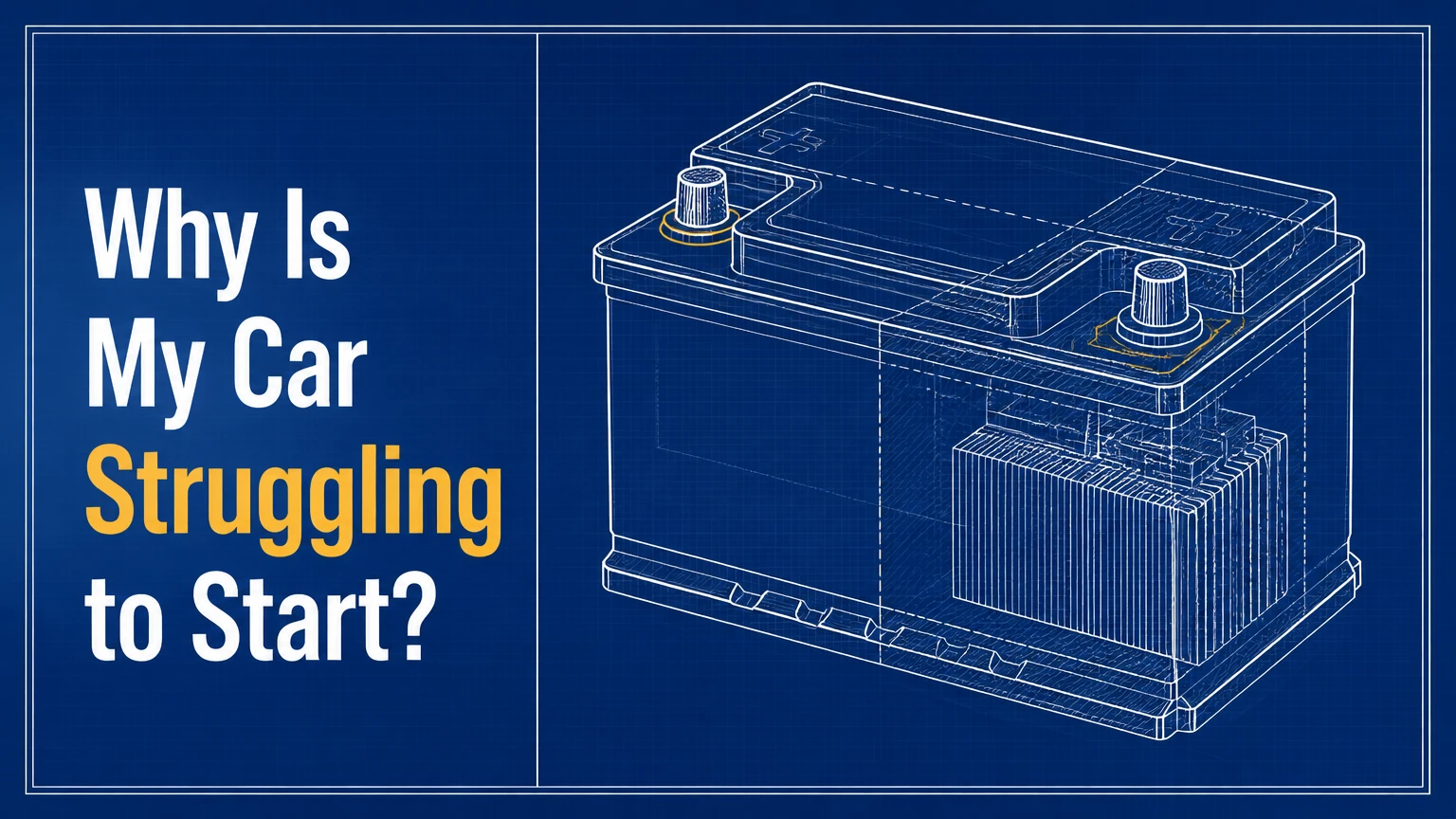
A car struggles to start when an issue disrupts one of the five essential internal combustion requirements: sufficient battery voltage, engine rotation, fuel delivery, intake air, or ignition spark. The most frequent causes include depleted battery charge below 12.2V, high electrical ground resistance, fuel pump pressure leak-down, or starter motor heat soak.
At a Glance
- Resting Voltage Threshold: A healthy 12V automotive battery must measure 12.6V to 12.8V at rest; resting voltage below 12.0V indicates a functionally dead battery.
- Cranking Voltage Minimum: Battery voltage should stay above 10.0V while cranking the engine.
- Normal Parasitic Drain: Vehicle sleep draw must range between 20 mA and 50 mA (0.02 A to 0.05 A).
- Fuel Rail Pressure Baseline: Port injection systems require 30 to 50 PSI during prime, while direct injection systems require up to 2,000+ PSI under mechanical pump pressure.
- Clicking vs Cranking: Rapid clicking signifies insufficient current for the starter solenoid, whereas extended cranking indicates fuel, air, or spark delivery failure.
What Core Requirements Are Needed for an Engine to Start?
An internal combustion engine requires five synchronized systems to start: battery voltage, mechanical rotation, pressurized fuel, clean air, and timely spark. If any single system strays outside its tight operational parameters, the engine will either crank slowly, crank indefinitely without firing, or fail to turn over entirely.
- Voltage: The electrical system must provide sufficient power to energ2e computer control modules and trigger the starter solenoid.
- Rotation: The starter motor must physically turn the crankshaft at a minimum speed (typically 150 to 250 RPM) to create cylinder compression.
- Fuel: The fuel pump must deliver gasoline at precise system pressure to the injectors.
- Air: The intake throttle body and air filter must supply un-restricted airflow mixed in proper stoichiometric ratios.
- Spark: The ignition coils and spark plugs must arc with enough thermal energy to ignite the compressed air-fuel mixture.
A failure in any one system mimics symptoms in others. Diagnosing a hard start requires systematic testing of these five core requirements rather than guessing or swapping components blindly.
What Critical Battery Voltage Metrics Indicate Start Failure?
A vehicle battery requires specific resting and dynamic load voltages to successfully turn the engine starter motor. Measuring voltage with a digital multimeter across the battery terminals reveals whether the battery retains adequate chemical energy to handle cranking loads.
| Battery State | Voltage Measurement | System Condition |
| Fully Charged (At Rest) | 12.6V to 12.8V | Optimal chemical potential |
| 50% Discharged (At Rest) | 12.2V | Weak charge; prone to cold-start struggle |
| Functionally Dead (At Rest) | 12.0V or below | Defective cell or full discharge; cannot hold starter load |
| Healthy Cranking Drop | 10.0V to 11.0V | Normal starter electrical draw |
| Severe Cranking Drop | 7.0V to 9.0V | Failed battery cell or shorted starter motor windings |
When resting voltage drops to 12.2V, the battery retains only half its capacity. During ignition key turn, if voltage plunges below 10.0V, the starter motor cannot draw enough electrical current to turn the flywheel at required cranking speeds.
What Is the Difference Between a Slow Crank and an Extended Crank?
A slow crank is an electrical or mechanical drag issue where the engine turns over sluggishly, while an extended crank is a fuel, spark, or compression issue where the engine spins at normal speed but takes 5 to 10 seconds or longer to ignite.
Slow Crank (Electrical or Mechanical Resistance)
During a slow crank, you hear a rhythmic, heavy dragging sound (“rrmmm… rrmmm… rrmmm”). The starter is struggling to rotate the crankshaft. This condition points directly to:
- A discharged or degraded battery with low Cold Cranking Amps (CCA).
- High resistance in the battery ground cables or positive starter cables.
- Internal starter motor wear, such as worn carbon brushes or degraded bushings.
- Extreme oil viscosity drag during freezing temperatures.
Extended Crank (Delivery or Timing Failure)
During an extended crank, the starter spins the engine rapidly and smoothly (“whir-whir-whir-whir”), but the combustion chambers fail to catch promptly. This condition indicates:
- Fuel pressure loss in the fuel rail due to a failing check valve or clogged filter.
- Degraded spark plugs or weak ignition coil output.
- Incorrect crankshaft or camshaft position sensor signals.
- Small vacuum leaks admitting unmetered air into the intake manifold.
Distinguishing between these two operational sounds eliminates half of all potential diagnostic paths immediately.
Why Does My Car Struggle to Start Hot but Start Fine Cold?
A car that starts easily on cold mornings but cranks sluggishly or refuses to start after driving has suffered starter motor heat soak or thermal resistance degradation. High ambient engine bay temperatures increase electrical resistance inside degraded copper wiring and electronic components.
When an aging starter motor is positioned close to the exhaust manifold without a functioning thermal heat shield, radiant heat penetrates the starter casing. Hot copper field coils experience higher electrical resistance than cold copper coils. Consequently, the starter demands significantly more amperage to turn the engine than the battery can supply when hot.
To resolve hot start struggles:
- Verify that the factory starter heat shield is installed and intact.
- Inspect the starter battery positive cable for swollen insulation or internal green copper corrosion.
- Test battery voltage drop across the main engine ground cable while the engine is hot.
- Replace the starter motor if internal resistance measures out of specification when heated.
Why Is My New Battery Dying After 24 to 48 Hours?
A new battery that drains completely flat within 24 to 48 hours is suffering from a shorted alternator rectifier diode or an active parasitic module drain exceeding 100 mA. Installing a new battery without fixing an active parasitic draw will ruin the replacement battery through deep discharge cycles.
Alternator Diode Short Circuit
An alternator uses a bridge of silicone diodes to convert alternating current (AC) generated by the rotor into direct current (DC) used by the vehicle. If a diode breaks down and shorts internally, it acts as an open gate. When the engine is shut down, electrical current travels backward from the battery terminal, through the alternator windings, and directly to ground. This creates a hidden 1.0A to 3.0A drain that rapidly empties the battery without triggering dashboard warning lights.
Modern Control Module Drain
Modern vehicles contain dozens of electronic control units (ECUs). If a module (such as a body control module, keyless entry receiver, or aftermarket dashcam) fails to enter sleep mode after key removal, it maintains continuous current draw. While normal background current ranges between 20 mA and 50 mA, a active control module draws 200 mA to over 1,000 mA continuously.
How Do You Isolate a Parasitic Battery Drain with a Multimeter?
Isolating a parasitic battery drain requires placing a digital multimeter set to DC Amperes in series with the negative battery terminal and removing fuses sequentially to identify the active circuit.
1.Prepare the Vehicle for Sleep Mode:Ensure all electrical systems are fully shut down.
Park the vehicle, turn off all accessories, and remove the key or key fob. Manually latch the hood and door latches using a screwdriver so the car’s computer modules register all doors as closed while allowing access to fuse boxes.
2.Connect Multimeter in Series:Do not break current connection entirely.
Disconnect the negative battery cable terminal. Set your multimeter to measure DC Amps (10A port). Clamp one multimeter lead to the negative battery post and the other lead to the disconnected negative cable clamp.
3.Wait for Module Sleep Phase:Allow 20 to 45 minutes for bus quiet.
Wait up to 45 minutes without disturbing the vehicle. Computer modules wake up upon battery connection and require time to drop into low-power sleep mode. Watch the multimeter display drop below 0.050 A (50 mA).
4.Pull Fuses Sequentially:Monitor current drop on the meter display.
If current remains above 0.100 A (100 mA), pull individual fuses from the interior and under-hood fuse blocks one by one. When pulling a specific fuse causes current draw to drop sharply into the 20 mA to 50 mA range, you have isolated the failing circuit.
Why Does My Engine Crank Indefinitely Without Starting and Show No Check Engine Light?
An engine that cranks indefinitely without starting or triggering a Check Engine Light (CEL) usually has a failed Crankshaft Position (CKP) sensor with an intermittent thermal circuit failure.
The Engine Control Unit (ECU) depends entirely on the CKP sensor to detect engine rotation speed and piston position. If the sensor’s internal wire coil develops a hairline thermal fracture, the signal breaks down when hot or under vibration.
Because the sensor outputs zero pulses when fractured, the ECU assumes the engine is stationary and the driver has not attempted to start the car. Consequently:
- The ECU does not energize the fuel injectors.
- The ECU withholding ignition coil ground toggling, stopping spark production.
- The ECU does not register a diagnostic trouble code (DTC) or light the Check Engine icon because it sees no logical error in a stationary engine state.
Testing with a diagnostic scan tool while cranking reveals if the ECU registers engine speed (typically 150 to 250 RPM). If the RPM display stays flat at zero while the starter spins the motor, the crankshaft position sensor or its wiring circuit has failed.
Why Does My Car Take 5 to 10 Seconds of Cranking After Sitting?
An extended crank delay after a vehicle sits for several hours indicates a failed fuel pump check valve, causing fuel line pressure to drop back into the fuel tank.
In a functioning fuel injection system, an anti-drainback valve inside the fuel pump module retains residual pressure in the lines when the engine turns off. Port fuel injection systems must retain 30 PSI to 50 PSI at rest. Gasoline Direct Injection (GDI) systems rely on a low-pressure in-tank pump (40 to 60 PSI) to supply the mechanical high-pressure pump.
When the anti-drainback check valve fails:
- Fuel drains back down the supply line into the tank due to gravity.
- Air enters the empty fuel rail.
- Upon turning the key, the extended 5 to 10 second crank time is simply the mechanical delay required for the fuel pump to purge air and prime the fuel line back up to 40+ PSI.
- If you turn the engine off and immediately restart it, the car fires instantly because fuel pressure has not yet bled down.
The Key-Prime Testing Shortcut
To confirm a failing check valve without tools, turn the ignition key to the “ON” position (without engaging the starter) for 3 seconds, turn it back to “OFF”, and repeat three times. If the engine fires instantly on the third cycle, the fuel pump check valve has failed.
Why Does My Car Struggle to Start in Rain or High Humidity?
A car that struggles to start or misfires badly during rainy or humid weather suffers from cracked secondary ignition insulation, allowing electrical voltage to leak directly into the engine block.
Aging ignition components develop microscopic hairline cracks in rubber spark plug boot insulation, synthetic outer plug wire jackets, or plastic ignition coil housings. Under dry conditions, air acts as an effective electrical insulator across these cracks, forcing current to travel through the spark plug electrode gap inside the cylinder.
In high humidity or wet environments:
- Moisture condenses on cool engine components, creating a thin conductive film of water across cracked ignition surfaces.
- Electrical current takes the path of least resistance, arcing through the moisture film directly to the metal engine cylinder head.
- The spark plug inside the combustion chamber receives zero electrical current, resulting in no combustion.
To check for moisture arcing, mist a light water spray from a bottle over the ignition wires and coil packs in dark conditions while cranking the engine. Visible blue electrical arcs confirm compromised insulation.
Why Does My Car Click Rapidly When Starting If Lights and Radio Work?
Rapid clicking during key turn occurs when a depleted battery has enough voltage to power low-draw accessories (10 to 15 Amps) but lacks the current capacity (150 to 350 Amps) required to run the starter motor.
Key Turned to Start -> Battery sends current to Starter Solenoid
                      |
                      v
Solenoid Engages Plunger -> High Amperage Draw Begins (150A - 350A)
                      |
                      v
Weak Battery Voltage Plunges Below 8.0V -> Solenoid Disengages
                      |
                      v
Amperage Draw Drops to Zero -> Voltage Bounces Back
                      |
                      v
Solenoid Re-engages Rapidly -> [ RAPID CLICKING NOISE ]
The rapid clicking sound is the physical movement of the starter solenoid plunger snapping back and forth against its mechanical contacts. Replacing or charging the battery resolves rapid clicking in over 90% of cases.
Can a Bad Ground Strap Cause Slow Cranking with a Good Battery?
Yes, a corroded, loose, or frayed engine ground cable causes slow cranking even if the battery tests perfectly at 12.6V across its posts.
The vehicle’s steel chassis and engine block complete the negative return path for the electrical system. The starter motor requires 150 to 350 Amps of current flowing through the engine block back to the battery negative post.
If the main ground strap develops corrosion, rust, or loose mounting hardware:
- Electrical resistance across the ground connection increases significantly.
- Under heavy current loads, voltage drops across the resistance point rather than powering the starter.
- The starter receives effective operating voltage of only 8.0V to 9.0V despite a healthy 12.6V battery reading.
Ground Strap Voltage Drop Test
To test ground resistance, connect the positive lead of a multimeter to the negative battery terminal post and the negative lead directly to the clean metal starter motor case. Crank the engine. If the multimeter reads higher than 0.2V to 0.3V during cranking, the engine ground strap connection is defective.
Can a Failing Starter Motor Permanently Damage a New Battery?
Yes, a failing starter motor with internal short circuits or worn bushings can permanently damage a new car battery through extreme current draw and sudden voltage drops.
When starter motor armature bushings wear out, the internal rotor shifts off-center and physically drags against the permanent magnets. This mechanical drag causes the starter to draw 400 to 600+ Amps of current instead of its standard 150 to 250 Amp rating.
This massive electrical draw affects a new battery in two ways:
- Plate Buckling: Continuous current draws over 400 Amps generate intense thermal heat inside lead-acid battery cells, warping lead plates and causing internal short circuits.
- Deep Discharge Degradation: Dropping cell voltage below 8.0V repeatedly causes rapid lead sulfate crystallization on active plate surfaces, permanently reducing Cold Cranking Amps (CCA) capacity.
Replacing a weak battery without testing the starter motor’s amperage draw risks ruining the new battery within weeks.
When Should You Stop Cranking a Car That Refuses to Start?
You should stop cranking an engine after 10 to 15 seconds of continuous cranking and allow the starter motor to cool for at least two minutes before trying again.
Starter motors are short-duty electrical components engineered for rapid bursts of activity rather than continuous operation. Over-cranking introduces serious mechanical and electrical hazards:
- Starter Overheating: Continuous cranking past 15 seconds overheats internal copper windings, melts internal solder connections, and burns out brushes.
- Unburned Fuel Accumulation: Prolonged cranking without ignition pumps raw fuel into the exhaust system, unmetered fuel washes protective oil off cylinder walls, washing away mechanical compression ring seals, and risks destroying the catalytic converter upon eventual start.
- Hydro-locking Risks: Repeated cranking on direct injection engines with leaking injectors can flood cylinders with liquid fuel, creating a non-compressible fluid barrier that bends engine connecting rods.
The Bottom Line
A car struggling to start stems from a failure in voltage supply, starter rotation, fuel line pressure, intake air, or ignition spark. Systematic multimeter testing of battery resting voltage (12.6V target) and cranking voltage drop (10.0V floor) quickly separates electrical failures from fuel pressure leak-down or mechanical component wear. Addressing root causes early prevents secondary damage to starter motors, catalytic converters, and high-voltage electrical components.


