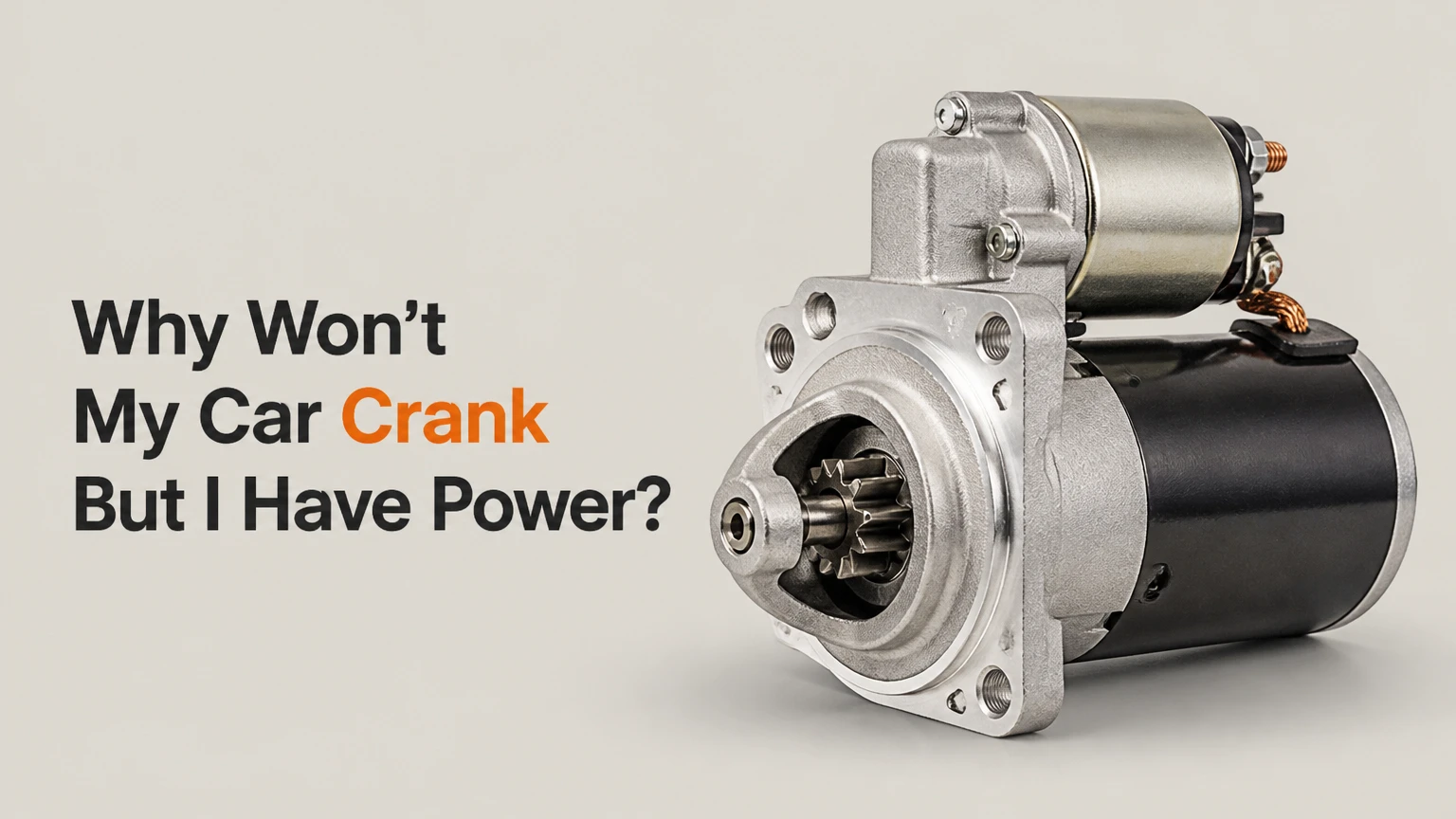
A car that has dashboard power but will not crank suffers from a high-amperage starting circuit failure or an engaged security interlock. While cabin electronics require only 5 to 15 amperes, turning the starter motor requires 150 to 300+ amperes. A minor voltage drop, corroded connection, or tripped safety sensor permits lights to illuminate while completely preventing engine rotation.
At a Glance
- Cabin accessories require 5 to 15 amps, whereas an engine starter draws 150 to 400+ amps under full load.
- A healthy battery reads 12.6V resting, but a battery reading 12.0V retains only 25% capacity and fails under starter load.
- Terminal corrosion adding just 0.05 ohms of resistance can drop available starter voltage below operational thresholds.
- A single sharp click indicates adequate solenoid engagement but failed starter motor contacts or low voltage.
- Rapid clicking points directly to high resistance or severe battery voltage depletion during load transfer.
- Transmissions, brake switches, and anti-theft key fobs actively interrupt starter relay grounding to prevent cranking.
Why does a car have dashboard power but fail to crank?
A car has dashboard power but fails to crank because lower-draw electronic accessories operate at low amperage, while the starter motor demands massive amperage that a compromised circuit cannot deliver. Accessories such as instrument clusters, radios, and headlights draw between 5 and 15 amperes. In contrast, an internal combustion engine starter motor requires between 150 and 400 amperes to overcome engine mechanical compression.
When an electrical circuit experiences internal resistance, bad grounding, or partial battery cell degradation, it maintains sufficient surface voltage (around 12 volts) to power light loads. However, the moment the ignition switch requests high amperage for the starter, circuit resistance causes voltage to collapse. Additionally, modern engine control units (ECUs) utilize digital interlocks. If a safety sensor (such as the clutch switch, brake pedal switch, or anti-theft transceiver) fails to verify its status, the ECU actively denies current to the starter relay despite powering the rest of the vehicle.
What is the difference between battery voltage and cranking amperage?
Battery voltage measures electrical potential, whereas cranking amperage measures the volume of electrical current flowing through a circuit. A fully charged 12-volt lead-acid battery reads between 12.6 and 12.8 volts at rest. When a battery is discharged to 12.0 volts, it retains only 25 percent of its functional energy capacity, yet this potential is more than enough to illuminate instrument panel bulbs.
When the starter solenoid engages, current flow is dictated by Ohm’s Law (I=V/R). A typical four-cylinder starter motor draws 80 to 120 amps, while large V8 or diesel engines require 250 to 400+ amps. If the battery lacks internal chemical plate area due to sulfation or lost electrolyte, its voltage will drop below 9.6 volts instantly when forced to output high amperage. Consequently, resting voltage confirms circuit presence, but only amperage capacity under load turns the engine over.
How does terminal contact resistance block starter current?
Terminal contact resistance blocks starter current by creating an electrical bottleneck that consumes voltage in the form of heat before it reaches the starter motor. According to the formula for voltage drop (V=I×R), resistance scales directly with current draw. A microscopic layer of corrosion or a loose battery terminal clamp can add a tiny resistance of just 0.05 ohms to the circuit.
At a light accessory draw of 10 amps, a 0.05-ohm resistance causes a negligible voltage drop of 0.5 volts (10 A×0.05 Ω=0.5 V), allowing lights and radios to operate normally. However, when the starter attempts to draw 200 amps through that same connection, the voltage drop surges to 10 volts (200 A×0.05 Ω=10.0 V). This leaves only 2.6 volts available at the starter motor armature, causing the starter to remain completely motionless despite full battery voltage existing at the terminals.
What does a single click vs rapid clicking mean?
A single sharp click indicates that the starter solenoid switch is mechanically engaging, whereas rapid clicking indicates that battery voltage is collapsing and recovering in a continuous loop.
Diagnostic Indications
- Single Click: The ignition circuit successfully sends 12 volts to the starter solenoid, pushing the starter pinion gear forward into the flywheel ring gear. However, high-amperage current fails to pass across the internal copper contact disk inside the starter motor, or the motor brushes are completely worn out.
- Rapid Clicking: The battery holds sufficient surface charge to pull the starter solenoid inward (causing the initial click). The instant the starter motor attempts to draw high amperage, battery voltage drops below 9 volts. The solenoid magnet loses power, retracts the gear (second click), voltage instantly bounces back up, and the solenoid re-engages. This cycle repeats multiple times per second.
How do you perform a starter voltage drop test with a multimeter?
You perform a starter voltage drop test by connecting a digital multimeter set to DC volts directly to the battery posts while cranking the engine to locate high resistance in the circuit.
- Test Battery Load Capacity: Place the red multimeter probe on the positive battery post (not the clamp) and the black probe on the negative battery post. Have an assistant turn the key to the crank position for 5 seconds. If voltage drops below 9.6 volts, the battery is discharged or failing internally.
- Test Positive Cable Resistance: Place the red probe on the positive battery post and the black probe on the main positive terminal lug at the starter motor. Crank the engine. A reading higher than 0.2 volts indicates excessive resistance in the positive battery cable.
- Test Ground Circuit Resistance: Place the red probe on the starter motor metal casing and the black probe on the negative battery post. Crank the engine. A reading higher than 0.2 volts proves that the engine block ground strap or negative terminal connection is degraded.
How does an anti-theft system or key fob glitch stop an engine from cranking?
An anti-theft system stops an engine from cranking by cutting the ground or power path to the starter relay inside the engine bay fuse box. Modern vehicles utilize transponder chips inside the key fob that communicate via radio frequency identification (RFID) with an antenna module located around the ignition cylinder or push-button start receiver.
If the key fob battery is dead, the transponder chip is damaged, or the Engine Control Module (ECM) loses synchronization, the vehicle enters security lockout. In this state, the ECM powers up the dashboard, HVAC, and audio system to allow vehicle access, but it deliberately prevents the starter relay from energizing. Drivers can identify this condition by looking for a flashing security icon (a key or padlock symbol) remaining illuminated on the instrument cluster during key turn.
How do brake pedal switches and neutral safety switches interrupt cranking?
Brake pedal switches and neutral safety switches interrupt cranking by keeping the starter control circuit physically or electronically open until safety conditions are met. These switches act as inline electrical gates designed to prevent the vehicle from moving unexpectedly upon starting.
In automatic transmission vehicles, the neutral safety switch (or transmission range sensor) requires the gear selector to be in Park or Neutral. If the shift cable stretches by even two millimeters, the sensor fails to register the Park position, opening the starter relay trigger line. In manual transmission vehicles, a clutch pedal position switch performs this role. In push-button start vehicles, the Engine Control Module monitors the brake light switch. If the brake switch fails internally, the ECM assumes the driver is not depressing the pedal and transitions the car to “Accessory” or “Ignition On” mode instead of engaging the starter.
Will shifting an automatic transmission into Neutral allow a no-crank car to start?
Yes, shifting an automatic transmission into Neutral will allow a no-crank car to start if the primary failure stems from a misaligned or failing neutral safety switch in the Park position.
When a transmission linkage wears down, the internal contacts for the Park circuit can lose continuity while the Neutral circuit remains fully functional. To test this, firmly apply the foot brake, shift the gear selector from Park down into Neutral, and turn the key or press the start button. If the engine cranks immediately, the starter motor, battery, and main power cables are functional. The issue is isolated to the shift linkage alignment, selector cable bushing, or transmission range sensor.
Why does a car start cold but fail to crank when the engine is hot?
A car starts when cold but fails to crank when hot due to a phenomenon known as heat soak, which dramatically increases the electrical resistance of starter motor windings.
As an engine runs, ambient temperatures inside the engine bay often exceed 90 degrees Celsius. Copper wire resistance increases predictably as temperature rises. In an aging starter motor with internal insulation breakdown or worn copper brushes, thermal expansion expands internal tolerances and elevates electrical resistance beyond threshold limits. When cold, the starter draws normal amperage. Once heat-soaked, the motor requires significantly higher amperage to rotate against engine compression. If the battery or battery cables are slightly degraded, they cannot supply the elevated current required by the hot starter motor until the engine bay cools back down.
Why does a jump start fail when a car has full electrical power?
A jump start fails when a car has full electrical power if the original battery has an internal short circuit, if the engine ground strap is disconnected, or if the starter motor itself has suffered a hard mechanical failure.
Common Jump-Start Failure Causes
- Internal Battery Short: If an internal lead plate collapses inside the vehicle’s battery, it creates a dead short. The battery acts as a massive energy sink, absorbing all current supplied by the booster vehicle and leaving insufficient amperage for the starter solenoid.
- Corroded Engine Ground: Jump-starting directly at the battery terminals cannot bypass a broken ground strap connecting the engine block to the chassis. Current cannot complete its path from the starter casing back to the negative post.
- Open Starter Solenoid: If the internal solenoid coil is burned open (0 amps flow), supplying 12 volts or 14 volts from an external vehicle does not complete the circuit.
Can a brand-new car battery cause a no-crank condition?
Yes, a brand-new car battery can cause a no-crank condition if it sat uncharged on a store shelf, retained factory terminal protective coatings, or suffered an internal manufacturing defect.
New batteries degrade over time through self-discharge if left on retail shelves for months without maintenance charging. A new battery reading 12.1 volts out of the store will light up dashboard displays but fail under cranking load. Additionally, battery manufacturers coat terminal posts with non-conductive anti-corrosion grease or plastic covers for transit. Installing terminal clamps over heavy protective grease prevents metal-to-metal contact, introducing high contact resistance. Finally, internal weld failures between battery cells can pass low current for electronics but break open instantly when subjected to a 200-amp starter draw.
Which fuses and relays should be checked for a no-crank issue?
The primary components to check for a no-crank issue are the starter fuse, the starter relay, and the main ignition/ECU fuse located in the under-hood power distribution center.
Critical Fuse Box Components
- Starter Fuse (STR / ST): Usually a 30A to 40A high-amp fuse (maxi-fuse or cartridge fuse). If this fuse is blown, power cannot reach the starter solenoid pull-in winding.
- Starter Relay: An electromechanical switch that uses a low-current signal from the ignition switch to close a high-current circuit to the starter. Drivers can test a suspect starter relay by swapping it with an identical, non-critical relay in the same box, such as the air conditioning clutch relay or horn relay.
- Ignition/ECU Fuse: A 10A to 20A fuse powering the engine control unit. If blown, the main computer remains dark, preventing interlocks from clearing the start command.
What causes an engine to hydro-lock and mimic a failed starter?
An engine hydro-locks and mimics a failed starter when liquid fills one or more combustion chambers, mechanically locking the pistons because liquids cannot be compressed.
If a fuel injector leaks continuously while the engine is off, or if a blown head gasket allows liquid coolant to sweep into a cylinder overnight, the volume above the piston fills with fluid. When the driver attempts to crank the engine, the piston travels upward on its compression stroke until it strikes the non-compressible liquid column. The starter motor attempts to turn, draws extreme current (often causing dash lights to dim or go completely dark), and stops abruptly with a single thud. In this scenario, the starter motor and electrical system are completely healthy, but the crankshaft is physically restricted from rotating.
Why does the starter hammer trick fail, and when is it safe to attempt?
The starter hammer trick fails when the underlying fault is electrical rather than mechanical, such as a blown fuse, bad ground, or burnt solenoid coil.
Tapping the starter casing with a tool can temporarily free stuck carbon brushes or realign a binding bendix drive gear inside an aging starter assembly. However, mechanical vibration provides zero benefit if the internal copper copper-windings have melted, or if the control wire lacks 12-volt signal delivery. It is safe to attempt only as an emergency maneuver when diagnostic testing confirms that 12 volts reach the solenoid trigger wire, but the starter refuses to rotate. Owners should use light, firm taps on the motor housing using a wooden mallet or small iron rod, avoiding heavy force that can shatter internal permanent magnets inside modern starters.
How do you test if the starter solenoid receives an ignition signal?
You test if the starter solenoid receives an ignition signal by measuring DC voltage at the small control terminal (often labeled Terminal 50 or “S-Terminal”) located on the starter solenoid while the key is turned to the crank position.
Disconnect the small control wire attached to the starter solenoid terminal. Connect the positive lead of a digital multimeter to the wire terminal and clamp the negative lead to a clean engine ground point. Have an assistant turn the key or hold the engine start button. If the multimeter displays 12 volts during the key turn, the entire control circuit (including the ignition switch, safety interlocks, body control module, and starter relay) is working correctly, proving the starter motor itself is defective. If 0 volts appears, the failure resides upstream in the safety interlocks, fuses, or wiring harness.
The Bottom Line
A car that has dashboard power but fails to crank is almost always hindered by a high-amperage electrical failure or an active safety interlock rather than a dead battery. While cabin accessories require minimal current to function, the starter motor demands hundreds of amperes that cannot pass through corroded battery posts, degraded ground cables, or depleted battery cells. Drivers should verify safety interlocks by trying to start the vehicle in Neutral and checking for security dash lights before replacing electrical hardware. Utilizing a multimeter to perform a voltage drop test quickly isolates whether the fault lies in the battery, the starter control circuit, or the starter motor itself.


